• Following Us

  • Categories

  • Check out the Archives


  • Awards & Nominations

Star Trek: Deep Space Nine – Civil Defense (Review)

This September and October, we’re taking a look at the jam-packed 1994 to 1995 season of Star Trek, including Star Trek: Deep Space Nine and Star Trek: Voyager. Check back daily for the latest review.

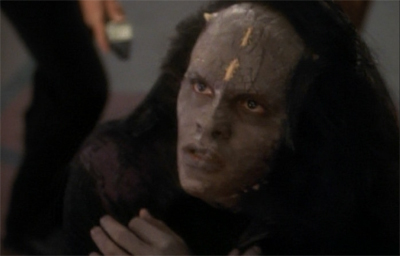
Civil Defense is an episode that really worked a lot better than it should have. The third season of Star Trek: Deep Space Nine hit a bit of a stumbling block in the early part of the third season. Indeed, Second Skin had been shot from what was pretty much Robert Hewitt Wolfe’s first draft of a teleplay. The Abandoned felt like a good premise pushed in front of the camera too early. Civil Defense was similarly rushed into production, with very little turn around from the production staff.

However, despite these production concerns, Civil Defense turns out to be an enjoyable pulpy adventure. The production team wouldn’t royally screw up until the next episode. The biggest problem with the script is that it feels like we’re seeing it far too late in the show’s run. Civil Defense is a fun third season episode, but it would have been a spectacular first season adventure.
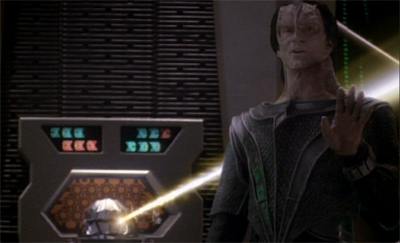
"Free dissident suppression system with every purchase over twelve bars!"

“Free dissident suppression system with every purchase over twelve bars!”

Continue reading

Star Trek: Deep Space Nine – The Abandoned (Review)

The September and October, we’re taking a look at the jam-packed 1994 to 1995 season of Star Trek, including Star Trek: Deep Space Nine and Star Trek: Voyager. Check back daily for the latest review.

The Abandoned is a problematic episode.

It’s brave and provocative and challenging, but it’s also incredibly grim and cynical. In fact, it is probably the most relentlessly pessimistic episode of Star Trek: Deep Space Nine‘s third season. And, given the episodes surround it, that is quite an accomplishment. Deep Space Nine has subverted classic Star Trek storytelling before. The Maquis was really a watershed moment for the series, suggesting that paradise itself might be unsustainable – attacking Roddenberry’s utopia rather brutally.

However, The Abandoned pushes things even further. There’s a social and racial subtext to this episode that grounds it in the racial politics of Los Angeles in the mid-nineties. The story of a young angry drug-addicted killer can’t help but feel associated with the increased profile of Los Angeles’ gangland in the early-to-mid-nineties. Casting the episode’s young Jem’Hadar soldier using African American actors invites this comparison, something that director Avery Brooks himself has conceded.

The racial politics of The Abandoned are decidedly uncomfortable, but they are clearly meant to be. Still, there’s something rather cynical and pessimistic about the episode’s conclusion that this young boy cannot be saved from a life of brutality and violence.

A Jem?

A Jem?

Continue reading

Non-Review Review: The Wizard of Oz (IMAX, 3D)

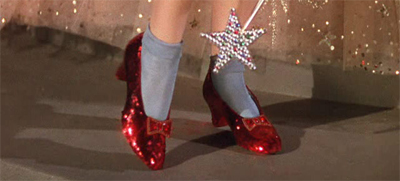
“For nearly forty years this story has given faithful service to the Young in Heart,” an introductory title card advises the audience, “and Time has been powerless to put its kindly philosophy out of fashion.” Although the opening of The Wizard of Oz makes reference to the classic series of children’s stories written by Frank L. Baum, the text is just as applicable to the film itself. It has been seventy-five years, but The Wizard of Oz still has the power to warm even the most jaded and cynical of hearts.

Dorothy is modelling our snazzy red slippers. Order now to avoid disappointment...

Dorothy is modelling our snazzy red slippers. Order now to avoid disappointment…

Continue reading

Doctor Who: Robot of Sherwood (Review)

Shortly, I shall be the most powerful man in the realm. King in all but name, for Nottingham is not enough.

It isn’t?

After this, Derby.

Right.

Then Lincoln. And after Lincoln…

Worksop?

The world!

– the Sheriff outlines his plot to Clara

Robot of Sherwood is a functional piece of television, with a wonderful closing scene capping a very light forty-five minutes. Mark Gatiss is a writer who tends to trade on nostalgia, and who clearly holds a great deal of affection for the past. As such, Robot of Sherwood provides a fairly effective and straightforward counterpoint to the heavy moral questions of Deep Breath and Into the Dalek. Is the Doctor a hero? It doesn’t matter, because his story is that of a hero.

There is a sense that perhaps Gatiss is being a little bit too glib here, to the point where Robot of Sherwood almost plays defensively – a justification of the writer’s tendency to rose-tinted nostalgia and a rejection of critical approaches towards history or story. Nevertheless, Robot of Sherwood does pretty much what it sets out to do. It provides Peter Capaldi with a suitably light script and a chance to flex his comedic muscles, while providing a suitably fairy-tale-ish pseudo-historical.

Legendary outlaw...

Legendary outlaw…

This season is introducing a new lead actor, a risky proposition for any show. As a result, the first half of the season tends to play it rather safe. Robot of Sherwood is the only episode in the first half of the season not to credit Steven Moffat as writer or co-writer; however, it is still written by an established Doctor Who veteran. After all, Mark Gatiss wrote The Unquiet Dead, the first episode of the relaunched series not written by Russell T. Davies. He also wrote Victory of the Daleks, the first story of the Moffat era not written by Moffat himself.

Indeed, the season returns to the classic “home”/“future”/“historical” opening triptych structure that defined the Davies era; it is the first time that this structure has been seen since Matt Smith’s opening season. (For Davies, “home” was twenty-first century London; for Moffat, it is the Paternoster Gang.) Robot of Sherwood is the show’s first proper “celebrity historical” since Vincent and the Doctor in that same opening season. “Safe” is very much the name of the game for this stretch of the season. Robot of Sherwood is very safe.

"You'll ruin the paint work!"

“You’ll ruin the paint work!”

Continue reading

Non-Review Review: The Guest

The Guest is a pulpy delight. It’s a glorious throwback to classic seventies horror, with writer Simon Barrett and director Adam Wingart perfectly channeling the mood and feel of classic seventies exploitation films. It’s affectionate and unapologetic. It is gleeful and grim. It is darkly hilarious and also brutally pulpy. The Guest is a film that knows exactly what it wants to be, and accomplishes that with great skill.

Seeing red...

Seeing red…

Continue reading

Non-Review Review: Maps to the Stars

It is a cliché to suggest that Hollywood loves movies about Hollywood.

Sure, quite often these are celebratory meditations on how great Tinseltown is – Argo was the story of how Hollywood saved the lives of Americans caught up in the Iranian Revolution; Hitchcock celebrated the making of Psycho. Sometimes these are more cynical and jaded explorations of how Hollywood works, seeking to expose the community’s seedy underbelly to the world – Robert Altman’s The Player remains the definitive example, but films like What Just Happened probably count as well.

These stock Hollywood-story-about-Hollywood are the weakest aspects of Maps to the Stars. The movie often feels like it’s trying too hard to add a surface gloss of what people expect from a film about Hollywood, on top of a much more interesting and compelling tale of dysfunction and decay. Maps to the Stars is held together by a rake of terrific performances and a wonderfully creepy central metaphor, but it feels let down by the more superficial elements of the script.

We're all in the gutter...

We’re all in the gutter…

Continue reading

Non-Review Review: The Hundred-Foot Journey

Guest review by Sinéad Finegan. You can find her at sineadfinegan.com.

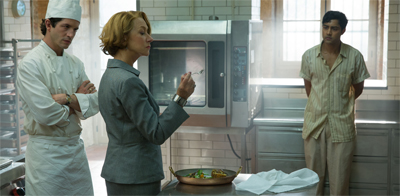
Anyone who goes to see this foodie film to sample a little of the its finest dish – Helen Mirren – will not be disappointed. Humour, light-hearted fun, and a gently simmering Mirren are definitely on the menu; and who would complain?

One particularly memorable scene stands out: Mirren as Madame Mallory, the impeccably dressed proprietress of a Michelin-starred restaurant, stands before her assembled staff and silently holds up a single, rather flaccid-looking, asparagus which droops mournfully and looks an altogether unappetising specimen. Food should not be like a tired marriage, she informs us; no, the food in her restaurant must be a steamy affair. Which is rather a good assessment of the film itself: a fun, light-hearted and steamy foodie affair.

100footjourney5

Continue reading

Non-Review Review: Pride

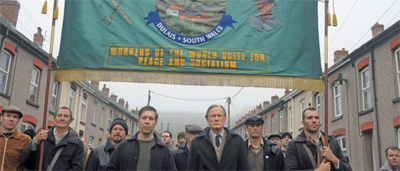
Lesbians and Gays Support the Miners is an oft over-looked chapter in the history both the labour and the gay rights movement. Based around the fundamental principle that oppressed groups have a great chance of achieving their goals standing side-by-side (or shoulder-to-shoulder) than they would ever would apart, the alliance forged during the 1984 coal strikes went on to have a lasting and important influence on both the mining community and the gay community.

Pride is perhaps a little bit too whimsical and twee for its own good, going for any number of easy feel-good smiles and affectionate chuckles, but there’s something quite compelling about this tale of two different groups forging an unexpected and unprecedented alliance in pursuit of a common good. Pride is a light and charming “opposites unit” story with enough wit and soul to win over even the most cynical audience members.

Labour of love...

Labour of love…

Continue reading

Star Trek: Deep Space Nine – The Search, Part I (Review)

The September and October, we’re taking a look at the jam-packed 1994 to 1995 season of Star Trek, including Star Trek: Deep Space Nine and Star Trek: Voyager. Check back daily for the latest review.

The Search, Part I is interesting. It is an episode that, in effect, serves as something of a second pilot for the show. It’s an episode that re-conceptualises the show, while taking a great deal of trouble to ensure that any new viewers will be brought up to speed. In fact, The Search is a rather disjointed two-parter as a whole. The first part feels like a lot of set-up with a cliffhanger tacked on to the end of the episode, while the second part is very clearly its own story.

It makes sense. At this point, Star Trek: Deep Space Nine is the only Star Trek on television. It’s a period that doesn’t last, and which is really just a scheduling fluke. The show’s second season continued on past the airing of All Good Things…, the final episode of Star Trek: The Next Generation. The third season began broadcasting before the airing of Caretaker, the pilot of Star Trek: Voyager. Star Trek: Generations was released somewhere in the middle. So the stretch where Deep Space Nine was “the only Trek on television” feels largely illusory.

Still, The Search, Part I feels like a conscious attempt to welcome any wayward Star Trek fans. Including, appropriately enough, new staff writer Ronald D. Moore.

Staring into space...

Staring into space…

Continue reading

Non-Review Review: If I Stay…

If I Stay… has a pretty great leading performance from actress Chloë Grace Moretz and a fantastic supporting turn from veteran character actor Stacy Keach. Both actors do the best they can with the material on hand, although it is clearly an uphill struggle. There’s a sense that the two actors are wandering lost through the film. Moretz’s character is not so much trapped in a hospital as in a terrible screenplay.

If I Stay… squanders these performances with an incredibly cynical and calculated narrative that plays less like the reflective highlights of teenager’s life, and more like a collection of young adult clichés combined together and served up through a blatantly manipulative framing device.

Leaving the audience cold...

Leaving the audience cold…

Continue reading