• Following Us

  • Categories

  • Check out the Archives


  • Awards & Nominations

163. Klaus – This Just In/Christmas 2020 (#176)

Hosted by Andrew Quinn and Darren Mooney, The 250 is a fortnightly trip through some of the best (and worst) movies ever made, as voted for by Internet Movie Database Users.

This time, a belated Christmas treat. Sergio Pablos and Carlos Martínez López’s Klaus.

Exiled to the remote island of Smeerensberg, postal employee Jesper comes up with an elaborate plan to inspire the locals to write the six thousand letters that he’ll need to earn back his life of luxury. However, Jesper doesn’t count on the ways in which he’ll change the lives of the island’s inhabitants, including a lonely and isolated woodsman named Klaus who makes children’s toys.

At time of recording, it was ranked the 176th best movie of all time on the Internet Movie Database.

Continue reading

157. Ford v. Ferrari (Le Mans ’66) – This Just In (#156)

Hosted by Andrew Quinn and Darren Mooney, The 250 is a (mostly) weekly trip through some of the best (and worst) movies ever made, as voted for by Internet Movie Database Users. New episodes are released every Saturday at 6pm GMT.

This time, James Mangold’s Ford v. Ferrari.

In response to the worst sales slump in American history, the Ford Motor Company embraces a radical idea: it will build a car to beat Ferrari at the 24 Hours of Le Mans. However, in order to do that, it needs to recruit and work with two radicals who have their own unique approach to engineering and racing, Carroll Shelby and Ken Miles. These two mavericks soon discover that their allies in Ford might be as dangerous as their enemies at Ferrari.

At time of recording, it was ranked 156th on the Internet Movie Database’s list of the best movies of all-time.

Continue reading

Non-Review Review: Klaus

Around midway through Klaus, the film’s title character has an introspective moment. The film’s protagonist, a wiry and self-interested postman named Jesper, has decided that Klaus need not settle for delivering the toys that he has already handcrafted. Instead, Klaus could fashion new toys for all the boys and girls of the local community. Klaus’ mood darkens. He stares off into middle distance. “I don’t make toys,” he tells Jesper, in an understated manner. After a beat, he clarifies, “Not anymore.”

It is a very strange moment for a family-friendly animated movie that promises a glimpse at the origin story of Christmas. It obviously hints at a dark and traumatic back story for the muscular woodsman. Klaus has experienced things. It is the children’s movie equivalent of the shell-shocked combat veteran, of Sylvester Stallone retreating from his failure at the start of Cliffhanger or Sergeant Powell having sworn off the use of his sidearm in Die Hard. What horrors could Klaus have experienced that would have made him stop designing adorable handcrafted toys for children?

Snow bad ideas.

It’s a very weird beat, one that feels all the weird for the way in which it tonally clashes with the more openly absurd slapstick elements of the plot or the occasional nods to contemporary pop culture. Klaus is a very odd film, which seems to have little idea of what it actually wants to be. It is a mishmash of themes and influences, awkwardly bouncing between various extremes and never settling on any one long enough to find a grove. It’s a film that really needed more time on the original story break and scripting phases, requiring a stronger vision of what exactly Klaus is supposed to be.

This is a shame, because Klaus looks absolutely gorgeous.

Making a play for the animation market.

Continue reading

Non-Review Review: The Laundromat

The Laundromat is as messy and awkward as it is ambitious and creative.

At the very least, The Laundromat demonstrates that director Steven Soderbergh is as playful as he has ever been. Soderbergh is fifty-six years old. He is supposedly retired. However, Soderbergh remains vital and energised. Soderbergh’s filmography is ecclectic, with projects varying wildly in terms of tone and quality. However, a willingness to experiment and to try new things remains one of the most unifying threads within his expansive filmography. While some older directors get stuck in familiar patterns and routines, Soderbergh seems pathologically anxious about the possibility of stasis.

A wealth of revelations.

This is most obvious in terms of craft, with Soderbergh often tweaking how he produces and distributes his output. Soderbergh directed the entirety of The Knick, embracing the potential of television as a storytelling medium beyond the familiarity of cinema. He has spent his retirement re-editing classic films, reflecting the ascent of “remix” culture. He shot all of Unsane on an iPhone, seizing on the potential of new technology to alter the film-making paradigm. He partnered with Netflix for the release of High Flying Bird, taking advantage of the streaming service’s deep pockets and esoteric sensibilities.

The Laundromat is not a huge leap for Soderbergh in terms of craft. Instead, it’s an ambitious film in terms of narrative. The Laundromat represents an effort on the part of the director to map the complicated and corrosive mechanisms of global capitalism through a series of sprawling and open-ended vignettes intended to sketch the outline of something far larger than any single story. It’s a familiar Soderbergh premise; the director has long been fascinated by the way in which systems and structures work – especially those built around capitalism or globalisation. It doesn’t always work, but is never less than fascinating.

Boxed in.

Continue reading

Escapist Column! “Dark Crystal: The Age of Resistance” as an Ode to Craft…

And it’s time for another In the Frame column from Escapist Magazine.

This one is taking a look at the recent Netflix streaming series Dark Crystal: The Age of Resistance, skillfully and beautifully created the Jim Henson workshop. It’s a fascinating series, in large part because so much of its appeal goes beyond the (relatively simple) story being told. So I took a look at The Age of Resistance as a technical showcase, a celebration of the artistry involve.

You can read the article here, or click the picture below.

Non-Review Review: Always Be My Maybe

Perhaps Always Be My Maybe is a more accurate reminder of the romantic comedy.

Much digital ink has been spilled on the state of the romantic comedy as a genre, particularly in the context of the streaming wars. Many critics and observers have lamented the death of the mid-budget movie at the American box office, citing the romantic comedy as one of the genres most obviously affected. However, there were a number of hopeful signs of life in the genre in recent years. Netflix has been consciously investing in these sorts of films, with internet favourites like Set It Up or To All the Boys I’ve Loved Before. (Tellingly, Netflix became the international home for Isn’t It Romantic?)

The script could use a punch-up.

However, the genre also performed robustly in cinemas with Crazy Rich Asians becoming a breakout success story for Warner Brothers and sparking a lot of excitement and interest around the genre. In fact, even Late Night looks like it might do something similar for the related “woman at work” subgenre; although its box office success seems much less assured, critical response is very positive. As a result, it seems like reports of the death of the romantic comedy and similar works have been greatly exaggerated. There is life in that old genre yet, whether theatrically or streaming.

The arrival of Always Be My Maybe underscores at least one factor in the success of breakout hits like Crazy Rich AsiansSet It Up or Late Night. A lot of the modern attention on the romantic comedy genre is focused on exceptional examples of the genre; films within the genre that are very, very good. In contrast, Always Be My Maybe feels like something of a grim corrective. It is perhaps more representative of the romantic comedy genre as it tended to be, rather than evoking the popular memory of it. This is to say that Always Be My Maybe is occasionally charming, largely derivative, and generally quite bland.

I left my heart in San Francisco.

Continue reading

New Podcast! Scannain Podcast (2019) #15!

It’s time for the Scannain podcast!

This week, I join Jay Coyle and Grace Duffy to discuss the week in film.  As usual, we talk about what we watched this week, including another in-depth discussion of Brie Larson’s directorial debut Unicorn Store, the cynicism of Netflix’s The Silence, the enduring appeal of Road House, the insanity of Jupiter Ascending, and the strange nostalgia of Hotel Artemis. In film news, there is a lot happening. Close to home, the IFI is hosting a season dedicated to memory on screen and has added The Loopline Connection to the online IFI Player. In international news, the latest Star Wars movie has a name and a trailer, Avengers: Endgame spoilers sweep across the internet, and the Cannes film festival announced its line-up.

All of this plus the top ten and the new releases.

The top ten:

  1. Missing Link
  2. Captain Marvel
  3. Peppa Pig: Festival of Fun
  4. Hellboy
  5. Little
  6. Pet Sematary
  7. Wild Rose
  8. Wonder Park
  9. Shazam!
  10. Dumbo

New releases:

New Podcast! Scannain Podcast (2019) #13!

It’s time for the Scannain podcast!

This week, I join Grace Duffy, Ronan Doyle and Jay Coyle to discuss the week in film. There’s a lot to cover this week, most obviously the passing of Agnès Varda, who was something of a patron saint of the podcast. However, the film news also covers the United States Justice Department’s intervention in the row between Netflix and the Academy, big announcements from Cinema Con, news about Disney’s purchase of Fox, the Newport Beach Film Festival, and the Celtic Media Awards.

All of this plus the top ten and the new releases.

The top ten:

  1. How to Train Your Dragon III: The Hidden World
  2. Die Walkure – Met Opera 2019
  3. The Lego Movie 2: The Second Part
  4. Green Book
  5. Instant Family
  6. Lucifer
  7. What Men Want
  8. Captain Marvel
  9. Us
  10. Dumbo

New releases:

Non-Review Review: Unicorn Store

Unicorn Store is, appropriately enough, a strange beast.

Brie Larson’s feature-length directorial debut, adapted from a screenplay by Samantha McIntyre, struggles to manage its tone. What is Unicorn Store? Who is the target audience for Unicorn Store? The stylistic sensibilities of Unicorn Store evoke the modern American mid-budget indie film; the listless title character stuck in arrested development, the cast populated by distinguished character actors like Joan Cusack and Bradley Whitford, the use of shaky handheld camerawork to create a sense of grounded intimacy and authenticity. However, the narrative itself aspires towards something more surreal and strange, the sort of abstract stylised magical realism associated with directors like Michel Gondry or Tim Burton.

Painting a perfect picture.

Similarly, the story itself never seems to figure out at what level it wants to pitch itself. Is Unicorn Store meant for children, with its empowering story about the importance of pursuing one’s dreams in a world that expects too much adult responsibility too quickly? If so, the narrative is too rooted in adult fears and anxieties to really land, the whimsical wonder often eroded by more mundane realities that are of little interest to a young audience. Is Unicorn Store aimed at an older audience then, people like the lead character Kit, who never grew up despite society constantly telling them that they needed to? If so, the story is too light and fluffy, too superficial and too simplistic in its outlook.

Perhaps, like the mysterious “Store” featured in the film, Unicorn Store is trying too hard to be all things to all people. Indeed, the climax of the film hinges on the idea that the eponymous “Store” cannot satisfy all of its customers. While the Unicorn Store attempts to put an optimistic spin on this, there is a sense in which this is true of the film itself. Unicorn Store seems so eager to be everything that anybody could want it to be that it never figures out what it actually is.

Making her mark.

Continue reading

Non-Review Review: Triple Frontier

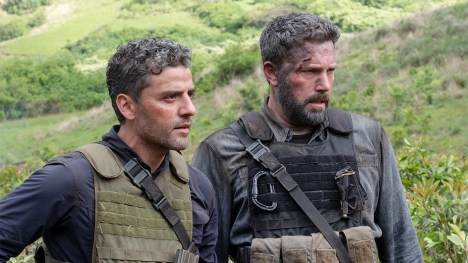
Triple Frontier feels very much like a J.C. Chandor grab bag. And that’s no bad thing of itself.

The film runs on a variety of different concepts and ideas that run through Chandor’s other films. On a purely plotting level, the idea of a story about five guys trapped alone in the wilderness trying to survive on hostile terrain evokes the survival drama of All is Lost, albeit with more men carrying more weapons. The thematic underpinnings of the story, particularly its preoccupations with the dangers of greed and the consequences of unchecked avarice, resonate with Chandor’s earlier work like Margin Call or A Most Violent Year. There is a sense in which Triple Frontier feels of a piece with the body of work that Chandor is building for himself.

Even more broadly, Triple Frontier feels like the kind of older sort of film that rarely gets made in the current studio system; an ensemble cast dropped into a fairly standard premise, anchored in the recognisability of the actors rather than the familiarity of the intellectual property. Triple Frontier is a film build around the closest thing that modern Hollywood has to star wattage. The film reunites Chandor with Oscar Isaac, who anchored A Most Violent Year and the secondary lead role is given over to Ben Affleck, who is arguably one of the rare remaining movie stars. There is no small irony in the fact that Triple Frontier should end up on Netflix, despite being the sort of mid-budget, actor-driven, basic-concept action thriller that studios used to churn out on a regular basis.

Triple Frontier is perhaps Chandor’s weakest film. It lacks the raw urgency of Margin Call, the desperate intimacy of All is Lost and the claustrophobic anxiety of A Most Violent Year. However, it is still a well-constructed survival parable driven by a likable cast and confident director with a clear affection for an older style of Hollywood film-making.

Continue reading