Hosted by Andrew Quinn and Darren Mooney, and this week with special guest Billie Jean Doheny, The 250 is a weekly trip through some of the best (and worst) movies ever made, as voted for by Internet Movie Database Users. New episodes are released Saturdays at 6pm GMT.
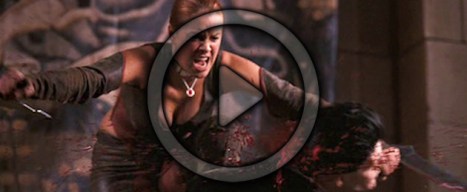
So this week, Uwe Boll’s BloodRayne.
An ancient evil stalks the landscape. The evil vampire lord Kagan casts a long shadow. The only hope of humanity lies with his daughter Rayne, who aims to avenge her mother and slay her father. However, she also has to reckon with the secret Brimstone Society, a human organisation that might have its own agenda.
At time of recording, it was ranked 32nd on the list of the worst movies of all time on the Internet Movie Database.
When it premiered, Lin-Manuel Miranda’s In the Heights was a radical piece of work.
Miranda had begun working on the musical when he was in his sophomore year of college, producing an eighty-minute version of the play in 1999. He would take a prototype of the completed musical to Waterford, Connecticut in 2005. The show would move Off-Broadway two years later, and would open on Broadway in February 2008. It was a move that very much announced the arrival of Miranda as a serious talent, and would serve as a springboard to his later success with Hamilton.
“There’ll be dancing… Dancing in the Street…”
In the Heights is set against the backdrop of Washington Heights, a neighbourhood on the north west side of Manhattan. Inspired by Miranda’s own experience as a Puerto Rican immigrant, the musical follows the inhabitants of the neighbourhood as they navigate a changing world. The story is told through the eyes of Usnavi, the young owner of a small bodega who dreams of returning to his home in the Dominican Republic, but who needs to find a way to express his feelings for Vanessa, who is considering a move of her own to the West Village.
Miranda wrote In the Heights as a very pointed response to traditional staged musicals like West Side Story. It’s no small irony that, more than twenty years after it premiered, the film adaptation feels as much like a traditional musical as any of the classics that Miranda had railed against.
There’s an appealing low-stakes gentleness to Luca. In fact, Luca might be Pixar’s first hangout movie.
The film tells the story the eponymous sea monster. The young boy lives off the Italian Riviera, tending to the local fish and dreaming of the world above the surface. One day, following a chance encounter with a more adventurous boy named Alberto, Luca discovers that he can change form when dry. Outside the ocean, Luca and Alberto can pass as human children. Against his family’s better judgment and aware of what might happen if he is discovered, Luca decides to make the most of life above the waves.
“I wanna be where the people are…”
This description makes Luca sound like a retread of The Little Mermaid. That’s not an entirely unfair point of comparison. Both Luca and The Little Mermaid are stories about young characters who dare to dream of a life beyond the underwater world they know. However, Luca has a very distinct mood and ambiance. Luca is not really plot-driven. It lacks a central villain like Ursula or stakes as overt as the terms of Ursula’s spell. Instead, Luca is much more interested in the smaller details that mark a wonderful childhood summer.
Luca is undeniably minor Pixar, but that doesn’t mean it’s especially shallow.
The Escapist have launched a movie podcast, and I was thrilled to join Jack Packard and Lee Murkey for the eighteenth episode of the year, to discuss Zack Snyder’s Army of the Dead and the perennial debate over movie lengths.
It’s absurd to think that The Conjuring is probably the second most successful shared universe at Hollywood.
Of course, this is arguably more an indictment of the struggles that companies like Warner Bros. and Universal have faced in trying to launch competition for the Marvel Cinematic Universe, but it is still impressive that a gigantic homage to populist seventies horror has successfully grossed nearly two billion dollars across eight films. After all, this is a property anchored in a cinematic nostalgia which has succeeded through casting character actors appreciably older than most horror leads, notably Vera Farmiga and Patrick Wilson, but also Linda Cardellini, Anthony LaPaglia, Miranda Otto, Lili Taylor and Ron Livingston.
“Holy Plot! I mean, this plot… it’s full of holes…”
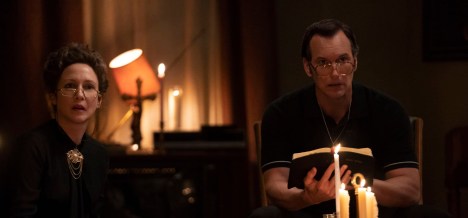
Following a variety of spin-offs and tie-ins including The Nun, The Curse of La Llorona and the separate Annabelle trilogy, The Conjuring: The Devil Made Me Do It is the third entry in the franchise’s cornerstone series. It is the first entry in that main series not to be directed by James Wan. Instead, Wan hands over directorial responsibilities to Michael Chaves, who helmed The Curse of La Llorona. Still, in terms of aesthetic and scale, The Devil Made Me Do It is recognisable as a continuation and development of the previous two entries in the trilogy.
Much like The Conjuring 2, The Devil Made Me Do It is a curious genre hybrid. It feels like a conscious effort to build a blockbuster horror movie, incorporating elements from more populist films and tying them back to the nuts-and-bolts mechanics of classic horror films. Like The Conjuring 2, this hybridisation is perhaps more interesting than it is effective. It doesn’t entirely work, but it certain merits investigation.
With a slew of Marvel Studios productions coming to Disney+ over the next six months, The Escapist has launched a weekly show discussing these series
This week, with Loki launching next Wednesday, I join KC Nwosu and Amy Campbell to talk about our expectations and our predictions for the last of this wave of big three live action Marvel shows on Disney+.
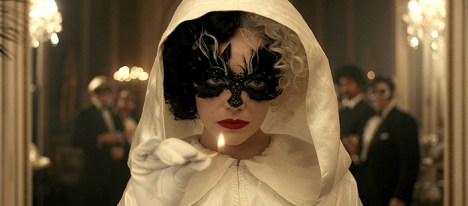
Cruella arrives as the culmination of two interconnected trends.
Most obviously, Cruella is the latest in the long line of live action (or pseudo-live action) adaptations of classic Disney properties hoping to turn the studio’s animated back catalogue into a source of rich intellectual property that can be steadily mined for quick returns. Movies like Beauty and the Beast, Aladdin and The Lion King all grossed over a billion dollars, so there is surely an audience hungry to see beloved childhood classics transferred into live action.
Ready for some hot takes?
Ironically enough, 101 Dalmatians was one of the first films to make that leap from pencil and inks to live action, with an adaptation (and a sequel) in the mid-nineties. Indeed, it’s arguable that Glenn Close’s incarnation of Cruella DeVil looms just large enough in the culture that a simple reboot of the premise might feel a little gauche. Jon Favreau could direct a second pseudo-live-action version of The Jungle Book for the company, but only because the earlier effort had no cultural footprint.
So Cruella is not content to be a straight-up reimagining of the classic Disney cartoon. Instead, the film draws from another contemporary trend when it comes to managing these intellectual properties: the villain-centric reboot. Cruella is arguably of a piece with recent pop culture like Ratchet, Maleficent or Joker, all works that reimagined a familiar intellectual property through the lens of its antagonist. There is evidently money in this concept, with Joker earning over a billion dollars and Maleficent earning half a billion and inspiring a sequel.
A crime of fashion.
So Cruella offers an origin story for the classic Disney villain, inviting the audience to get to know the monstrous fashion designer whose defining character trait was her desire to skin a lot of adorable puppies to make the perfect coat. It’s certainly an ambitious assignment. While Cruella is one of the most striking villains in the Disney canon, with one of the catchiest theme songs, she is hardly the most complex or nuanced. There’s hardly a lot of tragedy to be mined in a character so horrifically monstrous that “if she doesn’t scare you, no evil thing will.”
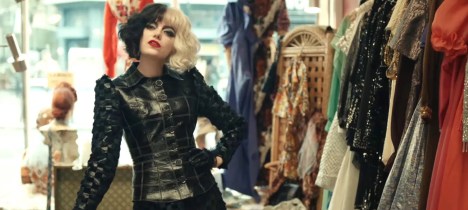
This sets up the central tension in Cruella, and the problem that the movie never quite manages to resolve. Cruella is a much stronger movie whenever it allows itself to drift away from the shadow of 101 Dalmations and become its own thing, but it suffers greatly when it finds itself drawn back into the gravity of the original Disney classic. Cruella works reasonably well as a seventies-set fashion heist movie, but struggles when it tries to be a compelling villain origin story for a character who really never needed one.
Spiral: From the Book of Saw is an interesting, if dysfunctional, franchise extension.
The obvious point of contrast is something like Jigsaw, the last attempt to restart the Saw franchise. Jigsaw was released in 2017, two years after Star Wars: Episode VII – The Force Awakens, and it bet big on a particular kind of nostalgia. It was a film that consciously aspired to evoke the memory of the Saw franchise among an audience that had probably seen an entry or two in the franchise a decade earlier and had vague memories of the experience.
Rocking the boat.
Jigsaw offered a much more polished take on the Saw template, eschewing the grimy green and grey aesthetic of the previous seven films in favour of a crisp sheen. Still, the film worked very hard to demonstrate its affection and veneration for the source material, even while offering superficial updates like moving the action into the countryside and swapping blades for lasers. The company logos at the start of Jigsaw appeared over a remix of Hello Zepp. Billy the Puppet got a makeover. Tobin Bell got considerable screentime as John Kramer, and the film tied itself to his back story and history.
Spiral takes a very different approach to its nostalgia. The film is the first in the series not to feature the character of John Kramer. Billy the Puppet has also been retired. While a variation on Hello Zepp does eventually play, Spiral holds it back and makes the audience wait for the pay-off. Spiral is very much part of the larger Saw franchise, and contains the requisite death traps and even brings back director Darren Lynn Bousman, but it feels like a consciously pared down and “back to basics” approach to the franchise that strips out a lot of the clutter that has accrued over the franchise’s long life span.
Bloody horrific.
This is most notable with the film’s sharp genre shift. While all of the earlier Saw movies had some procedural element that followed law enforcement’s efforts to track down and stop the serial killer, Spiral centres this thread. Spiral is arguably a forensic thriller with gory elements, rather than a gory horror with a dash of forensic thriller for flavour. It’s a clear attempt at a fresh start, with Spiral even relegating the Saw brand to the subtitle while leaning more heavily on the spiral and pig imagery that was largely secondary in the original franchise.
The result is fascinating, even if it doesn’t quite work. Spiral is arguably a “back to basics” take on the Saw franchise, going so back to basics that it draws more heavily from the serial killer thrillers that originally inspired Saw than it does from the Saw movies themselves.
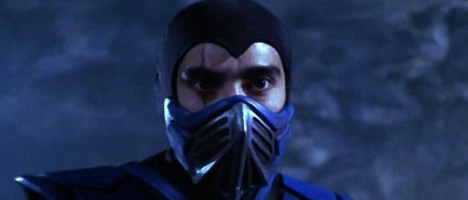
I published a new In the Frame piece at The Escapist this evening. With the release of Mortal Kombat over the weekend, it seemed like as good a time as any to take a look back at the earlier nineties iteration of the cinematic franchise.
In particular, Mortal Kombat: Annihilation is a much more interesting movie than is often acknowledged. It is a complete disaster in just about every sense, but is a revealing one. Watched from remove of two decades, Annihilation often feels like a template for the sort of fan service blockbuster that we now take for granted, with its broad themes of “family” and its plot that serves primarily as an object on which continuity references and nostalgic shoutouts might be ornately arranged.
You can read the piece here, or click the picture below.
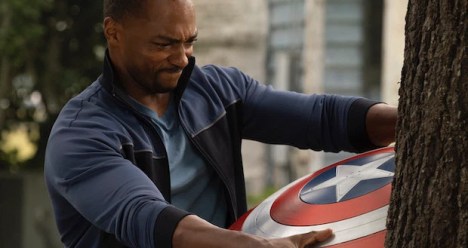
I published a new In the Frame piece at The Escapist this evening. As The Falcon and the Winter Soldier winds down its season, it seemed like a good opportunity to consider the show’s approach to the question: “What does Captain America stand for?”
It has been a turbulent few years for American identity, and it makes sense that a television about a character carrying the mantle of “Captain America” should have to figure out what that title means. The biggest issue with The Falcon and the Winter Soldier is that it defines the concept of “Captain America” in negative terms. The series is more preoccupied with what Captain America isn’t than what he actually and actively is.
You can read the piece here, or click the picture below.




















 the m0vie blog