We’re thrilled to be launching a fortnightly companion piece to In the Frame at The Escapist. The video will typically launch every second Monday, and be released on the magazine’s YouTube channel. This is kinda cool, because we’re helping relaunch the magazine’s film content – so if you can throw a subscription our way, it would mean a lot.
With the release Moon Knight, it seemed like a good opportunity to talk about the show. In particular, how Moon Knight offers an interesting approach to the long-standing “villain problem” facing Marvel Studios.
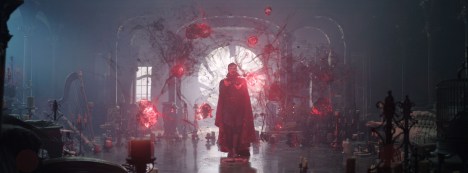
I published a new In the Frame piece at The Escapist this evening. With the looming release of Doctor Strange in the Multiverse of Madness, it seemed like a good time to reflect on how so much of the fate of the Marvel Cinematic Universe came to rely on he sequel to Doctor Strange.
Doctor Strange was a solid midtier entry in the Marvel Cinematic Universe. It was warmly, but not raptuously, received by both audiences and critics. However, there is something fascinating in how the studio has positioned Doctor Strange in the Multiverse of Madness as essentially the franchise’s first true “event” movie since Avengers: Endgame. Indeed, there’s a surprising amount riding on the film, following the performance of the previous three Marvel Studios films and the success of Spider-Man: No Way Home and The Batman.
You can read the piece here, or click the picture below.
Hosted by Andrew Quinn and Darren Mooney, this week joined by special guests Graham Day, Luke Dunne and Bríd Martin, The 250 is a (mostly) weekly trip through some of the best (and worst) movies ever made, as voted for by Internet Movie Database Users. New episodes are released every second Saturday at 6pm GMT, with the occasional bonus episode between them.
This time, Jon Watts’ Spider-Man: No Way Home.
Peter Parker returns home from a school trip to discover that his deepest secret has been revealed to the world: thanks to the villain Mysterio, now everybody knows that the teenage is the vigilante known as Spider-Man. Peter races to put the genie back in the bottle, but discovers that his plans might have unforeseen consequences.
At time of recording, it was ranked 8th on the list of the best movies of all time on the Internet Movie Database.
Podcast 616 is a podcast looking at the Marvel Cinematic Universe. I was thrilled to be invited to join Dan Owen for a discussion of Chloé Zhao’s Eternals, which is a movie I enjoyed considerably more than most.
It’s a fun and broad discussion, which delves into questions around auteurship within the Marvel Cinematic Universe, the paradox of superheroes, the question of power, and the challenges in adapting concepts like the Deviants for the big screen. It was really fun to roll up my sleeves and delve into this discussion with Dan, which allowed me to chat about everything from my blind spots with certain characters to the way in which the plot and themes of Eternals feels true to the spirit – if not necessarily the art – of Jack Kirby.
You can listen to the episode here, or click the link below.
It is easy to understand why this is. There have been Marvel Studios movies directed by Oscar-winners before; Joe Johnson won an Academy Award for visual effects on Raiders of the Lost Ark and Taika Waititi recently won a Best Adapted Screenplay award for JoJo Rabbit. However, there is something tangibly different about seeing a big budget blockbuster coming from an artist who won both Best Picture and Best Director at that year’s Academy Awards.
It also makes sense in the context of the Marvel Cinematic Universe. There have undoubtedly been Marvel Studios films with strong senses of authorship: Shane Black’s Iron Man 3, Taika Waititi’s Thor: Ragnarok, James Gunn’s Guardians of the Galaxy and Guardians of the Galaxy, Vol. 2, and Ryan Coogler’s Black Panther. However, those movies all feel quite a long time ago. Although one can perhaps pick up traces of Cate Shortland’s personality in Black Widow or Daniel Destin Cretton’s interests in Shang-Chi and the Legend of the Ten Rings, those films feel very familiar and very rote.
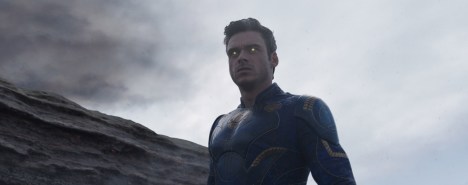
Red eyes in the morning…
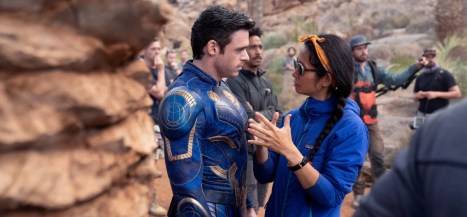
There is tangible sense of opportunism at play in way that Marvel Studios has positioned Eternals as an auteur-driven project. After all, the studio has a long and complicated history with directors who have distinct visions; Patty Jenkins, Edgar Wright and Ava DuVernay have all suggested that the company’s culture is not particularly welcoming to creatives. In particular, Zhao’s assertion that she oversaw the movie’s action sequences exists in the context of Argentine director Lucrecia Martel, who recalls being told that if she chose to direct Black Widow, she would not be allowed to direct the action scenes.
Again, context is important here. Eternals is really the company’s first director-driven project since Black Panther, which is a big deal given the studio’s history of beginning pre-visualization of scenes and special effects “before the cinematographer or director has signed on to the project.” While movies like Avengers: Infinity War, Captain Marvel, Ant Man and the Wasp, Avengers: Endgame and Spider-Man: Far From Home are all varying degrees of entertaining, none of them feel like the work of a filmmaker who has something particularly pressing to say about the modern world.
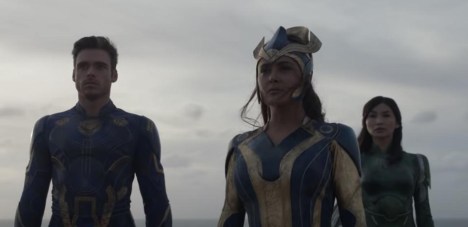
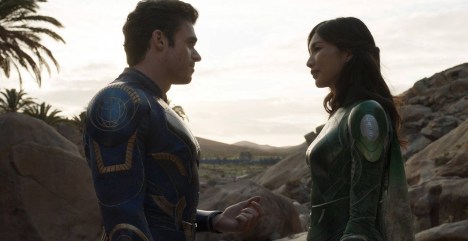
Superfriends.
All this tension plays through Eternals, the fine balancing act between a director with a very distinctive artistic sensibility working with a studio that appears eager to launder its reputation by association, while also being anxious that this auteur doesn’t get to go too far. In some ways, Eternals feels like a limit case for the Marvel Cinematic Universe, an example of just how far the studio will allow a creative talent to stretch a rubber band before aggressively snapping it back into the default position.
This is the challenge facing Eternals. It goes further than any Marvel Studios film in recent memory, but that’s still not far enough.
I published a new column at The Escapist today. With the upcoming release of Chloé Zhao’s Eternals, and the ongoing debate around it, it seemed like a good opportunity to take a look at the narrative around the film.
Publicity around Eternals has made a big deal of the extent to which Zhao is the author of the film. Zhao has made it clear that she directed all the film’s action, and Kevin Feige has talked about how hard she fought to use real locations rather than simply green-screen effects. This is interesting, because these two very basic accomplishments are being treated as a big deal, as a revolutionary amount of freedom being afforded to a creative talent. It’s an interesting snapshot of modern blockbuster filmmaking, where these freedoms are considered exceptional and newsworthy.
You can read the piece here, or click the picture below.
I published a new column at The Escapist today. I took a look at the opening three episodes of the new animated series What If…?
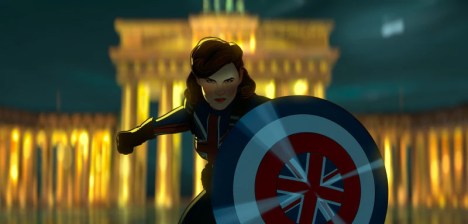
What If…? is an interesting step into the Marvel multiverse. It is a series of adventures that depart from the existing shared continuity in interesting ways, imaging alternate possibilities within the established superhero framework. The series itself is at its most interesting when it embraces the possibilities of the shared universe, but it suffers from a weird conservatism. At its worst, What If…? feels far too beholden to what has been rather than would could be.
You can read the piece here, or click the picture below.
I published a new In the Frame piece at The Escapist this evening. With Loki wrapping up its first season this week, it seemed like a good opportunity to take a look back at the show. In particular, how the season finale betrayed the show’s core themes and characters.
Loki is a story about many things, but it is primarily about power. It is about whether individuals have the power to determine the paths of their own lives. It is about who has the power to determine what stories get told and what they do with that power. It is also about how power intrinsically acts in its own best interests. There’s a lot of really interesting and biting stuff in Loki, which makes it slightly frustrating when the final makes a conscious choice to rob its characters of their agency, to reveal that this story doesn’t belong to them, and to argue that power must be centralised. In the end, Loki betrayed itself.
You can read the piece here, or click the picture below.
Hosted by Andrew Quinn and Darren Mooney and with special guest Scott Mendelson, The Bottom 100 is a subset of The 250. It is a journey through the worst 100 movies of all-time, as voted for by Internet Movie Database Users.
This time, Albert Pyun’s Captain America.
Polio sufferer Steve Rogers is selected for a dangerous experiment that could turn the tide of the Second World War, being reborn as Captain America. When a mission behind enemy lines throws him into conflict with the Italian supervillain the Red Skull, Steve Rogers ends up trapped in the ice. However, he awakens just as his country needs him most.
At time of recording, it was ranked the 65th worst movie of all time on the Internet Movie Database.
I published a new column at The Escapist yesterday. Following the premiere of Loki, it seemed like an opportunity to take a look at some of the meta-fictional aspects of the beloved trickster.
At its core, Loki is essentially the story of a character trying to escape their own narrative and wrest control of the story in which they’ve found themselves trapped. The title character of Loki has always been a supporting player, an antagonist or an ensemble player. Loki finds the character pushing his way to the fore, trying to figure out his own arc and his own place when he is no longer defined by the role that he has played for the past decade of the Marvel Cinematic Universe.
You can read the piece here, or click the picture below.

















 the m0vie blog