• Following Us

  • Categories

  • Check out the Archives


  • Awards & Nominations

Non-Review Review: I’m Gonna Git You, Sucka!

Wow. A Wayans’ movies that wasn’t completely terrible. Okay, it isn’t great, but there are some genuinely hilarious moments hidden in this blaxploitation spoof. There’s a fairly high miss-to-hits ratio, though – but it still hits the spot frequently enough.

Pretty fly...

Continue reading

Non-Review Review: Futurama – Into the Wild Green Yonder

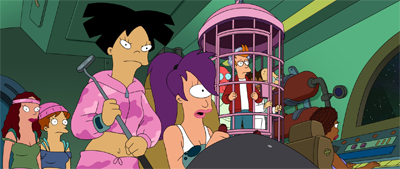
Interesting. It seems that Futurama has somehow (presumably unconsciously) incorporated one of the central features from its key sources, the Star Trek franchise. It’s frequently asserted by fans of that series that the television show spawned a rather inconsistent movies series. Some, such as Star Trek II: The Wrath of Khan, could stand tall and be measured along the best movies that science-fiction could offer; while others, notable Star Trek V: The Final Frontier (in which Kirk kills God in a story pitched and directed by William Shatner), were actually terrible. The consensus emerged that the even numbered sequels were great and the odd numbered movies were terrible. This is just a run of thumb, and it’s possible it has been reversed (the tenth movie, Star Trek: Nemesis, was pretty disappointing; the eleventh, Star Trek, was a blast of fresh air) or even completely deconstructed. While none of the four Futurama movies are “terrible” or even “bad”, the distinction between the “okay” and the “great” seems to fall on similar lines. The first and third, Bender’s Big Score and Bender’s Game, weren’t great, while the second and fourth, The Beast With A Billion Backs and Into the Wild Green Yonder, perfectly capture all that was great about the show.

Here we go-go again...

Continue reading

Non-Review Review: Futurama – Bender’s Big Score

If only all cancelled shows had the same good fortune as Futurama. After being taken off the air, the show was shopped around a bit, before coming back as a series of four two-hour movies (which could, conveniently for the network, could be split into sixteen episodes – four episodes per movie). The first of the movie’s – Bender’s Big Score – seems an interesting choice to open the specials. Rather than being framed as a re-introduction to the series, designed to attract new fans and effectively act as a second pilot for the show, instead it’s clearly intended as something of a valentine to existing fans.

It's good to be back...

Continue reading

Non-Review Review: Superman

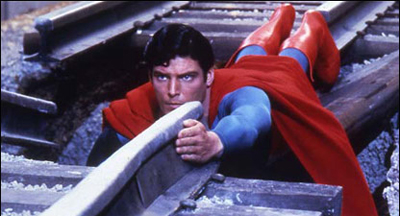
Tell me your heart doesn’t skip a beat when you hear the familiar brass of John Williams’ iconic score. Or that you can resist a smile as a small child introduces the movie by opening a comic book and reading aloud. Or that the opening shot of the crystal canyons of Krypton doesn’t make your spine tingle just a bit. Richard Donner’s Superman is perhaps correctly regarded as the father of the whole superhero genre, and deservedly so, but it’s also a stunningly well put together film in its own right. You could argue that this film predates the whole “superhero” genre in Hollywood, and – as such- more deserves classification as a “fantasy” film. And it can certainly stand with the very best of them.

Don't worry, he's trained for this sort of emergency...

Continue reading

Thoughts on Meaning…

So what does this cartoon mean?

It shows how the depletion of our natural resources has pitted our small farmers against each other.

Yes, and birds go tweet, what else?

– College lecturer and student dissect Itchy & Scratchy, “Little Girl in the Big Ten”, The Simpsons

I had the pleasure of moving in with my better half last week, and we grew quite fond of listening to her “best of REM” CD – the excellent In Time. “Orange Crush” happened to play, and my significant other happened to remark that she greatly enjoyed the song. As we nodded in time to the music, I pondered aloud if she was familiar with the meaning of the song – she had been unaware of the origins of the Boomtown Rats’ “I Don’t Like Mondays”, for instance, or “What’s the Frequency Kenneth?” on the same CD. She admitted that she was not, so I offered her a brief synopsis over the discussion as to the “meaning” and “roots” of the song:

Orange Crush was an orange flavored soft drink. In this case, though, it was meant to refer to Agent Orange, a chemical used by the US to defoliate the Vietnamese jungle during the Vietnam War. US military personnel exposed to it developed cancer years later and some of their children had birth defects.

This was met with observations that I tend to “ruin” songs be talking about such things, implying that once you know something like that about a song it becomes a lot more difficult to nod your head along and join in on the chorus. Part of me wonders if the same is a little true of movies, in a manner of speaking – does over analysing and disecting them ultimately lead us to somewhat devalue them as entertainment?

It's actually about nuclear proliferation...

Continue reading

Anatomy of a Backlash: Intercepting Inception Criticisms…

It’s always interesting to watch the reaction to a highly anticipated blockbuster. Sure, most of the time it hits like a drop in the ocean: there’s a moment of anticipation as it travels through the air and a slight reverberation as it joins the rather sizeable pool of existing movies, quickly forgotten or accepted. However, sometimes – if the movie is big enough – you get a slightly more complex reaction. That second before it hits the water becomes longer, the audience holds its breath even tighter and then, when it hits… there are reactions. The first wave, usually one of acceptance – the geekery, the exotic embrace, the types of reviews that push a Rotten Tomatoes score up to 100% before it even gets a wide release. Then there’s the second wave, as a few high-profile commentators dare to speak out against the film – usually reviewers from prestigious publications, usually as release day dawns. There’s a third movement, perhaps in direct response to the above – the rapid fanboy passion, one determined to lock down any criticism, sometimes aggressive, just sometimes caught up in the moment. And, if the film is really big, there’s a fourth wave, the public backlash against the film itself. It’s interesting to watch a movie cycle through these four basic events, like Inception certainly has of late. There are ripples across the internet, and waves of discussion and engagement, which is always great to see. However, it’s somewhat less exciting to witness how bitter criticisms and arguments can become.

It's all a bit topsy-turvy...

Continue reading

Who Exactly is the Target Market for Tron Legacy?

Don’t get me wrong, I’m brimming with excitement for the impending release of Tron Legacy – it’s one of my most anticipated films of the year, after all. And the trailers look pretty damn spiffing, if I do say so myself (and I do). However, I can’t help but wonder what the book office appeal of the film is? I mean, it looks absolutely stunning, like a huge amount of work has been done on it (the effects look pretty incredible) – but I’m wondering where Disney’s renewed fascination with the Tron franchise came about.

Will the crowd go Wild(e)?

Continue reading

Non-Review Review: The Incredibles

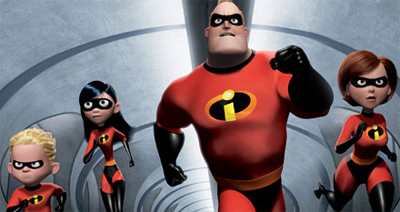
I think Pixar’s The Incredibles must stand as one of their best productions – alongside Finding Nemo, perhaps. It’s certainly one of their more conventional entries in the Pixar stable, in that it’s offered in the blockbuster format of the decade (superhero adventure), but – like the very best of their work – it’s so much more. A whole host of Pixar’s films – Toy Story and Finding Nemo chief among them – deal with the notion of paternal abandonment (though perhaps more fond of addressing the story of parents abandoned by kids, rather than kids abandoned by adults), but The Incredibles is perhaps the one which best deals with the challenges that managing a ‘functioning’ family.

That's one incredible family...

Continue reading

Non-Review Review: A Serious Man

I can’t help but feel like I’m missing something with A Serious Man. I mean, I get it, it’s all pointless and we’re meant to be as unable to make sense of it all as the dentist who finds words on his goy‘s teeth or Larry Gopnik himself, but there’s something ultimately uncomfortable about the film’s reflexiveness. After all, the story filters tales through tales through tales, with a rabbi sharing a pointless story with Larry as he waits there for the rabbi to instill it with meaning, but can’t. The movie’s central thesis is that – assuming he exists – God is a sadistic and horrible creature for the way he arranges the world without meaning and seemingly to punish a man “trying to be a serious man”. Of course, whether or not God exists is a question for each individual to come to themselves, but the film draws attention to its nature as a narrative rather than a documentary – first through a random introductory film and then through a-story-within-a-story – which makes it clear that while the real world may or may not have an omnipotent creator, Larry’s world does. And you can’t help but feel, at the end of it, that the Coens are really just dicks.

Is it wrong that I was a little board?

Continue reading

Top of the Pops: The IMDb Top 250 Movies All Time and Movie Lists in General…

Sometimes talking about talking about movies can be as fascinating as actually discussing movies. That’s why I’ve followed with interest the crisis of identity that has gripped film criticism of late. What’s interesting, however is to hear Donald Clarke of The Irish Times complaining about the Internet Movie Database Top 250 Films of All Time:

The performance of Inception highlights the most serious problem with this list. Like most such sites, IMDb receives contributions from a disproportionately high number of teenage boys. If you doubt this, look at the ratings for the Twilight films. I know that most critics are less keen on the teen vampire pictures than I am, but the appalling ratings  for the pictures on IMDb speak of a spotty allergy to “gurl’s fillums”. Such boys idolise Nolan and — crucially — know how to put together internet campaigns.

I’m kinda wondering though, what exactly is Mister Clarke arguing against? When did any film ranking become an objective exercise that needs to be treated like “serious business”?

Looks like Inception made quite the splash... (Inception, #3)

Continue reading