• Following Us

  • Categories

  • Check out the Archives


  • Awards & Nominations

Non-Review Review: Inherent Vice

In many ways, Inherent Vice resembles its central character – former-hippie-turned-private-investigator Larry “Doc” Sportello.

Inherent Vice is prone to ramble and meander, stumbling across its central conspiracies as much by fate as by actual investigation. The logic is fuzzy, but the genius is clear. Navigating a complex web of seventies paranoia, it often seems as if Inherent Vice is playing a game of free association between its themes, stumbling upon some higher meta-physical plane where all the evils of the world (or, at least, Los Angeles) are connected by threads almost imperceptible.
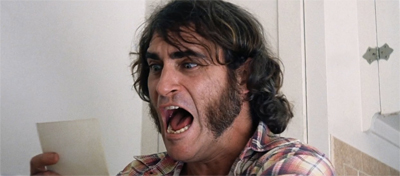
Bad trip...

Bad trip…

Both Inherent Vice and Doc are hooked on their own particular drugs. Over the course of Inherent Vice, Doc makes it quite clear that heroine is just about the only dope he won’t take into his body. Inherent Vice itself is drawn the delightfully trippy far-out prose of Thomas Pynchon, with Paul Thomas Anderson’s script pausing intermittently to dump large quantities of existential musing on to the market. If Pynchon’s prose didn’t flow eloquently from actresses like Katherine Waterston and Jeannie Berlin, the audience might complain.

Running almost two-and-a-half hours, Inherent Vice is more than a little indulgent. Luckily, it is more than a little brilliant as well.

Lawyer up...

Lawyer up…

Continue reading

The X-Files (Topps) #13 – One Player Only (Review)

This November (and a little of December), we’re taking a trip back in time to review the third season of The X-Files and the first (and only) season of Space: Above and Beyond.

After a twelve-issue opening mega-arc of interconnected stories about conspiracies-within-conspiracies and wheels-within-wheels, author Stefan Petrucha and artist Charles Adlard step back a little bit to close out their run with a series of standalone stories. The four issues (and three stories) that make up the rest of their run on Topps’ X-Files comic stand alone. They are connected by themes and subtext, but very clearly stand apart from what came before. Indeed, they play out almost like a postscript to the main body of work, a series of smaller bite-sized chunks.

In that light, it is interesting that One Player Only feels – superficially, at least – a lot more in step with the television show. The early issues of the comic had seen Petrucha and Adlard creating their own supporting cast and their own conspiracy, so as to avoid stepping on the toes of the production company. The Cigarette-Smoking Man was largely reduced to a number of cameos, with Skinner popping up once or twice along the way.

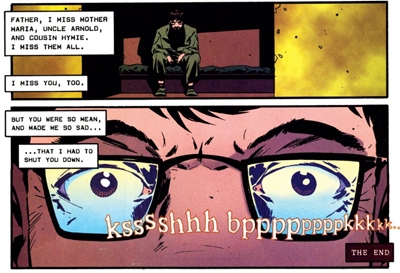
Ghosts in the machines?

Ghosts in the machines?

Not only does One Player Only feature a guest appearance from supporting characters like Mr. X or yhe Lone Gunmen, it also harks back to the structure and format of the first season of the show. On the most basic of levels, One Player Only feels like a more cyberpunk take on Ghost in the Machine, right down to the fact that Mulder is drawn into a murder at a tech company by an acquaintance from his days in the Violent Crimes Division. At one point, Mulder and Scully stumble on a ransacked house, for Mulder to deadpan, “Hm. Nothing new.”

However, if one peels back the layers, One Player Only is a fascinating piece that sets the tone for Petrucha and Adlard’s last three issues on the series, while infusing the comic with a host of fascinating cyberpunk stylings and body horror that seem to call forward to William Gibson’s future writing for the show.

Coding out...

Coding out…

Continue reading

The X-Files – War of the Coprophages (Review)

This November (and a little of December), we’re taking a trip back in time to review the third season of The X-Files and the first (and only) season of Space: Above and Beyond.

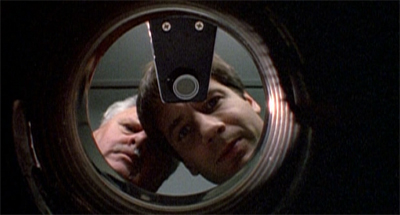
It is very odd to describe any Darin Morgan episode as “underrated.” And yet, despite that, War of the Coprophages feels like the underrated Darin Morgan teleplay.

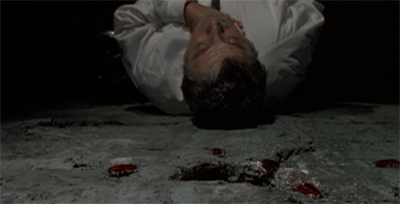
Clyde Bruckman’s Final Repose had appeared towards the start of the season, featuring a powerhouse guest performance from Peter Boyle. Both Boyle and Morgan would win Emmys for their work on that episode, and Clyde Bruckman’s Final Repose is perhaps Morgan’s most conventional script for The X-Files or Millennium. In contrast, Jose Chung’s “From Outer Space” is perhaps the most adventurous and gonzo episode of The X-Files ever produced, coming at the end of the season and relentlessly (but affectionately) mocking the show’s core iconic mythology.

Down the drain...

Down the drain…

In contrast, War of the Coprophages sits in the middle, literally and figuratively. It is positioned almost precisely in the middle of the third season, with Morgan writing the screenplay in an exceptionally short period of time. It isn’t a truly exceptional example of a monster-of-the-week episode in the way that Clyde Bruckman’s Final Repose was, but it also isn’t as off-the-walls and bizarre as Jose Chung’s “From Outer Space.” It doesn’t feel like it has as much to say about death as Clyde Bruckman’s Final Repose, nor as much about life as Jose Chung’s “From Outer Space.”

And yet, in its own way, War of the Coprophages as an incisive and well-constructed commentary on The X-Files as a television show while allowing Morgan to tackle his recurring themes about society and humanity, and whether the world is what we would like to think that it is.

Bug hunt...

Bug hunt…

Continue reading

Star Trek: Voyager – Non Sequitur (Review)

This September and October, we’re taking a look at the jam-packed 1994 to 1995 season of Star Trek, including Star Trek: Deep Space Nine and Star Trek: Voyager. Check back daily for the latest review.

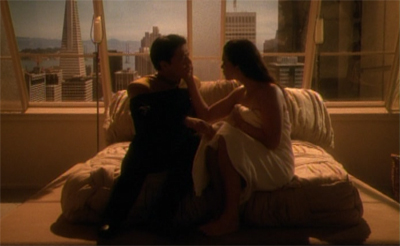
Non Sequitur is a Brannon Braga script touching on familiar Brannon Braga concepts – big ideas like time and space and reality and existence. Harry Kim wakes up to find himself in bed with his girlfriend, Libby. The two are living in San Francisco on Earth. Ensign Harry Kim never served on Voyager, instead working in Starfleet Engineering on Earth. Unable to explain what has happened, Kim finds himself struggling to cope with the situation.

Luckily, in true Star Trek: Voyager fashion, everything is conveniently reset at the end of the episode.

Feels like going home...

Feels like going home…

Continue reading

Star Trek: Deep Space Nine – Whispers (Review)

Star Trek: Deep Space Nine is twenty years old this year. To celebrate, I’m taking a look at the first and second seasons. Check back daily for the latest review or retrospective.

You could make a credible argument that each of the first three Star Trek shows beautifully encapsulated their time and place. The original show was the very embodiment of the sixties zeitgeist, providing a channel for commentary and insight into counter-culture and the Vietnam War, and an outlet for various fixations and phobias. Star Trek: The Next Generation was a show that spoke to a version of America which was emerging from the Cold War, a clean and sterile morning for a new America.

Star Trek: Deep Space Nine was positioned somewhat strangely, as the idealism and enthusiasm of the early nineties gave way to paranoia and insecurity. If the hyperreal technicolour production values of the original Star Trek spoke to the energy and enthusiasm sixties, then the drab grey Orwellian design of Deep Space Nine was a reflection of the late nineties.

Whispers is really the first time that the show has pushed its sense of paranoia to the fore, and it confirms that Deep Space Nine will be a show of its time, anchored in the nineties.

It's all a bit askew...

It’s all a bit askew…

Continue reading

Non-Review Review: Star Trek V – The Final Frontier

This August, to celebrate the upcoming release of Star Trek: Into Darkness on DVD and blu ray, we’re taking a look at the Star Trek movies featuring the original cast. Movie reviews are every Tuesday and Thursday.

Star Trek V: The Final Frontier is not a good movie. There’s really nothing that can be excavated from the film that might redeem it. It isn’t a misunderstood masterpiece. It isn’t an insightful diamond in the rough. It’s just a bad film, the one which forms the cornerstone of the “odd-numbered Star Trek films” curse. It’s indulgent, pretentious and narrow-minded. It tries to blend a world-weary cynicism with an ill-judged and mean-spirited sense of humour.

Despite being shorter than Star Trek IV: The Voyage Home, it feels remarkably longer. It feels like a rather halfhearted attempt to recapture the spirit of the television show – oblivious to the fact that the franchise has spent the past decade moving onwards. It confuses ponderous pretension for intelligent insight.

Feeling blue...

Feeling blue…

Continue reading

Pixar and the Weight of Expectation…

Well, it probably had to happen. I know it’s probably not statistically impossible, just highly improbable – but I guess that I always knew (deep down) that Pixar’s batting average was too good to last. I mean, I (at the very least) really like all of their films, and I genuinely love the majority of them. And that fact is borne out by the Rotten Tomatoes ratings of the various films. The vast majority rank in the 90% to 100% range, something any studio would kill for: Toy Story (100%), A Bug’s Life (91%), Toy Story 2 (100%), Monsters Inc (95%), Finding Nemo (98%), The Incredibles (97%), Ratatouille (96%), Wall-E (96%), Up (98%), Toy Story 3 (99%). Even the single film that ranks lowest, the only one not in the range, still had mostly positive reviews, Cars with 74%. However, Cars 2 looks to have bucked that winning trend, with reviews that not only fall far short of Pixar’s impressive average, but is actually pretty negative.

I can’t help but feel more than a little bit sad.

Do Pixar need to get in gear?

Continue reading

Critical Predisposition: What Preconceptions Do You Bring Into Movies?

Over the last week, I had the pleasure to visit the Jameson Dublin International Film Festival. I saw a lot of films as part of that, and the reviews have been popping up all week. Anyway, they give out an audience award, which gave me occasion to actually score films. Regular readers here know that I am loath to try to objectively rank cinema, as it’s a very subjective medium and I have difficulty reconciling relative grades, but I went along with it. Anyway, they use a four-point scale and, long story short, I found myself using a lot of “3” grades, which is the second-highest rank. This kinda got me thinking: Am I a little too generous to films I really shouldn’t be? How do I approach the cinema? Do I look for things to love? Do I have a pre-disposed bias? Do I want to love films, even if they aren’t especially great?

Me, aged about eight...

Continue reading

Suspending Your Belief: Age Before Beauty…

It’s strange, isn’t it, what will break our suspension of disbelief? I mean, we’ll accept (while watching Superman) that a man can fly around in his underwear, but the fact he advertises his weakness to kryptonite in a public interview is distracting. Or we’ll somehow buy into an archeologist who searches for the holy grail and encounters all manner of occult phenomenon, but when it comes to aliens extra-dimensional beings… well, a lot of us call foul. Still, I’ve been thinking a bit of late about the really quite weird fascination that movies seem to have with age and recasting.

Grasping at straws to keep Patrick Stewart on board...

Continue reading

Claws Out for Sex and the City? The Irish Times Has Just the Ticket…

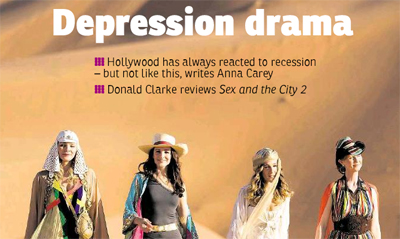
Sex and the City 2 came out last week. Not that it really affects or bothers me one way or the other. I just find it fascinating that The Ticket, the normally rather wonderful entertainment supplement which comes with The Irish Times, chose to offer its front page to the girls, while containing nothing but vitriol within. It seems a little contrary to have your reviewer and your features writer going at the film with the critical equivalent of baseball bats and then give them prime of place in your lineup and publicity, no? Especially given that the front page didn’t read “Sex and the City 2: It’s Quite Crap, Actually”.

Just the ticket?

Continue reading