• Following Us

  • Categories

  • Check out the Archives


  • Awards & Nominations

Star Trek: Enterprise – The Council (Review)

Next year, Star Trek is fifty years old. We have some special stuff planned for that, but – in the meantime – we’re reviewing all of Star Trek: Enterprise this year as something of a prequel to that anniversary. This August, we’re doing the third season. Check back daily for the latest review.

From a technical standpoint, The Council is the third last episode of the third season. From an arc-based standpoint, the third season Xindi arc is not completely resolved until the events of Home three episodes into the fourth season. However, there is an argument to be made that The Council represents the logical conclusion of the third season arc. Sure, Countdown and Zero Hour provide a suitably bombastic resolution to the year-long story, but The Council is the story that really resolves the central conflict driving the season.

After twenty-one episodes of moral ambiguity and ethical compromise, The Council exists to assure viewers that Star Trek: Enterprise has not forgotten the optimistic humanism that has guided the franchise. The Council confirms what most even-handed fans had probably deduced from The Expanse and what had been rendered explicit in The Shipment. The third season was never about getting away from the core utopian values associated with the Star Trek franchise; instead, it was about an attempt to get back to those hopeful ideals.
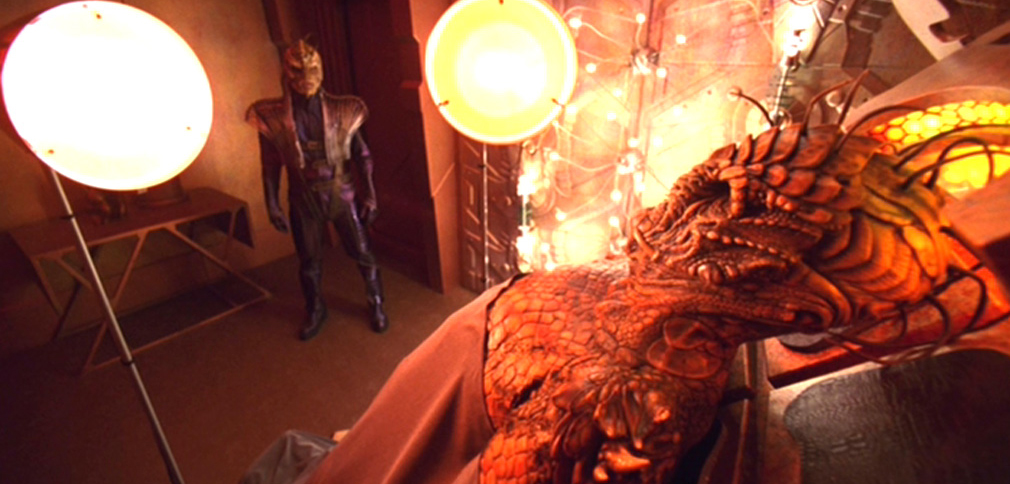
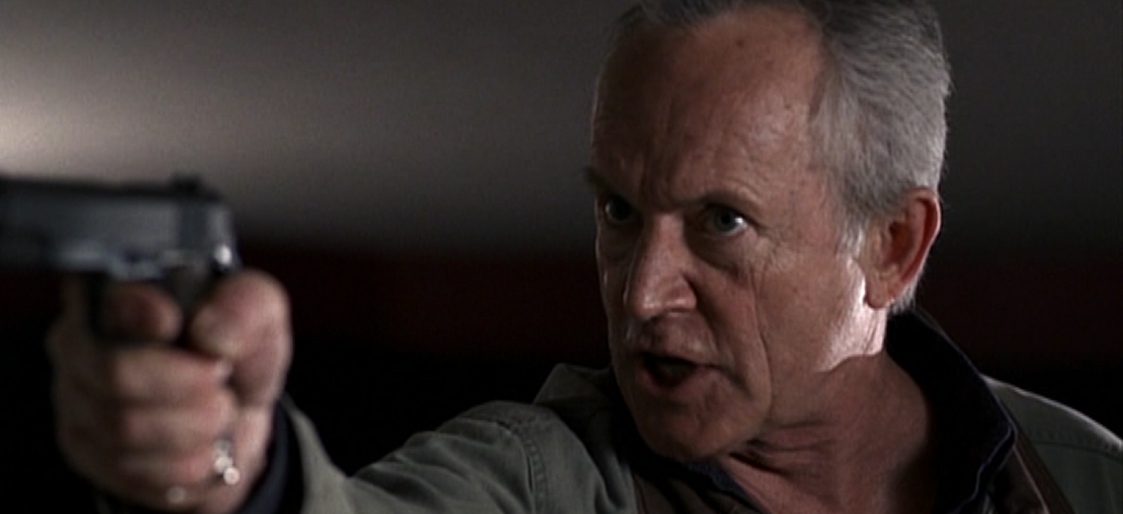
"I told you not to interrupt me when I'm working on my tan!"

“I told you not to interrupt me when I’m working on my tan!”

As the name implies, The Council is a rather talky script; it is certainly the most talky script between this point and the end of the third season. The episode’s plot finds Archer making his case to the Xindi Council, appealing for a peaceful resolution to the escalating crisis. Archer puts aside his anger and his thirst for retribution, in the hope of finding common ground that might accommodate both sides without resort to warfare or attempted genocide. Naturally, Archer is not entirely successful; the season needs an action climax. However, he is close enough.

Much like The Forgotten, it turns out that The Council is a script about moving beyond grief and hatred towards reconciliation and understanding. It affirms that the third season of Enterprise is (and was always) following a very traditional Star Trek arc.
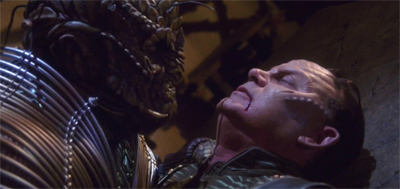
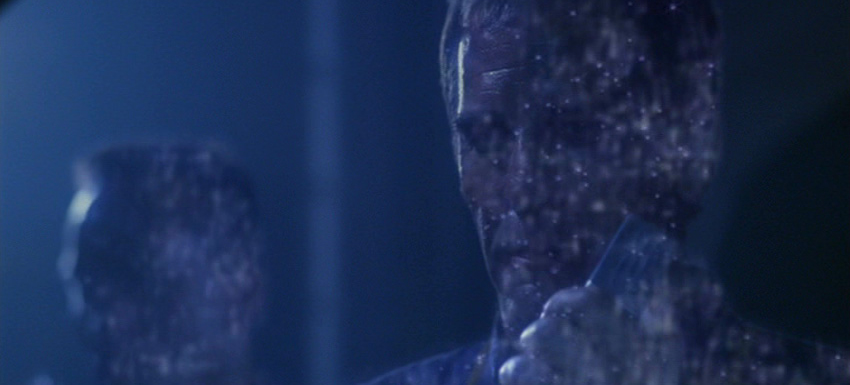
"Et tu, Dolim?"

“Et tu, Dolim?”

Continue reading

Star Trek: Enterprise – Damage (Review)

Next year, Star Trek is fifty years old. We have some special stuff planned for that, but – in the meantime – we’re reviewing all of Star Trek: Enterprise this year as something of a prequel to that anniversary. This August, we’re doing the third season. Check back daily for the latest review.

The stock comparison for Damage is In the Pale Moonlight.

This makes a great deal of sense. After all, both are Star Trek episodes that hinge on a series of morally questionable decisions made by the lead actor in a moment of sheer desperation. In In the Pale Moonlight, Benjamin Sisko starts a chain of events that builds towards the assassination of a Romulan Senator to trick the Romulans into joining the war effort. In Damage, Jonathan Archer resorts to piracy in order to obtain the parts necessary to make a meeting with Degra in order to plead against the use of the Xindi weapon.

A met a man who wasn't there...

A met a man who wasn’t there…

There are some notable differences, of course. In purely practical plotting terms, Sisko dominates the narrative of In the Pale Moonlight; the entire story is related directly by Sisko to the audience in the form of a personal log. In contrast, Damage is split between the demands of Archer’s own arc in the episode and various other continuity elements; the episode needs to get Archer back to his ship and devote a considerable amount of time to T’Pol’s addiction. As a result, it lacks the keen focus that made In the Pale Moonlight so compelling.

At the same time, there is something much more direct about Damage. Sisko is quite detached from the horrors of In the Pale Moonlight, with the audience insulated from his choices through the use of a framing device and Sisko himself insulated through his use of Garak to conduct all the unpalatable actions. In contrast, Archer makes a point to bloody his own hands over the course of Damage. He doesn’t have somebody else to make the decision for him; he leads the boarding party himself.

Everything comes apart...

Everything comes apart…

It is a very bold an unsettling choice, a culmination of a character arc that has been pushing Archer towards this sort of horrific choice since Anomaly. The third season of Star Trek: Enterprise has not been entirely consistent when it comes to its character arcs, working better in broad strokes than in fine detail. Nevertheless, Damage represents a very clear commitment to the promise of the third season of Enterprise; an interrogation of the franchise’s core values in an increasingly morally ambiguous world.

Damage is a deeply uncomfortable and unsettling episode of Star Trek, but it is arguably a necessary one. It is, in many ways, a criticism of the moral absolutism that informs a lot of discussion about terrible situations, suggesting that reality is often a lot more complicated than people might hope it would be.

Drowning his sorrows...

Drowning his sorrows…

Continue reading

Millennium – Season 3 (Review)

This July, we’re taking a trip back in time to review the sixth season of The X-Files and the third (and final) season of Millennium.

Three seasons is a good run.

It’s not a great run, but it is worth noting that Millennium ran longer than any of Chris Carter’s creations other than The X-Files. Given you grim and esoteric Millennium turned out to be, that is quite impressive. Notably, even the third season of Millennium performed better in the ratings than the first season of Harsh Realm. In many respects, Millennium is a very odd television show; it seems surprising that it lasted for three seasons. While fans (and many who worked on it) might have wanted more, Millennium is not a failure.

millennium-thesoundofsnow28

That said, the third season of Millennium is a disaster. There are a lot of reasons for this. The show was renewed by Fox quite late in the process, meaning the production team had little time to prepare. Glen Morgan and James Wong had no interest in returning to run the show, even if the rest of the staff would have them. Either due to time constraints or frustration, nobody asked Morgan and Wong about resolving the ending of The Time is Now. Michael Duggan was hired as showrunner, only to depart eight episodes into the season.

With all of this going on, the problems with the third season are entirely understandable. The season feels like a disjointed mess because there was chaos behind the scenes. The season was confused about its own continuity because the production team had no idea what to make of the second season. With ratings plunging, the show sought comfort in the familiar; there is an extended stretch near the start of the third season where it feels like the production team were trying to turn the show into a copy of The X-Files.

millennium-teotwawki22

The third season of Millennium has fairly terrible reputation among fans. This is not entirely undeserved; the early stretch of the third season contains a string of the worst episodes that Millennium ever produced. As sympathetic as the surrounding circumstances might make an audience to the show, that goodwill evaporates when confronted with episodes like The Innocents, Exegesis, TEOTWAWKI, Skull and Bones, Through a Glass Darkly, Human Essence and Omertà. The series improves dramatically in its middle section; but it is never consistent.

The third season contains a number of underrated episodes that do count among the best that the show ever produced, and a whole host of more interesting failures around those episodes. Perhaps the best thing that might be said about the third season is that it is interesting at least as often as it is bad. That might not sound like a ringing endorsement. It isn’t. The third season of Millennium doesn’t work. The reasons for this are entirely understandable, but that does not make it any easier to watch.

millennium-sevenandone24

Continue reading

Star Trek: Enterprise – Anomaly (Review)

Next year, Star Trek is fifty years old. We have some special stuff planned for that, but – in the meantime – we’re reviewing all of Star Trek: Enterprise this year as something of a prequel to that anniversary. This August, we’re doing the third season. Check back daily for the latest review.

Anomaly continues the sense that the third season of Star Trek: Enterprise is essentially a new first season of the show.

That is most obvious in the way that the script works hard to establish the ground rules of the Expanse. There is a sense that the episode is very clearly establishing rules and plot points that will come into play later in the run. Anomaly not only explains why mining for trellium-D is such a profitable enterprise; explaining that ships without it are susceptible to all sorts of strange distortions to the laws of physics. Anomaly also introduces the spheres, strange structures that will become a key part of the third season’s mythology.

A good man goes to war...

A good man goes to war…

The show is also marking out ground for later exploration. Anomaly becomes a lot more potent in hindsight, with various decisions here reversed in later episodes. In Anomaly, Archer is a victim of piracy; in Damage, he is forced to commit piracy. In Anomaly, Archer tortures a prisoner in order to procure information that he needs; in Countdown, Hoshi is tortured by Dolim in order to procure information that he needs. It is not entirely clear whether these plot beats were figured out ahead of time, but – like the destroyed Xindi home world in The Xindi – they lend the third season a nice sense of moral symmetry.

Most interestingly – and, perhaps, most pointedly – Anomaly represents a clear return to two very early episodes of the first season. The script of Anomaly touches quite overtly on plot points from Fight or Flight and Strange New World. In some ways, it could be seen as a belated do-over.

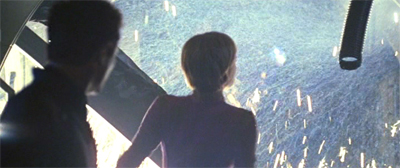
Sparks fly...

Sparks fly…

Continue reading

Millennium – Goodbye to All That (Review)

This July, we’re taking a trip back in time to review the sixth season of The X-Files and the third (and final) season of Millennium.

Goodbye to All That is not a bad place to leave Millennium, truth be told.

Sure, the episode has its problems, but that is true of pretty much every third season episode. However, showrunners Chip Johannessen and Ken Horton do try to offer the show some sort of closure. While Emma betraying Frank before he rides off into the sunset might have been a nice set up for a new fourth season status quo, it also feels like a nice place to leave the show as well. Director Thomas J. Wright frames that closing shot beautifully, to the point where anything that follows does feel like a coda to the three-season show.

Don't be dark, Frank Black...

Don’t be dark, Frank Black…

More than that, there’s a curious magnanimity to Goodbye to All That. The episode seems to suggest that perhaps Millennium has finally resolved all its internal conflicts about its own history. As with Borrowed Time, The Sound of Snow or Collateral Damage, there is a sense that Goodbye to All That is trying to create a cohesive theory of Millennium – suturing together three very different seasons into something approaching a singular entity. The task is impossible, but Goodbye to All That makes a valiant effort.

Yes, the actual plotting is ridiculous and Goodbye to All That tries to do too much in a single forty-five minute episode, but these are far from the worst vices of the third season. It is too much to suggest that Goodbye to All That wraps up Millennium on a high, but it does allow the show to bow out with its head held high.

"You know, for a secret organisation, we sure do a lot of branding..."

“You know, for a secret organisation, we sure do a lot of branding…”

Continue reading

Millennium – The Sound of Snow (Review)

This July, we’re taking a trip back in time to review the sixth season of The X-Files and the third (and final) season of Millennium.

“Our pasts are what we are,” Alice Severin explains to Emma Hollis and Bob Giebelhouse towards the climax of The Sound of Snow. It seems as if she might be talking for Millennium itself.

The Sound of Snow is a literal homecoming for Frank Black and Millennium as a television show. It is the last time that a number of crucial elements of Millennium appear in the show. It is the last appearance of Detective Bob Giebelhouse, the Seattle police officer who has been around since The Pilot. It is the last appearance of the yellow house, although it has since been painted a less striking white. It is also the last appearance of Catherine Black, who was a regular character for the show’s first two seasons.

...............

……………

The Sound of Snow features Frank Black returning to Seattle. This is not a big deal of itself. After all, Frank visited Seattle during TEOTWAWKI. However, The Sound of Snow sees Frank wading through memories. He flashes back to the events of The Fourth Horseman and The Time is Now, and visits the yellow house. He even takes a trip out to visit the cabin where he tried to wait out the end of the world with his wife and daughter. The Sound of Snow is about reconciliation, allowing Frank one last conversation with his beloved.

The Sound of Snow is also about reconciliation for the show itself. Since Omertà, the show has been trying to deal with the legacy of a second season that the first eight episodes of the year had tried minimise or ignore. The Sound of Snow is the culmination of that approach, with the third season finally picking up from where the second season let off.

...............

……………

Continue reading

The X-Files – Tithonus (Review)

This July, we’re taking a trip back in time to review the sixth season of The X-Files and the third (and final) season of Millennium.

Alas! for this gray shadow, once a man—
So glorious in his beauty and thy choice,
Who madest him thy chosen, that he seem’d
To his great heart none other than a God!
I ask’d thee, ‘Give me immortality.’
Then didst thou grant mine asking with a smile,
Like wealthy men, who care not how they give.
But thy strong Hours indignant work’d their wills,
And beat me down and marr’d and wasted me,
And tho’ they could not end me, left me maim’d
To dwell in presence of immortal youth,
Immortal age beside immortal youth,
And all I was, in ashes. Can thy love,
Thy beauty, make amends, tho’ even now,
Close over us, the silver star, thy guide,
Shines in those tremulous eyes that fill with tears
To hear me? Let me go: take back thy gift:
Why should a man desire in any way
To vary from the kindly race of men
Or pass beyond the goal of ordinance
Where all should pause, as is most meet for all?

– Alfred, Lord Tennyson, Tithonus

Shades of grey...

Shades of grey…

Continue reading

The X-Files – The Beginning (Review)

This July, we’re taking a trip back in time to review the sixth season of The X-Files and the third (and final) season of Millennium.

The more things change, the more they stay the same.

The opening shot of The Beginning makes it quite clear that things have changed. The camera opens staring at the sunny cloudless sky of California, doubling for Arizona. It pans down to an open desert. As the production team conceded with Anasazi, the desert was just about the only American environment that Vancouver could not easily mimic – to the point where the team had to paint rocks red in order to convincingly set a scene in New Mexico. California makes for a much more convincing desert.

Bursting on to the scene...

Bursting on to the scene…

The contrast is striking. The sixth season of The X-Files is bright and sunny; it is aware of its new production reality and chooses to embrace them rather than pointlessly resist them. Things had changed, and there was nothing to be gained from pretending otherwise. It is no wonder that the opening sequence of The Beginning features a group of working-stiff conspirators in transit; the perfect opening image for a season still figuring out how Los Angeles works. The Beginning loads all of that into its opening shot, getting it out in the open before it gets down to business.

At the same time, The Beginning is keen to stress that not too much has actually changed. The naming of the fifth season finalé and the sixth season premiere is decidedly symmetrical – The End and The Beginning. In fact, naming the second part of a two-part episode “The Beginning” is a very clear attempt at reassurance. It is a beginning without actually being a beginning; it is a conclusion without actually being a conclusion. The wheel keeps on turning. All that is missing is the ouroboros.

Dude, that's totally not sterile...

Dude, that’s totally not sterile…

The closing shot as much as confirms this, revealing that the bold new alien design revealed in The X-Files: Fight the Future is not so bold and new after all. Instead, the monster obviously inspired by Alien is something of a missing link, a tether connecting the grey aliens seen in episodes like Duane Barry to the black oil introduced in Piper Maru. It is all one big circle in perpetual motion. Everything is connected. Everything fits together. The show might have moved two thousand miles south, but it hasn’t missed a step.

For better or worse, The Beginning is about assuring viewers that – no matter what has changed – everything remains the same. It is up to the viewer to decide whether that is a good or a bad thing.

The truth is in there...

The truth is in there…

Continue reading

Non-Review Review: Ant Man

Ant Man was always going to be a tough one to crack.

There are obvious reasons. Some of them involve the unique production history of the film, which arguably serves as an example of the downside of the tight managerial style operated by Disney and Marvel. Some of them are more fundamental, tied into the legacy and impact of the source material that make adapting Hank Pym and Janet Van Dyne to screen a particularly dicey proposal for a family-friendly blockbuster movie studio. There’s a lot of pressure on the film, and a lot that could go wrong.

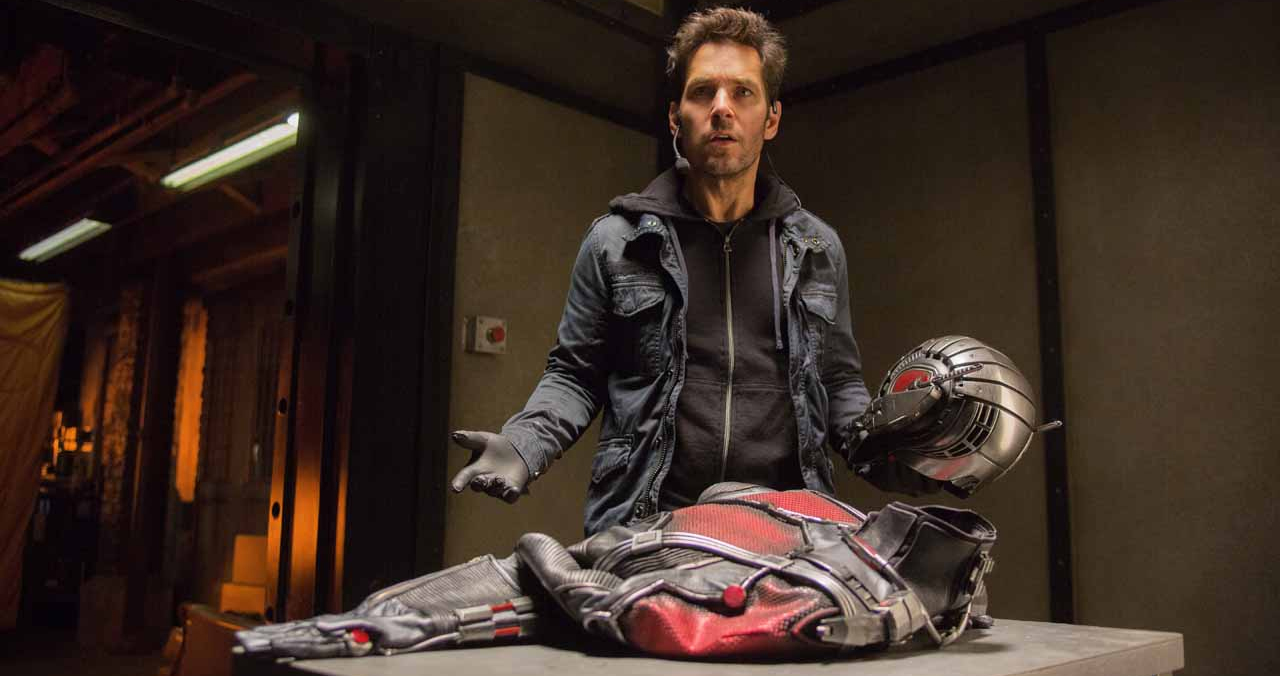
"You couldn't have called him 'Giant Man'?"

“You couldn’t have called him ‘Giant Man’?”

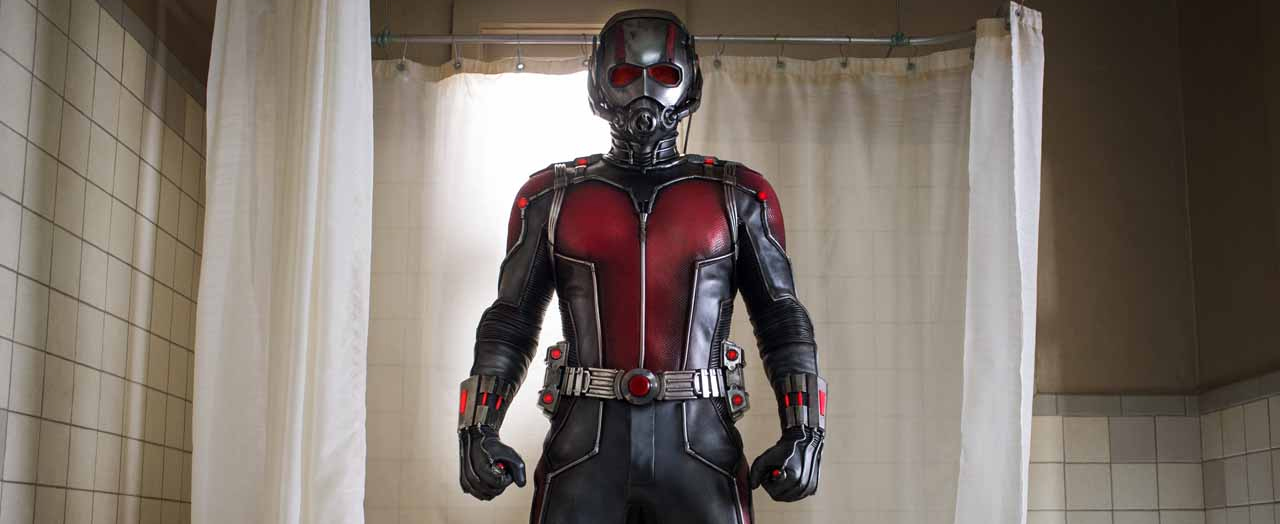
As such, director Peyton Reed does a pretty good job bringing the character to screen. Adam McKay and Paul Rudd adapted the original story written by Edgar Wright and Joe Cornish, providing a movie that sits more comfortably within the framework of the ever-expanding shared universe. Ant Man is a little clumsy in places, suffering from some of the stock weaknesses of the Marvel film franchises, but it is also clever and fun. All involved shrewdly play to the Marvel house style, offering a light run around populated by likable characters with clear-cut conflicts.

However, Ant Man‘s real strengths become obvious when the film deviates (even slightly) from the standard formula. After seven years of watching superhero films grow bigger and bigger, it’s nice to have a smaller story.

"One size fits all, eh?"

“One size fits all, eh?”

Continue reading

Millennium – Skull and Bones (Review)

This July, we’re taking a trip back in time to review the sixth season of The X-Files and the third (and final) season of Millennium.

Skull and Bones brings a lot of the problems with the third season of Millennium to the fore.

Most obviously, the third season of Millennium is making a conscious effort to return to the aesthetic and style of the first season, with an emphasis on horrific crimes and abhorrent psychologies. In interviews around the launch of the third season, Chris Carter repeatedly suggested that something had been lost in the second season. TEOTWAWKI was an issue-driven episode about school shootings and Y2K. Closure was a story about how spree killers can engage in random patterns of violence and there is no way to reliably discern a pattern of logic in truly evil behaviour.

The hole in things...

The hole in things…

At the same time, the third season is struggling to deal with the legacy and impact of the second season. The Innocents and Exegesis rather clumsily attempted to write their way out of The Fourth Horseman and The Time is Now by downplaying the impact of the end of the world at the end of the second season. However, the third cannot completely erase what happened. The absence of Catherine Black and the presence of Peter Watts are constant reminders. The Millennium Group itself cannot revert back to its first season self.

Skull and Bones plays out this conflict, creating an impression of a show trapped at a crossroads with a problem it cannot resolve. Skull and Bones is an episode that attempts to both minimise the impact of the second season of Millennium while still acknowledging and building upon it. It is not an approach that lends itself to satisfactory or fulfilling storytelling. However, it does articulate just how confused the show must be at this point in its life cycle.

There are going to be a lot of Yorrick captions this time...

There are going to be a lot of Yorrick captions this time…

Continue reading