












“How is that a screwdriver?”
“In a very broad sense.”
“Well, how is it sonic?”
“It makes a noise.”
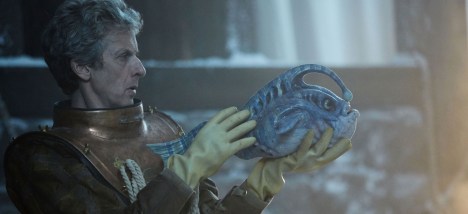
Pilot fish.
Thin Ice is a fairly solid historical adventure, one that takes a fairly conventional Doctor Who template and puts a slightly self-aware spin on it.
As with The Pilot and Smile, there is a decidedly nostalgic quality to Thin Ice. As with the two prior episodes, Thin Ice feels like a conscious throwback to the structure of the Davies era. Moffat’s final season as showrunner has opened with the classic present-future-past triptych that recalls Rose, The End of the World and The Unquiet Dead, or The Christmas Invasion, New Earth and Tooth and Claw or Smith and Jones, The Shakespeare Code and Gridlock. This is a very familiar and comforting pattern.

Hat’s off to him.
As with Smile before it, Thin Ice is built upon a stock plot. A series of mysterious disappearances lead the Doctor and his companion to one inescapable conclusion: there is a monster menacing Regency England. Thin Ice feels very much like the kind of episode that Mark Gatiss has been known to write, an affectionate historical depiction of an iconic chapter in British history like The Unquiet Dead, The Idiot’s Lantern or The Crimson Horror. Indeed, Thin Ice looks lavish, complete with all the costume drama trappings that one might expect.
However, much like Smile, there is a slight twist on the tale. Whereas Smile attempted to subvert the classic “machines gone awry” plot with a clumsy last-minute twist, Thin Ice instead makes a point to weave its commentary and theme through the familiar structure of the episode. Thin Ice might be a very conventional historical monster story, but it engages with themes of race and class that are often under-explored in these stories.
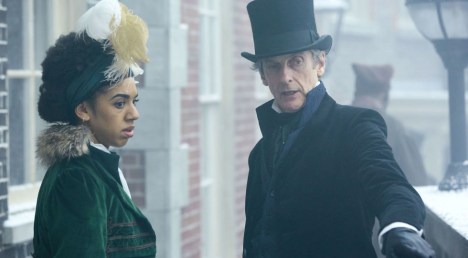
The time travelers who came in from the cold…
Filed under: Television | Tagged: capitalism, cultural marxism, doctor who, peter capaldi, sarah dollard, steven moffat, thin ice | 9 Comments »







 the m0vie blog
Star Trek – Bread and Circuses (Review)
The first Star Trek pilot, The Cage, was produced in 1964. To celebrate its fiftieth anniversary, this December we are reviewing the second season of the original Star Trek show. You can check out our first season reviews here. Check back daily for the latest review.
Bread and Circuses is not subtle. Then again, that is the point.
There’s a lot of interesting stuff happening in Bread and Circuses, the fourteenth episode produced for the second season, but the last to air. There’s the idea of a world dominated by “a twentieth century Rome”, a rogue captain, a Prime Directive dilemma and a scathing indictment of modern television. Not only is it one of the last episodes with a “produced by Gene L. Coon” credit, it is also an episode co-written by Roddenberry and Coon. It is also the episode of Star Trek that endorses Christianity most explicitly and heavily.
“Wait, we’re only getting it in black and white?”
Bread and Circuses is a bold and audacious piece of television, full of venom and righteous anger, rich in satire and cynicism. It’s a plot so ridiculously over-stuffed with good ideas that viewers are liable to forgive the show’s somewhat cop-out ending where Kirk and his away team beam back to the Enterprise and continue on their merry way as though little has actually happened. Bread and Circuses feels like it uses every minute of its fifty-minute runtime wisely, balancing character with world-building.
It is probably a little bit too messy and disjointed to be labelled a dyed-in-the-wool classic, particularly when compared to the shows produced around it. Nevertheless, it is a decidedly ambitious piece of work, and one that demonstrates what Star Trek could do when it sets its mind to something.
When in Rome…
Continue reading →
Filed under: The Original Series | Tagged: behind the scenes, cancellation, capitalism, Christ, christianity, competition, culture, faith, fans, fourth wall, game shows, Gene L. Coon, gene roddenberry, kirk, McCoy, ralph senensky, reality television, religion, romans, romulans, science fiction, Shatner, social commentary, space!romans, spock, star trek, star trek: the original series, Television, the all, the original series, tos | 6 Comments »