












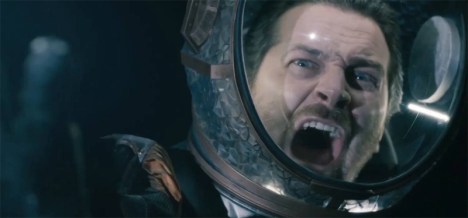
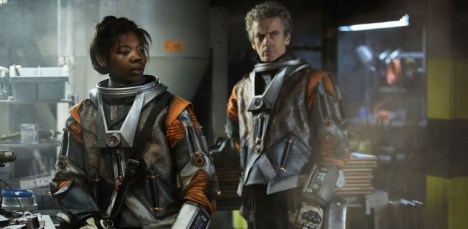
Watching Kerblam! makes for a very strange sensation.
As with the earlier stretch of the eleventh season, there is a sense that Chris Chibnall is consciously harking back to the era overseen by Russell T. Davies. This explains the opening present-future-past triptych of The Woman Who Fell to Earth, The Ghost Monument and Rosa. It also accounts for the positioning of Arachnids in the U.K. as an opportunity to spend time in the contemporary United Kingdom for the twin purposes of character development and broad political commentary.
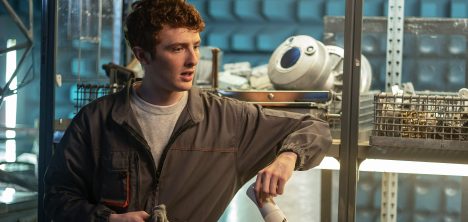
A clean record.
Kerblam! is the kind of futuristic story that Davies would frequently tell early in his own seasons, like New Earth, Gridlock or Planet of the Ood. It might also be reflected in episodes like The Long Game or Midnight. Interestingly, the episode is populated with the sort of politically-coded iconography that defined those stories, iconography that had largely been stripped out of The Ghost Monument in favour of some broad asides about how late-stage capitalism is a destructive rat race without any real depth to them.
Kerblam! is very overtly a story about hypercapitalism, with the eponymous company obviously standing in for Amazon. This is much more overtly political than any subtext that could be read into the season’s other “future” stories like The Ghost Monument or The Tsuranga Conundrum. Following on from episodes like Arachnids in the U.K. and Demons of the Punjab, it seems like Kerblam! might be positioned as bit of biting social commentary, using the broadly drawn science-fiction future in the same way as even Moffat era tales like The Beast Below, Smile or Oxygen.

Doesn’t scan.
On a purely surface level, Kerblam! looks like it might engage with the legacy of the Davies era as more than just a production aesthetic, understanding the potential to use a cartoonish and exaggerated science-fiction framework to slip in some genuinely provocative social commentary for family consumption. One of the great ironies of the Chibnall era has been the narrative that it is “too PC!”, despite the fact that it has actually been surprisingly moderate in its political ambitions. The surface level design of Kerblam! looks like a breath of fresh air in that context.
Unfortunately, the episode takes a number of very sharp swerves and veers crazily off course, featuring the surreal assumption that “the systems aren’t the problem.”
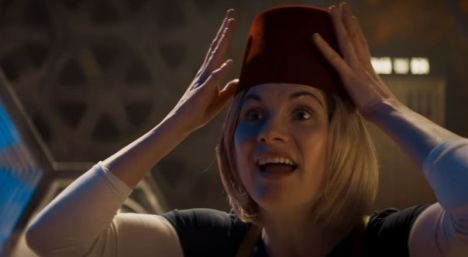
Difficulty Fezzing up to reality.
Filed under: Television | Tagged: Amazon, capitalism, doctor who, kerblam!, non-review review, pete mctighe, review | 6 Comments »









 the m0vie blog
Star Trek: Voyager – Critical Care (Review)
Critical Care is the seventh season of Star Trek: Voyager attempting to be archetypal Star Trek.
To be fair, Voyager had done this before. When Jeri Taylor took over the show during its third season, she steered it away from the disaster of the Kazon arc and towards a more conventional style of Star Trek storytelling. Many of the episodes of the later seasons could easily have been repurposed for Star Trek: The Next Generation or Star Trek: Deep Space Nine or Star Trek: Enterprise without changing much beyond the characters’ names; think of Warlord, Scientific Method, Random Thoughts, Waking Moments.
What’s up, Doc?
This isn’t inherently a bad thing. Indeed, many of the best episodes of Voyager had this broad and generic quality to them, offering something resembling an archetypal distillation of Star Trek for audiences. Remember and Memorial were both stunning explorations of cultural memory and Holocaust denial that could arguably have worked with any Star Trek cast. Blink of an Eye was a beautiful science-fiction parable that was more about Star Trek itself than Voyager. Even Nemesis could have easily worked with Riker or O’Brien or Tucker as easily as it did with Chakotay.
However, there are also points when these attempts to create “archetypal Star Trek” feels cynical and exploitative, the writing staff very cynically offering audiences something that is designed to meet as many of the vaguely defined aesthetic qualities of Star Trek, but without any substance underneath it. This happens repeatedly during the seventh season of Voyager, when it seems like the production team understand what Star Trek looks and feels like enough to offer a passable approximation, but don’t understand the underlying mechanics enough to replicate that ineffable feeling.
“Don’t worry, we’re almost home.”
Like a lot of seventh season episodes, Critical Care is couched in the trappings of Star Trek but without any substance to group it. On the surface, Critical Care is classic “social commentary” storytelling, the type of allegorical narrative exemplified by stories like Let That Be Your Last Battlefield or The High Ground. It is an episode about the horrors of contemporary healthcare, transposed to a distant alien world where Voyager can draw some very broad parallels for the audience watching at home. This is, on a very superficial level, what Star Trek is to a large number of fans.
Unfortunately, these touches do not add up to anything particularly insightful or compelling, Critical Care providing observations on contemporary American healthcare that amount to “this is pretty bad, isn’t it?” without anything resembling actual engagement. The result is a shell of an episode, a missed opportunity, and a pale imitation of the franchise’s best social commentary.
“What is up, Doc?”
Continue reading →
Filed under: Voyager | Tagged: capitalism, critical care, death panels, emh, healthcare, hmos, nostalgia, obama care, social commentary, socialism, star trek, star trek: voyager, Television, topical | 9 Comments »