• Following Us

  • Categories

  • Check out the Archives


  • Awards & Nominations

Star Trek: Enterprise – The Council (Review)

Next year, Star Trek is fifty years old. We have some special stuff planned for that, but – in the meantime – we’re reviewing all of Star Trek: Enterprise this year as something of a prequel to that anniversary. This August, we’re doing the third season. Check back daily for the latest review.

From a technical standpoint, The Council is the third last episode of the third season. From an arc-based standpoint, the third season Xindi arc is not completely resolved until the events of Home three episodes into the fourth season. However, there is an argument to be made that The Council represents the logical conclusion of the third season arc. Sure, Countdown and Zero Hour provide a suitably bombastic resolution to the year-long story, but The Council is the story that really resolves the central conflict driving the season.

After twenty-one episodes of moral ambiguity and ethical compromise, The Council exists to assure viewers that Star Trek: Enterprise has not forgotten the optimistic humanism that has guided the franchise. The Council confirms what most even-handed fans had probably deduced from The Expanse and what had been rendered explicit in The Shipment. The third season was never about getting away from the core utopian values associated with the Star Trek franchise; instead, it was about an attempt to get back to those hopeful ideals.
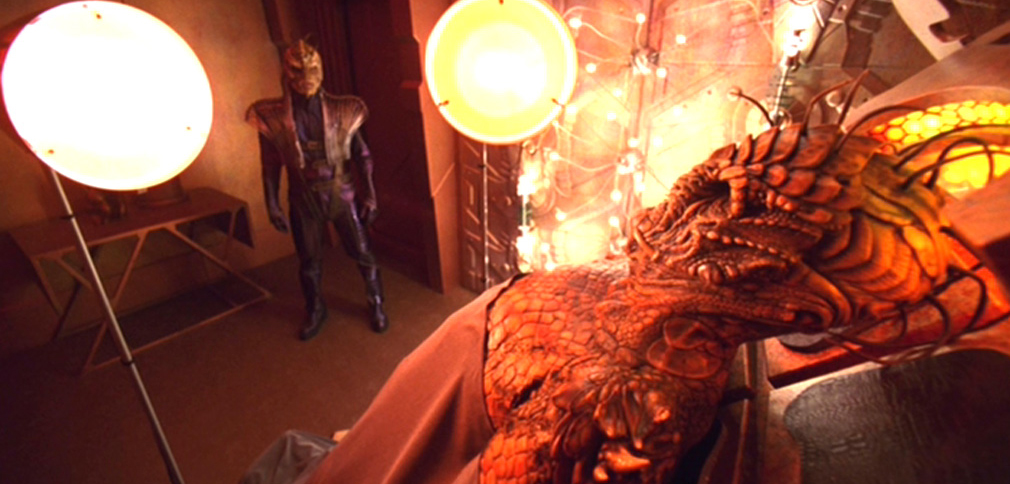
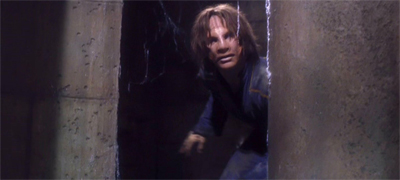
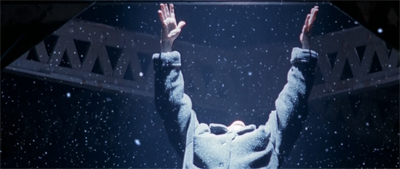
"I told you not to interrupt me when I'm working on my tan!"

“I told you not to interrupt me when I’m working on my tan!”

As the name implies, The Council is a rather talky script; it is certainly the most talky script between this point and the end of the third season. The episode’s plot finds Archer making his case to the Xindi Council, appealing for a peaceful resolution to the escalating crisis. Archer puts aside his anger and his thirst for retribution, in the hope of finding common ground that might accommodate both sides without resort to warfare or attempted genocide. Naturally, Archer is not entirely successful; the season needs an action climax. However, he is close enough.

Much like The Forgotten, it turns out that The Council is a script about moving beyond grief and hatred towards reconciliation and understanding. It affirms that the third season of Enterprise is (and was always) following a very traditional Star Trek arc.
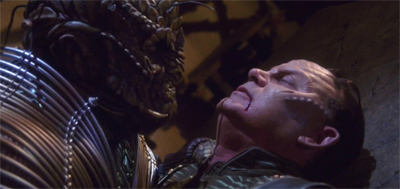
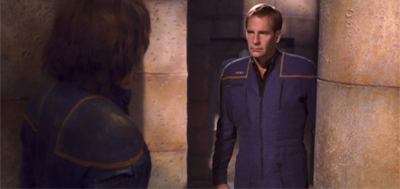
"Et tu, Dolim?"

“Et tu, Dolim?”

Continue reading

Star Trek: Enterprise – Extinction (Review)

Next year, Star Trek is fifty years old. We have some special stuff planned for that, but – in the meantime – we’re reviewing all of Star Trek: Enterprise this year as something of a prequel to that anniversary. This August, we’re doing the third season. Check back daily for the latest review.

In many respects, The Xindi and Anomaly opened the third season as if it were the first season of a new show. In particular, Anomaly built consciously and cleverly off of Fight or Flight and Strange New World in providing a solid foundation for the year ahead. The comparison works quite well. By that logic, Extinction and Rajiin serve as Unexpected and Terra Nova. They are two of the weakest episodes of the season, harmed by their close proximity to the start of the year. Anybody wanting to reach Twilight or Damage has to get through Extinction and Rajiin.

In many respects, this early lag in the third season demonstrates just how inexperienced the creative team were at long-form serialised storytelling. The only arc comparable to the Xindi arc in the entire Star Trek franchise is the Dominion War arc on Star Trek: Deep Space Nine. There, the writers were clever enough to launch the new status quo with an unheralded six-episode interconnected story. The Dominion War had its share of duds, but the opening salvo was magnificently confident.

Archer's not feeling himself lately...

Archer’s not feeling himself lately…

In contrast, the third season of Star Trek: Enterprise suffers out of the gate. The Xindi and Anomaly do good work setting up plot points and character beats that will be of use later in the season, but there is no real sense that the writing staff has any idea what that use might be at this point of the season. Two episodes into the third season, the show is already back to fairly formulaic adventures that stand quite cleanly alone. It is not too difficult to imagine Extinction or Rajiin as episodes in any other season – albeit with some slight tinkering.

However, this is only part of the problem. Long-form storytelling need not become a burden. There is a great deal of value to be had in drifting away from a serialised story arc to tell a quality standalone tale. Unfortunately, Extinction is not a quality standalone tale. In fact, it is one of the worst episodes of Enterprise ever produced. Airing it as the third episode of a bold new season feels like a poor choice.

"C'mon, wouldn't you like to go back to being a torturing and almost genocidal human?"

“C’mon, wouldn’t you like to go back to being a torturing and almost genocidal human?”

Continue reading

The X-Files – Biogenesis (Review)

This July, we’re taking a trip back in time to review the sixth season of The X-Files and the third (and final) season of Millennium.

‘When Alexan­der saw the breadth of his domain, he wept for there were no more worlds to con­quer.’ Ben­e­fits of a clas­si­cal education.

– Hans Gruber, Die Hard

In hindsight, “ending” the mythology with a two-parter in the middle of the season was always a risky proposition.

Airing Two Fathers and One Son during February Sweeps was a logical decision. Ending the mythology that had been running through the show for five-and-a-half seasons was certain to grab the attention of casual viewers, reeling them in to boast up ratings. The X-Files had always aired mythology two-parters during Sweeps, putting them forward as examples of the best that the series could do and cementing the show’s claim to be “blockbuster television.” Choosing to wrap up the mythology during February Sweeps was just an extension of that approach.

Look what just washed up...

Look what just washed up…

And it worked. Two Fathers earned the second highest Nielsen score of the sixth season, landing just behind The Rain King. Two Fathers was the last time that The X-Files would rate so highly. As such, the decision to “close off” the mythology in the middle of the season was a very shrewd decision. However, it did raise questions about what the show would do at the very end of season. After all, The X-Files liked to bookend its seasons with mythology episodes, counting on a mythology cliffhanger to carry viewers across the long gap between seasons.

How do you tell a mythology story when you’ve just worked so hard to tidy it all away?

Behind the curtain...

Behind the curtain…

Continue reading

The X-Files – Dreamland I (Review)

This July, we’re taking a trip back in time to review the sixth season of The X-Files and the third (and final) season of Millennium.

It occasionally seems like the sixth season of The X-Files is having something approaching a midlife crisis.

It has gone through a fairly massive change in routine and lifestyle; the show recently pulled up sticks and moved to Los Angeles. It has gotten a lot more ostentatious; it looks to be spending a lot more money than it was before, and it is hanging around with a whole new caliber of guest star. It has reinvented itself completely; no longer the brooding and atmospheric show it once was, it is now downright goofy and silly. Old acquaintances would be forgiven if they had trouble recognising the show. And it’s perfectly understandable.

Back to back...

Back to back…

This is the sixth season. Dreamland I is the one-hundred-and-twenty-first episode of The X-Files. The show is well past what Chris Carter had originally planned, and well past just about any measure of success. Most shows are lucky to reach a sixth season, let alone come into the sixth season off the back of a summer film and with a great deal of security about the future. David Duchovny, Gillian Anderson and Chris Carter were all committed through to the end of the seventh season. There was even talk of a sequel to The X-Files: Fight the Future being released in 2000.

Dreamland I and Dreamland II just externalise that midlife crisis, using the classic “freaky friday” body swap set up putting Fox Mulder in a dead-end job with a family that hates him as Morris Fletcher tries to help the FBI agent grow up just a little bit.

"Yep. It's a little... out there."

“Yep. It’s a little… out there.”

Continue reading

The X-Files: Season One (Topps) #6 – Space (Review)

This May and June, we’re taking a trip back in time to review the fifth season of The X-Files and the second season of Millennium.

If the jump to Ice suggested that the Season One line would only be covering the “highlights” of the first season of The X-Files, then the decision to immediately follow with an adaptation of Space puts paid to that theory.

Ice is generally regarded as one of the strongest stories of the first season. It is moody and atmospheric, tense and claustrophobic. It shines a light on the characterisation of Mulder and Scully, while also offering a particularly memorable (and unsettling) monster of the week. In contrast, Space is generally regarded as one of the weakest stories of the first season. It is clumsy and muddled, slow and dreary. The episode’s direction is bland and the special effects are woeful. On paper, it is probably the least likely choice for a Season One adaptation.

Face the future...

Face the future…

However, Space ultimately lends itself to a comic book adaptation. The story finds itself well-suited by the transition from live action footage to comic book page. there are a number of different reasons for this, but the truth is that the story is simply better suited to this format. That applies to the technical limitations imposed on film, but also to the storytelling conventions associated with comic books as opposed to live action television. It is a startling result, and arguably the biggest success of the entire Season One line.

Although it is a qualified accomplishment at best, Space is the first Season One comic that manages to surpass its source material.

Is there life on Mars?

Is there life on Mars?

Continue reading

The X-Files – The Red and the Black (Review)

This May and June, we’re taking a trip back in time to review the fifth season of The X-Files and the second season of Millennium.

“Before the exploration of space, of the moon and the planets, man hailed that the heavens were the home and province of powerful gods who controlled not just the vast firmament, but the earthly fate of man himself and that the pantheon of powerful, warring deities, was the cause and reason for the human condition, for the past and the future, and for which great monuments would be created on earth as in heaven. But in time man replaced these gods with new gods and new religions that provided no more certain or greater answers than those worshipped by his Greek or Roman or Egyptian ancestors. And while we’ve chosen now our monolithic and benevolent gods and found our certainties in science, believers all, we wait for a sign, a revelation. Our eyes turn skyward ready to accept the truly incredible to find our destiny written in the stars.”

Lift me up...

Lift me up…

Continue reading

The X-Files – Patient X (Review)

This May and June, we’re taking a trip back in time to review the fifth season of The X-Files and the second season of Millennium.

This should not work.

There are lots of reasons why Patient X and The Red and the Black should simply implode under their own weight. Most obviously, they are scripts that are rather blatantly just piling more and more back story and convolution onto a framework that is already overloaded and over-stretched. They are introducing new characters at a late stage of the game. They rely on contrivance and sketchy character development. They seem to exist at odds with the script for The X-Files: Fight the Future, which had been written and shot, but was awaiting release.

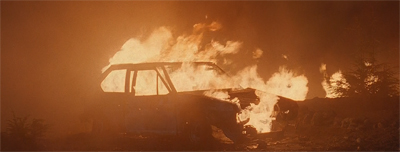
Everything burns...

Everything burns…

However, despite all this, Patient X and The Red and the Black work very well together. They are the strongest story-driven mythology two-parter since Nisei and 731 at the start of the third season. There is an energy and drive to Patient X and The Red and the Black that has been largely absent from the show’s big blockbuster two-parters since Herrenvolk at the start of the fourth season. After a year-and-a-half treading water as the release date of the movie draws ever closer, it is nice to see Chris Carter cut completely loose.

Patient X and The Red and the Black form a story which doesn’t seem at all worried about what any of this means for the summer realise of Fight the Future. Parts of it become quite difficult to reconcile with the film as released. However, the two-parter is all the stronger for it.

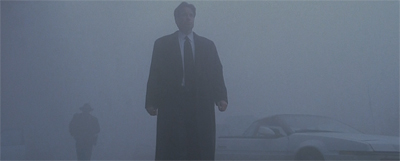
Fog of war...

Fog of war…

Continue reading

Star Trek: Enterprise – The Catwalk (Review)

Next year, Star Trek is fifty years old. We have some special stuff planned for that, but – in the meantime – we’re reviewing all of Star Trek: Enterprise this year as something of a prequel to that anniversary. This April, we’re doing the second season. Check back daily for the latest review.

The Catwalk is a solid, if unexceptional, piece of Star Trek.

Given the problems that the second season of Star Trek: Enterprise has been having to date, it feels like a breath of fresh air. As with a lot of the episodes around it, The Catwalk feels a little familiar. There are refugees with a secret; an alien take-over of the ship; a clever bluff to reclaim the ship from a position of weakness. If we are looking at The Catwalk in the “… by way of …” formula that seems to apply to most of this stretch of the second season, The Catwalk is “Starship Mine by way of Basics.”

"Right, right! Goddammit, Trip, now we'll never get the high score!"

“Right, right! Goddammit, Trip, now we’ll never get the high score!”

However, The Catwalk feels a lot more functional than many of the earlier episodes in the season. A large part of that is down to the way that writers Mike Sussman and Phylis Strong play to their strengths. The inevitable alien hijacking and threat is relegated to the background; The Catwalk is almost half over by the time that anything actually happens. While the episode’s pacing is a little uneven, it does allow Sussman and Strong a bit of room to explore the characters, building up the sense that the crew is something of a family unit.

While The Catwalk isn’t innovative or particularly adventurous, it works quite well. The idea of pushing the whole crew into a confined space and having them weather the storm together feels like it captures a lot of the pioneering sense of adventure that the show has allowed to fade over the second season.

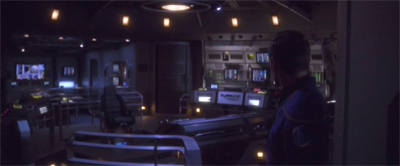
Don't forget to turn out the light...

Don’t forget to turn out the light…

Continue reading

The X-Files – Tempus Fugit (Review)

This February and March, we’re taking a trip back in time to review the fourth season of The X-Files and the first season of Millennium.

Conspiracy lives in the gaps.

Conspiracy theories grow in the gaps of history. They multiple and divide in the absences on the historical record. They entangle and dissemble in the lacunas of memory. In many ways, conspiracy theories represent an attempt to impose order upon a chaotic universe, to know the unknowable. They grow from doubts and questions, holes and voids. Every ellipsis, every redacted line points towards infinite possibilities. Every “no comment” is but conformation of the worst possible outcome.

The truth is up there...

The truth is up there…

Tempus Fugit opens with a nine-minute gap before a plane crash that claims over one hundred lives. Max closes with another nine-minute gap that sees the ever-elusive proof slip through Mulder’s fingers once again. However, Tempus Fugit and Max are not truly “conspiracy” episodes. Characters like the Cigarette-Smoking Man, the Well-Manicured Man, Alex Krycek and Marita Covarrubias are all absent. Even the sinister functions of shadowy government officials are outsourced to “Cummins Aerospace”, a government contractor never mentioned on the show before or since.

Instead, Tempus Fugit and Max are focused on the little people trying to assemble what they can from these gaps. Mike Millar is an honest and hard-working member of the National Transportation and Safety Board trying to piece together a crashed aeroplane. Max Fenig is trying to piece together some meaning for all his suffering. Mulder and Scully are trying to piece together the truth. Even the aliens themselves seem to be searching. Tempus Fugit and Max are populated with characters trying desperately to make sense of the gaps.

Fly by night...

Fly by night…

Continue reading

The X-Files (Topps) #17 – Thin Air (Review)

This February and March, we’re taking a trip back in time to review the fourth season of The X-Files and the first season of Millennium.

By all accounts, this was the kind of creative team that Ten Thirteen Productions probably wanted on Topps’ X-Files comic since the start.

Stefan Petrucha and Charles Adlard had done a phenomenal amount of work on The X-Files comic line. They had written sixteen issues of the monthly series, an annual, two digests and a slew of short stories scattered across various forums. However, it was quite clear that their approach to the comic was not quite what Ten Thirteen had hoped for when they licensed the comic to Topps. Petrucha’s scripts were ambitious, bold and playful; they were occasionally downright cheeky. Adlard was a master of mood and expression; he was less suited to likeness.

Here come the men in black...

Here come the men in black…

This had caused no small amount of friction between the production company and the creative team. By all accounts, the working relationship between Petrucha and the production company was quite strained. Eventually they fired him from the comic, making Home of the Brave the last story written by Stefan Petrucha and Charles Adlard on Topps’ The X-Files comics. Given the two had been with the comic from the start, this was quite a radical change.

However, this did allow Topps to put a team more agreeable to Ten Thirteen’s demands on the comic.

"I call it blue steal..."

“I call it blue steal…”

Continue reading