• Following Us

  • Categories

  • Check out the Archives


  • Awards & Nominations

Doctor Who: The Beast Below (Review)

To celebrate the fiftieth anniversary of the longest-running science-fiction show in the world, I’ll be taking weekly looks at some of my own personal favourite stories and arcs, from the old and new series, with a view to encapsulating the sublime, the clever and the fiendishly odd of the BBC’s Doctor Who.

The Beast Below originally aired in 2010.

What are you going to do?

What I always do. Stay out of trouble. Badly.

So is this how it works, Doctor? You never interfere in the affairs of other peoples or planets, unless there’s children crying?

Yes.

– Amy and the Doctor reiterate the way things work

Steven Moffat’s first season producing Doctor Who owes a conscious debt to the rigid structure of the seasons produced by Russell T. Davies. There’s an opening episode in contemporary Britain, followed by one episode visiting the past, one visiting the future. There are three two-parters – the season finalé, a “monster”-driven two-parter and a more atmospheric and moody piece. There’s even a brief spell in the middle of the season where Moffat spices up the TARDIS dynamic by adding in a temporary companion.

This approach worked quite well. It’s worth noting that Moffat’s first season was the only point following the departure of Russell T. Davies that Doctor Who was able to deliver thirteen episodes of the show on thirteen consecutive weeks. It struck something of a happy middle between Davies’ more episodic approach to the show that the more arc-driven storytelling favoured by Moffat. Still, there are moments when it seems like this approach isn’t quite the perfect fit, with Moffat’s voice struggling to fit into the structure established by Davies.

Essentially Steven Moffat’s impression of Russell T. Davies’ update of Andrew Cartmel’s social allegory stories, The Beast Below is an interesting – if slightly unsuccessful – experiment. Moffat’s second season would feature much more effective attempts to evoke the Cartmel era of the classic show, without the sense that Moffat was trying a little too hard to emulate his predecessor.

The space in-between...

The space in-between…

Continue reading

Agents of S.H.I.E.L.D. – The Well (Review)

So this is what a tie-in to Thor: The Dark World looks like. This is the episode of Agents of S.H.I.E.L.D. broadcast specifically to tie into the major motion picture blockbuster. In essence, this is as close as Agents of S.H.I.E.L.D. will ever get to integrating with the shared Marvel universe. Given the fact that the show’s official title includes the prefix “Marvel’s”, that cross-media synchronicity is a large part of Agents of S.H.I.E.L.D.‘s branding.

The result is… disappointing, to say the least. It’s just a generic “strange phenomena of the week” episode with even more crossed wires than usual, a tiresome bit of back story for a bland character played by a mediocre actor and an unwillingness to take advantage of any of the benefits of being a television show tied into a blockbuster franchise while remaining firmly anchored to the weaknesses associated with the medium.

Hot rod...

Hot rod…

Continue reading

Doctor Who: The Happiness Patrol (Review)

To celebrate the fiftieth anniversary of the longest-running science-fiction show in the world, I’ll be taking weekly looks at some of my own personal favourite stories and arcs, from the old and new series, with a view to encapsulating the sublime, the clever and the fiendishly odd of the BBC’s Doctor Who.

The Happiness Patrol originally aired in 1988.

Think I’ll hang out here for a while, Doc. See if I can teach this planet the blues again.

Yes, thank you for giving them back to us, Doctor.

– Earl and Susan shouldn’t be so surprised that the Doctor is fond of blue

The Happiness Patrol is an absolutely fascinating piece of Doctor Who. On the surface, it’s another example of the series’ rapidly falling budget and the production values point towards the show’s impending cancellation. While nowhere near as dodgy as Warriors of the Deep, The Happiness Patrol looks like a very cheap piece of television, struggling to realise a futuristic colony on a tiny budget. On a purely superficial level, The Happiness Patrol is really the kind of show that Michael Grade could point to and argue that Doctor Who was a show that desperately needed to be put out of its misery.

However, if the viewer is willing to pull back the layers a bit, and to peer beneath the somewhat rough trappings of The Happiness Patrol, the adventure is really everything that eighties Doctor Who could ever want to be. There is a reason that the serial has, somewhat improbably, endured. In 2010, The Happiness Patrol became headline news in Great Britain, with national newspapers astounded by the audacity of Andrew Cartmel’s vision for the show. The following year, the Archbishop of Canterbury casually name-dropped it in an Easter Sermon.

These references aren’t derogatory. These are proof that The Happiness Patrol, despite its dodgy special effects and the limitations of its production design, is one of the most important Doctor Who adventures of the eighties.

He's perfectly sweet!

He’s perfectly sweet!

Continue reading

Doctor Who: Gridlock (Review)

To celebrate the fiftieth anniversary of the longest-running science-fiction show in the world, I’ll be taking weekly looks at some of my own personal favourite stories and arcs, from the old and new series, with a view to encapsulating the sublime, the clever and the fiendishly odd of the BBC’s Doctor Who.

Gridlock originally aired in 2007.

The sky’s a burnt orange, with the Citadel enclosed in a mighty glass dome, shining under the twin suns. Beyond that, the mountains go on forever. Slopes of deep red grass, capped with snow.

– the Doctor takes us to Gallifrey, for the first time in ages

Gridlock is the final (and best) of Davies’ “New Earth” trilogy, encompassing The End of the World and New Earth. The decision to focus the opening futuristic stories of the first three seasons around the same strand of “future history” is a very clever move, and perhaps an indication of how acutely aware Davies is of the way the modern television differs from television when the classic show aired. In short, it creates a pleasing sense of continuity between episodes that are very disconnected from the show’s main continuity.

This is far from the Powell Estate as you can get, and yet – three years in – it also feels strangely familiar.

The skyline's the limit...

The skyline’s the limit…

Continue reading

Non-Review Review: Mandela – Long Walk to Freedom

Mandela: Long Walk to Freedom is very clearly a sentimental life-affirming true story, very clearly pitching itself as an upbeat and hopeful account of one of the most iconic statesmen of our time. A collection of all the “greatest hits” of Mandela’s struggle against oppression and hatred, Mandela is an efficiently calculated piece of cinema. It’s a grand sweeping historical epic that never really pulls back the layers of the character it examines, instead opting (mostly) to film the legend.

And it works. After all, what other world leader in the past half-century can lay claim to such an inspirational narrative? Nelson Mandela’s journey lends itself to this sort of optimistic and inspirational adaptation, and the subject is a comfortable fit for this sort of sweeping life-affirming whirl-wind exploration of Mandela’s personal history.

Courting public opinion...

Courting public opinion…

Continue reading

Doctor Who: The Sun Makers (Review)

To celebrate the fiftieth anniversary of the longest-running science-fiction show in the world, I’ll be taking weekly looks at some of my own personal favourite stories and arcs, from the old and new series, with a view to encapsulating the sublime, the clever and the fiendishly odd of the BBC’s Doctor Who.

The Sun Makers originally aired in 1977.

Why did you come here, then?

Because my new little chum here seemed unhappy about something.

Mandrell discovers all he needs to know about the Doctor

The Sun Makers was reportedly written as a result of a disagreement between writer Robert Holmes and the British Revenue and Customs. That’s the oft-cited background to the story, so well known that it’s even included on the notes included in the DVD release. With that summary, you’d expect The Sun Makers to be a condemnation of the tax system, and a protest at the government’s funnelling off of money from the individual to pay like pesky things like roads or schools or hospitals.

Instead, Holmes has crafted The Sun Makers as something altogether more compelling and instructive. Rather pointedly, while The Sun Maker is a story about excessive taxation, the episode casts a large interstellar corporation as the villain of the piece. The episode’s primary antagonist isn’t a state official, it’s a single-minded number-crunching accountant who operates a large corporation that has managed to turn light itself into a financial commodity. This isn’t the story about individuals fighting for the right not to pay tax, it’s people fighting for decent working and living conditions.

Indeed, it’s quite easy to read The Sun Makers as a rather socialist piece of Doctor Who, ending with the massive organisation of the working class to resist their greedy capitalist overlords. That’s quite a radical shift from the story you’d expect given the background. In that respect, it seems almost like a call-forward to the pointed subversive social commentary of the Cartmel and even Davies eras.

I see the future...

I see the future…

Continue reading

Jameson Cult Film Club: Predator

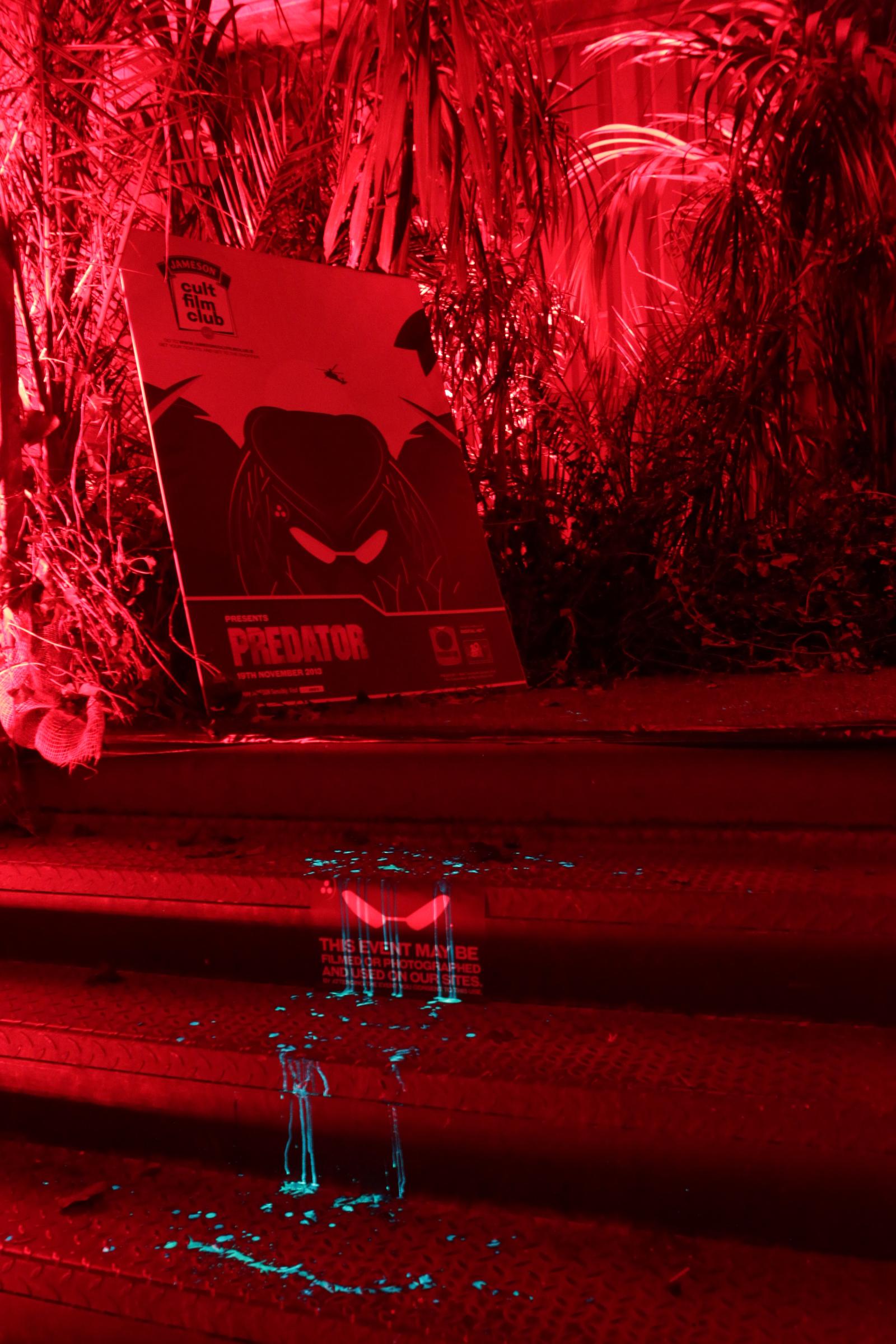
I had the privilege of attending last Tuesday evening’s Jameson Cult Film Club screening of Predator. It’s easy to take for granted the care a preparation that goes into these nights celebrating popular classic films, but the crew pulled out all of the usual stops for the evening, turning their city centre into something of a jungle. From improvised death traps (within health and safety regulations, of course) through to advice on movie etiquette translated from… whatever that noise is that Predator’s make, the evening was a fitting tribute to an eighties cult classic.

Again, the production team walked the line, balancing the need for spectacle carefully against the integrity of the film. Predator is a loud film by its nature, and the special effects on the location were well-chosen to turn the volumes up to eleven. The pyrotechnics display during the movie’s climax was just astounding, as were brief interludes of the Predator itself preparing for battle or cleaning up after one.

The guys at Jameson Cult Film have sent over some snapshots of the night. Check them out below and click to enlarge. In the meantime, feel free to register at their website for free tickets to their next event, which I am already looking forward to.

EK4G0958 Continue reading

Non-Review Review: 12 Years a Slave

12 Years a Slave is a harrowing and moving piece of cinema. The most profound and cutting of the recent studio films to explore slavery in America, Steve McQueen’s 12 Years a Slave is almost relentless in its probing explorations of the systems an structures that allowed and reinforced that slavery – it’s hard to watch at points, providing a deeply unsettling glimpse at the suffering that man is capable of inflicting upon his fellow man.

12yearsaslave9

Continue reading

Doctor Who: The Long Game (Review)

To celebrate the fiftieth anniversary of the longest-running science-fiction show in the world, I’ll be taking weekly looks at some of my own personal favourite stories and arcs, from the old and new series, with a view to encapsulating the sublime, the clever and the fiendishly odd of the BBC’s Doctor Who.

The Long Game originally aired in 2005.

No, no, you stick with the Doctor. You’d rather be with him. It’s going to take a better man than me to get between you two.

– Adam outlines another reason he had to get kicked out of the TARDIS

The Long Game is a breathtakingly ambitious piece of Doctor Who, for a variety of reasons. The most obvious is the fact that it’s basically Russell T. Davies pushing through a story idea that Andrew Cartmel rejected when he pitched it to the classic show in the eighties, but there are a whole bunch of other reasons. The Long Game is trying to do so many things at once that it ends up getting a little lost. However, it does serve as an example of what Davies was really trying to do with this first season of the revived Doctor Who.

On the surface, The Long Game a clever and daring piece of science-fiction television, a piece of social commentary hidden behind funny-looking aliens and scenery-chewing villains. It’s really a spiritual successor to the science-fiction stories of the Cartmel era. However, it’s also something else entirely. It’s a conscious embrace of the new realities of television, an acknowledgement that these trappings have be blended with character-based storytelling and more modern tea-time telly conventions.

After all, for a show about the manipulation of the media to corrupt the public consciousness, the teaser doesn’t end on a monster reveal or a shocking twist, but a pithy personal comment. “He’s your boyfriend.”

Body of work...

Body of work…

Continue reading

Doctor Who: The Day of the Doctor (Review)

Waste no more time arguing about what a good man should be. Be one.

– Clara sums up the Moffat era in a nutshell

The Day of the Doctor was a suitable anniversary celebration for Doctor Who, feeling like Moffat had borrowed more from The Three Doctors than The Five Doctors in piecing it together, allowing for multi-Doctor interaction grafted over a fairly generic Pertwee-era alien invasion tale. (“Not now!” the Eleventh Doctor protests as the multi-Doctor tale intrudes on his paintings mystery. “I’m busy!”) In terms of scale and spectacle, The Day of the Doctor falls a little bit short. While it looks lavish and clearly had more than a little bit of money thrown at it, the episode lacks a strong central narrative thread.

Instead, it serves as a meditation on who the Doctor is and what that means in the grand scheme of things – looking at the tapestry of his life and character, and trying to reconcile everything that the show was and ever could be. It’s the story of the War Doctor in the Time War, of the death of the classic show and the birth of the new, suggesting that the rift left by the cancellation can finally be healed, that the bridge can be crossed and that wounds might finally be closed.

Well, most of them, anyway.

doctorwho-thedayofthedoctor11

The Three Doctors…

Continue reading