• Following Us

  • Categories

  • Check out the Archives


  • Awards & Nominations

The Defenders – Mean Right Hook (Review)

The shared universe is a feature of comic book storytelling that has gradually crept into the mainstream.

In some ways, it is a logical escalation of the concept of sequels, a way of expanding storytelling opportunities in a way that beacons in fans of existing properties. The shared universe is a prime example of modern pop culture’s investment in intellectual property ahead of personality, where the familiar concept behind a film or television series is often as attractive as any star headlining. The Marvel Cinematic Universe is perhaps the most successful example, spanning movies, novels and television shows all (in theory) set within the same fictional world.
It’s a big universe out there.

The shared universe has become the default mode for big-budget storytelling in the twenty-first century, a structure towards which studios aspire. The most obvious examples are the shared comic book universes from Disney and Warner Brothers, with another coming from Sony in the near future. However, there are countless other examples. Disney has begun constructing standalone stories within its Star Wars universe. James Wan has built up an unlikely blockbuster horror shared universe.

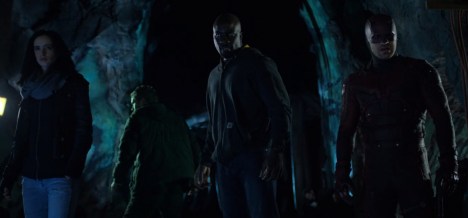
The Defenders is an interesting beast, the culmination of a shared subuniverse. It brings together the primary characters from Daredevil, Jessica Jones, Luke Cage and Iron Fist in their own weird little corner of the shared Marvel cinematic universe.
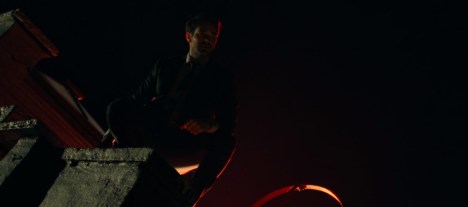
Devil in the details.

Continue reading

Marvel and Netflix’s The Defenders (Review)

The Defenders stumbles in familiar ways.

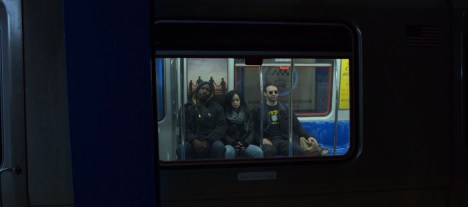
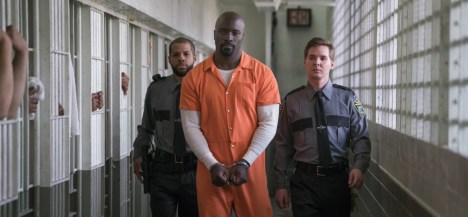
The series is nominally a crossover between the four Marvel Netflix series, a small-screen version of The Avengers providing a point of intersection between Daredevil, Jessica Jones, Luke Cage and Iron Fist. In theory, this is the perfect opportunity to bring together four television superheroes to face a larger threat. There is something inherently cool in the idea of a crossover, in watching worlds collide and watching protagonists folded into a larger ensemble.

However, things are not so simple. The Defenders prejudices some of its constituent elements more than others. Most notable, it is overseen by Marco Ramirez and Doug Petrie, the producers on the second season of Daredevil. It also carries over several elements from that season, including the hole in the ground from Semper Fidelis and the death and resurrection of Elektra from A Cold Day in Hell’s Kitchen. More than that, The Defenders carries over the mythology of the Hand and the Iron Fist from Iron Fist, putting heavy focus on Danny Rand.

From the outset, The Defenders effectively handicaps itself by leaning on the two weakest pillars of this multimedia empire. The second season of Daredevil was a disjointed mess packed with poor writing and stuffed with generic ninjas. The first season of Iron Fist was a collection of Orientalist stereotypes crammed into a cheap and poorly constructed origin story fashioned from whatever meat that Daredevil had left on the bones of the template that Christopher Nolan had established in Batman Begins. These are not foundations for an epic.

More than that, this emphasis on the second season of Daredevil and the first season of Iron Fist comes at the expense of the three strong seasons of Marvel’s Netflix output. The Defenders never captures the emotional power of Jessica Jones, nor the street-level perspective of life in New York conveyed through Luke Cage. Even more basically, The Defenders never even tries to create the same sense of pulpy thrill that defined so much of the first season of Daredevil. Instead, The Defenders focuses on ninjas and mystical nonsense.

The central plot of The Defenders hinges on the revelation that the island of Manhattan has been built on a volatile foundation. The Defenders could just as easily be speaking about itself.

Continue reading

The Defenders – The H Word (Review)

It’s a hell of a town.

One of the most striking aspects of The Defenders is its emphasis on New York City. Of course, the Marvel Universe has always been centred on the Big Apple. Decades before Fantastic Four #1 laid the foundation stone for that elaborate shared continuity, Marvel Comics #1 established New York City as a hub for characters like Namor, the Angel and the Human Torch. The city has a long and rich shared history with the comic book publisher, allowing visitors to take tours of iconic comic book locations and even lighting the Empire State Building in the colours of The Amazing Spider-Man.

Matt’s got the devil off his back.

Of course, this long-standing association between New York and the Marvel universe has inevitably bled over into the Marvel Cinematic Universe. Most obviously, The Avengers places its iconic long pan around the eponymous heroes right in front of Grand Central Station. Spider-Man: Homecoming features its hero swinging through Queens and the suburbs. However, most of these scenes are shot on location outside New York; Atlanta and Toronto frequently double for New York.

In contrast, the Netflix Marvel series have all shot in and around New York. Daredevil, Jessica Jones, Luke Cage and Iron Fist all went to the bother of filming Manhattan, rather than trying to recreate the city using another location. In many ways, it feels like these series unfold in a more authentic and grounded version of New York than the corresponding feature films, right down to the fact that their skylines all feature the real-life MetLife Building instead of the fictional “Avengers Tower.”

Trish Talk.

The Netflix shows did not always engage with a particular vision of New York. Iron Fist was so confused about its own identity that it never engaged with the city around it. Jessica Jones never invested in Jessica’s surroundings, but it still found time to include the city itself in the title character’s goodbye tour in AKA Top Shelf Perverts. However, both Daredevil and Luke Cage were very firmly rooted in their own versions of the Big Apple. Daredevil imagined a pre-gentrification eighties urban hellscape, while Luke Cage celebrated the history and culture of Harlem.

Given that The Defenders is being overseen by showrunners Marco Ramirez and Doug Petrie, it makes sense that the series would have a very strong sense of place. Ramirez and Petrie were previously in charge of the second season of Daredevil, which imagined a version of New York that seemed trapped in the urban decay of the late seventies and early eighties, Bang even evoking the Summer of Sam in its introduction of the Punisher while the ninjas that populate the second half of the film look to have escaped a particularly dodgy seventies exploitation film.

Cage re-match.

However, The Defenders is not particularly interested in one individual version of New York. It is not a show that is firmly rooted in one single idea of the Big Apple, not a story that unfolds against the backdrop of one individual conception of the urban space. Instead, The Defenders is particularly interested in the capacity for these various iterations of New York to overlap with one another. The opening credits offer a visual expression of this approach, suggesting the series serves as a point of intersection.

The Defenders is a series built around the infinite potential of New York, this idea of the city as a space in which narratives collide and coalesce, where separate stories might come together and where people on their own journeys might find common cause with one another. The Defenders seems to accept that nightmarish cityscape of Daredevil is hard to reconcile with the uncaring urban environment of Jessica Jones or the vibrant community of Luke Cage. However, The Defenders also insists that they are are all facets of the same city.

Oh, and Danny is there too.

Continue reading

Star Trek: Voyager – Dark Frontier, Part I (Review)

The fifth season of Star Trek: Voyager arrives at a point when the Rick Berman era of the Star Trek franchise has hit its midlife crisis.

Star Trek: Deep Space Nine is coming to an end, bring down the curtain on a seven-year period where there were always two franchise series boldly going simultaneously. Star Trek: Insurrection had been released into cinemas as a snapshot of that midlife crisis, where Michael Piller’s last script for the franchise found the cast of Star Trek: The Next Generation desperately chasing their own youth and vitality on a planet with a fountain of youth.

Seven gets back in touch with her roots.

On the fifth season of Voyager, it seemed like the show turned inwards. The scripts for the fifth season are surprisingly retro and nostalgic in tone; Janeway’s reflections on the events of Caretaker in Night, the return of the Maquis and the Cardassians in Nothing Human, the indulgence of retro thirties sci-fi in Bride of Chaotica!, Tuvok’s childhood flashbacks in Gravity, the “telepathic pitcher plant” in Bliss, Seven’s trip back to the launch of Voyager in Relativity, Janeway’s investigation of her ancestor in 11:59.

However, there was a fundamental problem with all of this introspection. Voyager was a television series that had long struggled to define a unique identity, too often feeling like a half-hearted reheat of the leftovers from The Next Generation. It was very hard to turn the focus inwards when there wasn’t a lot unique or distinctive about Voyager. This is a show that was much closer to its end than to its beginning, and it still lacked any true sense of identity or self.

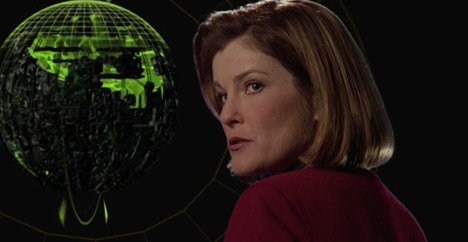
There’s coffee… I mean transwarp coils in that there Borg Sphere.

Dark Frontier, Part I and Dark Frontier, Part II serve as an example of this nostalgic indulgence, both in form and plot. It is a two-parter consciously designed to recapture the success of broadcasting The Killing Game, Part I and The Killing Game, Part II on the same night in the late fourth season. It is also a television movie that is very clearly patterned off the story for Star Trek: First Contact, borrowing key story beats and clear characters from that memorable Next Generation film.

However, Dark Frontier, Part I and Dark Frontier, Part II also demonstrate the shallowness of Voyager‘s own internal memory. This is a story built around an act of narrative archeology within the larger Star Trek universe, touching on the secret history of humanity’s true first encounter of the Borg. However, that history is ultimately illusory, built around what feels like a misremembrance of one of the franchise’s most iconic alien species. As Voyager turns its gaze backwards, it discovers that it has no real history.

Drone warfare.

Continue reading

Star Trek: Deep Space Nine – Chimera (Review)

Chimera is a welcome return to form for the seventh season of Star Trek: Deep Space Nine, following an underwhelming run of episodes from Prodigal Daughter through The Emperor’s New Cloak and into Field of Fire.

It is another example of how storytelling real estate in the seventh season is at a premium, the production team understanding that their remaining time is finite and that there are a number of key plot and character beats that the show needs to hit before it can begin the massive final arc that will run from Penumbra through to What You Leave Behind. As such, Chimera has a very clear purpose in the overall arc of the seventh season. As with Treachery, Faith and the Great River, this is an episode designed to clarify that Odo cannot remain on Deep Space Nine forever.

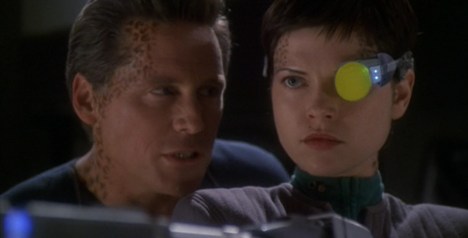
Their Laas.

However, Chimera is more than just the writing staff moving pieces across a chessboard. It is in many ways an exploration of one of the fundamental (and often unspoken) tensions within the larger Star Trek universe. As with a lot of Deep Space Nine, there is a sense that Chimera is consciously exploring and interrogating some of the underlying assumptions of Gene Roddenberry’s massive universe. In particular, Chimera is an episode that wonders whether mankind can ever be truly comfortable with the alien, and whether there is a difference between assimilation and multiculturalism.

The result is a powerful and provocative piece of science-fiction, a story that has aged as well as the show around it. Chimera is a story about what it means to be different, and what it means to part of a society. It is a cautionary tale about the unspoken conditions that are often attached to membership of a community, and of the conflict between blending in and standing out.

Changelings. Together. Strong.

Continue reading

40. The Emoji Movie: Express Yourself – This Just In (-#11)

Hosted by Andrew Quinn and Darren Mooney, This Just In is a subset of the fortnightly The 250 podcast, looking at notable new arrivals on the list of the 250 best(and the 100 worst) movies of all-time, as voted for by Internet Movie Database Users.

This time, Tony Leondis’ The Emoji Movie: Express Yourself.

Continue reading

Star Trek: Voyager – Bliss (Review)

Bliss is a textbook example of Star Trek: Voyager doing textbook Star Trek.

The episode feels like a stew composed primarily of leftovers, the residue of past meals thrown together to serve up something lukewarm and familiar. Bliss is not necessarily a bad episode of television, per se. It is rather lifeless and generic, but it is hardly the weakest episode of the season or the series. Instead, Bliss is the kind of episode that fades gently from memory, a hollow confection that doesn’t taste particularly nice, but which at least offers something to chew over.

Good Sheppard.

Bliss is a cocktail of familiar Star Trek plot elements. At the centre of the story is the sort of gigantic monstrous space entity that haunted earlier tales like The Immunity Syndrome or Datalore, a reminder of how weird and dangerous space can be. The “pitcher plant” in Bliss recalls the parasites from Operation — Annihilate! or the space vampire from The Man Trap. It feels like something almost Lovecraftian, a “beast” with tendrils that reach into the minds anybody near enough so that it might lure them to their doom. It is unfathomable to those caught within its grasp.

Qatai exists in opposition to this malign entity, caught in an immortal struggle with a force more vicious and more powerful than he could ever be. The EMH compares Qatai to Ahab, acknowledging the debt that Bliss owes to Moby Dick. Of course, the Star Trek franchise is populated with stories built upon that classic template; Obsession, The Doomsday Machine, Star Trek II: The Wrath of Khan, Star Trek: First Contact, Star Trek: Nemesis, Star Trek. It is hard to think of a more generic source of inspiration for an episode of Star Trek.

The show could use a shot in the arm.

Even beyond that, Bliss touches on plot ideas and elements that will be familiar to most Voyager viewers. As with episodes like Eye of the Needle or False Profits, the crew are tempted by a phenomenon that seems to promise the possibility of getting the crew home quickly. As in Hope and Fear and The Voyager Conspiracy, Seven of Nine becomes preoccupied with the notion that she is the only member of the crew with an objective perspective that allows her to see the truth. As with The Cloud or One, this might be deemed an “anomaly of the week” episode.

The result is something the feels very much like a representative distillation of Voyager, the statistical mean of the series derived to a decimal point. Bliss is perhaps the perfect encapsulation of Voyager as a television show. It is neither truly great or truly awful, it is merely there.

Coming down to Earth.

Continue reading

Non-Review Review: Annabelle – Creation

The issue with Annabelle: Creation is not one of skill or technique. Annabelle: Creation is a very well-crafted and well-constructed horror film. The issue is that Annabelle: Creation never quite figures out what kind of horror film it wants to be.

Annabelle: Creation struggles with tone. The movie bounces between extremes. At some points, it feels like it wants to be a genuinely dark and unsettling study of trauma and exploitation, a harrowing horror movie metaphor for some of the worst terrors that could be inflicted upon its young cast in their remote location. At other points, it is a much more conventional action horror movie, combining the blockbuster thrills approach of The Conjuring with the almost playful concept-driven self-aware scares of Lights Out.

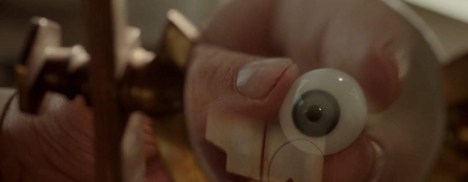
Eye, Creepy Demonic Doll.

The movie often feels caught between these two approaches, repeatedly suggesting something much darker nestled at the core of what is a fairly solid and fairly recognisable horror template. There are moments when Annabelle: Creation is skin-crawlingly effective, and there are moments when the film cleverly punctuates its scares with awkward-laugh-out-loud moments of stress relief. In isolation, David Sandberg balances both approaches quite well.

The problem comes in trying to blend them together.

“Give me a moment, I’ve got to put my face on.”

Continue reading

Star Trek: Deep Space Nine – Field of Fire (Review)

Field of Fire is an oddly nineties piece of television.

All television shows are inevitably a product of their time. This was particularly true of the twenty-odd-episode-a-season shows produced during the twentieth century, subject to the brutal churn of a weekly production schedule. The production team needed scripts, which meant that the writers needed ideas. Inevitably, those ideas were drawn from the wider culture around them. As a result, television is often an interesting lens through which culture might be examined, a projection of how a given society sees (or perhaps wishes to see) itself.

The noblest aim.

Star Trek: Enterprise was inescapably a product of the War on Terror, caught in the gravity of the attacks upon the World Trade Centre. Star Trek: Voyager was undeniably a child of the nineties, driven largely be a sense of listless anxiety in the shadow the millennium. While Star Trek: Deep Space Nine could never be entirely removed from its cultural context, it still stood apart. The writers tended to draw their themes from history, rather than from current affairs, creating a Star Trek show that seemed to exist beyond its cultural moment.

Of course, there are exceptions. Field of Fire is that most nineties of television episodes, the serial killer psychological thriller.

Highly illogical.

Continue reading

Non-Review Review: Atomic Blonde

Atomic Blonde is a very pretty mess.

Atomic Blonde is a stylistic showcase for director David Leitch and star Charlize Theron, a bruising and beautiful ballet of brutality with a killer soundtrack. Atomic Blonde is a film set in a funhouse mirror version of Berlin in November 1989, a movie that argues its location is more a state of mind than a physical place. The violence in Atomic Blonde is visceral, the mood tangible, the soundtrack delectable. Atomic Blonde is a feast for the senses.

Seeing red.

However, Atomic Blonde also makes next to no sense. The film is an action movie dressed in the attire of a nihilistic espionage thriller, and a little narrative confusion inevitably comes with the territory. These films are all but obligated to have twists and betrayals, macguffins and revelations, switches and levers. Atomic Blonde embraces that zany approach to plot and structure with relish. However, the problem with Atomic Blonde is more fundamental than all that. It often struggles to remain coherent from one scene to the next, from one set piece to another.

Atomic Blonde is beautiful chaos, an exploding collage that probably didn’t make any sense to begin with.

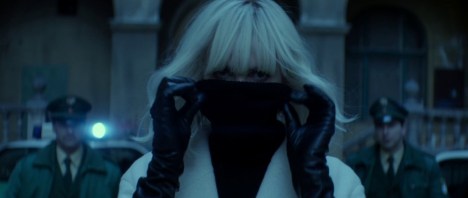
Putting her turtleneck on the line.

Continue reading