• Following Us

  • Categories

  • Check out the Archives


  • Awards & Nominations

The Defenders – The Defenders (Review)

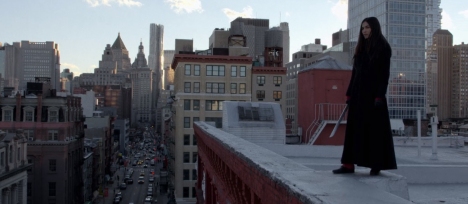
If The Defenders is fundamentally a story about New York, then it seems inevitable that it should return to the city’s defining tragedy.

It is no exaggeration to suggest that the events of 9/11 changed the course of world history. They fundamentally altered the foreign and domestic policies of the United States, the world’s strongest superpower. Inevitably, they also changed New York itself. It could reasonably be argued that the twenty-first century began with the 9/11 attacks, at least culturally; the atrocity brought an end to the global peace and stability that had defined the nineties, ushering in a new world order.
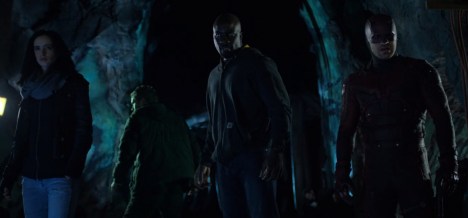
“Um, Danny? Hero shot?”

The Defenders is a story very much invested in New York City, with characters repeatedly referring to New York as “my/your/our city.” Of course, each of the four series leading into The Defenders imagines a different city. Daredevil is set against the backdrop of an early eighties version of Hell’s Kitchen, one never tamed nor gentrified. Jessica Jones unfolds in a vast and anonymous and disconnected city. Luke Cage imagines Harlem as an ideal, a cultural hub. Iron Fist treats Manhattan as the stage on which familial conflicts might play out.

The Defenders is about bringing those separate versions of New York together, of integrating them into a single story set against the backdrop of a single version of the city. Inevitably, that version of the city is the city as it was defined at the start of the twenty-first century, a city united by catastrophe and destruction. However, there is more to it than that. The Defenders embraces the 9/11 subtext seeded through the first season and plays the idea out to its logical conclusion.
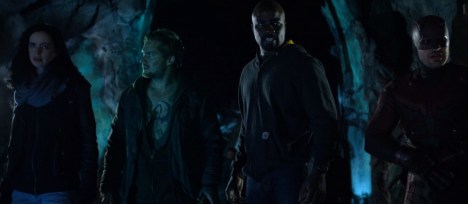
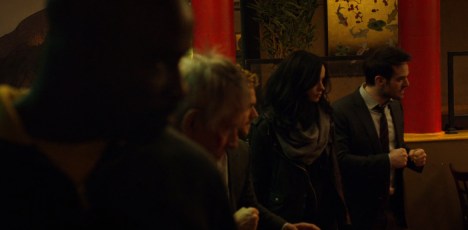
“What? Am I supposed to look serious doing this?”

The season culminates in a bizarre inversion of 9/11, in which our heroes lay siege to an empty skyscraper. They decide that the only way to save Manhattan is to demolish the building. Although the episode is edited in such a way that the audience never sees the collapse of the skyscraper in question, The Defenders is still structured in a way that evokes the most uncomfortable paranoid conspiracy theories about the events of 9/11. With the structure destroyed from the inside with architectural precision, this change to the New York skyline really is “an inside job.”

It plays almost as a grotesque and uncomfortable attempt to reclaim a traumatic image, to take ownership of the atrocity. It is an attempt to construct a heroic iteration of the terrorist attacks that forever changed the city, as if that may somehow provide an opportunity for healing and reconciliation.
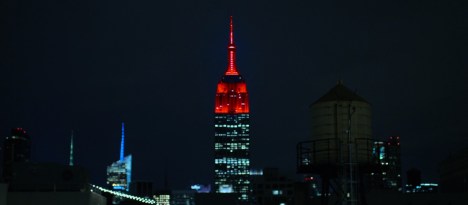
Take it as red.

Continue reading

We Stood Like Kings’ New Soundtrack for Koyaanisqatsi

We Stood Like Kings are releasing a new soundtrack for Godfrey Reggio’s impressionistic documentary Koyaanisqatsi.

Given that Phillip Glass’ iconic soundtrack to Koyaanisqatsi is almost impossible to separate from Reggio’s images and narrative, it is certainly an ambitious project. However, We Stood Like Kings certainly have form in this area. Formed more than a half-a-decade ago in Brussels, We Stood Like Kings have a long history of adapting new soundtracks for classic films.

USA 1982 is the third in a trilogy of such albums; USSR 1926 was a live soundtrack to Dziga Vertov’s A Sixth Part of the World and Berlin 1927 was a live soundtrack to Walther Ruttmann’s Die Sinfonie der Großstadt. The decision to wed USA 1982 to Koyaanisqatsi is intriguing. Reggio’s exploration of contemporary society is a rich visual odyssey, one conveying without dialogue or even title cards.

In many ways, it lends itself to this approach, inviting the audience to interpret the images on their own terms. The use of an alternative soundtrack feels very much like an organic extension of this approach; how might the audience’s interpretation change with soundtrack, how is meaning altered by something other than the image itself?

You can find more information on We Stood Like Kings and USA 1982 on their website. You can also see a short trailer below. It is released September 22 from Kapitän Platte Records.


The Defenders – Fish in the Jailhouse (Review)

The second season of Daredevil hangs over The Defenders.

This is not a surprise. Daredevil was the first Marvel Netflix show, and so it occupies pride of place in the line-up. It was the only series to get a second season before the release of The Defenders. More than that, the showrunners in charge of The Defenders are the same showrunners who oversaw the second season of Daredevil. It makes sense that Matt Murdock would find himself cast as the protagonist of The Defenders, and that the show would like a logical continuation of his arc.

Apparently the Dutch settlers made the mistake of building Manhattan on a load-bearing dragon skeleton.

In many ways, the story of The Defenders is the story of Matt Murdock. In fact, Matt Murdock is the only character to end The Defenders in a markedly different place than he began. He begins the show having retired his costumed life following the death of Elektra in A Cold Day in Hell’s Kitchen. Over the course of the show, he embraces his status as hero. He comes to don the costume again and to lead the nascent team in Take Shelter, just over half-way through the season. He ends The Defenders sacrificing himself to save the city, only to narrowly survive.

While the stars of Iron Fist, Jessica Jones and Luke Cage are all returned to a position where their first and second seasons might flow organically into one another, The Defenders almost feels like a truncated blockbuster season of Daredevil.

“Yeah, Thor: The Dark World did this gag first, but let’s just go with it.”

Continue reading

The Defenders – Ashes, Ashes (Review)

As much as The Defenders is hobbled by the Hand, it is also handicapped by Iron Fist.

It is very clear that the production team heading into The Defenders intended for Iron Fist to be a springboard to the crossover, to move the last pieces into place before the big event miniseries. After all, Iron Fist was heavily marketted as “the Last Defender.” More than that, the series devoted pretty much all of its thirteen-episode runtime to fleshing out the Hand, the secretive ninja cult that would serve as the primary antagonists of The Defenders. There was a clear sense that the production team saw Iron Fist as something of an extended lead-in to The Defenders.

Sorry, Danny. But it’s true.

There was just one problem with all of this. Iron Fist was terrible. By all accounts, the show was the result of a rushed production cycle that explains some of the shoddiness in terms of practical effects and direction, but its biggest problems were more fundamental than that. Finn Jones was the weakest series lead of the Marvel Netflix series by a considerable distance. Scott Buck was the weakest lead writer on a Marvel Netflix series by a considerable distance. The result was a car crash of a television series.

Given that this car crash was intended to serve as the lead-in to The Defenders, this causes significant problems for the sprawling eight-episode crossover.

Luke is a real hero.

Continue reading

Non-Review Review: American Made

“Sh!t gets really crazy from here,” promises Barry Seal at one point in American Made, as this true story takes another sharp escalation.

Unfortunately, American Made never quite lives up to that promise. Starring Tom Cruise and directed by Doug Liman, American Made is never less than charming and endearing, but it also feels overly familiar. American Made plays like a decidedly old-fashioned crime biography film, one that feels appropriate following the cheekily time-warped production logos that introduce the film. Gary Spinelli’s script feels almost retro in the way that it very neatly and very efficiently fits the life of Barry Seal to the familiar crime movie template.

He can handle the truth.

American Made is a well-made film, one anchored in Tom Cruise’s star power charisma and Doug Liman’s competent direction. It is a film with a clear narrative arc and a very sturdy storytelling structure. American Made hints every beat in a very efficient manner, dividing its time very effectively between charming episodic details and its broader overarching themes. The film never loses track of itself, even if it feels like most of the characters around Barry Seal and his CIA handler “Schaffer” never feel particularly alive.

However, there is a something almost disappointing in this efficiency. American Made is too tightly constructed to ever let itself embrace the absurdity of its central narrative. “Sh!t” is too carefully managed to ever get “really crazy.”

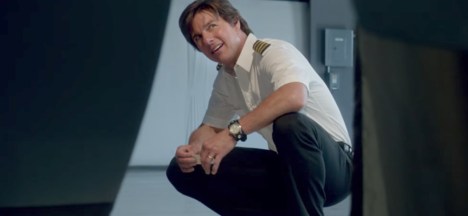
Pilot error.

Continue reading

The Defenders – Take Shelter (Review)

The Hand are an unequivocal disaster, looming large over The Defenders.

To be fair, this an entirely foreseeable problem. When the Hand were teased in the first season of Daredevil, they were at least interesting. Largely carried over from the Frank Miller comics that were a major influence on the series, episodes like Stick and Speak of the Devil suggesting something uncanny lurking in the shadows behind Wilson Fisk. However, as the Hand emerged from the shadows, they became a lot less intriguing. As they became less mysterious, they become more generic. By the end of Iron Fist, the audience had enjoyed enough of the Hand to last a lifetime.

“I’ll tell you where to Stick it.”

A major part of this problem is the fact that the Marvel Netflix shows cannot agree upon a single unifying theory of the Hand. What is the Hand? What are their goals? What are their motivations? What are their methods? It seems like every other episode had a different idea of what the Hand could be, allowing what had been a fairly simple premise of a secret ninja death cult to evolve into something that could be everything to everyone. With every reversal and twist and reinvention, the Hand became less ominous and more frustrating.

As a result, The Defenders suffers from the decision to build its story around the Hand. Much like the series reveals of Manhattan itself, The Defenders is built on a rather shaky foundation.

Homecoming.

Continue reading

Non-Review Review: Wind River

Taylor Sheridan’s loose “Frontier trilogy” imagines the frontier as the site of America’s original sin.

Like Sicario and Hell or High WaterWind River is set in what might be considered a modern-day equivalent of the “wild west.” It is a harsh and brutal world, one in which people fight a losing battle to make sense of that violence. Sicario imagined the frontier as Mexico, a tale of lawless retribution set against the backdrop of the already-lost War on Drugs. Hell or High Water imagined that frontier in Texas, a modern tale of bank robberies and land grabs. Wind River pushes that frontier to vast frozen surroundings of Wyoming, putting Native Americans in focus.

In the wild white yonder…

As the trilogy has moved North, it has also shifted tones. Sicario was confused and angry, struggling to explain the horrors that were unfolding. Hell or High Water blended that anger with a sense of wistful nostalgia, reflecting on the tragic irony of manifest destiny eroded by late capitalism. Wind River is just profoundly sad, a meditation on loss that seems more exhausted than angry. It is a tale about those people left behind on what remains of the frontier, about violence that is too easily overlooked and ignored. There is no rage here, no passion. There is just fatigue.

Wind River is a western set in the forgotten part of the west. It is a western set in the snow, on a Native American reservation. It is the story of a frontier that is too readily forgotten.

In cold blood.

Continue reading

The Defenders – Royal Dragon (Review)

Royal Dragon might just be the best episode of The Defenders. It is also the smallest.

Royal Dragon is in many ways the runt of the litter. It is an episode relatively low on action beats, particularly given that it is sandwiched between the closing scenes of Worst Behaviour and the opening scenes of Take Shelter. It also has a relatively small primary cast. There is no sign of supporting players like Colleen Wing, Misty Knight, Trish Walker, or Claire Temple. The episode also confines most of the four heroes to one location for the bulk of the runtime, even if Jessica Jones gets to take a breather. It could easily be the “bottle” episode.

Hero shot.

Royal Dragon is also an episode that accomplishes relatively little in terms of plot momentum or forward movement. There are no major revelations in the episode, with a lot of the exposition covering information that the audience already knows from the other four shows. In some ways, Royal Dragon feels like a void at the centre of the season. It does not tangibly push the season forward. In many ways, the cliffhanger is arguably just a retread of the ending to Worst Behaviour; these four heroes, standing together against impossible odds.

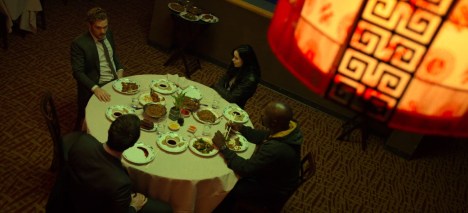
At the same time, Royal Dragon luxuriates in this space and this emptiness. It is an episode that essentially locks its four leads together in a confined space for most of the runtime, which affords the writing staff the opportunity to have the characters slow down and process what has happened to them, to bounce off one another. Royal Dragon allows for the first extended interactions between various combinations of these four players.

A taste of teamwork.

Continue reading

The Defenders – Worst Behaviour (Review)

One of the big issues with The Defenders is that it works a lot better as a weird cross-cutting fusion of four different television series than it does as a single cohesive narrative.

The H Word and Mean Right Hook feature a few small crossover between primary and supporting characters; Foggy and Luke, Misty and Jessica, a fight between Luke and Danny, a quick tease of Matt and Jessica. Otherwise, the four lead characters seem to operate in isolation from one another, continuing threads and themes from their own shows, even as they inch closer and closer together. Worst Behaviour and Royal Dragon finally bring the big four characters together, while still trading on the incongruity of this team-up.

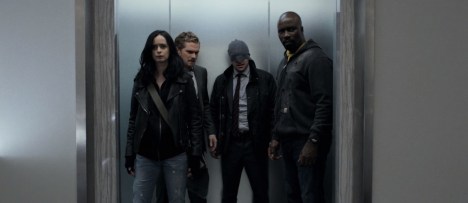
Privileged information.

This tension provides the first half of The Defenders with a compelling narrative hook, an interesting set of internal conflicts between various genres and styles and conventions. In contrast, a lot of this tension evaporates in the second half of the season, as The Defenders figures out exactly what it wants to be in Take Shelter and Ashes, Ashes, before devolving into a familiar and distracting chaos with Fish in the Jailhouse and The Defenders. The first half of the season is compelling, because it seems to be about more than wave-after-wave of generic ninja.

As the team begins to cohere in Worst Behaviour, worlds begin to collide. There is something sublime and ridiculous, as the audience comes to realise that a blind vigilante might coexist alongside a super-strong alcoholic private investigator, a bulletproof social crusader and a billionaire martial arts expert. It is weird, wonderful and jarring. The Defenders manages an interesting frisson in Worst Behaviour.

Lift off.

Continue reading

41. Crossover (-#35)

Hosted by Andrew Quinn and Darren Mooney, The Bottom 100 is a subset of the fortnightly The 250 podcast, a trip through some of the worst movies ever made, as voted for by Internet Movie Database Users.

This time, Preston A. Whitmore II’s Crossover.

At time of recording, it was ranked the 35th worst movie of all time on the Internet Movie Database.

Continue reading