• Following Us

  • Categories

  • Check out the Archives


  • Awards & Nominations

Star Trek: Deep Space Nine – Inter Arma Enim Silent Leges (Review)

Inter Arma Enim Silent Leges is a perfectly fitting penultimate episode of Star Trek: Deep Space Nine.

Sure, the production team had originally planned for Badda-Bing, Badda-Bang to take the audience into the sweeping ten-hour epic that would wrap up the series. That certainly would have been a satisfying deep breath before the plunge, one last story celebrating this ensemble in a low-stakes adventure that treats them like an extended family before everything hits the fan. Badda-Bing, Badda-Bang would have been immensely fulfilling in that context.
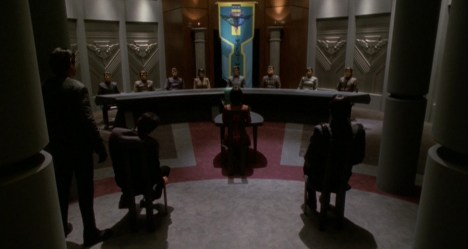
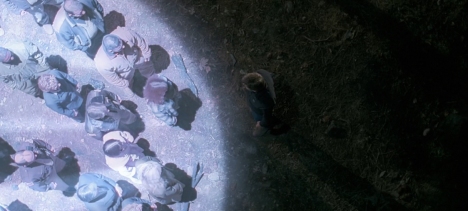
Tribunal.

However, Inter Arma Enim Silent Leges feels like a necessary episode before Deep Space Nine commits to its sprawling ten-episode-long finale. In particular, Inter Arma Enim Silent Leges is the only episode of the seventh season to devote any time or any energy to the question of what happens after the Dominion War. Deep Space Nine has been so tied up in this epic existential struggle that the production team have never really acknowledged what happens when the dust settles, beyond the rolling of the closing credits and the conclusion of the series.

Inter Arma Enim Silent Leges represents the first time that Deep Space Nine has dared to look beyond the immediate status quo, to acknowledge that life will undoubtedly continue in the Alpha Quadrant after the end of What You Leave Behind. In many ways, Deep Space Nine is notable for extending a sense of political realism and pragmatism to the mechanics of the larger Star Trek universe, and Inter Arma Enim Silent Leges feels like an organic extension of that, acknowledging that events ripple beyond that arbitrary boundaries that are conveniently labelled as “endings.”
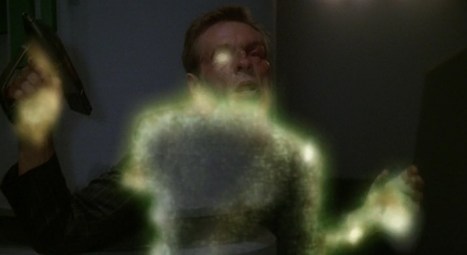
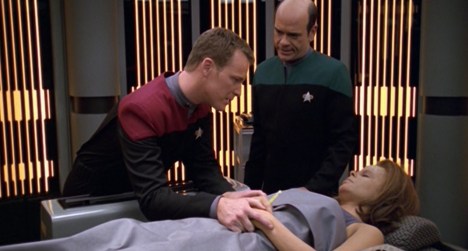
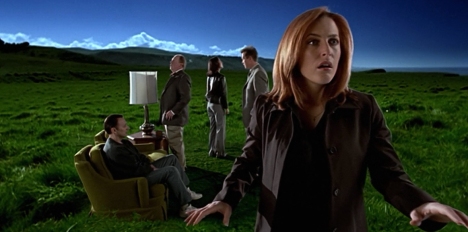
I met a man who wasn’t there.

Continue reading

Non-Review Review: IT

IT works best as a fusion of weird fiction with a classic coming of age story.

IT is arguably one of Stephen King’s most iconic and influential works. Pennywise the Dancing Clown is perhaps King’s most instantly recognisable creation. King’s work seems to recognise this. The monster clown haunts his fiction, making various appearances in other works, suggesting that the creature is an infection spreading across the author’s vast tableau. There are lots of reasons for IT‘s success and status, but a lot of it comes down to the fact that IT is an encapsulation of many of King’s pet themes and plays to many of King’s strengths.

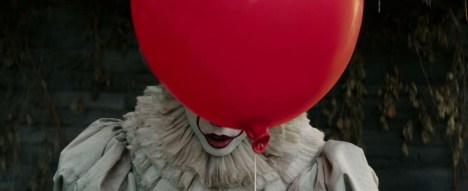
Bill Skarsgård used his other 98 red balloons on Atomic Blonde.

Director Andrés Muschietti seems to understand this. In fact, IT serves as a smorgasbord of cinematic King adaptations, drawing upon and even quoting from various other successful adaptations of the author’s work. Most notably, IT owes a surprisingly large debt to Stand By Me. The decision to exorcise the “present day” sequences of the novel from this film, leaving them to a potential sequel, means that IT is even more overtly and consciously a coming of age narrative.

However, IT is very much a coming of age horror story, a grotesque and unsettling expression of the nightmares lurking just behind familiar childish fears.

There’s something in water.

Continue reading

Star Trek: Voyager – Course: Oblivion (Review)

Course: Oblivion is a fantastic piece of television, in large part because of how strange and surreal it feels. Like Distant Origin or Living Witness, it is an episode that demonstrates how effective Star Trek: Voyager can be, once it is willing to push itself beyond the template of familiar Star Trek storytelling. Course: Oblivion is a staggeringly weird piece of television, a bottle episode filmed with the primary cast on standing sets, but which only features the briefest of appearances from the regular characters.

More than that, Course: Oblivion effectively weaponises many of the long-standing weaknesses and clichés associated with the storytelling on Voyager. It is the very definition of a “reset” button episode, in that the events (and the ending) of the episode are both catastrophic in scale and utterly inconsequential in the larger scheme of things. In some ways, Course: Oblivion is the quintessential Voyager episode, distilling the destruction of Voyager and the death of Janeway into a tragedy with absolutely no repercussions.

‘Til death do us…

Voyager could often feel generic and disconnected, a show without a unique identity. In many ways, Course: Oblivion is very unique to Voyager in that it builds those core ideas into the very fabric of the episode, constructing an episode that reflects Voyager‘s identity by channeling its identity crisis. As with various other episodes of the fifth season, like Night and TimelessCourse: Oblivion builds a meta-text around the anxieties rippling through Voyager at this point in the run.

However, Course: Oblivion is more than just an effective illustration of Voyager‘s storytelling tropes and unique sensibility. Course: Oblivion is also an episode that taps into a lot of the anxieties bleeding through the zeitgeist at the turn of the millennium. Voyager was undoubtedly a television of its time, and tended to reflect the existential paranoia of the nineties. Course: Oblivion is an episode about what it means to grapple with a person’s own unreality, to wrestle with an existence where meaning no longer exists, and everything is illusory.

“… well, that was quicker than expected.”

Even beyond those themes that anchor Course: Oblivion is the cultural landscape of the late nineties, the episode ties back into broader Star Trek themes. One of the great strengths of the Star Trek franchise is the freedom to use a science-fiction template to explore big questions. Course: Oblivion is an episode about what it means to face death, in a manner very distinct from the way that television usually treats death. The death in Course: Oblivion is not meaningful or epic or heroic. The death in Course: Oblivion is inevitable decay, a murmur in an infinite void.

The result is one of the most striking and effective episodes that Voyager ever produced, and easily the most ambitious episode of the fifth season as a whole.

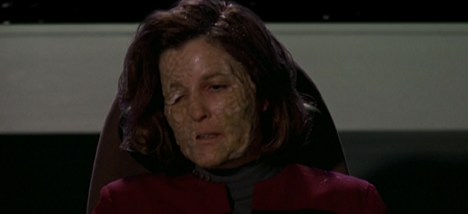
Face off.

Continue reading

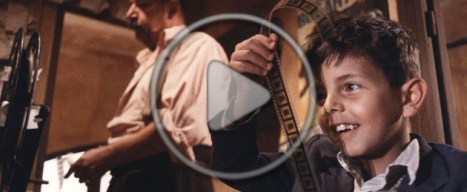
42. Cinema Paradiso (#55)

Hosted by Andrew Quinn and Darren Mooney, The 250 is a fortnightly trip through some of the best (and worst) movies ever made, as voted for by Internet Movie Database Users. New episodes are released every second Saturday at 6pm GMT, with the occasional bonus episode between them.

This time, Giuseppe Tornatore’s Cinema Paradiso.

Successful film director Salvatore Di Vita receives word the projectionist at the Cinema Paradiso has died. This news prompts Salvatore to embark on a literal and metaphorical journey back to the small village in which he grew up, exploring memories of his childhood and of the magical days spent in the cinema that served as the lynchpin of his idyllic community.

At time of recording, it was ranked the 55th best movie of all time on the Internet Movie Database.

Continue reading

Star Trek: Deep Space Nine – Badda-Bing, Badda-Bang (Review)

Badda-Bing, Badda-Bang is nonsense, but it is fun nonsense.

It goes without saying that the plotting of Badda-Bing, Badda-Bang is ridiculous, even by the standards of the obligatory “holodeck goes crazy” episodes like The Big Goodbye or Our Man Bashir or Bride of Chaotica! The episode’s internal logic is strikingly weak, to the point that even the most sympathetic and understanding audience member has to acknowledge the sizable plot holes in the narrative. It is not that the plotting of Badda-Bing, Badda-Bang is lazy or clumsy, it is that the plotting is almost non-existent.

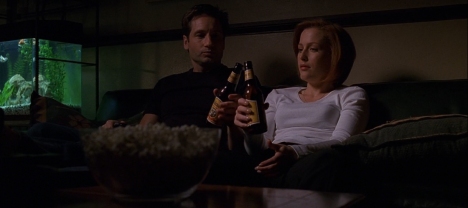
Sisko’s seven.

More than that, the seventh season has already had a much stronger “the crew hang out together and have fun in the holosuite” episode in Take Me Out to the Holosuite. More than that, Star Trek: Deep Space Nine is within a dozen episodes of the end of its seven-season run. There is a very valid argument to be made that Badda-Bing, Badda-Bang is a completely unnecessary indulgence at this late stage of the game and that the time invested in this episode could be more wisely invested in some other story thread or dangling plot.

But, yet. There is an incredible charm to Badda-Bing, Badda-Bang that comes from seeing this cast together and having fun for the last time.

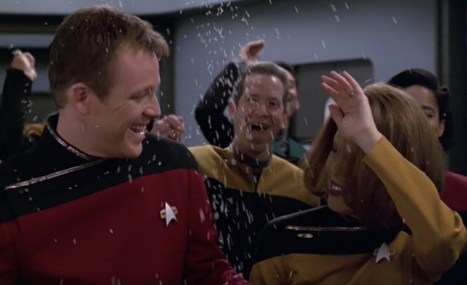
“Well, I think we have a promo shot.”

Continue reading

Non-Review Review: The Black Prince

The Black Prince is a well-intentioned misfire.

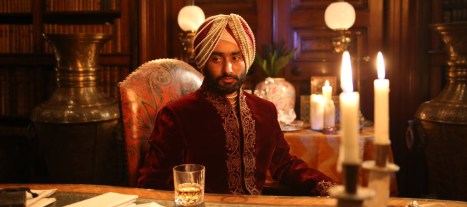
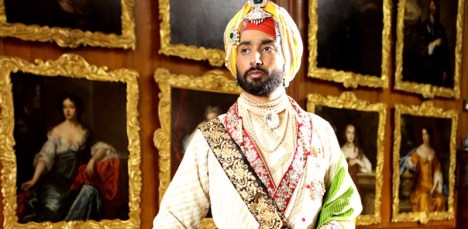
Written and directed by Kavi Raz, The Black Prince is a historical epic attempting to explore the life and times of the Maharaja Duleep Singh, who was abducted from India and taken to the United Kingdom where he became Queen Victoria’s “black prince.” The movie is undoubtedly ambitious and a labour of love for Kavi Raz, who is clearly working within any number of severe budget and production restraints. The best thing about The Black Prince might just be its canny use of existing locations that create a fascinating period atmosphere that recalls a vintage BBC drama.

However, the problems with The Black Prince are more fundamental than any issue with budget or ambition. Raz clearly has an abiding sympathy for and interest in the Maharaja Duleep Singh, but the film suffers from a reluctance to take a step back from its subject. Instead of tightening its focus on one aspect of the character’s life, or one key decision, the film attempts to condense the character’s entire history down to a two-hour movie. The result is a movie where a lot of things happen, but none of those things feel grounded in anything particularly important.

The Black Prince is a movie that suffers from its desire to be all things to all audiences, trying to pivot between genres in the spaces between scenes, reducing its central characters to vehicles for plot-driven or historical exposition, and changing its core premise so frequently that it feels like the cliffnotes of a much stronger film.


Continue reading

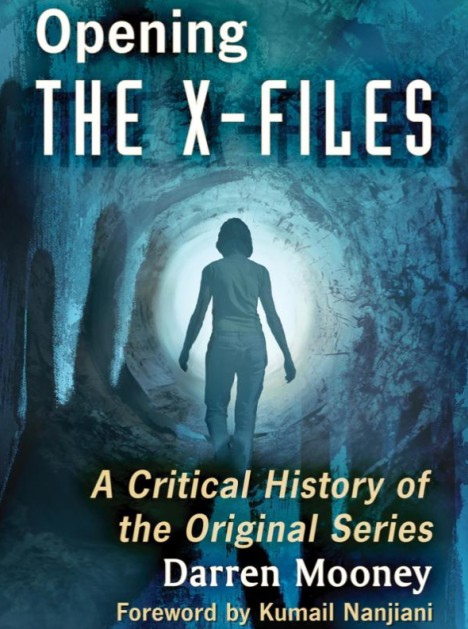
“Opening The X-Files” is Now Available on Amazon Kindle and Google Books!

Hi guys!

Just a quick update to let you know that my new book, Opening The X-Files: A Critical History of the Original Series, is now available as an eBook from Amazon and Google Books. Links available below.

There will also be a print book available, and that will be released in a few weeks. But if you absolutely, positively have to read it now, you can pick it up for your eReader of choice at that links below.

The book has been a labour of love. It is basically the distillation of all of my reviews of The X-Files into a singular linear narrative that charts the show from its origins and influences through to the release of I Want to Believe. It includes sidebars and tangents for particular creators of interest and for the various other tie-ins, spin-offs and other interesting thematic divergences.

(It does not include the revival series, but if it is popular enough, a second edition or follow-up could always be possible.)

It has been a fun project, and I am hugely indebted to those who offered their support along the way. The book was published by McFarland Books and comes with an introduction by actor and comedian Kumail Nanjiani. With a bit of luck, if this project goes well, I might attempt something similar in the near future.

If you need the book right now, here are the links to the places where you can purchase the eBook online:


You are willing to wait a little longer, you can order a hard copy of the book from many of the same places:

If you’d like to support the book, there are a number of things that you could do:

If you want a sample of what the book will cover, in a much more organised manner, there are some sneak peaks online:

If you’re still on the fence, here are come very nice things that some very nice people said about the book:

A welcome, and well-written addition to X-Files lore, by an author who knows his stuff.

John Kenneth Muir, author, The X-FilesFAQ

I get excited about watching the episodes, but I get just as excited about reading Darren afterward.

Kumail Nanjiani, actor, comedian and writer

The truth is in here! If The X-Files were a college class, Mooney’s book would be the essential text. It not only supplements, but greatly enhances one’s enjoyment of the groundbreaking series.

Rod Lott, FlickAttack.com

A massive thank you to everybody who has supported the book so far. If you have any questions, feel free to leave them in the comments and I’ll try to answer all of them.

Non-Review Review: Patti Cake$

Patti Cake$ is intermittently charming, but far too familiar.

Patti Cake$ is a familiar breed of indie movie. It is the story of a young protagonist trapped in a small town and surrounded by eccentric characters who yearns to escape, but finds herself hemmed in by lack of opportunity, by family and by sheer economic pressure. It is a quintessential triumph-over-adversity narrative, albeit approached from the slightly skewed perspective of a young white female rapper in New Jersey.

Let’s get this Patti started in here.

There are some interesting elements of Patti Cake$, especially the performances by actors like Danielle Macdonald and Bridget Everett. There are moments when this familiar template works very well at hitting particular cues, whether the mundanity of Patti’s day-to-day existence, the emotional realism of particular relationships in her life, or even a really good and well-timed joke. However, those moments are largely fleeting. For most of its runtime, Patti Cake$ is a perfectly adequate story of what it feels like to socially strive.

Patti Cake$ doesn’t have any new rhymes, and so settles for some well-worn beats.

She’s got drive.

Continue reading

Star Trek: Voyager – The Disease (Review)

One of the curses of Star Trek is the tendency to saddle the weakest and most ill-defined members of a given ensemble with a generic soul-destroyingly dull love story.

Deanna Troi has Haven, The Price and Man of the People. Geordi LaForge has Booby Trap and Galaxy’s Child. In the first few years of Star Trek: Deep Space Nine, both Bashir and Dax were subjected to such plots. Bashir had Melora, and Second Sight was originally developed with his character in mind. Dax got a similar story in Meridian. Chakotay has Unforgettable, and was shipped with both Janeway and Seven at various points in the run of Star Trek: Voyager. Even Mayweather’s subplot in Demons and Terra Prime was romantic in nature.

Kiss and Tal.

Of course, there are any number of compelling and interesting  romantic episodes built around characters over the history of the franchise. Kirk had The City on the Edge of Forever. Spock had All Our Yesterdays. Tuvok had Gravity. Even the more developed seventh season version of Bashir had Chrysalis. However, it frequently seems like the production team’s go-to plot for an underdeveloped regular character is a romance-of-the-week plotline, perhaps because it is a fairly standard story and because it can be applied to almost any type of character.

However, the problem with building these romantic storylines around undeveloped characters is that they lack any real hook. The audience implicitly understands that the romantic interest is unlikely to stick around, so the story has offer a compelling insight into the regular character. This is understandably difficult if the production team have chosen to tell this story with this character because they really cannot think of any other interesting story to tell. As a result, these episodes can feel like an exercise in boredom, in watching wheels turn.

“Dammit, Harry. I thought we had this conversation after Favourite Son.”

This is particularly true in episodes built around weaker (or more disinterested) members of the ensemble. In a romantic installment of an episodic show, the audience needs to invest in the love story very quickly. This puts a lot of pressure on a performer to sell the romantic attraction. On a weekly schedule, with two performers who may not know one another particularly well, this can be very difficult to accomplish. Robert Beltran is a relatively serviceable performer with the right material, but he would never make a convincing romantic lead.

The Disease is a romantic episode built around Harry Kim. While the script has its own very severe problems, the biggest issue is that Garrett Wang simply cannot sell the intense attraction that is necessary for the episode to work.

Colony ship collapse disorder.

Continue reading

Star Trek: Voyager – Dark Frontier, Part II (Review)

Star Trek: Voyager has a morbid fascination with the Borg. Quite literally.

Time and time again, the series returns to the image of the Borg dead and dying. Blood Fever ends with the discovery of a Borg corpse. Unity features the extended autopsy of that corpse. In Scorpion, Part I, Kes is haunted by the image of a grotesque mound of Borg drones, torn apart and reassembled. In Unimatrix Zero, Part I, the Borg Queen tears the heads off her drones and mounts them on spikes. There is a very similar image in Dark Frontier, Part I, where Janeway wanders casually through the wreckage of a Borg ship.

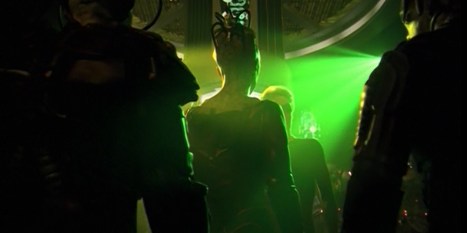
Queen of minds.

Star Trek: The Next Generation worked hard to establish the Borg as a credible threat. If the Borg were associated with death, it was only because they delivered something akin to it. In The Neutral Zone, the Borg scooped an entire outpost off the surface of a planet. In Q Who?, Picard had to literally beg Q to save the Enterprise after the loss of eighteen crewmembers. In The Best of Both Worlds, Part I and The Best of Both Worlds, Part II, the Borg tore through the Federation like it was made of tissue paper. The trauma of that invasion informed Emissary.

In contrast, Voyager seems preoccupied with the destruction and desecration of the Borg Collective. This is an interesting creative choice on a number of levels. Most obviously, it severely undercuts the menace and threat posed by the Borg Collective. Janeway seems to travel through the Delta Quadrant leaving a trail of broken Borg bodies in her wake. It is hard to believe that the Borg are a big deal, when Janeway seems to decorate her ship with their remains. The Kazon, the Vidians and the Hirogen have all taken Voyager at some point. The Borg have never.

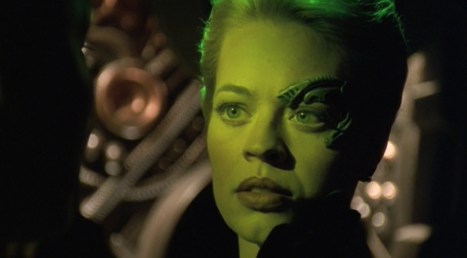
Green light for reassimilation.

Perhaps this fascination with Borg corpses and remains simply speaks to their visual aesthetic. With their pale skin and their lack of individual identity, the Borg have always evoked the walking dead; Star Trek: First Contact was essentially a zombie movie in deep space. However, perhaps this desecration of the Borg speaks to something buried deeper within the psyche of Voyager. The Borg are perhaps the most iconic aliens of the Berman era; they represent the moment that The Next Generation came into its own. Perhaps their decay mirrors that of the Berman era itself.

Dark Frontier, Part I and Dark Frontier, Part II represent something of a final frontier for the Borg Collective. While the Borg had been in decline for some time, Dark Frontier, Part I and Dark Frontier, Part II marked a point of no return. Regeneration is an underrated return to form for the iconic cyborgs, but it is too little and too late. Dark Frontier, Part I and Dark Frontier, Part II is effectively a funeral for the most iconic adversaries of the Berman era. However, they would remain shuffling lifeless for another two-and-a-half seasons.

Subject to change.

Continue reading