• Following Us

  • Categories

  • Check out the Archives


  • Awards & Nominations

Star Trek: Voyager – Hunters (Review)

Hunters is a weird episode of Star Trek:Voyager, perhaps most notable for the manner in which it flirts with serialisation.

More than any other episode of the fourth season, with the possible exception of The Gift, this mid-season episode seems to exist primarily in relation to the episodes around it. The script is very consciously a sequel to Message in a Bottle, with the crew discovering the ancient network of space stations is a two-way radio back to the Alpha Quadrant. It also introduces the Hirogen, an alien species that will recur in Prey, The Killing Game, Part I and The Killing Game, Part II. The story also sets up a narrative thread that will pay off in Hope and Fear, the season finale.

“Prey, tell.”

More than that, Hunters is an episode that is very consciously engaged with dangling threads of continuity. It resolves the relationship between Janeway and Mark that has haunted the lead character since Caretaker, offers Tom Paris some hint of reconciliation with the father who seemed so disappointed in Persistence of Vision, and even resolves the Maquis plot thread by tying back to Blaze of Glory. This is an episode that exists as something of a storytelling nexus point, a variety of intersecting threads all tied together as part of a single narrative.

Voyager had largely eschewed any attempt at long-form storytelling, perhaps in response to the trauma of the troublesome Kazon arc in the second season that led to ill-judged misfires like Alliances and Investigations. However, those early attempts at serialisation were heavily plot-driven, a series of stories building towards a number predetermined plot points. In contrast, the serialisation suggested by Hunters is looser; a collection of character beats, some earlier details that had largely been forgotten, some elements that might be useful in the future.

The farthest woman from home.

That said, Hunters seems just as cautious about long-form storytelling as The Gift was. As much as Hunters revives old story lines and character beats, it also makes a conscious effort to close many of them. Hunters makes it very clear that this level of serialisation will not be the default for the series going forward. The episode tidies away more loose threads than it unravels. The relationship between Kathryn Janeway and Mark Johnson is brought back purely so it can be ended. The Maquis are mentioned only to confirm they have been destroyed.

Still, there is something oddly intriguing about Hunters, a mostly quiet episode that exists primarily as both prelude and coda rather than a narrative in its own right. It is a quieter, stranger Voyager episode, even while introducing a race of giant space!hunters.
Gripping stuff.

Continue reading

New Podcast! The X-Cast – Season 2, Episode 16 (“Colony”)

Just a quick link to a recent (unscheduled) guest appearance over on The X-Cast, a great X-Files podcast run by the prolific Tony Black.

In the first of a two-parter experience, I had the pleasure of an extended conversation with Tony about Colony. It was a huge honour, given the importance of Colony in the overall mythology of The X-Files. We got to talk about all sorts of fun things, from Chris Carter’s recurring fascination with Frankenstein to nineties television direction to how hard it must be for the Alien Bounty Hunter to shop for clothes. I will also be back next week to talk about End Game with Tony. Check it out the episode here, or click the link below.

Continue reading

Iron Fist – Dragon Plays With Fire (Review)

With Dragon Plays With Fire, it is almost as though Iron Fist remembered that it had its own story to wrap up and that it was not simply a lead-in to The Defenders.

The bulk of Iron Fist has been dedicated to setting up characters and concepts for use in The Defenders. Most notably, the series has devoted a lot of attention to developing the Hand, even repurposing large parts of the Iron Fist mythos to set Danny up as a key part of The Defenders by aligning him against the Hand. Shadow Hawk Takes Flight revealed that the Iron Fist was “sworn enemy of the Hand”, while The Blessing of Many Fractures suggested that the Hand played a role in the death of Danny’s parents.

“This makes me so angry that I might flash back to my parents’ death again!”

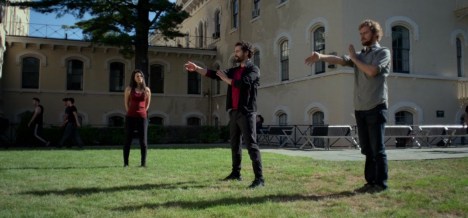
Iron Fist spent so long playing into The Defenders that it would easy to forget that the series has own narrative arc to fulfil. Indeed, it even seems like Iron Fist itself forgot about those obligations, to the point that Bar the Big Boss played almost like a season finale with Danny vanquishing Bakuto and the Hand before heading home with Colleen for some funky Tai Chi action. However, at the last minute, Bar the Big Boss seems to remember that Iron Fist still has to resolve the whole Harold Meachum business, and possibly set up a second season.

The result is that Dragon Plays With Fire is an incredibly rushed piece of television, covering what feels like multiple episodes worth story in the space of fifty minutes while also cramming in a bunch of sequel hooks to both The Defenders and a hypothetical second season of Iron Fist. The finale is deeply disappointing, much like the season before it. More than that, it is a constant reminder of how little of its own identity was afforded to Iron Fist.

“Oh hey, it’s the ending of Star Trek: Nemesis, everyone’s favourite Star Trek movie!”

Continue reading

Iron Fist – Bar the Big Boss (Review)

It’s impossible to talk about Iron Fist without talking about cultural appropriation.

There are multiple reasons for this. The most obvious are baked into the character himself, from his origin all the way back in Marvel Premiere as a white guy who travels to a mystical Asian city and becomes better at kung fu than any of the inhabitants before returning to America. There’s also very much the conversation that has been happening around the television series, which has prompted larger debates about the role of Asian performers and culture in Hollywood. Finally, there’s the fact that show so expertly puts its foot in its mouth.

Shaping up…

Bar the Big Boss is the perfect point at which to address this. Again, for multiple reasons. The most obvious is that it represents the last point at which the most obvious aspects of Asian exoticism are in play; barring the closing scene of Dragon Plays with Fire, this episode is the end of the Hand and K’un Lun as narrative forces in the context of the larger narrative. It is also an episode that effectively allows Davos to lightly touch upon the issue of cultural appropriation before brushing his concerns aside by turning him into a stock villain.

But, really, the issue is so firmly baked into the Iron Fist mythos that it is impossible to talk about in isolation.

Warding off evil spirits.

Continue reading

Iron Fist – Lead Horse Back to Stable (Review)

K’un Lun is a notable void at the heart of Iron Fist, even before the closing moments of Dragon Plays With Fire.

There are any number of terrible mistakes that were made during the production of Iron Fist, fundamental flaws that could easily have been avoided by a more competent and committed creative team. The series was assigned a showrunner with a horrific track record. The production team cast a lead actor without any raw charisma and who was incapable of doing his own stunts, while refusing to put the character in a mask. The series focused more on board room antics than kung fu fun. The Hand were used as the primary antagonist.

You shall not pass.

However, one of the most grating disappointments is the simple fact that a lot of the really fun and interesting stuff about Danny Rand happens long before he stumbles back into New York in Snow Gives Way. There is a solid argument to be made that Danny Rand is a third- or fourth-tier comic book character, but there undeniable cool parts of the Iron Fist mythos. None of them take place in the offices of Rand Industries. Iron Fist is the story of a man who gained his power by punching a dragon in a heart. Whatever an adaptation of Iron Fist should be, it should never be boring.

And, yet, for whatever reason, the first season of Iron Fist makes a point to consciously shoot around the more impressive and distinctive parts of the Iron Fist mythos, reducing its title character to a cut-rate (and ironically trust-fund) Matt Murdock. Danny left K’un Lun behind, and it was a terrible mistake.

The watcher on the pass.

Continue reading

Iron Fist – Black Tiger Steals Heart (Review)

And so it becomes a little clearer what exactly Iron Fist is trying to do with the Hand.

Black Tiger Steals Heart reveals that Madame Gao is not the leader of the Hand, but instead one faction of the Hand. Presumably, Nobu was the leader of another faction of the Hand on Daredevil, although his interactions with Gao never seemed anywhere near as charged as they might otherwise be. Black Tiger Steals Heart properly introduces the character of Bakuto, a mysterious figure who has been lurking at the edge of the narrative since he was introduced as a friend of Colleen Wing in Felling Tree With Roots.

“Ay, Macarena!”

Bakuto is ultimately revealed to be a major player in the Hand, a character with ambiguous motivations and impressive influence. Black Tiger Steals Heart immediately sets Bakuto up as a cool idealist with progressive values and socialist leanings. He attracts young followers who seem genuinely devoted to them, arguing against capitalism as a philosophy and suggesting that the power of disaffected youth can be channeled in a more constructive manner. Contrasted with Gao’s capitalism or Rand Industries’ exploitation, Bakuto makes a lot of sense.

Bakuto is ultimately revealed as a sinister cult leader looking to exploit the young people placed in his care, turning them into weapons through which he might wage war upon the establishment. Bakuto’s reinvention of the Hand away from Nobu’s Asian mysticism or Gao’s magical capitalism continues the theme of the Hand as a stand-in for American anxieties about foreign belief systems. In this case, Iron Fist treats the Hand as a reactionary critique of left-leaning social movements like Black Lives Matter or Bernie Sanders supporters.

Enjoy this, because this is the only Asian Iron Fist that you’re going to get.

Continue reading

Iron Fist – The Mistress of All Agonies (Review)

Inevitably, being a street-level superhero show that owes a huge stylistic debt to Daredevil, Iron Fist inevitably wades into the whole “thou shalt not kill” side of superheroics.

Matt Murdock has spent the better part of two seasons wrestling with that same question. In the first season, he agonised over the question of whether he should kill Wilson Fisk, a criminal who was otherwise above the law. This angst informed episodes like Nelson v. Murdock and The Path of the Righteous. It was a reasonably solid plot line that worked as well as could be expected because it was rooted as much in Charlie Cox’s performance and Matt Murdock’s Catholicism as in any large moral or legal framework.

Knife to see you…

However, Matt Murdock revisited the question with less success during the second season. Confronted with Frank Castle’s lethal methods of crime fighting and an undead ninja cult, Matt found everything was up for debate. The series did not handle the dilemma with any real sense of grace. Frank Castle constructed a ridiculously elaborate moral dilemma in New York’s Finest, while Matt Murdock seemed to confess that the Punisher’s methods worked in .380. One of the most tone deaf sequences in the series had Frank Castle kill a bad guy so Matt would be spared.

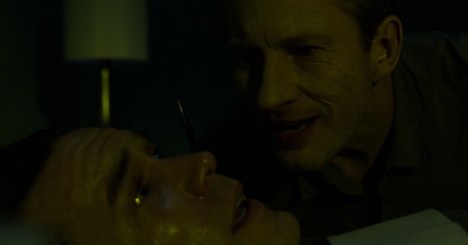
Iron Fist puts it own spin on the age-old debate of vigilante morality. In keeping with the general tone of the series, the debate is lazy and clumsy, ultimately resolved through the same sort of tidy deus ex machina that got Danny proof of identity in Rolling Cannon Thunder Punch and control of his company in Eight Diagram Dragon Palm. It is not satisfying storytelling.

Supervillains understandably have fewer moral qualms about killing.

Continue reading

Iron Fist – The Blessing of Many Fractures (Review)

As “The Last Defender”, Iron Fist bears the burden of tying most heavily into The Defenders.

This is not a surprise. This has been a large part of the Marvel Studios model, with productions teasing concepts and characters that will not arrive for quite some time. By the time that Thanos moves against Earth’s Mightiest Heroes in Avengers: Infinity War, it will have been more than half a decade since the stinger at the end of The Avengers teased his looming threat. Even since Samuel L. Jackson appeared at the end of Iron Man and Robert Downey Jr. dropped by the stinger in The Incredible Hulk, these teases have been a way of doing business.

Glowing yellow peril.

As such, it makes sense that the company would put a lot of groundwork into setting up the summer’s big-ticket crossover between the four different Marvel Netflix shows. Jessica Jones and Luke Cage had largely been their own thing, while Daredevil had devoted a considerable amount of time and effort to introducing concepts and ideas that would pay off down the line. However, as the last of the shows to be released before the big summer event series, Iron Fist carries a heavier burden than any of its predecessors.

Unfortunately, Marvel and Netflix seem to have wholeheartedly committed to the idea of the Hand as the enemy of choice for this eight-part crossover miniseries. And so Iron Fist gets burdened with the Hand.

“Time for snooping.”

Continue reading

Iron Fist – Felling Tree With Roots (Review)

Danny Rand is perhaps the biggest problem with Iron Fist.

In many ways, Danny is really just an extrapolation of the kind of live action comic book hero seen in Daredevil and Batman Begins, the angsty young man with father issues who struggles to get past his own dysfunction to become the hero that the city (if not the world) needs at this exact moment. Danny is full of emotional turmoil, with Iron Fist revelling in his insecurities and uncertainties. Even when he succeeds, the show makes a point to stress how incredibly difficult it is to be Danny Rand.

Sleeping beauty.

This feels ill-judged on several levels. Finn Jones lacks the sort of nuance and ability that is necessary to bring that sort of mopey self-centred sulking to life in an engaging manner. Jones is no Charlie Cox, and he’s certainly no Christian Bale. However, Iron Fist itself also struggles to properly capture the right tone. Immortal Emerges From Cave ends with Danny saving an innocent life, but he spends Felling Tree With Roots whining about it. The loss of K’un Lun in Dragon Plays With Fire is treated as something that affects Danny more than its residents.

Ironically, the Iron Fist himself seems to be the weakest aspect of Iron Fist.

Her Hand-iwork.

Continue reading

Iron Fist – Immortal Emerges From Cave (Review)

Immortal Emerges From Cave might just be the best episode of the first season of Iron Fist.

Of course, Immortal Emerges From Cave is not a good episode of television. It is bedevilled by all the other issues with Iron Fist, from inconsistent characterisation to dead-end subplots to pacing issues. It even adds a few new problems of its own, especially with a ham-fisted and ill-judged attempt to bring the character of Bride of Nine Spiders into live action. Immortal Emerges From Cave is unlikely to make much of an impression, and it certainly doesn’t rank with the other best episodes of the Marvel Netflix series.

“Three men enter! One man (or two men) leave!”

At the same time, Immortal Emerges From Cave is the episode of Iron Fist that perhaps comes closest to fulfilling its own ambition. Immortal Emerges From Cave is a relatively self-contained narrative in the middle of the season, in which Danny finds himself forced to compete in a tournament against the Hand in order to save an innocent life. It is a hokey premise, but one that leads to a series of fairly middling set pieces in which Danny Rand works his way through various “levels” in pursuit of his goal.

Immortal Emerges From Cave feels very much like some forgotten z-list direct-to-video martial arts film from the nineties, a pulpy and absurd excuse to string together a collection of fight scenes. The result is not spectacular by any measure, but it is far more entertaining than the meandering story being told around it. Immortal Emerges From Cave might not succeed on general terms, or even on its own terms, but it at least has a strong sense of its own identity. That is enough to put it ahead of the rest of the season.

Glowing reviews.

Continue reading