• Following Us

  • Categories

  • Check out the Archives


  • Awards & Nominations

Star Trek: Deep Space Nine – Chimera (Review)

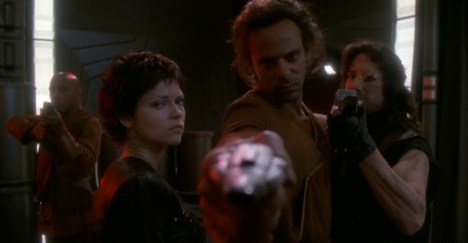
Chimera is a welcome return to form for the seventh season of Star Trek: Deep Space Nine, following an underwhelming run of episodes from Prodigal Daughter through The Emperor’s New Cloak and into Field of Fire.

It is another example of how storytelling real estate in the seventh season is at a premium, the production team understanding that their remaining time is finite and that there are a number of key plot and character beats that the show needs to hit before it can begin the massive final arc that will run from Penumbra through to What You Leave Behind. As such, Chimera has a very clear purpose in the overall arc of the seventh season. As with Treachery, Faith and the Great River, this is an episode designed to clarify that Odo cannot remain on Deep Space Nine forever.

Their Laas.

However, Chimera is more than just the writing staff moving pieces across a chessboard. It is in many ways an exploration of one of the fundamental (and often unspoken) tensions within the larger Star Trek universe. As with a lot of Deep Space Nine, there is a sense that Chimera is consciously exploring and interrogating some of the underlying assumptions of Gene Roddenberry’s massive universe. In particular, Chimera is an episode that wonders whether mankind can ever be truly comfortable with the alien, and whether there is a difference between assimilation and multiculturalism.

The result is a powerful and provocative piece of science-fiction, a story that has aged as well as the show around it. Chimera is a story about what it means to be different, and what it means to part of a society. It is a cautionary tale about the unspoken conditions that are often attached to membership of a community, and of the conflict between blending in and standing out.

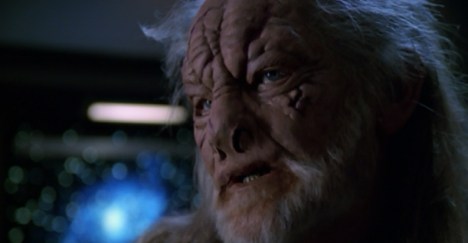
Changelings. Together. Strong.

Continue reading

Star Trek: Voyager – Bliss (Review)

Bliss is a textbook example of Star Trek: Voyager doing textbook Star Trek.

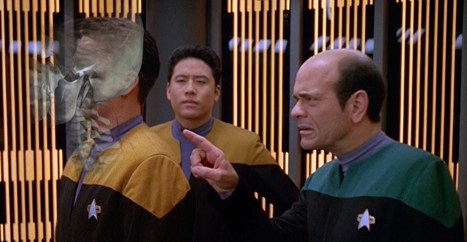
The episode feels like a stew composed primarily of leftovers, the residue of past meals thrown together to serve up something lukewarm and familiar. Bliss is not necessarily a bad episode of television, per se. It is rather lifeless and generic, but it is hardly the weakest episode of the season or the series. Instead, Bliss is the kind of episode that fades gently from memory, a hollow confection that doesn’t taste particularly nice, but which at least offers something to chew over.

Good Sheppard.

Bliss is a cocktail of familiar Star Trek plot elements. At the centre of the story is the sort of gigantic monstrous space entity that haunted earlier tales like The Immunity Syndrome or Datalore, a reminder of how weird and dangerous space can be. The “pitcher plant” in Bliss recalls the parasites from Operation — Annihilate! or the space vampire from The Man Trap. It feels like something almost Lovecraftian, a “beast” with tendrils that reach into the minds anybody near enough so that it might lure them to their doom. It is unfathomable to those caught within its grasp.

Qatai exists in opposition to this malign entity, caught in an immortal struggle with a force more vicious and more powerful than he could ever be. The EMH compares Qatai to Ahab, acknowledging the debt that Bliss owes to Moby Dick. Of course, the Star Trek franchise is populated with stories built upon that classic template; Obsession, The Doomsday Machine, Star Trek II: The Wrath of Khan, Star Trek: First Contact, Star Trek: Nemesis, Star Trek. It is hard to think of a more generic source of inspiration for an episode of Star Trek.

The show could use a shot in the arm.

Even beyond that, Bliss touches on plot ideas and elements that will be familiar to most Voyager viewers. As with episodes like Eye of the Needle or False Profits, the crew are tempted by a phenomenon that seems to promise the possibility of getting the crew home quickly. As in Hope and Fear and The Voyager Conspiracy, Seven of Nine becomes preoccupied with the notion that she is the only member of the crew with an objective perspective that allows her to see the truth. As with The Cloud or One, this might be deemed an “anomaly of the week” episode.

The result is something the feels very much like a representative distillation of Voyager, the statistical mean of the series derived to a decimal point. Bliss is perhaps the perfect encapsulation of Voyager as a television show. It is neither truly great or truly awful, it is merely there.

Coming down to Earth.

Continue reading

Star Trek: Deep Space Nine – Field of Fire (Review)

Field of Fire is an oddly nineties piece of television.

All television shows are inevitably a product of their time. This was particularly true of the twenty-odd-episode-a-season shows produced during the twentieth century, subject to the brutal churn of a weekly production schedule. The production team needed scripts, which meant that the writers needed ideas. Inevitably, those ideas were drawn from the wider culture around them. As a result, television is often an interesting lens through which culture might be examined, a projection of how a given society sees (or perhaps wishes to see) itself.

The noblest aim.

Star Trek: Enterprise was inescapably a product of the War on Terror, caught in the gravity of the attacks upon the World Trade Centre. Star Trek: Voyager was undeniably a child of the nineties, driven largely be a sense of listless anxiety in the shadow the millennium. While Star Trek: Deep Space Nine could never be entirely removed from its cultural context, it still stood apart. The writers tended to draw their themes from history, rather than from current affairs, creating a Star Trek show that seemed to exist beyond its cultural moment.

Of course, there are exceptions. Field of Fire is that most nineties of television episodes, the serial killer psychological thriller.

Highly illogical.

Continue reading

Star Trek: Deep Space Nine – The Emperor’s New Cloak (Review)

The Emperor’s New Cloak is a disaster.

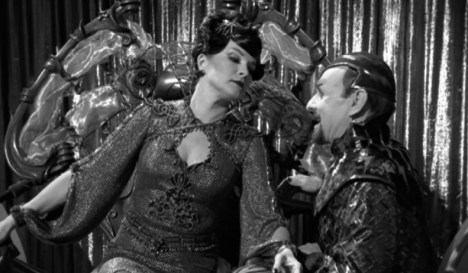
To be fair, it is not a messy disaster. There is nothing particularly novel in how terrible The Emperor’s New Cloak actually is. Most of the awfulness is carried over from Through the Looking Glass and Shattered Mirror. The sharp decline in quality and merit of the mirror universe episodes since the concept’s reintroduction in Crossover has become a gentle slope. The Emperor’s New Cloak is unfunny and broadly homophobic nonsense, clumsily plotted and horribly paced. If it sets a lower bar for these mirror universe episodes, that bar is not appreciably lower.

Not quite having a blast…

The Emperor’s New Cloak is terrible in the same way that Prodigal Daughter and Field of Fire are terrible. It is as though Star Trek: Deep Space Nine has reached a point where its bad episodes are no longer surprising, simply uninspired. No audience member watching The Emperor’s New Cloak will wonder how any of these ideas made it to screen. There is none of the novelty that defined the horrors in episodes like Meridian, Let He Who Is Without Sin… or even Profit and Lace. There is just a creeping sense of fatigue.

In some ways, it makes sense that the most disappointing episodes of the seventh season should be affected by this feeling of exhaustion. The end is nigh, the production team have been working on the series for seven years. Even their bad jokes are no longer shocking, simply tired.

A dark moment for all involved.

Continue reading

Star Trek: Voyager – Gravity (Review)

Gravity is a powerful story, all the more effective for its relative simplicity.

Tuvok has been one of the most overlooked and ignored regular cast members on Star Trek: Voyager. The later seasons tend to neglect Harry Kim and Chakotay, but they had been given considerable focus in the earlier years of the show. Chakotay had been a major focus in The Cloud, State of Flux, Cathexis, Initiations, Tattoo, Manoeuvres and Basics, Part I. Kim had taken centre stage in Emanations, Prime Factors, Non Sequitur and The Thaw. In contrast, Tuvok remained relatively anonymous, more of a supporting player than a narrative focal point.

Vulcan on a ledge.

In hindsight, this appears a rather strange choice. Tuvok is the first full-blooded Vulcan character to appear as a regular on a Star Trek show. Spock is easily the most iconic character in the franchise, to the point that he would be the torchbearer for the JJ Abrams reboot and his family still haunts Star Trek: Discovery. As such, having a fully Vulcan character should have led to all manner of interesting stories. After all, Tuvok was introduced in Caretaker as a spy working undercover in the Maquis. There should have been a lot of material to mine in the set-up.

However, for most of the run of Voyager, Tuvok seemed cast in a supporting role. He was the investigator in episodes where the crew were falsely accused, as Paris was in Ex Post Facto or Torres was in Random Thoughts. He was a reliable sounding board for other characters, as with Kes in Cold Fire or Neelix in Rise or Seven of Nine in The Raven. He was even effectively employed as a mind-controlled monster in episodes like Cathexis and Repression. Tellingly, most of the handful of episodes focusing on Tuvok focus on events where he is not himself; Tuvix, Riddles.

Vulcan love slave.

This is a shame, as there is a lot of fertile ground to explore within Vulcan psychology. Logic is never as clean or simple as Spock made it sound. Existence is full of logical contradictions and inconsistencies. The two best Tuvok-centric episodes of Voyager tend to focus on these inconsistencies. Meld is an episode in which Tuvok asks questions for which there can be no answer, and in which his insistence that the universe is an ordered and logical structure pushes him to some very dark places. Gravity explores the long-standing myth that Vulcans are emotionless.

Gravity is a surprisingly influential episode of Voyager, an episode that explores the implications of an idea which the larger Star Trek franchise had taken for granted for more than thirty years. It is an episode that feels unique in the larger context of Voyager, one build as much around character as action. It is story about love and repression, one rooted very much in who Tuvok is. It might just be one of the best Vulcan-centric stories in the franchise.

Tuvok lightens up.

Continue reading

Star Trek: Voyager – Bride of Chaotica! (Review)

Bride of Chaotica! is an enjoyable mess.

As its title implies, Bride of Chaotica! is a celebration of nostalgic futurism. It is a culmination of a number of themes running through the series. Most obviously, this particular brand of retrofuturism has been a recurring gag since Night at the start of the fifth season, but it fits within a broader context. From the outset, Star Trek: Voyager has been engaged with a more nostalgic sci-fi aesthetic than Star Trek: The Next Generation or Star Trek: Deep Space Nine.

Bride of evil.

Voyager‘s retrofuturism has taken various forms; the old school “space western” tone established by Caretaker, the retro sci-fi trappings of episodes like Innocence or Rise, the monster mayhem of episodes like Phage or Macrocosm, the Cold War paranoia of Cathexis or In the Flesh, Tom Paris’ nostalgic holoprograms in Lifesigns or Vis á Vis, the abductees from the early twentieth century in The 37’s. However, perhaps the most basic is baked into the concept of the show. Voyager is literally a series about the desire to return to a safer and more familiar time.

In some ways, Bride of Chaotica! cements this nostalgia in the context of the larger Star Trek canon, embracing the anxiety that has become increasingly apparent in the years since the thirtieth anniversary. After all, the surrounding feature films all literalise the pull of the past. Star Trek: First Contact has Jean-Luc Picard literally journey back to twenty-first century Earth while revisiting his most iconic moment. Star Trek: Insurrection has the crew discover the fountain of youth. Star Trek: Nemesis confronts Picard with a younger clone of himself.

Radio Chaotica!

It is perhaps telling that Voyager was the moment at which the Star Trek franchise stopped pushing forward. During and after Voyager, the franchise would become increasingly backwards-looking. Star Trek: Enterprise would invite the audience to meet James T. Kirk’s childhood era, trying to recapture that old magic. JJ Abrams’ Star Trek reboot would focus on a young version of Kirk and Spock. Star Trek: Discovery will feature a central character who is something close to Spock’s sister. There is a conscious pull of nostalgia.

Perhaps the future was better yesterday.

Never too far afield.

Continue reading

Star Trek: Voyager – Latent Image (Review)

Latent Image is a powerful allegorical piece of Star Trek, a prime example of how Star Trek: Voyager could occasionally spin gold from its shift towards a more “archetypal Star Trek” template. It is a story that could easily have been told with Data on Star Trek: The Next Generation, for example.

At the same time, Latent Image is a story that touches on many of the core themes of Voyager, many of the show’s key recurring fixations and fascinations. It is an episode about the link between memory and identity, about the importance of preserving history rather than burying it; it touches upon both the metaphorical manipulation of history in stories like RememberDistant Origin and Living Witness and the literal manipulation of the past in stories like Future’s End, Part IFuture’s End, Part IIYear of Hell, Part I and Year of Hell, Part II.

Picture imperfect.

However, it filters that experience through Brannon Braga and Joe Menosky’s recurring fascination with themes of identity and self-definition. The writers have often used the artificial characters on Voyager to explore the malleability of self, how easily the sense of self might be eroded or decayed; the EMH grappled with this challenge in Projections and Darkling, while Seven wrestled with it in Infinite Regress. The artificial characters on Voyager frequently seemed on a verge of a nervous breakdown.

Latent Image is notable for wedding these two concepts together, for integrating these two concepts and exploring the manipulation of an individual’s history as the root of an identity crisis. What happens to the EMH in Latent Image is at once an extension of the dysfunction suggested in Projections and Darkling as well as a more intimate exploration of the cultural identity crises in episodes like RememberDistant Origin and Living Witness. Latent Image suggests that memory is the thread that ties identity together. Without that continuity of self, everything unravels.

A bone to pick with him.

As such, Latent Image exists in an interesting space. It is a story that works very well as a high-concept character study, focusing on the nature of the EMH has a computer programme. Although episodes like Pen Pals suggest that Starfleet has the power to remove memories from biological life forms, the plot of Latent Image could not work as well with a character like Kim or Paris. At the same time, it is a broader allegory about how important memories and experiences are in terms of defining who a person is, and how dealing with these memories defines a cultural identity.

Latent Image is a powerful and clever piece of television.

The camera never lies.

Continue reading

Star Trek: Deep Space Nine – Prodigal Daughter (Review)

Prodigal Daughter is an incredibly limp piece of television.

Prodigal Daughter plays more like a first season episode than a final season episode, the result of a creative process where the writing staff are still trying to figure out how best to approach major characters and even how best to structure individual episodes of the series. There is something distractingly amateurish about Prodigal Daughter, which seems to largely consist of one-shot guest characters standing around drab sets talking about things that happened off-screen. It is not so much bad as it is boring.

Painting a pretty picture.

To be fair, there are reasons for these problems. Ezri Dax was still a new character, and the production team were still getting to grips with her. Although Ezri had been integrated into the ensemble with relative ease, the writers had only given her a single character-focused episode in Afterimage. This was understandable, with everything else going on, but it meant that the character still had to find a unique voice. Beyond that, the structural problems with Prodigal Daughter were largely down to nightmarish disorganisation behind the scenes.

Of course, knowing this does not make it any easier to watch Prodigal Daughter.

Oh, brother!

Continue reading

Characters in Search of an Ending: Prestige Television and Literary Adaptation

The possibilities of prestige television seem limitless.

This is obvious just looking at the creative talent embracing the opportunities of the medium. Director Jane Campion observed, “The really clever people used to do film. Now, the really clever people do television.” It seems fair. Woody Allen has a television series at Amazon. Nicole Kidman and Reese Witherspoon headlined Big Little Lies. Cary Fukunaga directed all eight episodes of the first season of True Detective, starring Woody Harrelson and Matthew McConaughey. Quentin Tarantino reflected, “If ever there’s been a chance for somebody to truly do a filmed novel, it’s in this area.”

There is a sense that prestige television has come to occupy the space that used to be given to mid-tier mid-range movies, thrillers and character studies that were too small to compete with the blockbusters but also weren’t an easy fit for the traditional Oscar season. Television is arguably the place to go for smart character-driven narratives telling adult stories in a restrained and considered manner. It is an interesting shift that has in some ways redefined the relationship between film and television.

Part of this has seen an increased emphasis on book-to-television adaptations. In the past, the default path for audio-visual adaptations of successful novels has been from the page to the silver screen, cinematic takes on iconic and memorable pieces of fiction. After all, countless Best Picture winners have been adaptations of popular novels or short stories; No Country for Old Men, Million Dollar Baby, The Lord of the Rings: Return of the King, The English Patient, Forrest Gump, Silence of the Lambs. A lot of blockbusters are inspired by comic books or young adult novels.

However, as televisual storytelling has grown more complex and ambitious, producers and writers have increasingly looked to the storytelling opportunities afforded by the smaller screen. Television offers more space for writers and directors to tell their stories, to expand out novels with complex mythologies or epic scope. The gaps that had existed between film and television, in terms of budget and talent, are rapidly closing. It is entirely possible for a televisual adaptation of a beloved novel to have a list of credible writers and directors, and recognisable on-screen talent.

Still, as much as this shift might represent an important step forward in the development of television as an artform, it also illustrates some of the problems that still exist in how producers approach the medium. While television shows can do a lot of things that novels can do, they still struggle in one respect. Television shows have yet to truly embrace the power of brevity and the weight of a proper ending.

Continue reading

Star Trek: Deep Space Nine – It’s Only a Paper Moon (Review)

It’s Only a Paper Moon is a fantastic illustration of a lot of things that Star Trek: Deep Space Nine does consistently well.

It is an episode that builds off events depicted in an earlier story, picking up with the character of Nog following the loss of his leg in The Siege of AR-558. In many ways, It’s Only a Paper Moon feels like a necessary part of that earlier adventure, dealing with the consequences of something truly horrific. It would have been cheap and crass to gloss over the enormity of what had happened to Nog. In The Siege of AR-558, the loss of Nog’s leg was a minor detail; one of many reminders of how war is hell. It’s Only a Paper Moon allows that story to play out in more depth.

“I’ll be seeing you…”

It’s Only a Paper Moon is also an episode that feels quite removed from what audiences expect from a Star Trek episode. The central story focuses on two supporting characters who exist outside the regular cast, trusting Nog and Vic Fontaine to carry a story on their own terms. It is a testament to how well-developed the world of Deep Space Nine has become, recalling the focus on Martok in Soldiers of the Empire or Once More Unto the Breach, Dukat in Indiscretion or Return to Grace and Garak in The Wire or Improbable Cause and The Die is Cast.

Unfolding primarily in a holographic recreation of sixties Las Vegas, It’s Only a Paper Moon is a very surreal and unusual episode of Deep Space Nine. However, it works perfectly in the context of Deep Space Nine.

A hard day’s Nog.

Continue reading