• Following Us

  • Categories

  • Check out the Archives


  • Awards & Nominations

Doctor Who: The End of Time, Part I (Review)

To celebrate the fiftieth anniversary of the longest-running science-fiction show in the world, I’ll be taking weekly looks at some of my own personal favourite stories and arcs, from the old and new series, with a view to encapsulating the sublime, the clever and the fiendishly odd of the BBC’s Doctor Who.

The End of Time, Part I originally aired in 2009.

The human race was always your favourite, Doctor. But now, there is no human race. There is only the Master race.

– the Master always did like a good pun

The problem with The End of Time isn’t a lack of good ideas. Indeed, there are far too many good ideas here. There are enough large concepts here to sustain an entire season of Davies’ Doctor Who, from the resurrection of the Master to the return of Gallifrey to the resurrection gate to Naismith to the Tenth Doctor’s impending mortality and quite a few more. The End of Time is bristling with so many ideas and concepts that only the truly outrageous examples really stick. Is that really the Tenth Doctor’s mother?

The End of Time is fundamentally flawed, but it remains intriguing. There’s a wealth of good ideas here that tend to get drowned out in the spectacle and fury of it all, a sense that Davies had a wealth of clever ideas but was unable to tie them into anything fully satisfying.
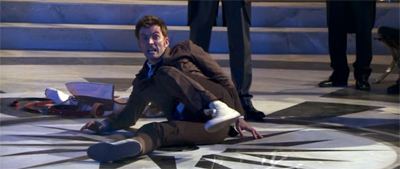
Ten cedes the floor...

Ten cedes the floor…

Continue reading

Doctor Who: The Waters of Mars (Review)

To celebrate the fiftieth anniversary of the longest-running science-fiction show in the world, I’ll be taking weekly looks at some of my own personal favourite stories and arcs, from the old and new series, with a view to encapsulating the sublime, the clever and the fiendishly odd of the BBC’s Doctor Who.

The Waters of Mars originally aired in 2009.

Adelaide, I’ve done this sort of thing before. In small ways, saved some little people, but never someone as important as you. Oh, I’m good.

Little people? What, like Mia and Yuri? Who decides they’re so unimportant? You?

For a long time now, I thought I was just a survivor, but I’m not. I’m the winner. That’s who I am. The Time Lord Victorious.

– the Doctor does a pretty poor job of comforting Adelaide

The Waters of Mars is the strongest of the specials that ran from the end of the fourth season of Doctor Who through to David Tennant’s regeneration into Matt Smith on New Year’s Day 2010. Despite teasing the issue in The Next Doctor and Planet of the Dead, The Waters of Mars is the first time that the show really engages with the mortality of the Tenth Doctor – exploring the idea that it might be time for the Tenth Doctor to leave. As much as the Tenth Doctor might be reluctant to leave, The Waters of Mars suggests that the character’s flaws are gaining critical mass and that his ego runs the risk of collapsing in on itself.

It’s a very bold and daring piece of Doctor Who, which is quite striking given the audience-pleasing “comfort food” nature of the other specials. Reinforcing ideas that Davies has been hinting at since the very start of the relaunch, The Waters of Mars is about how the Doctor can sometimes be absolutely terrifying.

This is what happens when the Doctor goes wrong.

This is what happens when the Doctor goes wrong.

Continue reading

Doctor Who: Planet of the Dead (Review)

To celebrate the fiftieth anniversary of the longest-running science-fiction show in the world, I’ll be taking weekly looks at some of my own personal favourite stories and arcs, from the old and new series, with a view to encapsulating the sublime, the clever and the fiendishly odd of the BBC’s Doctor Who.

Planet of the Dead originally aired in 2009.

Hello, I’m the Doctor. Happy Easter!

– the Doctor sets the mood

Planet of the Dead is light-weight Doctor Who. That wouldn’t normally be a problem. In fact, there’s a significant portion of each season devoted to light-weight run-around adventures. The problem is that it didn’t air as part of a season. It aired as the first piece of Doctor Who since Christmas and the next aired around Halloween. This was something of an attempt to tide fans over, to remind everybody that Doctor Who was still on the air while Steven Moffat and Matt Smith prepared to take over the TARDIS, the BBC got used to filming in HD and David Tennant pursued his career beyond the show.

As a result, the special feel a little funny. In a way, they seem like an attempt to truncate a standard season of Davies’ Doctor Who. The Next Doctor fits the mould of Christmas special quite well. It even snows! The Waters of Mars is the darker second two-parter of the season, dealing with bigger ideas and adult fears. The End of Time is very much a spiritual successor to Journey’s End. All of this is a way of pointing out that Planet of the Dead is clearly designed to serve as the bombastic family-friendly adventure two-parter that typically aired after the first two episodes of a given season.

As such, the logical point of comparison is Rise of the Cybermen, The Sontaran Stratagem or Daleks in Manhattan. Indeed, Planet of the Dead is conspicuous for its gratuitous location shooting; the last time the production team went abroad to film a story was Daleks of Manhattan, even if the cast stayed at home that time. The problem is that those light two-parters are tolerable in the context of a longer series. On its own, Planet of the Dead is far from satisfying.

Egging him on...

Egging him on…

Continue reading

Agents of S.H.I.E.L.D. – Repairs (Review)

Ah! We’re half-way through the first season! It’s an episode written by show runners Maurissa Tancharoen & Jed Whedon! This must be the episode that will finally provide direction to a first season of Agents of S.H.I.E.L.D. that has been coasting on autopilot for weeks now!

Well, it was nice idea in theory at any rate.

May day...

May day…

Continue reading

Doctor Who: The Beast Below (Review)

To celebrate the fiftieth anniversary of the longest-running science-fiction show in the world, I’ll be taking weekly looks at some of my own personal favourite stories and arcs, from the old and new series, with a view to encapsulating the sublime, the clever and the fiendishly odd of the BBC’s Doctor Who.

The Beast Below originally aired in 2010.

What are you going to do?

What I always do. Stay out of trouble. Badly.

So is this how it works, Doctor? You never interfere in the affairs of other peoples or planets, unless there’s children crying?

Yes.

– Amy and the Doctor reiterate the way things work

Steven Moffat’s first season producing Doctor Who owes a conscious debt to the rigid structure of the seasons produced by Russell T. Davies. There’s an opening episode in contemporary Britain, followed by one episode visiting the past, one visiting the future. There are three two-parters – the season finalé, a “monster”-driven two-parter and a more atmospheric and moody piece. There’s even a brief spell in the middle of the season where Moffat spices up the TARDIS dynamic by adding in a temporary companion.

This approach worked quite well. It’s worth noting that Moffat’s first season was the only point following the departure of Russell T. Davies that Doctor Who was able to deliver thirteen episodes of the show on thirteen consecutive weeks. It struck something of a happy middle between Davies’ more episodic approach to the show that the more arc-driven storytelling favoured by Moffat. Still, there are moments when it seems like this approach isn’t quite the perfect fit, with Moffat’s voice struggling to fit into the structure established by Davies.

Essentially Steven Moffat’s impression of Russell T. Davies’ update of Andrew Cartmel’s social allegory stories, The Beast Below is an interesting – if slightly unsuccessful – experiment. Moffat’s second season would feature much more effective attempts to evoke the Cartmel era of the classic show, without the sense that Moffat was trying a little too hard to emulate his predecessor.

The space in-between...

The space in-between…

Continue reading

Doctor Who: The Happiness Patrol (Review)

To celebrate the fiftieth anniversary of the longest-running science-fiction show in the world, I’ll be taking weekly looks at some of my own personal favourite stories and arcs, from the old and new series, with a view to encapsulating the sublime, the clever and the fiendishly odd of the BBC’s Doctor Who.

The Happiness Patrol originally aired in 1988.

Think I’ll hang out here for a while, Doc. See if I can teach this planet the blues again.

Yes, thank you for giving them back to us, Doctor.

– Earl and Susan shouldn’t be so surprised that the Doctor is fond of blue

The Happiness Patrol is an absolutely fascinating piece of Doctor Who. On the surface, it’s another example of the series’ rapidly falling budget and the production values point towards the show’s impending cancellation. While nowhere near as dodgy as Warriors of the Deep, The Happiness Patrol looks like a very cheap piece of television, struggling to realise a futuristic colony on a tiny budget. On a purely superficial level, The Happiness Patrol is really the kind of show that Michael Grade could point to and argue that Doctor Who was a show that desperately needed to be put out of its misery.

However, if the viewer is willing to pull back the layers a bit, and to peer beneath the somewhat rough trappings of The Happiness Patrol, the adventure is really everything that eighties Doctor Who could ever want to be. There is a reason that the serial has, somewhat improbably, endured. In 2010, The Happiness Patrol became headline news in Great Britain, with national newspapers astounded by the audacity of Andrew Cartmel’s vision for the show. The following year, the Archbishop of Canterbury casually name-dropped it in an Easter Sermon.

These references aren’t derogatory. These are proof that The Happiness Patrol, despite its dodgy special effects and the limitations of its production design, is one of the most important Doctor Who adventures of the eighties.

He's perfectly sweet!

He’s perfectly sweet!

Continue reading

Doctor Who: The Long Game (Review)

To celebrate the fiftieth anniversary of the longest-running science-fiction show in the world, I’ll be taking weekly looks at some of my own personal favourite stories and arcs, from the old and new series, with a view to encapsulating the sublime, the clever and the fiendishly odd of the BBC’s Doctor Who.

The Long Game originally aired in 2005.

No, no, you stick with the Doctor. You’d rather be with him. It’s going to take a better man than me to get between you two.

– Adam outlines another reason he had to get kicked out of the TARDIS

The Long Game is a breathtakingly ambitious piece of Doctor Who, for a variety of reasons. The most obvious is the fact that it’s basically Russell T. Davies pushing through a story idea that Andrew Cartmel rejected when he pitched it to the classic show in the eighties, but there are a whole bunch of other reasons. The Long Game is trying to do so many things at once that it ends up getting a little lost. However, it does serve as an example of what Davies was really trying to do with this first season of the revived Doctor Who.

On the surface, The Long Game a clever and daring piece of science-fiction television, a piece of social commentary hidden behind funny-looking aliens and scenery-chewing villains. It’s really a spiritual successor to the science-fiction stories of the Cartmel era. However, it’s also something else entirely. It’s a conscious embrace of the new realities of television, an acknowledgement that these trappings have be blended with character-based storytelling and more modern tea-time telly conventions.

After all, for a show about the manipulation of the media to corrupt the public consciousness, the teaser doesn’t end on a monster reveal or a shocking twist, but a pithy personal comment. “He’s your boyfriend.”

Body of work...

Body of work…

Continue reading

Doctor Who: The Day of the Doctor (Review)

Waste no more time arguing about what a good man should be. Be one.

– Clara sums up the Moffat era in a nutshell

The Day of the Doctor was a suitable anniversary celebration for Doctor Who, feeling like Moffat had borrowed more from The Three Doctors than The Five Doctors in piecing it together, allowing for multi-Doctor interaction grafted over a fairly generic Pertwee-era alien invasion tale. (“Not now!” the Eleventh Doctor protests as the multi-Doctor tale intrudes on his paintings mystery. “I’m busy!”) In terms of scale and spectacle, The Day of the Doctor falls a little bit short. While it looks lavish and clearly had more than a little bit of money thrown at it, the episode lacks a strong central narrative thread.

Instead, it serves as a meditation on who the Doctor is and what that means in the grand scheme of things – looking at the tapestry of his life and character, and trying to reconcile everything that the show was and ever could be. It’s the story of the War Doctor in the Time War, of the death of the classic show and the birth of the new, suggesting that the rift left by the cancellation can finally be healed, that the bridge can be crossed and that wounds might finally be closed.

Well, most of them, anyway.

doctorwho-thedayofthedoctor11

The Three Doctors…

Continue reading

Doctor Who: The Two Doctors (Review)

To celebrate the fiftieth anniversary of the longest-running science-fiction show in the world, I’ll be taking weekly looks at some of my own personal favourite stories and arcs, from the old and new series, with a view to encapsulating the sublime, the clever and the fiendishly odd of the BBC’s Doctor Who.

The Two Doctors originally aired in 1985.

That is the smell of death, Peri. Ancient musk, heavy in the air.

– welcome to the Colin Baker era

The Two Doctors is an oddity. It’s the only story of the Nathan Turner era that runs over two hours, unless you choose to count The Trial of a Time Lord as a single story. It’s also the only “multi Doctor” story that wasn’t filmed on one of the show’s significant anniversaries. (Time Crash was, after all, filmed in the show’s forty-fifth year.) It’s also notable for the fact that it completely eschews the charmingly impish portrayal of the Second Doctor that fans have come to know and love over the course of reunion stories like The Three Doctors or The Five Doctors.

Indeed, The Two Doctors is almost the exact opposite of the show that you would expect it to be. The low opinion in which fans seem to hold the serial confirms that writer Robert Holmes has delivered a story that is markedly different from what those waiting for a team-up between Colin Baker and Patrick Troughton would have been expecting. Far from a nostalgia-packed love-in, The Two Doctors is written with Holmes’ trademark cynicism. This time the writer is directing that cynicism towards the show itself.

Patrick Troughton! In colour!

Patrick Troughton! In colour!

Continue reading

Doctor Who: Blood of the Daleks (Review)

To celebrate the fiftieth anniversary of the longest-running science-fiction show in the world, I’ll be taking weekly looks at some of my own personal favourite stories and arcs, from the old and new series, with a view to encapsulating the sublime, the clever and the fiendishly odd of the BBC’s Doctor Who.

Blood of the Daleks originally broadcast in 2006-2007.

Blood of the Daleks is an interesting piece of Doctor Who lore. It isn’t the first of Paul McGann’s audio adventures in the role of the Doctor. While McGann wasn’t the first of the performers to work with Big Finish, he recorded his first performance in 2001, half a decade before he recorded Blood of the Daleks. He’d gone through years of audio adventures and even a couple of companions before Blood of the Daleks.

Paul McGann been working on the character since before Russell T. Davies had had a chance to structure and plan the revival, and he has been a fixture of the line throughout the tenures of Christopher Eccleston, David Tennant and Matt Smith in the role. However, Blood of the Daleks marks something of a big moment for the character, a definite step forward for his version of the character, and a bold endorsement of his interpretation by the BBC.

Blood of the Daleks didn’t debut on audio CDs in collectible shops. It broadcast on BBC7, less than a week following the broadcast of The Runaway Bride.

doctorwho-bloodofthedaleks

Continue reading