• Following Us

  • Categories

  • Check out the Archives


  • Awards & Nominations

Doctor Who: Voyage of the Damned (Review)

To celebrate the fiftieth anniversary of the longest-running science-fiction show in the world, I’ll be taking weekly looks at some of my own personal favourite stories and arcs, from the old and new series, with a view to encapsulating the sublime, the clever and the fiendishly odd of the BBC’s Doctor Who.

Voyage of the Damned originally aired in 2007.

I’m the Doctor. I’m a Time Lord. I’m from the planet Gallifrey in the constellation of Kasterborous. I’m nine hundred and three years old and I’m the man who’s going to save your lives and all six billion people on the planet below. You got a problem with that?

No.

In that case, allons-y!

– of course, the Doctor’s boasting would be much more effective if most of the cast didn’t die

Voyage of the Damned is an ambitious piece of Doctor Who, at least in terms of scope. It’s very clearly an attempt to do The Poseidon Adventure in space, on a television budget, with a sinister corporate conspiracy layered on top. It’s all this and a big Christmas Special guest starring Kylie Minogue to boot. That’s a lot to pile into a single episode, and Voyage of the Damned strains under the pressure.

There are various flaws that chip away at Voyage of the Damned. It’s very hard to do a disaster movie with about six sets and only one big set piece. The fact that this was all planned ahead of time gives the Doctor a convenient adversary to face, but it does over-crowd the script somewhat; Max Capricorn feels like a cardboard cut-out of a baddie. And Astrid feels less like a fully-formed companion in the style of Donna and more like a generic secondary character.

And yet, despite that, Davies’ ambition is infectious. Even if Voyage of the Damned struggles to carry off everything that it attempts, it’s still a remarkable accomplishment of tea-team Christmas viewing.
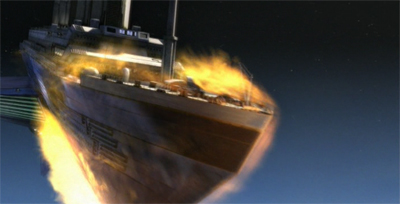
Ship-shape...

Ship-shape…

Continue reading

Doctor Who: The Runaway Bride (Review)

To celebrate the fiftieth anniversary of the longest-running science-fiction show in the world, I’ll be taking weekly looks at some of my own personal favourite stories and arcs, from the old and new series, with a view to encapsulating the sublime, the clever and the fiendishly odd of the BBC’s Doctor Who.

The Runaway Bride originally aired in 2006.

What, there’s like a secret base hidden underneath a major London landmark?

Oh, I know. Unheard of.

– Donna and the Doctor present Doctor Who 101

The Runaway Bride is really more indicative of a Davies-era Christmas Special than The Christmas Invasion was. The Christmas Invasion came with so much narrative baggage to unpack that it even spilt over into the Born Again scene that aired as part of Children in Need. While The Runaway Bride does have to deal with some of the fallout from Billie Piper’s departure in Doomsday, it’s a much more stand-alone piece of Doctor Who.

It’s a very light piece of television, but that’s really the ideal kind of Doctor Who to air as part of the BBC’s Christmas line-up.

He's fire and ice and rage...

He’s fire and ice and rage…

Continue reading

Doctor Who: The Christmas Invasion (Review)

To celebrate the fiftieth anniversary of the longest-running science-fiction show in the world, I’ll be taking weekly looks at some of my own personal favourite stories and arcs, from the old and new series, with a view to encapsulating the sublime, the clever and the fiendishly odd of the BBC’s Doctor Who.

The Christmas Invasion originally aired in 2005.

Oh, that’s rude. That’s the sort of man I am now, am I? Rude. Rude and not ginger.

– the Doctor

Part of what’s remarkable about The Christmas Invasion is that it’s a great big important episode. Not only is it the first Doctor Who Christmas Special, the beginning of a BBC institution, it’s also the first full-length adventure to feature David Tennant in the title role, and so it comes with a lot of expectations. Whereas most of Davies’ Christmas Specials tended to be relatively light fare – enjoyable run-arounds aimed rather squarely at the kind of people who didn’t tune into the show week-in and week-out – The Christmas Invasion is a pretty big deal.

It’s a vitally important part of Davies’ Doctor Who, and one that really lays out a general blue print for where he wants to take the series over the next few years. The fact that so much of this winds up tying back into the final story of the Davies era – The End of Time – is quite striking on re-watch.

Song for Ten(nant)...

Song for Ten(nant)…

Continue reading

Doctor Who: Born Again (Review)

To celebrate the fiftieth anniversary of the longest-running science-fiction show in the world, I’ll be taking weekly looks at some of my own personal favourite stories and arcs, from the old and new series, with a view to encapsulating the sublime, the clever and the fiendishly odd of the BBC’s Doctor Who.

Born Again originally aired in 2005.

Can you change back?

Do you want me to?

Yeah.

Oh.

Can you?

No.

– Rose and Doctor

Davies revived Doctor Who devoted considerable time to reintroducing the core concepts of the series. Unlike The TV Movie, Davies saw no need to over-complicate Rose by featuring the regeneration from the previous Doctor to the current lead. The Ninth Doctor was introduced as-is to an entire generation of new viewers. Only a quick examination of his features in Rose seemed to hint that he was getting used to his new face.

The prospect of “regeneration” hadn’t been flagged too heavily by the time The Parting of the Ways aired. This makes sense. For one thing, there’s a sense that Eccleston’s departure was not something that the production team had accounted for – which makes it even stranger that the whole first season seems to be building towards his redemption in death. For another thing, it’s very hard to drop “by the way, I change into somebody else when I die” casually into conversation.

So the regeneration at the end of The Parting of the Ways was kind of a big deal, and a huge moment for the series. After all, the classic Doctor Who had enjoyed more than three seasons with its lead character before having to swap him out – Hartnell being the last member of the original ensemble to depart. And, given the rules of television narratives in 2005, there was no way that the show’s first regeneration wasn’t going to be a pretty significant event.

Somebody needs a Doctor...

Somebody needs a Doctor…

Continue reading

Doctor Who: Survival (Review)

To celebrate the fiftieth anniversary of the longest-running science-fiction show in the world, I’ll be taking weekly looks at some of my own personal favourite stories and arcs, from the old and new series, with a view to encapsulating the sublime, the clever and the fiendishly odd of the BBC’s Doctor Who.

Survival originally aired in 1989.

Where to now, Ace?

Home.

Home?

The TARDIS.

Yes, the TARDIS. There are worlds out there where the sky is burning, where the sea’s asleep, and the rivers dream. People made of smoke, and cities made of song. Somewhere there’s danger, somewhere there’s injustice, and somewhere else the tea’s getting cold. Come on, Ace, we’ve got work to do!

– the Doctor and Ace turn off the lights on their way out

There was a long gap between Survival and Rose. It was filled with stuff. It was filled with lost of interesting and different Doctor Who stuff. There were books and audio plays and even a television movie to help fill the decade and a half when Doctor Who was not a regular feature of British television. A lot of that stuff was important, and a lot of it helped determine and shape what Doctor Who would become when it did return. It’s telling that the many members of the writing staff on the revived Doctor Who cut their teeth on novels and short stories and audio plays and specials in the wilderness years, while no writers returned from the classic show.

At the same time, however, the gap between Survival and Rose doesn’t feel as profound as it might. It’s misleading to suggest that Survival was a clear bridge towards the Russell T. Davies era, or even to hint that the revival could have emerged fully formed from this three-part closing serial. At the same time, Survival is really the closest that the classic series ever came to the spirit of the Davies era, hitting on quite a few familiar themes and ideas and settings, as if Cartmel’s vision of the future of Doctor Who was not too far from the version proposed by Davies.

Survival was the end of an era, but it also motioned towards the start of another.

Riding into the sunset...

Riding into the sunset…

Continue reading

Doctor Who: The Curse of Fenric – Special Edition (Review)

To celebrate the fiftieth anniversary of the longest-running science-fiction show in the world, I’ll be taking weekly looks at some of my own personal favourite stories and arcs, from the old and new series, with a view to encapsulating the sublime, the clever and the fiendishly odd of the BBC’s Doctor Who.

The Curse of Fenric originally aired in 1989. The special edition cut of the episode was released on DVD in 2003.

I’ve said it a lot over this past year, but you really have to be incredibly grateful for the wonderful team behind the classic Doctor Who DVD releases. Not only do they loving restore classic adventures that might be forgotten to the ages, and not only do they packages the episodes with buckets of in-depth and lovingly-made featurettes, but they also occasionally revisit classic serials to bring them up-to-date, or to move them more in line with the director or writer’s artistic vision. Sure, some of these “special editions” occur in the most random of places (Planet of Fire, anyone?) or simply to remove a few technical impairments holding a story back from being an entertaining romp (as in Day of the Daleks), but occasionally they do something more substantial. In this instance, they make a great adventure into something truly spectacular.

This is not a drill…

Continue reading

Doctor Who: Ghost Light (Review)

To celebrate the fiftieth anniversary of the longest-running science-fiction show in the world, I’ll be taking weekly looks at some of my own personal favourite stories and arcs, from the old and new series, with a view to encapsulating the sublime, the clever and the fiendishly odd of the BBC’s Doctor Who.

Ghost Light originally aired in 1989.

Sir, I think Mister Matthews is confused.

Never mind, I’ll have him completely bewildered by the time I’m finished.

– Gwendoline and the Doctor may as well be talking about the audience

Ghost Light is rather infamous as the “impossible to follow” story from the final year of Doctor Who, the episode that doesn’t quite make sense or fit together as well as it should. Although there’s an element of exaggeration here, there’s also a grain of truth. As with Silver Nemesis, there’s a sense that Andrew Cartmel’s approach to three-part adventures is simply to structure a four-part story and start whittling it down.

Of course, there’s one massive difference between Ghost Light and Silver Nemesis. While Silver Nemesis was a retread of ground that had been covered with more skill and thought in the season premiere, Ghost Light is something altogether different. As difficult as the episode is to piece together – and it’s far from impossible, even if it requires an increased level of engagement from its audience – it is quite brilliant.

Shine on, you crazy survey dude...

Shine on, you crazy survey dude…

Continue reading

Doctor Who: Battlefield – Special Edition (Review)

To celebrate the fiftieth anniversary of the longest-running science-fiction show in the world, I’ll be taking weekly looks at some of my own personal favourite stories and arcs, from the old and new series, with a view to encapsulating the sublime, the clever and the fiendishly odd of the BBC’s Doctor Who.

Battlefield originally aired in 1989.

Pitiful. Can this world do no better than you as their champion?

Probably. I just do the best I can.

– the Destroyer gets to know the Brigadier

Battlefield gets a bit of a bum rap as the weakest story in the final season of the classic Doctor Who. This isn’t entirely fair. Battlefield is a well-produced and thoughtful piece of Doctor Who, it just happens to be inferior to The Curse of Fenric, Ghost Light and Survival; it’s hardly the most damning indictment possible. After all, Battlefield would arguably be treated as an unsung gem had it aired during Colin Baker’s time on the show.

In keeping with Ben Aaronovitch’s last season opener, Remembrance of the Daleks, Battlefield is preoccupied with the history of the show – of its legacy and the artifacts that it carries with it. Archeology is a key theme here, but juxtaposed against a near future setting and the clever conceit of the Doctor manipulating his own history. There’s a wealth of great material here, even if the production never quite lives up to the potential teased.

A beacon of light...

A beacon of light…

Continue reading

Doctor Who: The Twin Dilemma (Review)

To celebrate the fiftieth anniversary of the longest-running science-fiction show in the world, I’ll be taking weekly looks at some of my own personal favourite stories and arcs, from the old and new series, with a view to encapsulating the sublime, the clever and the fiendishly odd of the BBC’s Doctor Who.

The Twin Dilemma originally aired in 1984.

Whatever else happens, I am the Doctor, whether you like it or not. 

– the perfect sentiment on which to enter a nine-month gap

Some mistakes only seem obvious in hindsight. Some errors are easy to judge with the weight of experience and history behind you. Some calls are easy to dismiss and ridicule retroactively, completely divorced from the context in which they were made.

Of course, some mistakes should have been blindingly obvious when they were made in the first place.

Go on, guess which one The Twin Dilemma was.

Hardly a moment of triumph...

Hardly a moment of triumph…

Continue reading

Doctor Who: The End of Time, Part II (Review)

To celebrate the fiftieth anniversary of the longest-running science-fiction show in the world, I’ll be taking weekly looks at some of my own personal favourite stories and arcs, from the old and new series, with a view to encapsulating the sublime, the clever and the fiendishly odd of the BBC’s Doctor Who.

The End of Time, Part II originally aired in 2010.

I don’t want to go.

– the Doctor channels David Tennant and Russell T. Davies

The End of Time, Part II is an incredibly confident piece of science-fiction. It’s also fiendishly self-indulgent. “Where are you going?” Wilf asks the Doctor after the Doctor takes a fatal dose of radiation. “To get my reward,” the Doctor responds, as if he has earned enough credit and kudos that he can cash it in for one last victory lap around the cosmos. Cue an exceptionally sentimental sequence in which the Tenth Doctor visits most of his major companions (and a few minor ones) before he departs.

It’s a nice excuse to trot out the familiar characters from the Davies era one last time. Martha is there; Jack shows up; even Jackie Tyler gets a look-in. It’s not just the Tenth Doctor’s farewell tour of the universe, it’s a reminder of how skilfully Davies has built a world around his lead character. And this was really the last chance for the show to say goodbye to all of that. It makes a great deal of sense, and it’s well earned. Davies resurrected a television show that died a joke and turned it into a success story that was strong enough to anchor the Christmas and New Year schedules. He’s earned the right to be this self-indulgent.

Worlds apart...

Worlds apart…

The problem is that the show seems more than a little entitled, more than a little brash about what is owed to it. The universe owes the Tenth Doctor one last go around; the audience owes Tennant and Davies enough to put up with this sort of ham-fisted sentimentality. There’s a moment when the Doctor seems to honestly consider leaving Wilf to die from radiation poisoning, and rants against the cruelty of the universe. How dare the universe put him in a position where he has to make this sort of moral choice!

The problem is that the episode tries to present this a sympathetic moment. We’re supposed to emphasise with the Doctor as he considers walking away from a poor old man who has been nothing but helpful and trustworthy and friendly to him. The End of Time, Part II is clearly intended as a celebratory romp in the style of Journey’s End, a reminder of how Doctor Who conquered television. The problem is that The End of Time, Part II overplays its hand a bit, and over-estimates how much the audience loves the Tenth Doctor.

Not quite a blaze of glory...

Not quite a blaze of glory…

Continue reading