• Following Us

  • Categories

  • Check out the Archives


  • Awards & Nominations

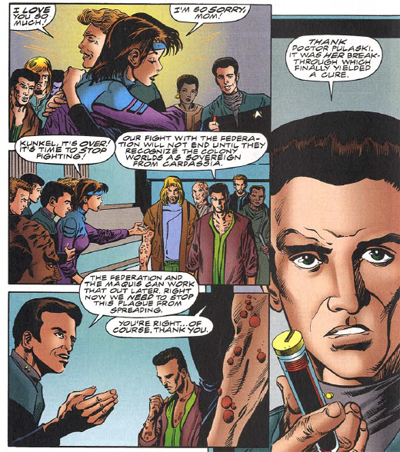
Star Trek: Deep Space Nine (Marvel Comics) #3-4 – The Cancer Within (Review)

This January and February, we’ll be finishing up our look at the second season of Star Trek: The Next Generation and moving on to the third year of the show, both recently and lovingly remastered for high definition. Check back daily for the latest review.

We’ll be supplementing our coverage of the episodes with some additional materials – mainly novels and comics and films. This is one such entry.

Poor Doctor Pulaski. She seems to have just disappeared from the canon. First season casualty Tasha Yar seemed to haunt to the show, returning for Yesterday’s Enterprise while her daughter become a recurring foe from The Mind’s Eye onwards. Even Wesley popped back every once in a while following his departure from the series. Pulaski, on the other hand, remains something of a phantom.

Barring an audible reference to her made in the background during the Star Trek: Voyager finalé Endgame, she disappears from the franchise without so much as a peep at the end of Shades of Grey.  She isn’t even referenced by name in the first episode of the third season to air (Evolution) or the first produced (The Ensigns of Command). While Beverly Crusher’s return is used as a plot point for Wesley, we only get the most fleeting of references to Pulaski in Who Watches the Watchers?

While this can easily be explained by the complex relationship that Diana Muldaur seems to have with Star Trek: The Next Generation. She has suggested the atmosphere on set was decidedly unfriendly, so the fact that Pulaski doesn’t return should not be that much of a surprise. What is interesting is the general apathy that the expanded universe seems to have for Pulaski. While even guest characters seem to get their own back stories and development in novels and comics, Pulaski is treated as a decidedly minor character in the Star Trek canon, reduced to guest spots and small appearances.
I like my family reunions generic and bland...

I like my family reunions generic and bland…

Continue reading

Star Trek: The Next Generation – The Schizoid Man (Review)

This January and February, we’ll be finishing up our look at the second season of Star Trek: The Next Generation and moving on to the third year of the show, both recently and lovingly remastered for high definition. Check back daily for the latest review.

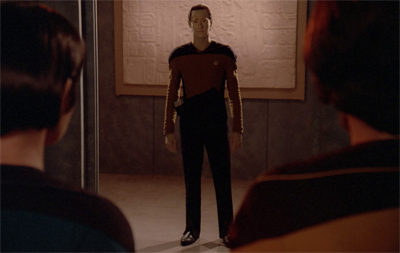
I should probably hate The Schizoid Man. It is certainly a very, very flawed piece of television. It would be a lot more forgivable had it aired during the first season of Star Trek: The Next Generation, when the show was still trying to find its feet – including it early in the second season feels like the show is pushing it a little. In many respects, The Schizoid Man embodies a lot of the (legitimate) complaints about the weaknesses of The Next Generation as a television show: the performances from the peripheral members of the main cast are a bit ropey, there’s an incredibly false sense of urgency generated by techno-babble and the dialogue is just terrible.

And yet, despite that, there’s quite a lot here to like. Stripping away the terrible dialogue and the unnecessary convolutions, The Schizoid Man is a very basic morality play, one touching on themes the show will handle a lot better a few episodes down the line. Brent Spiner is surprisingly creepy as Graves-as-Data, and W. Morgan Sheppard is pretty great in an admittedly thankless part as the misogynistic and creepy Ira Graves.

23rd century Schizoid Man...

23rd century Schizoid Man…

Continue reading

Star Trek: The Lost Era – The Buried Age by Christopher L. Bennett (Review)

This January and February, we’ll be finishing up our look at the second season of Star Trek: The Next Generation and moving on to the third year of the show, both recently and lovingly remastered for high definition. Check back daily for the latest review.

We’ll be supplementing our coverage of the episodes with some additional materials – mainly novels and comics and films. This is one such entry. This is actually supplementary to the first season of the Next Generation, specifically the episode Encounter at Farpoint.

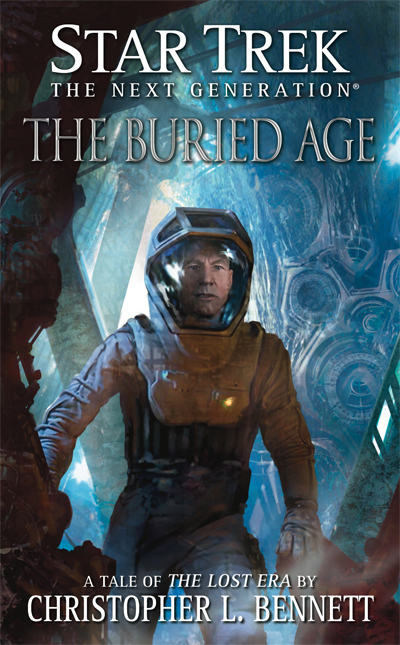
“I’m offering the chance to find something entirely new,” Picard teases at one point in The Buried Age. “To begin filling in a tremendous gap in our understanding of galactic history.” In a way, Picard might as well be addressing the reader, explaining one of the many joys of Christopher L. Bennett’s The Buried Age. It is a chance to delve into the world of Star Trek, exploring the lacuna that exists leading directly into Encounter at Farpoint.

tng-theburiedage

Continue reading

Doctor Who: City of Death (Review)

To celebrate the fiftieth anniversary of the longest-running science-fiction show in the world, I’ll be taking weekly looks at some of my own personal favourite stories and arcs, from the old and new series, with a view to encapsulating the sublime, the clever and the fiendishly odd of the BBC’s Doctor Who.

City of Death originally aired in 1979.

It’s quite good.

Quite good? That’s one of the great treasures of the universe and you say “quite good”?

The world, Doctor, the world.

What are you talking about?

Not the universe in public, Doctor. It only calls attention.

I don’t care. It’s one of the great treasures of the universe!

Shsh!

I don’t care. Let them gawp, let them gape. What do I care?

– Romana and the Doctor discuss the Mona Lisa

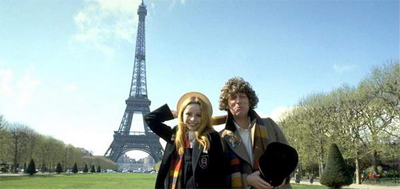
City of Death might divide fans of Doctor Who, with some regarding it as too silly or childish, but I think it’s easily the best Tom Baker serial the show produced, and probably the most entertaining serial for those unfamiliar with the classic show. It helps that the script combines some of the era’s best writers, with “David Agnew” serving to cover contributions from David Fisher, Douglas Adams and Graham Williams. I’ll concede that the farce tended to get a bit much towards the end of Adams’ tenure as script editor, but City of Deathpitches itself perfectly with some wonderful science-fiction concepts peppered over some fine location work, with a side of superb British wit.

From Paris with Love...

Continue reading

Doctor Who: The Awakening (Review)

To celebrate the fiftieth anniversary of the longest-running science-fiction show in the world, I’ll be taking weekly looks at some of my own personal favourite stories and arcs, from the old and new series, with a view to encapsulating the sublime, the clever and the fiendishly odd of the BBC’s Doctor Who.

The Awakening originally aired in 1984.

The Awakening was the third and final of Peter Davison’s smaller two-part adventures, taken once in each of his three seasons in the title role. Much like Black Orchid and The King’s Demons, it feels like a light and refreshing breather, especially in a final season that was becoming gradually darker and more somber. While Black Orchid allowed the cast and crew to take a somewhat relaxing break before the tragedy of Earthshock, The Awakening feels conspicuously grimmer, but still seems a relatively casual affair when measured against the stories that were to follow.

Malus aforethought…

Continue reading

Doctor Who: The Time of the Doctor (Review)

It’s okay, Barnable, don’t worry. I have got a plan. Off you pop.

[beat]

I haven’t got a plan, but people love it when I say that.

Doctor, what are you going to do?

I don’t know. Talk very fast. Hope something good happens. Take the credit. That’s generally how it works.

– the Doctor and Clara discuss standard operating procedure

An epic struggle for universal peace lasting centuries on a back water world; a conflict spanning generations; the potential to re-spark the Time War; the possibility of burning the turkey. The epic and intimate co-mingle in The Time of the Doctor.

In many respects, The Time of the Doctor serves as an effective counterpoint to The End of Time. Even the title seems to allude towards the Tenth Doctor’s final episode, as if to suggest that “time” is a thing that passes naturally rather than ending brutally. “I don’t want to go,” the Tenth Doctor pleaded in his final moments, a line that Moffat gently tried to re-write at the end of The Day of the Doctor. The Eleventh Doctor is more even-handed. “But you, you are the Doctor,” Clara assures him. “Yep, and I always will be,” he replies. “But times change, and so must I.”

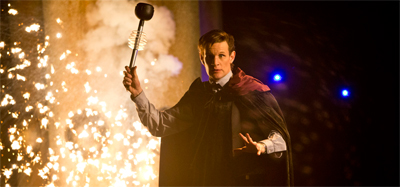
This is when the magic happens...

This is when the magic happens…

(In fact, Moffat has a bit of gentle fun at the expense of The End of Time. Whereas the Tenth Doctor reluctantly sacrificed himself to save Wilf, the Eleventh Doctor quite selfless spends his entire life defending the town of Christmas on the planet of Trenzalore. Discussing the fake regeneration at the climax of The Stolen Earth, the Eleventh Doctor quips, I had vanity issues at the time.” He could easily be hinting at the hubris that built up towards the Tennant and Davies era’s swansong.)

In contrast, The Time of the Doctor was relatively low key. Well, as low key as an episode featuring all of the Doctor’s classic adversaries laying siege to one planet across hundreds of years as the threat of a reignited Time War looms large in the horizon. Still, as wonderful as that epic scale might be, The Time of the Doctor feels like a spiritual companion to Moffat’s other Christmas episodes – the story of the loneliest man in the universe saving Christmas (the town and the holiday), on an intimate scale that just happens to be epic; “the man who stayed for Christmas.”

What's cooking?

What’s cooking?

Continue reading

Doctor Who: The Doctor, The Widow & The Wardrobe (Review)

To celebrate the fiftieth anniversary of the longest-running science-fiction show in the world, I’ll be taking weekly looks at some of my own personal favourite stories and arcs, from the old and new series, with a view to encapsulating the sublime, the clever and the fiendishly odd of the BBC’s Doctor Who.

The Doctor, The Widow & The Wardrobe originally aired in 2011.

I don’t understand. Is this place real, or is it fairyland?

Fairyland? Oh, grow up, Lily.

Fairyland looks completely different.

– Lilly and the Doctor get their geography straightened out

The Doctor, The Widow and the Wardrobe is, like A Christmas Carol before it, a rather wonderful idea. A Christmas Carol mashed up Doctor Who with one of the best-loved Christmas narratives of all time. The Doctor, The Widow and the Wardrobe does something similar, substituting CS Lewis for Charles Dickens. It’s a fantastic idea, given that Doctor Who is the spiritual successor of that peculiarly British thread of childhood fantasy.

The only real problem with The Doctor, The Widow and The Wardrobe is that it can’t quite stretch that good idea across an hour of television.

On the run again...

On the run again…

Continue reading

Doctor Who: A Christmas Carol (Review)

To celebrate the fiftieth anniversary of the longest-running science-fiction show in the world, I’ll be taking weekly looks at some of my own personal favourite stories and arcs, from the old and new series, with a view to encapsulating the sublime, the clever and the fiendishly odd of the BBC’s Doctor Who.

A Christmas Carol originally aired in 2010.

If you’re my babysitter, why are you climbing in the window?

Because if I was climbing out of the window, I’d be going in the wrong direction. Pay attention.

– Kazran and the Doctor get things straight

A Christmas Carol might just be the best Doctor Who Christmas Special ever produced, if only because it’s such a brilliantly obvious idea, executed with the show’s traditional wit and charm. Russell T. Davies tended to write the Christmas Special in the style of a gigantic blockbuster episode of Doctor Who, but Moffat adopts a slightly different approach to what has quickly become the annual tradition of the Doctor Who Christmas Special.

Davies traditionally had the Doctor collide with genres of Christmas television viewing. The Christmas Invasion was American blockbuster sci-fi, The Runaway Bride was fun odd-couple comedy action film, Voyage of the Damned was a disaster flick in space and The Next Doctor was a celebration of quaint Victoriana. In contrast, Moffat has Doctor Who collide with beloved children’s stories in his first two Christmas Specials. His second two are burdened with dealing with left-over plot threads.

A Christmas Carol is perhaps the most effective distillation of “Doctor Who as a story” that the show has ever managed, on top of being a wonderfully moving piece of Christmas television and hitting on the major themes of the Moffat era as a whole.

Turning back the clock...

Turning back the clock…

Continue reading

Doctor Who: The Specials (Review/Retrospective)

In theory, the specials were a great idea. The BBC is in the middle of converting to high-definition broadcast. One of their best-loved and most respected dramas isn’t quite ready to make that leap, and will require extensive re-working in order to be sustainable for high-definition broadcast, which seems to be the future of home entertainment. It’ll be a year before the show can get back to churning out thirteen episodes and a Christmas Special.

However, the show runner who brought the show back from the dead and turned it into a highlight of your broadcast schedule, and the beloved lead actor who has become deeply associated with the lead role are willing to do a series of five specials that you can broadcast to fill the gap year. Producing a series of Doctor Who specials to tide over the viewing public and keep the show fresh in the public’s mind was a great idea. After all, you don’t want fans to forget about the show.

doctorwho-theendoftimepart2o

The plan has the added benefit of allowing Russell T. Davies and David Tennant a bit more freedom to stretch their wings. Davies can work on Torchwood in a way that he was never able to find time before, producing the superb Children of Earth. Tennant can work with Royal Shakespearean Company, playing the lead in Hamlet. All this, and fans get their prescription dose of Doctor Who and the BBC has the time to upgrade the show so it can broadcast in high definition. Everybody wins! Everybody stays happy!

Unfortunately, there’s a bit of a catch. It turns out that these five episodes have to do more than merely “tide” fans over. These five specials are also the last episodes that will be written by Davies and that will star Tennant. So these five specials become more than just a way to stop the public forgetting about Doctor Who. They also have to close out what has been a phenomenal era for the show, and wrap up everything in a nice big bow. And this is where the specials don’t really work.

doctorwho-thewatersofmars19

Continue reading

Doctor Who: The Next Doctor (Review)

To celebrate the fiftieth anniversary of the longest-running science-fiction show in the world, I’ll be taking weekly looks at some of my own personal favourite stories and arcs, from the old and new series, with a view to encapsulating the sublime, the clever and the fiendishly odd of the BBC’s Doctor Who.

The Next Doctor originally aired in 2008.

Oh, goodness me. Well. But this is… but this is nonsense.

Well, that’s one word for it.

Complete and utter, wonderful nonsense. How very, very silly.

– Jackson Lake and the Doctor

The Next Doctor actually has a pretty audacious concept. It’s one gigantic tease that plays off the audience’s media savvy. Airing after David Tennant’s departure from the role had been announced, but before Matt Smith had been named as Tennant’s successor, The Next Doctor is one gigantic tease. Like the surprise “regeneration” at the climax of The Stolen Earth, it’s a shrewd attempt to turn the audience’s expectations against themselves.

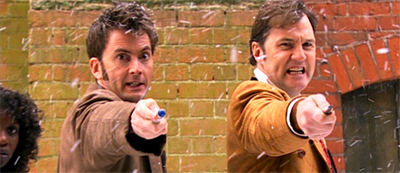
After all, the gap between an announced departure of an existing lead and the point where he actually leaves is rife for experimentation – particularly in a show about time travel. Up until The Next Doctor actually aired, it was quite possible that David Morrissey was Tennant’s successor, and The Next Doctor was a rather clever twist on the classic “multi-Doctor” story by having the Doctor team up with his future self.

Of course, as with The Doctor’s Daughter, Davies was just teasing. It’s to Davies’ credit that The Next Doctor remains interesting even after the illusion begins to slip. The first half is actually a wonderfully solid mystery and character study, albeit one that descends into confusion and chaos in the second half of the episode.

The Next Doctor...?

The Next Doctor…?

Continue reading