• Following Us

  • Categories

  • Check out the Archives


  • Awards & Nominations

Doctor Who: The Five Doctors (Review)

To celebrate the fiftieth anniversary of the longest-running science-fiction show in the world, I’ll be taking weekly looks at some of my own personal favourite stories and arcs, from the old and new series, with a view to encapsulating the sublime, the clever and the fiendishly odd of the BBC’s Doctor Who.

The Five Doctors originally aired in 1983.

There was one chap we tried to get hold of. What was his name? Used to be your scientific advisor.

Oh, the Doctor.

Yes that’s right.

Wonderful chap. All of them.

– Crichton and the Brigadier get into the spirit of things

The Five Doctors is a big anniversary celebration for the franchise, reuniting all five… er, four… er, three of the actors to play the lead role and one guy in a dodgy wig. Written by Terrance Dicks, The Five Doctors is 100 minutes of pure celebration, without too much in the way of depth or drama or development. It’s a beautifully packaged “greatest hits” collection for the franchise, to the point where the generally nostalgic atmosphere of the rest of the twentieth season (pairing up the Doctor with foes from his twenty-year history) can’t help but feel a little a little shallow in comparison.

Producer John Nathan Turner and script editor Eric Saward tended to fixate a bit too heavily on the show’s history and its continuity, with stories often becoming oppressively burdened with in-jokes and references to events that took place decades ago. In contrast, Dicks is able to craft a healthy slice of nostalgia that remains accessible and enjoyable, giving everybody their moment in the sun.

Well, everybody but the Cybermen.

Terrance Dicks does not care for the Cybermen...

Terrance Dicks does not care for the Cybermen…

Continue reading

Doctor Who: Terror of the Zygons (Review)

To celebrate the fiftieth anniversary of the longest-running science-fiction show in the world, I’ll be taking weekly looks at some of my own personal favourite stories and arcs, from the old and new series, with a view to encapsulating the sublime, the clever and the fiendishly odd of the BBC’s Doctor Who.

Terror of the Zygons originally aired in 1975.

Right, let’s see what other damage we can do. Anybody know what this is?

I haven’t the faintest idea.

You tell us.

I will. It’s a self-destructor, and it works like this.

– the Doctor demonstrates to the Duke and Lamont that you don’t ask a question without knowing the answer

Terror of the Zygons is a strange beast. Tom Baker’s first season was bookended by two relics from the Jon Pertwee era. Robot was essentially a Pertwee-era invasion story where the only real difference was Tom Baker’s larger-than-life performance; Revenge of the Cybermen had been commissioned by Barry Letts and felt more like a Pertwee-era space story than anything Hinchcliffe and Holmes would produce.

In contrast, Terror of the Zygons is very definitely an episode of Doctor Who produced by Philip Hinchcliffe and script edited by Robert Holmes. It kicks off one of the show’s strongest seasons, and plays into many of the recurring themes of the era. There are fallen gods and body horror and a sense of the Doctor as a bohemian who won’t be bound by society’s rule. And yet, at the same time, there’s also a sense that Terror of the Zygons is derived from the same basic structure of Pertwee-era invasion story.

In short, Terror of the Zygons feels like it straddles two very different eras of the show, and provides an opportunity for the show to very definitely transform from one form into another.

Let Zygons be Zygons...

Let Zygons be Zygons…

Continue reading

Doctor Who: Night of the Doctor (Review)

To celebrate the fiftieth anniversary of the longest-running science-fiction show in the world, I’ll be taking weekly looks at some of my own personal favourite stories and arcs, from the old and new series, with a view to encapsulating the sublime, the clever and the fiendishly odd of the BBC’s Doctor Who.

Night of the Doctor originally aired in 2013.

I’m a Doctor. But probably not the one you’re expecting.

– isn’t that the truth?

Paul McGann. The “sort of” Doctor; the version of the character that is highly contested by fan and casual viewer alike. With only a single televised story to his credit, produced and filmed in America, McGann was always a controversial part of Doctor Who lore. Before his face appeared in a notebook in Human Nature, there was even debate about whether or not the movie “counted” in the grand pantheon of Doctor Who.

Ironically, McGann’s Doctor has gone on to have one of the most prolific lives of any Doctor. He has appeared in Big Finish audios, webcasts and even a series of audio plays broadcast on BBC radio. McGann has had an impressive volume of output, even without counting the tie-in novels and comics featuring his character, made without his input. The state of limbo in which the character seemed to hover seemed monumentally unfair, a quirk of fate that was the result of powers far beyond those of McGann himself.

So The Night of the Doctor is a pleasant surprise, conferring the ultimate legitimacy upon Paul McGann’s interpretation of the character, effectively confirming the Eighth Doctor as the version who held the flame for the classic series, and whose regeneration marks a turning point for the show.

He really eights himself...

He really eights himself…

Continue reading

Doctor Who: The Three Doctors (Review)

To celebrate the fiftieth anniversary of the longest-running science-fiction show in the world, I’ll be taking weekly looks at some of my own personal favourite stories and arcs, from the old and new series, with a view to encapsulating the sublime, the clever and the fiendishly odd of the BBC’s Doctor Who.

The Three Doctors originally aired in 1973.

Well, Sergeant, aren’t you going to say it that it’s bigger on the inside than it is on the outside. Everybody else does.

It’s pretty obvious, isn’t it?

– the Doctor and Benton

The Three Doctors never seems entirely sure what it’s supposed to be. It knows what it has to accomplish. This was the first serial of the tenth season of Doctor Who, so it has to feature the three versions of the character to date. It also wants to radically shake-up the status quo of the series and to allow Jon Pertwee’s Doctor to take to the cosmos. Those are really the two primary objectives of The Three Doctors, and writers Bob Baker and Dave Martin accomplish them quite well.

The problem is that the story itself isn’t sure what it wants to be. Pertwee-era script editor Terrance Dicks would be a lot more confident when juggling The Five Doctors, conceding that the whole thing was a gigantic nonsensical spectacle. The Three Doctors seems almost like a regular story with the tenth anniversary grafted on to it – it’s easy enough to imagine a rough outline of this story that could work with only Jon Pertwee and without the end of his exile.

As a result, the two strongest beats in The Three Doctors feel almost like afterthoughts, grafted on to the outline of a generic and somewhat bland Doctor Who adventure.

Why does the Doctor hate himself...?

Why does the Doctor hate himself…?

Continue reading

Agents of S.H.I.E.L.D. – The Hub (Review)

Agents of S.H.I.E.L.D. has burnt through a lot of goodwill at this point. Offering a television spin-off from one of the most popular and successful movie franchises of the last decade (if not all time) should be easy; giving the show to long-time collaborators of Joss Whedon should only increase the series’ likelihood of success. The show has the budget and the scope to offer an exciting slice of pulpy comic book entertainment, but all the episodes so far have been incredibly generic, and could easily have been lifted from shows like The X-Files or Fringe.

At least The Hub offers us a sense that the writers are finally pitching shows to the niche filled by Agents of S.H.I.E.L.D. It’s a story about a massive multi-national spy organisation with dark secrets and impossible technology, which places it firmly in the show’s wheelhouse. There are a lot of problems, mostly with finding the right tone, but it seems like Agents of S.H.I.E.L.D. is at least finally finding its own voice. It’s not a strong or distinct voice yet, but there’s still a faint sliver of hope.

Plane sailing...

Plane sailing…

Continue reading

Doctor Who: Blink (Review)

To celebrate the fiftieth anniversary of the longest-running science-fiction show in the world, I’ll be taking weekly looks at some of my own personal favourite stories and arcs, from the old and new series, with a view to encapsulating the sublime, the clever and the fiendishly odd of the BBC’s Doctor Who.

Blink originally aired in 2007.

But listen, your life could depend on this. Don’t blink. Don’t even blink. Blink and you’re dead.

– the Doctor

Like Love and Monsters, Blink is a “Doctor-lite” episode, an effective time- and money-saving measure from the show’s production staff, built around filming an episode that requires the minimal involvement from the lead actors. Also like Love and MonstersBlink is an episode of Doctor Who that is about Doctor Who.

Granted, Steven Moffat’s script doesn’t engage with fandom as directly as Russell T. Davies did. Here, the fans trying to find their own meaning in the show are the anonymous net-izens on forums and fan sites, rather than a friendly group of eccentric individuals enriched by contact with one another.

While Love and Monsters is about how Doctor Who fandom tends to serve to unite diverse people beyond an interest in Doctor Who itself, forming bonds that become more significant and important than the interest in the show, Blink is very much a story about trying to make sense of the show itself.

Rocking the boat...

Rocking the boat…

Continue reading

Doctor Who: Carnival of Monsters (Review)

To celebrate the fiftieth anniversary of the longest-running science-fiction show in the world, I’ll be taking weekly looks at some of my own personal favourite stories and arcs, from the old and new series, with a view to encapsulating the sublime, the clever and the fiendishly odd of the BBC’s Doctor Who.

Carnival of Monsters originally aired in 1973.

Roll up and see the monster show! A carnival of monsters, all living in their natural habitat, wild in this little box of mine. A miracle of intragalactic technology! Roll up! Roll up! Roll–

– Vorg welcomes us to the new world

There’s a valid argument to be made that Carnival of Monsters is the heart of the show’s tenth anniversary celebrations. Sure, it lacks the bombast of recruiting William Hartnell and Patrick Troughton to guest star in The Three Doctors, but it’s very much an affectionate love letter to the show and a bold statement of purpose going forward. With the Time Lord’s ending the Doctor’s exile in The Three Doctors, the whole universe is at his doorstep.

Carnival of Monsters, then, is really the point at which a specific era of Doctor Who can be said to begin. While the First and Second Doctors had journeyed to other worlds and times, they had done so in black-and-white. The whole point of exiling the Doctor to Earth way back in Spearhead from Space was so that the shift to colour wouldn’t destroy the suspension of disbelief. The hope was that grounding the series might make it possible to maintain suspension of disbelief in bright colour.

Here there be monsters...

Here there be monsters…

While the Third Doctor has ventured to other worlds before (Colony in Space, Curse of Peladon, The Mutants), this is the point in the show where Doctor Who becomes the full-colour adventures of a man traveling through space and time in a blue box. This is the point at which cardboard sets and dodgy alien design become more than just occasional quirks – they become an expected part of the formula.

In a way, Carnival of Monsters is just as much a bold statement of purpose as Spearhead from Space was.

In the palm of his hands...

In the palm of his hands…

Continue reading

Doctor Who: Love and Monsters (Review)

To celebrate the fiftieth anniversary of the longest-running science-fiction show in the world, I’ll be taking weekly looks at some of my own personal favourite stories and arcs, from the old and new series, with a view to encapsulating the sublime, the clever and the fiendishly odd of the BBC’s Doctor Who.

Love and Monsters originally aired in 2006.

Someone wants a word with you.

You upset my mum.

Great big absorbing creature from outer space, and you’re having a go at me?

No one upsets my mum.

– the Doctor, Rose and Elton get their priorities straight

Love and Monsters remains one of the most divisive stories of the Davies era, if not the revival in general. It’s the show’s first “Doctor-lite” episode, a production featuring as little of the lead actor in possible in order to make the season’s arduous production schedule just a little bit easier. The Christmas Invasion had added another episode to the mix, and so the idea was that Love and Monsters could be shot during the production block of The Impossible Planet and The Satan Pit in order to allow for a standard length season without increasing an already impressive workload for the leads.

As such, it’s easy to imagine that the “Doctor-lite” episodes could be throw-away adventures, episodes chopped together to meet the quota of stories for a given season – churn them out and focus the attention on to the “bigger” and “more important” adventures. Instead, the “Doctor-lite” episodes have proven to be some of the most experimental and creative episodes of the entire Davies era. While critical and fan opinion remains divided on Love and Monsters, the subsequent “Doctor-and-companion-lite” episodes – like Blink, Midnight and Turn Left – are counted among the best of their respective seasons.

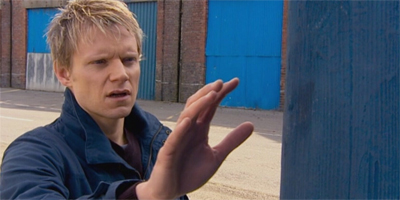
Love and Monsters is a show about Doctor Who. More specifically, it’s about Doctor Who fandom, and a romantic ode to the importance that the show can have in some people’s lives.

Reach out and touch faith...

Reach out and touch faith…

Continue reading

Doctor Who: The Greatest Show in the Galaxy (Review)

To celebrate the fiftieth anniversary of the longest-running science-fiction show in the world, I’ll be taking weekly looks at some of my own personal favourite stories and arcs, from the old and new series, with a view to encapsulating the sublime, the clever and the fiendishly odd of the BBC’s Doctor Who.

The Greatest Show in the Galaxy originally aired in 1988.

Sometimes I think it’s you that’s crazy, not Deadbeat here.

Anybody remotely interesting is mad in some way or another.

– Ace and the Doctor cut to the heart of Doctor Who

It’s very hard to believe that The Greatest Show in the Galaxy aired as the final story of the twenty-fifth season of Doctor Who. Stories like Remembrance of the Daleks and Silver Nemesis were clearly anniversary fodder, celebrating the progress of the show to this point. The Happiness Patrol was a delightfully surreal oddity that has only really been noticed by the general public in recent years, with news breaking in 2010 that Andrew Cartmel had been using Doctor Who to tell politically subversive stories. Which, I suppose, confirms just how few people were watching The Happiness Patrol in 1988.

The Greatest Show in the Galaxy is as concerned with the legacy of Doctor Who as Remembrance of the Daleks or Silver Nemesis, but it lacks the nostalgic shine. Instead, it’s a stunningly bitter piece of television that offers a pretty damning indictment of what Doctor Who had become by the late eighties, a critique of selling out and chasing ratings and living in constant fear that the gods of entertainment – the middle-class families so desperately courted and so carefully catered to – might tune out and consign the show to oblivion.

The Doctor welcomes you to The Greatest Show in the Galaxy...

The Doctor welcomes you to The Greatest Show in the Galaxy…

Continue reading

Watch! Day of the Doctor Trailer!

This being the month of the fiftieth anniversary, we’re going a bit Doctor Who mad here at the m0vie blog. The trailer for the special, The Day of the Doctor, has been released. And you can check it out below. It looks fairly epic. Check back daily over the next few weeks for our latest Doctor Who reviews, both classic and modern.