• Following Us

  • Categories

  • Check out the Archives


  • Awards & Nominations

Doctor Who: Genesis of the Daleks (Review)

To celebrate the fiftieth anniversary of the longest-running science-fiction show in the world, I’ll be taking weekly looks at some of my own personal favourite stories and arcs, from the old and new series, with a view to encapsulating the sublime, the clever and the fiendishly odd of the BBC’s Doctor Who.

Genesis of the Daleks originally aired in 1975.

Genesis of the Daleks is a great little story, and a strong contender for the title of “best Dalek story ever.” It works because Terry Nation takes his creations “back to basics” – not only in terms of time period, but also in terms of basic principles. If the Daleks are the embodiment of total warfare, it makes perfect sense to return to the war that spawned them, giving us an insight into their creation, and the philosophy that launched these deadly xenophobes into the wider universe.

Face of evil...

Continue reading

Doctor Who: Series Four (or Thirty) (Review/Retrospective)

The fourth season of the revived Doctor Who is probably the most consistent of the seasons produced by Russell T. Davies. The first season had a very clear arc running through it, building to a fantastic final run of episodes; the second season had some strong individual elements, but suffered from a lot of behind-the-scenes shuffling; the third season suffered from a shoddy opening stretch, teething difficulties with the show’s first new companion lackluster finalé, despite some great ideas and wonderful experimental plotting.

While the fourth season is far from perfect, it does hang together a lot better than any of the previous three seasons. Watching from Partners in Crime through to Journey’s End, it definitely feels like Russell T. Davies had a stronger sense of where he wanted to go than he had with any of the previous three seasons. It helps that the past three seasons had been spent trying to acclimatise viewers to the workings of Doctor Who. The first season introduced the first Doctor and companion and the Daleks. The second introduced the first new Doctor and the Cybermen. The third introduced the first new companion and the Master.

doctorwho-theunicornandthewasp

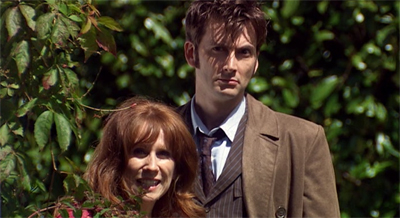
So the fourth season is the first time that the show doesn’t really have too much of a mission statement. Unlike the Daleks or the Master or the Cybermen, nobody was really clamouring to see the Sontarans reinvented, let alone to reintroduce Davros. Like a lot of the foruth season, it seems like the show was really enjoying any freedom from a sense of obligation. The public knew what Doctor Who was. The rules and players had been set out, the past had been acknowledged and the show defined.

As such, the fourth season feels a lot more relaxed for everybody involved.

doctorwho-planetoftheood12

Continue reading

Doctor Who: Journey’s End (Review)

To celebrate the fiftieth anniversary of the longest-running science-fiction show in the world, I’ll be taking weekly looks at some of my own personal favourite stories and arcs, from the old and new series, with a view to encapsulating the sublime, the clever and the fiendishly odd of the BBC’s Doctor Who.

Journey’s End originally aired in 2008.

Stand witness, humans. Your strategies have failed, your weapons are useless, and… oh, the end of the universe has come.

– Davros, master of understatement

Journey’s End covers a lot of ground incredibly quickly. Even running one-and-a-half times the length of a regular episode, Journey’s End feels like it’s ready to burst at any given moment. Those who don’t like Davies’ finalés will find a lot to complain about here. The stakes are raised so high as to become almost abstract. The plot is written into a corner where it takes nothing short of a convenient deus ex machina to resolve it all. The Tenth Doctor and Rose are as annoying together as they have ever been, despite both being quite awesome apart.

However, if you’re looking at The Stolen Earth and Journey’s End as a story, you’re missing the point. The real news is that this was a crowning accomplishment for the series. Not only did The Stolen Earth and Journey’s End both pull a record high Appreciation Index of 91, Journey’s End edged out East Enders and Coronation Street to become the most-watched show on British television that week. This was the first time that Doctor Who had accomplished this since it came back.
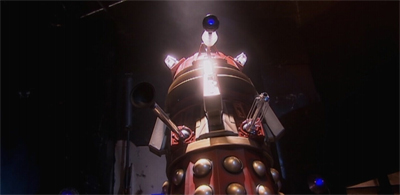
The Daleks' master plan...

The Daleks’ master plan…

The only comparable accomplishment in the history of the show is City of Death scoring the show’s highest ever ratings. And that only happened because an ITV strike made it quite difficult for anybody to watch anything else at the time. So, no matter how you cut it, Journey’s End is a phenomenal piece of event television, one that really solidifies the importance of the resurrected Doctor Who in British popular consciousness.

In a very real way, the title feels somewhat apt. The long journey of Doctor Who from a failed science-fiction show in the wilderness to a crown jewel in British television was finally over.
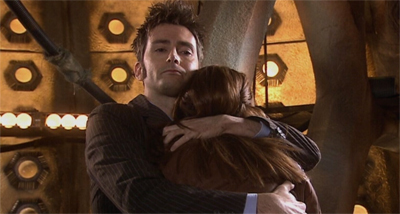
It's been a hell of a ride...

It’s been a hell of a ride…

Continue reading

Doctor Who: The Stolen Earth (Review)

To celebrate the fiftieth anniversary of the longest-running science-fiction show in the world, I’ll be taking weekly looks at some of my own personal favourite stories and arcs, from the old and new series, with a view to encapsulating the sublime, the clever and the fiendishly odd of the BBC’s Doctor Who.

The Stolen Earth originally aired in 2008.

Someone tried to move the Earth once before. Long time ago. Can’t be.

– the Doctor reminds us that just because the Daleks are threatening doesn’t mean they aren’t completely insane

The Stolen Earth and Journey’s End are not, by any stretch of imagination, tightly-constructed episodes. They don’t represent the pinnacle of the Davies era from any technical or production standpoint. The story logic is questionable at best, and Davies’ primary concern seems to be keeping the script moving fast enough that the plot holes and illogical narrative loose ends never overwhelm the production. It is basically the most bombastic and large-scale season finalé of the Davies era. And given that it’s measured against The Parting of the WaysDoomsday and The Last of the Time Lords, that’s really saying something.

And yet, despite that, I have a strange affection for this season finalé. It’s an excuse for Davies to really bask in the success of the revitalised Doctor Who, creating a plot that draws together all manner of disparate elements into one gigantic tribute to the past four years of Doctor Who. It’s hard to hate, on those grounds alone.

An explosive finalé...

An explosive finalé…

Continue reading

Doctor Who: Turn Left (Review)

To celebrate the fiftieth anniversary of the longest-running science-fiction show in the world, I’ll be taking weekly looks at some of my own personal favourite stories and arcs, from the old and new series, with a view to encapsulating the sublime, the clever and the fiendishly odd of the BBC’s Doctor Who.

Turn Left originally aired in 2008.

You said I was going to die, but you mean this whole world is going to blink out of existence. But that’s not dying, because a better world takes its place. The Doctor’s world. And I’m still alive. That’s right, isn’t it? I don’t die. If I change things, I don’t die. That’s that’s right, isn’t it?

– poor Donna… poor, poor Donna

The fourth season is basically one gigantic victory lap for Russell T. Davies’ Doctor Who. Davies has done the hard work of returning the show to television. He’s made the Daleks threatening. He’s rebooted the Cybermen. He’s made the Master sexy again. The fourth season is really just about enjoying the success of the show, and using that success to do crazy things like bringing back the Sontarans or Davros. Because nobody was clamouring for another Sontaran or Davros story.

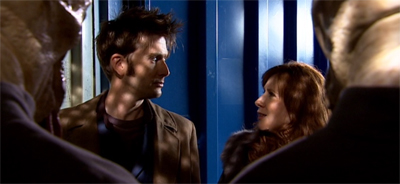
That sense of celebration is probably most obvious in Turn Left, the penultimate story of the fourth season. It’s basically It’s a Wonderful Life, starring the Tenth Doctor. Or, to be more accurate, It’s a Wonderful Life for the new series of Doctor Who. It’s an excuse to celebrate a raft of continuity from The Runaway Bride through to The Sontaran Stratagem, to bring back Billie Piper and just to celebrate not only the wonder of Doctor Who, but the virtue of Davies’ approach to the series.

Everything goes up in smoke...

Everything goes up in smoke…

Continue reading

The X-Files – Season 1 (Review)

Trying to appraise the first season of any show is quite different from judging any other season. While all subsequent seasons have some measure of continuity to build off, some experience to guide the cast and crew, some familiarity to play into or away from, the first season literally starts with nothing. Even when there’s a sizeable gap between the production of the pilot and the start of work on the series proper (with over a year between the filming of The Pilot and Deep Throat), there’s still a sense we’re watching the production team settle into their roles.

All of this is a round-about way of saying that the first season of The X-Files is not a great season of television, judged on its own merits. It’s certainly not the strongest season of the show, which would go from strength-to-strength over the next three years, while also having an ambitious (if not entirely successful) fifth season. The first season of The X-Files is probably the weakest of the first five years of the show, but to express it in those terms is to miss the point.

The first season does a pretty great job laying the ground rules for the franchise, and offers a pretty solid indication of the talent involved in the show, if they can figure out what they want to do. (With quite a few episodes serving as examples of what the show doesn’t want to do.)

xfiles-deepthroat7

Continue reading

Doctor Who: Midnight (Review)

To celebrate the fiftieth anniversary of the longest-running science-fiction show in the world, I’ll be taking weekly looks at some of my own personal favourite stories and arcs, from the old and new series, with a view to encapsulating the sublime, the clever and the fiendishly odd of the BBC’s Doctor Who.

Midnight originally aired in 2008.

And you be careful, all right?

Nah. Taking a big space truck with a bunch of strangers across a diamond planet called Midnight? What could possibly go wrong?

– Donna and the Doctor tempt fate

Midnight was the fiftieth episode of the revived Doctor Who to enter production. It had been intended to air as the fiftieth episode of the new series, but plotting similarities between Forest of the Dead and Turn Left forced Davies to shift the broadcast order of the episodes. As a result, we end up with the longest consecutive streak of Davies-written episodes in the history the show, stretching from Midnight through to The End of Time, Part II. In essence, although it’s not really intended as part of the over all arc, Davies’ swan song begins here.

And it’s the best episode that Davies has ever written. It might be the best episode of the fourth season. It might even compete for the best episode of show produced by Davies.

So it’s pretty great.

The long dark midnight of the soul...

The long dark midnight of the soul…

Continue reading

The X-Files – The Erlenmeyer Flask (Review)

When you think about it, The X-Files conspiracy mythology is just a fancy way of dressing up generational “daddy issues.” Both Mulder and Scully have problems with their fathers, and it plays into the show’s wider themes. The X-Files is, appropriately enough, a show that helps define what is known as “Generation X”, the generation born following the post war baby boom, as the afterglow from America’s ascent to global superpower began to wear off. Existing in the wake of the Cold War, in a unipolar world, The X-Files was a vehicle for introspection.

One of the recurring themes of the show, and one that has come up quite a bit in the first season, is the weight of history bearing down on the current generation. Living in the shadow of Watergate, dealing with the revelation of the Tuskegee Syphilis Experiments, coping the Vietnam and other skeletons, it’s little wonder that Generation X seemed completely disillusioned with their elders. Jamie Notter argued that “unlike their parents who challenged leaders with an intent to replace them, Generation Xers tend to ignore leaders.”

Christine Henseler would go further, suggesting that there’s something close to righteous anger in the attitude that Generation X holds to its parents, holding “a world view” that “is based on change, on the need to combat corruption, dictatorships, abuse, AIDS.” The Erlenmeyer Flask seems the perfect place to end this season then, pushing all this uncertainty to the fore and killing the series’ much-loved father figure.

Bodies of proof...

Bodies of proof…

Continue reading

Doctor Who: Forest of the Dead (Review)

To celebrate the fiftieth anniversary of the longest-running science-fiction show in the world, I’ll be taking weekly looks at some of my own personal favourite stories and arcs, from the old and new series, with a view to encapsulating the sublime, the clever and the fiendishly odd of the BBC’s Doctor Who.

Forest of the Dead originally aired in 2008.

Everybody knows that everybody dies. But not every day. Not today. Some days are special. Some days are so, so blessed. Some days, nobody dies at all. Now and then, every once in a very long while, every day in a million days, when the wind stands fair, and the Doctor comes to call, everybody lives.

– River brings Moffat’s contributions to the Davies era a full circle

There’s actually quite a lot to like about Forest of the Dead. Like Silence in the Library, it doesn’t really push Moffat’s work on Doctor Who that much further. A lot of its big ideas can be found in Moffat’s earlier Doctor Who work. Still, it is quite clever and quite well-written, and a pretty well-constructed episode. This is, after all, the last episode of the Davies era that is not credited to Davies himself. Given it’s written by the showrunner elect, that celebratory feel is justified.

At the same time, however, there are some very uncomfortable gender roles at work in Forest of the Dead for female characters like Donna or River. Moffat would come under a lot of fire during his tenure producing Doctor Who for the way that he wrote female characters, but I’d actually argue that the problems with Forest of the Dead are more in keeping with wider Davies-era trends towards the way that female characters are written.

It just clicked...

It just clicked…

Continue reading

The X-Files – Roland (Review)

Roland is an episode that works much better than it really should. On the surface, it has many of the same problems as Born Again, to the point where it seems like “angry spirits” take up a disproportionate amount of Mulder and Scully’s case load. The filming and broadcast of Born Again and Roland in rapid succession probably points to the kind of pressure that Carter and his crew were under towards the end of the first year – both episodes play a lot better spaced out, and having the room to shuffle the production order on the two stories probably would have helped them seem less derivative.

And yet, Roland is elevated by a superb guest performance. Željko Ivanek isn’t the first stellar guest star that we’ve seen this year. Doug Hutchinson was perfectly cast as Tooms, and Brad Dourif did a marvellous job as Luther Lee Boggs. However, Ivanek might be the first guest star on The X-Files to elevate an otherwise bland episode through the sheer force of his performance.

It doesn't suck or blow...

It doesn’t suck or blow…

Continue reading