• Following Us

  • Categories

  • Check out the Archives


  • Awards & Nominations

Doctor Who: Silence in the Library (Review)

To celebrate the fiftieth anniversary of the longest-running science-fiction show in the world, I’ll be taking weekly looks at some of my own personal favourite stories and arcs, from the old and new series, with a view to encapsulating the sublime, the clever and the fiendishly odd of the BBC’s Doctor Who.

Silence in the Library originally aired in 2008.

There’s the real world, and there’s the world of nightmares. That’s right, isn’t it? You understand that?

Yes, I know, Doctor Moon.

What I want you to remember is this, and I know it’s hard. The real world is a lie, and your nightmares are real.

– Cal and Doctor Moon get to the root of what makes Moffat scripts terrifying

Ah, Silence in the Library. The Steven Moffat story that isn’t, that doesn’t. The first Steven Moffat script that isn’t the strongest story in its season by a clear margin; the first Steven Moffat adventure that didn’t claim the Hugo for Doctor Who. The biggest problem with Silence in the Library and Forest of the Dead is that they can’t quite measure to The Empty Child, The Doctor Dances, The Girl in the Fireplace or Blink. That’s hardly an unforgivable sin, and there’s no shame in not being quite as good an episode of Doctor Who as Midnight was.

I’m quite fond of the two-parter, even though I’ll concede that it has its problems. The most obvious of which is the fact that – four years into the revival – the audience has had a chance to come to appreciate “Moffat-isms”, with many viewers able to recognise the writer’s preferred genre tricks and tropes. Silence in the Library is far from the most original script of the season, but it’s well written and well executed.

It’s just a little too familiar.

Going by the book on this one...

Going by the book on this one…

Continue reading

The X-Files – Born Again (Review)

Born Again is a very bland episode of The X-Files that really suffers from being broadcast this late in the season. Indeed, the first season of The X-Files seems almost obsessed with life after death and reincarnation – we’ve already had episodes like Shadows, Lazarus and even Young at Heart. We’re three episodes from the end of the season, and we’ll still find room for one more “vengeance from beyond the grave!” story before we close up shop. Born Again isn’t bad so much as it’s just bland.

I don’t hate Born Again. In fact, it’s the episode that I remember least from this first season – the only evidence I had that I had seen the episode before came from a vague creeping feeling of familiarity while I was watching it. Even now, as I sit down with my notes to type a review, I’m not sure I can tell you that much about it.

It's only a paper giraffe...

It’s only a paper giraffe…

Continue reading

Doctor Who: The Unicorn and the Wasp (Review)

To celebrate the fiftieth anniversary of the longest-running science-fiction show in the world, I’ll be taking weekly looks at some of my own personal favourite stories and arcs, from the old and new series, with a view to encapsulating the sublime, the clever and the fiendishly odd of the BBC’s Doctor Who.

The Unicorn and the Wasp originally aired in 2008.

Oh, it’s you… I was just doing a little research… I say, what are you doing with that lead piping? But that’s impossible. Oh, no!

– Professor Peach discovers the point of crossover between Agatha Christie and Doctor Who

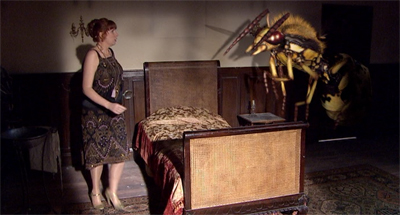
The Unicorn and the Wasp is the most fun episode of the fourth season, by a significant margin. It’s a high-concept high-energy run-around that has a great deal of fun playing with a genre mash-up, as the Doctor intrudes on an Agatha Christie mystery (starring Agatha Christie!) to create curious horror/sci-fi/mystery/class drama hybrid of an episode. It’s an episode that really benefits from the lighter tone of the fourth season. Despite some of the darkness creeping in at the edge of the frame, especially towards the final scenes, it’s an astonishingly light-hearted and playful episode.

In spite of Christie’s stern admonishings, it’s hard not to seize on the story with same glee as the Doctor does.

A sting in the tale...

A sting in the tale…

Continue reading

The X-Files – Tooms (Review)

Tooms offers us the show’s first returning monster, not counting the recurring alien menace that has appeared in episodes like Deep Throat or Fallen Angel or E.B.E. In fact, it arguably offers us two recurring monsters, with Eugene Victor Tooms putting in his second appearance, but also featuring the second official (but third possible) appearance of the Cigarette-Smoking Man.

Appropriately enough, Tooms doesn’t just bring back the eponymous serial killer, it begins to tie various loose ends together, and to fashion a sense of continuity and development from the various character moments and implications of the first season, suggesting that forces are moving in the background, behind the scenes of everything we’ve watched unfold.

They've got him boxed in...

They’ve got him boxed in…

Continue reading

Doctor Who: The Doctor’s Daughter (Review)

To celebrate the fiftieth anniversary of the longest-running science-fiction show in the world, I’ll be taking weekly looks at some of my own personal favourite stories and arcs, from the old and new series, with a view to encapsulating the sublime, the clever and the fiendishly odd of the BBC’s Doctor Who.

The Doctor’s Daughter originally aired in 2008.

Not what you’d call a natural parent, are you?

They stole a tissue sample at gunpoint and processed it. It’s not what I call natural parenting.

Rubbish. My friend Nerys fathered twins with a turkey baster. Don’t bother her.

You can’t extrapolate a relationship from a biological accident.

Er, Child Support Agency can.

– Donna and the Doctor discussing parenting

The Doctor’s Daughter is the weakest script of the fourth season. It’s just a mess of high concepts and ideas and in-jokes mashed together and then cut down to fit into a forty-five minute time slot. It’s a fundamentally flawed episode that has some meritorious elements, but a whole host of other ingredients that just fall flat. It’s the speed bump in the fourth season of the show, Russell T. Davies’ final season of Doctor Who, which had started out of the gate so very strong.

I suppose the real positive of The Doctor’s Daughter is that it doesn’t cause too much damage as it stumbles.

The ball's in his court...

The ball’s in his court…

Continue reading

The X-Files – Darkness Falls (Review)

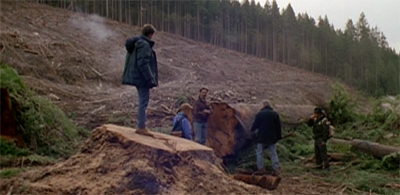
Darkness Falls is the best script Chris Carter has written so far. It it is far superior to Fire or Space or Young at Heart or The Jersey Devil or even The Pilot. It’s quite possibly the strongest normal “monster-of-the-week” episode that Carter ever wrote, discounting his work on “special” episodes (like Post-Modern Prometheus or Triangle) or even some mythology stories (I’m quite fond of Redux).

Darkness Falls is – at its most basic – just a very strong monster-of-the-week installment, hitting all the right buttons to provide an atmospheric horror thriller.

If a tree falls in the woods...

If a tree falls in the woods…

Continue reading

Agents of S.H.I.E.L.D. – The Girl in the Flower Dress (Review)

The first few episodes of any new show are about finding the right balance, striking the right tone. You experiment a bit, you figure out what works and what doesn’t, you try a number of new things knowing that only a few will pay off. The problem with Agents of S.H.I.E.L.D. isn’t that none of the show’s experiments are coming to fruition. It’s that the show seems completely afraid to try anything new at all.

The Girl in the Flower Dress is the show’s fifth episode, but it already feels like something of a reheat, taking the best parts of The Pilot and The Asset, and synthesising them into a single familiar story.

The problem is that the best bits of The Pilot and The Asset weren’t anything to write home about.

A chip off the old block...

A chip off the old block…

Continue reading

Doctor Who: The Poison Sky (Review)

To celebrate the fiftieth anniversary of the longest-running science-fiction show in the world, I’ll be taking weekly looks at some of my own personal favourite stories and arcs, from the old and new series, with a view to encapsulating the sublime, the clever and the fiendishly odd of the BBC’s Doctor Who.

The Poison Sky originally aired in 2008.

They’ve taken it. I’m stuck on Earth like, like an ordinary person. Like a human. How rubbish is that? Sorry, no offense, but come on.

– take that, Jon Pertwee!

Like The Sontaran Stratagem before it, The Poison Sky is pretty effective at accomplishing what it sets out to do. The first two-parter was always a troubled part of the Davies era, and so it feels strangely appropriate that the production team should manage to nail it on the fourth and final go-round. The Poison Sky isn’t the best episode of the show’s superlative fourth season, but neither it nor The Sontaran Stratagem are the worst, either. Instead, it’s a solidly entertaining feature-length adventure featuring the return of various old favourites from the classic show (U.N.I.T.! Sontarans!) and the revived series (Martha! the Valiant!).

It is goofy, silly, and fluffy, but it’s entertaining fluff.

His finger on the button...

His finger on the button…

Continue reading

The X-Files – Shapes (Review)

Shapes feels like something of a companion piece to Shadows. Both are very traditional horror monster stories, feeling a little dated and out of place among the more modern paranoia of The X-Files. Shapes might carefully avoid using the word “werewolf”, instead dressing up the classic movie monster in loose fitting Native American mythology, but it feels like an attempt to pay homage to one of the definitive Hollywood monsters. Unfortunately, like Shadows, it winds up feeling a little stale and tired, a little too familiar and cliché.

It’s a werewolf story that lacks bite.

Chew on this...

Chew on this…

Continue reading

Doctor Who: The Sontaran Stratagem (Review)

To celebrate the fiftieth anniversary of the longest-running science-fiction show in the world, I’ll be taking weekly looks at some of my own personal favourite stories and arcs, from the old and new series, with a view to encapsulating the sublime, the clever and the fiendishly odd of the BBC’s Doctor Who.

The Sontaran Stratagem originally aired in 2008.

Sontar-Ha!

– Sontaran hakka

The expectations for the opening two-parter of any Russell T. Davies season are markedly different from the expectations surrounding the second two-parter or even the season finalé – just as the expectations for the opening few episodes are different from the expectations for a mid-season stand-alone. It should go without saying, but it’s worth stressing at this point. The opening two-parter of a Davies season isn’t meant for the adults in the audience – it’s traditionally aimed towards the kids, with big epic iconic monsters, ridiculous set-pieces, broadly-defined settings and little room for nuance.

That’s not to excuses messes like World War III or Evolution of the Daleks, but simply to place them in context. The Sontaran Stratagem and The Poison Sky aren’t quite as profound or weighty as The Fires of Pompeii or Planet of the Ood. Instead, they offer bombastic spectacle, goofy visuals and a heightened sense of absolutely everything. In other words, The Sontaran Stratagem and The Poison Sky combine to form the strongest opening two-parter of the Davies era.

They hardly represent a crowning artistic accomplishment for the show, but they do a great job of accomplishing what they set out to do.

There's a potato eyes joke here, but I just can't make it work...

There’s a potato eyes joke here, but I just can’t make it work…

Continue reading