• Following Us

  • Categories

  • Check out the Archives


  • Awards & Nominations

The X-Files – Miracle Man (Review)

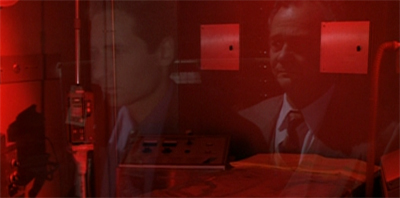
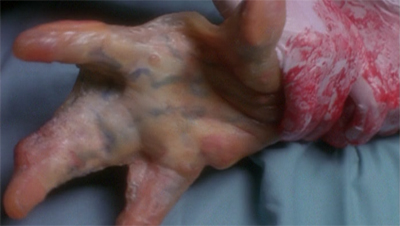
The biggest problem with Miracle Man is that it’s a Howard Gordon script. I don’t mean to diminish Gordon’s contributions to the show. Gordon is one of the strongest contributors to this rocky first season (only Morgan and Wong can claim to be stronger, and they also have their misfires), and he – along with frequent partner Alex Gansa – seems to have the strongest grip on Mulder as a character. And therein lies the most fundamental problem with Miracle Man, the horribly clumsy and muddled ending aside.

Miracle Man feels like it focuses on the wrong lead. It tackles themes and subject matter the show would revisit more successfully in the years ahead, in episodes like Revelations and All Souls. However, the religion-themed episodes in the years ahead would typically focus on Scully – contrasting her religious faith with her scientific skepticism to provide Anderson with some of the best work she’d do on the show.

Instead, Miracle Man digs its character hooks into Mulder, tying back to the disappearance of Samantha for no reason other than “well, this story needs to be about Mulder for some reason.”
Symbolism!

Symbolism!

Continue reading

Doctor Who: Planet of the Ood (Review)

To celebrate the fiftieth anniversary of the longest-running science-fiction show in the world, I’ll be taking weekly looks at some of my own personal favourite stories and arcs, from the old and new series, with a view to encapsulating the sublime, the clever and the fiendishly odd of the BBC’s Doctor Who.

Planet of the Ood originally aired in 2008.

How many Ood in total?

I’d say about two thousand, sir.

We can write them off. That’s what insurance is for.

– Halpen and Kess remind us that these are not nice people

Planet of the Ood is a bit blunt. And by “a bit”, I mean “a lot.” It’s an allegorical exploration of unchecked capitalism and slavery, using the science-fiction setting to tell a story with a familiar moral.Then again, Planet of the Ood largely works because that moral remains rather timely and relevant, but also because it’s a fantastically produced piece of television. It’s fast and pacey, it looks stylish, it has a fantastic cast and an efficient script. Sure, there are rough edges, but Planet of the Ood continues a fairly strong start for the fourth season.

Soaring...

Soaring…

Continue reading

The X-Files – E.B.E. (Review)

While the show was on the air, it seemed like the series’ “mythology arc” – the on-going recurring story arc concerning the government and the Syndicate and the aliens and the colonists and Samantha Mulder – was the best part of the show. Given how The Truth bungled tying up all the loose ends generated over nine years of mythology, hindsight has been somewhat harsh to these episodes. It’s a lot harder to get caught up in Mulder’s cat-and-mouse game against the government when you know the show won’t bother to offer a satisfying conclusion.

And yet, perhaps that isn’t the appeal of these conspiracy episodes. Perhaps these over-arching mythology episodes didn’t grab our attention because they promised long-form storytelling with set-up and pay-off. Certainly, there’s little direct connective tissue between The Pilot, Deep Throat, Fallen Angel and E.B.E., barring the appearance of Deep Throat, who has also guested in shows like Eve or Ghost in the Machine or Young at Heart. At this point in the run, there’s no hint of Mulder’s convoluted familial ties this stretched secret conspiracy, no suggestion the government was complicit in the abduction of Mulder’s sister.

Instead, E.B.E. offers another clever and interesting suggestion about why this government conspiracy plot line appeals to us. It’s nothing to do with a developing story arc, at least not in this place. It’s just a wonderful channel through which we may express our mistrust of authority, the most direct way to focus our well-honed paranoia against those in government, the most straight-forward expression of post Cold War anxiety.

The truth was in here...

The truth was in here…

Continue reading

Doctor Who: The Fires of Pompeii (Review)

To celebrate the fiftieth anniversary of the longest-running science-fiction show in the world, I’ll be taking weekly looks at some of my own personal favourite stories and arcs, from the old and new series, with a view to encapsulating the sublime, the clever and the fiendishly odd of the BBC’s Doctor Who.

The Fires of Pompeii originally aired in 2008.

Pompeii. We’re in Pompeii. And it’s Volcano Day.

– turns out the Doctor likes Steven Moffat scripts as well

What does it mean to be “just passing through” history? To watch events play out, knowing the expected outcome to every major event? To realise that the people you meet have all turned to ash before you were even born? If the Doctor travels through history fighting monsters and saving the world, how can he allow people to die needlessly? Surely it would be just as feasible for him to prevent the Challenger disaster as it is to foil the Nestene? Why can’t he warn people about impending natural disasters? Why do people killed by the Judoon matter more than people killed in car accidents or lightning storms or murdered by other human beings?

The answer is, of course, “because this is a television show”, but it puts the Doctor in a decidedly uncomfortable position. The show is fond of championing the Doctor as a romantic idealist out to make the universe a better place, and one who can’t abide oppression or suffering. And yet he only ever intervenes in cases involving aliens or futuristic technology. Rather than seeming like an agent of radical social change, this tends to make the Doctor feel a bit like an agent of the status quo.

It’s something the show has wrestled with quite a bit, particularly during the Jon Pertwee era. The Fires of Pompeii doesn’t necessarily provide satisfying answers to those questions within the narrative, but it does a lot to develop the role of the Doctor and his own relationship with history.

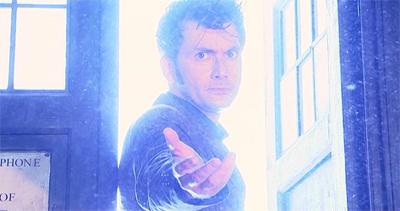
Come with me if you want to live...

Come with me if you want to live…

Continue reading

The X-Files – Young at Heart (Review)

Continuing on from Lazarus, there’s something about Young at Heart that feels very rote, very paint-by-numbers. It’s as if the show has worked so hard to define itself in the first half of the season that the second half of the first season has been dedicated to settling into routine. As far as Chris Carter scripts go, Young at Heart is roughly on par with Fire, and nowhere near as bad as Space, although that’s damning with faint praise. At this rate, Carter should begin to turn out episodes worth watching at some point in the fifth season.

Featuring yet another blast from the past, more gratuitous use of Deep Throat and reckless placing of Scully in danger, Young at Heart feels more like it was assembled from a rough blueprint of what an episode of The X-Files should look like, rather than because it was a story worth telling.

Keep it handy...

Keep it handy…

Continue reading

Doctor Who: Partners in Crime (Review)

To celebrate the fiftieth anniversary of the longest-running science-fiction show in the world, I’ll be taking weekly looks at some of my own personal favourite stories and arcs, from the old and new series, with a view to encapsulating the sublime, the clever and the fiendishly odd of the BBC’s Doctor Who.

Partners in Crime originally aired in 2008.

Would you rather be on your own?

No. Actually, no. But the last time, with Martha, like I said, it, it got complicated. And that was all my fault. I just want a mate.

You just want to mate?

I just want a mate!

You’re not mating with me, sunshine!

A mate. I want a mate.

Well, just as well, because I’m not having any of that nonsense. I mean, you’re just a long streak of nothing. You know, alien nothing.

There we are, then. Okay.

– Donna and the Doctor sort out the ground rules

From the outset, Partners in Crime makes it clear that the fourth season of Doctor Who is probably going to be lighter going than the show’s third year. To be fair, it was heavily foreshadowed by a Christmas special that drew heavily from the work of Douglas Adams, whose influence is keenly felt across this entire season – right down to repeated references to the bees disappearing.

Casting Catherine Tate, best know for her work on The Catherine Tate show, as the season’s female companion was a bit of an indicator, but Partners in Crime makes it quite clear – playing more as an affectionate spoof of a classic Doctor Who run-around rather than something equal parts witty and terrifying.

Then again, given that the end of the third season featured the death of one tenth of the world’s population, the assassination of the President of the United States, the destruction of a companion’s life and the Doctor’s crushing realisation that he’s so lonely he’d retire to serving as the Master’s warden, one might argue that “lighter” was the only way to go.

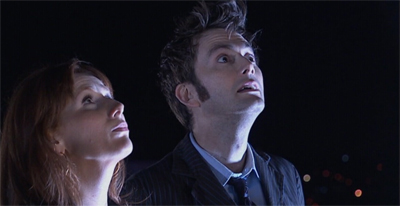
Things are looking up...

Things are looking up…

Continue reading

The X-Files – Lazarus (Review)

And, with Lazarus, we enter a long mediocre stretch in the second half of the first season of The X-Files. To be fair, none of the episodes in this run are anywhere near as bad as Space, but – with the exception of E.B.E., Tombs and The Erlenmeyer Flask – they all feel a little flat. It’s as if the first half of the season was more experimental, as The X-Files tried to figure out what it wanted to be, with the second half dedicated to settling into its particular groove.

Lazarus isn’t terrible. It just feels a little rote, a little paint-by-numbers, a littler average and safe. It’s a conventional enough supernatural (or psychological) thriller, but it lacks that extra “umph” to make it something particularly worthy of a viewer’s time.

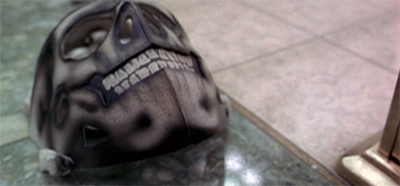
The mask is slipping...

The mask is slipping…

Continue reading

Agents of S.H.I.E.L.D. – Eye-Spy (Review)

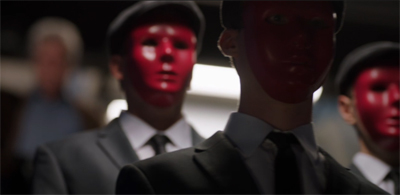
Well, we’re still at the point where Agents of S.H.I.E.L.D. is improving, so that’s something. On the whole, Eye-Spy is a well-produced and stylish piece of television, even if it still feels too light and fluffy and generic for its own good. Like 0-8-4, it feels like the kind of story that the show had to tell at some point, providing an explanation for why Coulson is doing what he is doing and giving him a dark secret from his past. It all feels pretty routine.

Still, there are signs that Agents of S.H.I.E.L.D. might be finding its feet. We still aren’t getting good television, with the show still feeling a little bit too much like a higher-budget and more stylish NCIS spin-off for its own good, but – like The AssetEye-Spy suggests that it might be possible to get good television at some point in the future.

Masque of the red... er, face...

Masque of the red… er, face…

Continue reading

Doctor Who: The Web of Fear (Review)

To celebrate the fiftieth anniversary of the longest-running science-fiction show in the world, I’ll be taking weekly looks at some of my own personal favourite stories and arcs, from the old and new series, with a view to encapsulating the sublime, the clever and the fiendishly odd of the BBC’s Doctor Who.

The Web of Fear originally aired in 1968.

See, now this is interesting.

The Enemy of the World had the luxury of arriving almost unannounced, a genuine honest-to-goodness classic story that had been written off by all but a minority of fans as a generic run-around James Bond pastiche. It was recovered, it turned out to be quite brilliant, and so was a massive surprise. Indeed, even if it had been merely “good” or “fine”, it would have been a joy to watch, because the episode was being measured against a popular imagination that had never really been too bothered with it. I don’t think it was too near the top of the majority of fans’ “would love to recover…” lists.

There were no expectations, so The Enemy of the World didn’t have to worry about measuring up to anything. The fact that it was quite brilliant was icing on the cake. In contrast, The Web of Fear has a lot of expectations to live up to. It is being measured not against the weight of continuity – featuring a much loved monster and introducing a recurring character – nor the sky-high expectations of fans. It is measured against the popular imagination. While The Enemy of the World probably seemed like an after-though to most Doctor Who fans, The Web of Fear is a massive part of what Doctor Who is to the general public.

Fur and loathing...

Fur and loathing…

Continue reading

The X-Files – Gender Bender (Review)

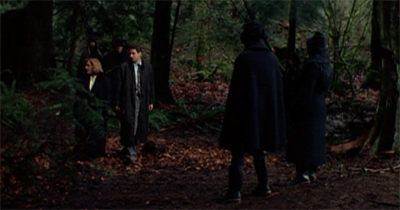
Gender Bender is weird. As an atmospheric moody piece of television, it’s pretty phenomenal – the script manages to tap into a whole bunch of basic nineties fears and uncertainties, while director Rob Bowman layers on the sense that something is not quite right here. On the other hand, as a narrative, the episode comes up short. From the cop-out ending to the laziness of putting Scully in peril twice, the story for Gender Bender is nowhere near as tight as it needs to be.

And yet, despite that, there’s a pervading sense of dread and unease that makes it far more compelling than it should be.

In the woods...

In the woods…

Continue reading