• Following Us

  • Categories

  • Check out the Archives


  • Awards & Nominations

New Escapist Column! On the Perpetual Apocalypse of “Atomic Blonde”…

I published a new In the Frame piece at Escapist Magazine this evening. Since it’s three years old, and there are rumours of a sequel coming, I thought it was worth taking a look at Atomic Blonde.

Released in July 2017 and set in November 1989, there’s a pervasive sense of apocalypse to Atomic Blonde. Set against the backdrop of the fall of the Berlin Wall and released in the early months of the Trump Presidency, Atomic Blonde captures the sense of a world collapsing into madness. The deliberately jumbled spy thriller unfolds as the ordering principles of the Cold War collapse around it. There’s a grim, suffocating, brutal nihilism to Atomic Blonde, one underscored in the film’s central fear: what if the apocalypse itself never actually ends? what if it’s eternal?

You can read the piece here, or click the picture below.


New Escapist Column! On the Cynicism of “Inception”…

I published a new piece at The Escapist earlier this week. Because Inception turned ten years old this week, it seemed like an appropriate opportunity to look back at Christopher Nolan’s blockbuster.

Inception is often discussed as a movie about movies, how the film’s team of dream infiltrators often feel like a team of filmmakers constructing an elaborate spectacle for an audience of one. However, this train of thought is rarely developed beyond the original premise. If Inception is a movie about movies, what exactly does it have to say about movies? How does it feel about them? The answers are surprisingly complicated and nuanced, especially in the context of a summer blockbuster from a director who clearly adores the format.

You can read the piece here, or click the picture below.

New Escapist Column! On the Strange Moral Panic Around “Batman Forever”…

I published a new In the Frame piece at Escapist Magazine this evening. With the film turning twenty-five last month and rumours circulating of a Joel Schumacher cut, it seemed like a good time to discuss Batman Forever.

Following on from Batman and Batman Returns, there was an immediate push for Batman Forever to be a much more conventional blockbuster. One of the interesting consequences of this is the complete erasure of anything that makes a Batman movie distinctive or unique. Batman Forever feels like a moral panic film, one desperately worried how kids might respond to the weirdness or dysfunction of Batman Returns. As such, Batman Forever offers a much more generic, much more conventional, much straighter, less interesting take on the Caped Crusader than any other film.

Indeed, the film resembles nothing so much as the moral panic around the character in the fifties, when – prompted by the publication of Doctor Frederic Wertham’s Seduction of the Innocent – there was a conscious effort to massage the character into a much more straightforward (and less complicated and less provocative) shape. Batman Forever follows a lot of the same playbook, resulting in a vision of Batman just as lost and muddled as so many of those fifties stories.

You can read the piece here, or click the picture below.

New Escapist Column! On “The Old Guard” and Offering Easy Answers to Tough Problems…

I published a new In the Frame piece at Escapist Magazine this evening. The Old Guard was released on Netflix this evening, so it seemed a film that was worth discussing.

The Old Guard is essentially a film that exists half-way between a turn-of-the-millennium high-concept action film and a modern superhero blockbuster, and it doesn’t always split the difference in a particularly elegant way. This is a film that is about the importance of doing good in the world, even when the results aren’t quantifiable or apparent. However, it makes a rather clumsy and facile argument about that, lacking the strength or vision to make its point from first principles.

You can read the piece here, or click the picture below.

Non-Review Review: Greyhound

Greyhound is a tight and claustrophobic maritime thriller that knows pretty much exactly what it’s doing.

At its best, Greyhound capitalises not just on Tom Hanks as the patron saint of dads, boomers and the American cultural memory of the Second World War, but also as a time-displaced Jimmy Stewart. This makes a certain amount of sense. Despite the presence of character actors like Stephen Graham, Rob Morgan and Elizabeth Shue, Tom Hanks is the only star in Greyhound. The film remains tightly focused on Captain Ernest Krause, the commander assigned to protect a convoy of supplies crossing the Atlantic shortly after America’s entry into the Second World War.

It doesn’t exactly shatter expectations.

It makes sense that Greyhound should be tailored to Tom Hanks. Hanks wrote the screenplay, adapting it from C.S. Forrester’s The Good Shepherd. More than that, Hanks has demonstrated his strong interest in the history of American involvement in the Second World War with films like Saving Private Ryan and television series like Band of Brothers and The Pacific. As such, Greyhound feels like it fits perfectly within the actor’s wheelhouse.

This is an illustration of how effectively Greyhound works. Greyhound is a movie that knows what it needs to deliver, and sets about delivering that in the most efficient manner possible.

The old man and the sea.

Continue reading

“There’s Nobody Left But You”: The Existential Horror at the Heart of White Heat…

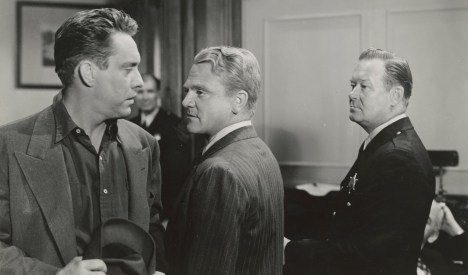
Last weekend, on the podcast I co-host called The 250, we discussed James Cagney’s 1949 gangster classic White Heat, with the wonderful Carl Sweeney from The Movie Palace Podcast. I’ve been thinking a lot about the film since, and so had some thoughts I just wanted to jot down.

White Heat is a gangster film, starring James Cagney.

It’s frequently discussed in relation to The Public Enemy, which makes sense. Both White Heat and The Public Enemy are mid-century gangster films starring James Cagney. It also merits comparison to The Roaring Twenties, another gangster film starring James Cagney and directed by Raoul Walsh. There’s a tendency to lump these sorts of films together, to examine them as part of a greater whole. It certainly makes sense in this context. After all, a huge part of the appeal of White Heat at time of release derived from seeing James Cagney playing a gangster once again.

However, there’s something altogether stranger about White Heat. It isn’t a film that fits particularly comfortably into the gangster genre, despite the obvious trappings. James Cagney plays the role of Cody Jarrett, the leader of a vicious gang introduced conducting a train robbery and who go on to plot a chemical plant raid at the climax. There is all manner of betrayal and violence, backstabbing and revenging. There are cops in dogged pursuit of the criminals, while Cody demonstrates that nobody should underestimate him.

Still, there’s something simmering beneath the surface of White Heat. As much as the film follows the structures and conventions of a crime film, it plays more like a melancholy monster movie. It is a funereal salute to a mythic figure retreating into history, a horror story about an outdated evil lurking in the shadows, trying to navigate a world that no longer has a place for it.
Continue reading

New Escapist Column! On “Predators” as a Film That Understands Its Own Limitations…

I published a new In the Frame piece at Escapist Magazine this evening. Predators is ten years old, so it seemed like an appropriate time to take a look back that second (and best) Predator sequel.

In hindsight, Predators is the rare movie that understands the limitations of its core premise. Fox spent decades trying to turn Predator into a franchise, but the sequels largely disappointed. A large part of this is down to the fact that Predator is a concept anchored in a particular time and place, without the timeless quality of a movie like Alien. In contrast to the other Predator sequels, Predators is a lean and modest machine. It never pushes its central concept too far, instead offering a pulpy and enjoyable b-movie. In doing so, it mostly works as a worthy successor.

You can read the piece here, or click the picture below.

Non-Review Review: Palm Springs

On the surface, Palm Springs is instantly recognisable as a genre-savvy update of the classic Groundhog Day template for the twenty-first century.

The basic plot finds two young adults – Nyles and Sarah – trapped living the same day over and over and over again. There is no escape from this nightmare, which finds the pair constantly reliving the wedding of Sarah’s sister Tala. As befitting the more modern media-literate approach to these sorts of stories, Palm Springs joins Nyles at a point where he has already been trapped in the loop for an extraordinarily long amount of time. He is already as familiar with the rules and limitations of this sort of narrative as any audience member who watched Groundhog Day on loop.

Making a splash.

This level of self-awareness in a story is potentially dangerous, encouraging ironic detachment. It’s very each for stories about these sorts of genre-savvy protagonists to feel more like plot devices than actual characters, particularly when operating within constructs that audiences only recognise from other films. “It’s one of those infinite time loop situations you might have heard of,” Nyles casually explains to Sarah early in the film. Sarah responds, aghast, “That I might have heard of?”

There are certainly moments when Palm Springs feels like it might be just a little too knowing and a little too arch, its own story too consciously framed in terms of familiar narrative devices. Most notably, even though the film is not directly named, one of the big emotional beats in Palm Springs seems to be lifted directly from Jurassic Park. Released the same year as Groundhog Day, it exists within the same nostalgic framework and was just as defining for an entire generation of movie-goers. Moments like that feel just a little bit too heavy-handed.

Some “him” time.

Continue reading

Non-Review Review: The Old Guard

The Old Guard works best as a nostalgic throwback to turn-of-the-millennium action movies, and struggles awkwardly when it tries to be a modern superhero blockbuster.

The Old Guard is adapted by writer Greg Rucka from the Image Comics series that he created with artist Leandro Fernandez. The story focuses on a group of immortal warriors who have worked at the margins of human history for centuries, making small differences wherever they can while trying to stay out of the spotlight. It’s a pretty solid premise with a lot of narrative potential, and it could easily branch in any number of directions.

Immortal narrative engines.

The best and worst thing about The Old Guard is that it insists on branching in various competing directions. It often feels like three or four different movies that have been edited down into a fairly conventional and generic structure. By turns, The Old Guard tries to be a character study about the weight of immortality, a franchise-launching origin story, a criticism of modern hyper-capitalism, a solemn meditation on what it means to do good in a fallen world, and an old-fashioned kick-ass action movie with a pretty neat soundtrack.

To the credit of The Old Guard, it manages to avoid embarrassing itself too badly while trying to serve all of those competing impulses. However, that balance comes at a cost. None of the central ideas in The Old Guard are ever truly explored or developed, because that might mean that some other angle would get a short shrift. The result is an action film that is largely functional, which isn’t entirely satisfying but is also never completely frustrating. It’s a solid and sturdy film that largely avoids a potential identity crisis by declining to commit to a single identity.

An axe-soldier.

Continue reading

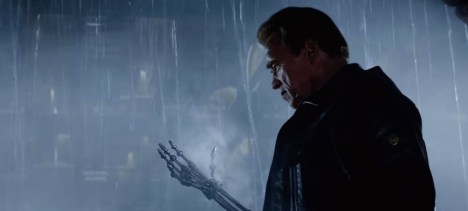
New Escapist Column! On the Cynical Honesty of “Terminator: Genisys”…

I published a new In the Frame piece at Escapist Magazine this evening. Terminator: Genisys turned five years old this month, so it seemed like the right time to take a look back at the third (of four) attempts to make a sequel to Terminator 2: Judgment Day.

Genisys has been largely forgotten, even overridden by the next film in the saga – Terminator: Dark Fate. This makes sense. Genisys itself overrode the previous two films on its own terms. Still, Genisys is an instructive and informative piece of blockbuster cinema. It’s a messy film, but in that messiness there’s an honesty. Genisys is a film that is naked in its ambition and its intent, in its efforts to reiterate and regurgitate the past while erasing any potential evolution. It’s a film that captures the emptiness of modern franchise filmmaking at its most cynical, and its most honest.

You can read the piece here, or click the picture below.