• Following Us

  • Categories

  • Check out the Archives


  • Awards & Nominations

Non-Review Review: The Tomorrow War

The Tomorrow War is a mess of a movie.

Rumour has it that Amazon paid $200m to acquire the movie from Paramount Pictures, which has taken the pandemic as an excuse to offload films like The Lovebirds, The Trial of the Chicago 7 and Coming 2 America. Blockbuster cinema is still something of a siren call for streaming services, with Paramount famously able to entice Netflix into buying The Cloverfield Paradox as a big post-Superbowl release. However, it’s notable that most major studios would be reluctant to part with a surefire financial hit.

“We need to have grown up conversation about how many deaths are acceptable in an alien invasion.”

The Tomorrow War feels very much like a streaming era blockbuster, something to fire up on television rather than to enjoy in cinemas, something that might be justified as a perk that comes with all the free shipping rather than a movie that is worth the audience’s time and attention (and the price of a ticket) on its own merits. The Tomorrow War is a clumsy misfire of a movie, essentially three different movies awkwardly stitched together with a bloated runtime and no internal coherence.

This would be a problem if any of the individual three movies were good. It’s somehow worse for the fact that all three are awful and are worse in combination.

Continue reading

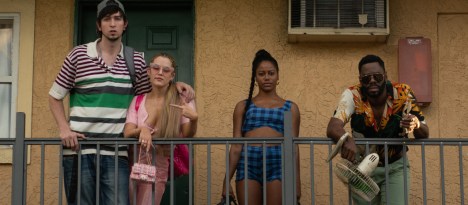
Non-Review Review: @zola

The opening line of @zola is inevitable.

“Y’all wanna hear a story about why me and this b!tch here fell out?” asks Aziah King, the “Zola” of the title. “It’s kind of long but full of suspense.” There was simply no other way that the film was going to start. The line was foregrounded in the movie’s first trailer, and of course it was the opening tweet of the viral twitter thread (#TheStory) that inspired this cinematic adaptation. To put it simply, there was never any way that @zola was going to open any other way.

#NoTimeForReflection

However, the opening line is also a statement of purpose and a key to the film’s central joke. @zola positions that opening salvo as an iocnic statement of itself, a millennial riff on “it was the best of times, it was the worst of times…” and “call me, Ishmael.” The central conceit of Janicza Bravo’s adaptation of the twitter thread is to treat the work like a piece of some modern literary canon, a snapshot of modern America filtered through the prism of art, captured 140 characters at a time. It’s a clever approach, and the best part of @zola is how eagerly it commits to that wry framing.

@zola is an impressive piece of craft, a collision of a very classical formalism with a more modern sensibility to create something that exists in a striking and imaginative space. However, there are times when @zola commits too heavily to studying its characters through the prism of social media, making them feel more like macabre exhibits in some twenty-first century freakshow than actual human beings. Still, @zola sets out to capture an extremely online aesthetic and it largely succeeds – for better and for worse.

#FreaksAndGeeks

Continue reading

Non-Review Review: F9 – The Fast Saga

They say “start as you mean to go on.” So it seems appropriate that F9: The Fast Saga opens with a car crash.

The ninth installment in the Fast and Furious franchise arrives at an interesting time in the run of the series. Vin Diesel has announced that it might be time to retire the franchise, following a closing trilogy worthy of the characters. After much internal drama, two of the franchise’s core characters have spun out into their own franchise with Fast and Furious Presents: Hobbs and Shaw. The series is also still coming to terms with the passing of Paul Walker, who was the glue that held the franchise together. After all, what are Roman and Tej doing on the team now that Brian is gone?

Back in the ‘burgh.

Perhaps understanding that this is a tumultuous time for the Fast and Furious series, F9 makes a number of obvious plays for safe and familiar ground. Justin Lin returns as writer and co-director, a veteran of the franchise who helmed the four films between Fast and the Furious: Tokyo Drift and Fast and Furious 6. Lin directed Fast Five, which is probably the best film in the franchise, existing at the perfect intersection between the series’ origins as a gritty urban western and the bombastic blockbuster behemoth that it would become.

F9 clearly and repeatedly attempts to recapture some of the magic of Fast Five, but only serves to demonstrate that the franchise can’t go home again.

Continue reading

Non-Review Review: In the Heights

When it premiered, Lin-Manuel Miranda’s In the Heights was a radical piece of work.

Miranda had begun working on the musical when he was in his sophomore year of college, producing an eighty-minute version of the play in 1999. He would take a prototype of the completed musical to Waterford, Connecticut in 2005. The show would move Off-Broadway two years later, and would open on Broadway in February 2008. It was a move that very much announced the arrival of Miranda as a serious talent, and would serve as a springboard to his later success with Hamilton.

“There’ll be dancing…
Dancing in the Street…”

In the Heights is set against the backdrop of Washington Heights, a neighbourhood on the north west side of Manhattan. Inspired by Miranda’s own experience as a Puerto Rican immigrant, the musical follows the inhabitants of the neighbourhood as they navigate a changing world. The story is told through the eyes of Usnavi, the young owner of a small bodega who dreams of returning to his home in the Dominican Republic, but who needs to find a way to express his feelings for Vanessa, who is considering a move of her own to the West Village.

Miranda wrote In the Heights as a very pointed response to traditional staged musicals like West Side Story. It’s no small irony that, more than twenty years after it premiered, the film adaptation feels as much like a traditional musical as any of the classics that Miranda had railed against.

Continue reading

Non-Review Review: Luca

There’s an appealing low-stakes gentleness to Luca. In fact, Luca might be Pixar’s first hangout movie.

The film tells the story the eponymous sea monster. The young boy lives off the Italian Riviera, tending to the local fish and dreaming of the world above the surface. One day, following a chance encounter with a more adventurous boy named Alberto, Luca discovers that he can change form when dry. Outside the ocean, Luca and Alberto can pass as human children. Against his family’s better judgment and aware of what might happen if he is discovered, Luca decides to make the most of life above the waves.

“I wanna be where the people are…”

This description makes Luca sound like a retread of The Little Mermaid. That’s not an entirely unfair point of comparison. Both Luca and The Little Mermaid are stories about young characters who dare to dream of a life beyond the underwater world they know. However, Luca has a very distinct mood and ambiance. Luca is not really plot-driven. It lacks a central villain like Ursula or stakes as overt as the terms of Ursula’s spell. Instead, Luca is much more interested in the smaller details that mark a wonderful childhood summer.

Luca is undeniably minor Pixar, but that doesn’t mean it’s especially shallow.

Continue reading

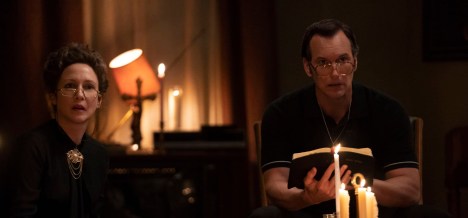
Non-Review Review: The Conjuring – The Devil Made Me Do It

It’s absurd to think that The Conjuring is probably the second most successful shared universe at Hollywood.

Of course, this is arguably more an indictment of the struggles that companies like Warner Bros. and Universal have faced in trying to launch competition for the Marvel Cinematic Universe, but it is still impressive that a gigantic homage to populist seventies horror has successfully grossed nearly two billion dollars across eight films. After all, this is a property anchored in a cinematic nostalgia which has succeeded through casting character actors appreciably older than most horror leads, notably Vera Farmiga and Patrick Wilson, but also Linda Cardellini, Anthony LaPaglia, Miranda Otto, Lili Taylor and Ron Livingston.

“Holy Plot! I mean, this plot… it’s full of holes…”

Following a variety of spin-offs and tie-ins including The Nun, The Curse of La Llorona and the separate Annabelle trilogy, The Conjuring: The Devil Made Me Do It is the third entry in the franchise’s cornerstone series. It is the first entry in that main series not to be directed by James Wan. Instead, Wan hands over directorial responsibilities to Michael Chaves, who helmed The Curse of La Llorona. Still, in terms of aesthetic and scale, The Devil Made Me Do It is recognisable as a continuation and development of the previous two entries in the trilogy.

Much like The Conjuring 2, The Devil Made Me Do It is a curious genre hybrid. It feels like a conscious effort to build a blockbuster horror movie, incorporating elements from more populist films and tying them back to the nuts-and-bolts mechanics of classic horror films. Like The Conjuring 2, this hybridisation is perhaps more interesting than it is effective. It doesn’t entirely work, but it certain merits investigation.

Continue reading

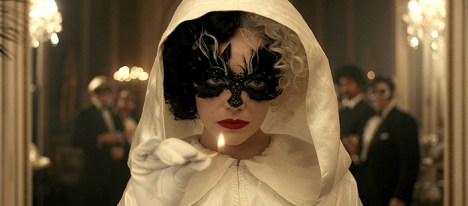
Non-Review Review: Cruella

Cruella arrives as the culmination of two interconnected trends.

Most obviously, Cruella is the latest in the long line of live action (or pseudo-live action) adaptations of classic Disney properties hoping to turn the studio’s animated back catalogue into a source of rich intellectual property that can be steadily mined for quick returns. Movies like Beauty and the Beast, Aladdin and The Lion King all grossed over a billion dollars, so there is surely an audience hungry to see beloved childhood classics transferred into live action.

Ready for some hot takes?

Ironically enough, 101 Dalmatians was one of the first films to make that leap from pencil and inks to live action, with an adaptation (and a sequel) in the mid-nineties. Indeed, it’s arguable that Glenn Close’s incarnation of Cruella DeVil looms just large enough in the culture that a simple reboot of the premise might feel a little gauche. Jon Favreau could direct a second pseudo-live-action version of The Jungle Book for the company, but only because the earlier effort had no cultural footprint.

So Cruella is not content to be a straight-up reimagining of the classic Disney cartoon. Instead, the film draws from another contemporary trend when it comes to managing these intellectual properties: the villain-centric reboot. Cruella is arguably of a piece with recent pop culture like Ratchet, Maleficent or Joker, all works that reimagined a familiar intellectual property through the lens of its antagonist. There is evidently money in this concept, with Joker earning over a billion dollars and Maleficent earning half a billion and inspiring a sequel.

A crime of fashion.

So Cruella offers an origin story for the classic Disney villain, inviting the audience to get to know the monstrous fashion designer whose defining character trait was her desire to skin a lot of adorable puppies to make the perfect coat. It’s certainly an ambitious assignment. While Cruella is one of the most striking villains in the Disney canon, with one of the catchiest theme songs, she is hardly the most complex or nuanced. There’s hardly a lot of tragedy to be mined in a character so horrifically monstrous that “if she doesn’t scare you, no evil thing will.”

This sets up the central tension in Cruella, and the problem that the movie never quite manages to resolve. Cruella is a much stronger movie whenever it allows itself to drift away from the shadow of 101 Dalmations and become its own thing, but it suffers greatly when it finds itself drawn back into the gravity of the original Disney classic. Cruella works reasonably well as a seventies-set fashion heist movie, but struggles when it tries to be a compelling villain origin story for a character who really never needed one.

Continue reading

Non-Review Review: Spiral – From the Book of Saw

Spiral: From the Book of Saw is an interesting, if dysfunctional, franchise extension.

The obvious point of contrast is something like Jigsaw, the last attempt to restart the Saw franchise. Jigsaw was released in 2017, two years after Star Wars: Episode VII – The Force Awakens, and it bet big on a particular kind of nostalgia. It was a film that consciously aspired to evoke the memory of the Saw franchise among an audience that had probably seen an entry or two in the franchise a decade earlier and had vague memories of the experience.

Rocking the boat.

Jigsaw offered a much more polished take on the Saw template, eschewing the grimy green and grey aesthetic of the previous seven films in favour of a crisp sheen. Still, the film worked very hard to demonstrate its affection and veneration for the source material, even while offering superficial updates like moving the action into the countryside and swapping blades for lasers. The company logos at the start of Jigsaw appeared over a remix of Hello Zepp. Billy the Puppet got a makeover. Tobin Bell got considerable screentime as John Kramer, and the film tied itself to his back story and history.

Spiral takes a very different approach to its nostalgia. The film is the first in the series not to feature the character of John Kramer. Billy the Puppet has also been retired. While a variation on Hello Zepp does eventually play, Spiral holds it back and makes the audience wait for the pay-off. Spiral is very much part of the larger Saw franchise, and contains the requisite death traps and even brings back director Darren Lynn Bousman, but it feels like a consciously pared down and “back to basics” approach to the franchise that strips out a lot of the clutter that has accrued over the franchise’s long life span.

Bloody horrific.

This is most notable with the film’s sharp genre shift. While all of the earlier Saw movies had some procedural element that followed law enforcement’s efforts to track down and stop the serial killer, Spiral centres this thread. Spiral is arguably a forensic thriller with gory elements, rather than a gory horror with a dash of forensic thriller for flavour. It’s a clear attempt at a fresh start, with Spiral even relegating the Saw brand to the subtitle while leaning more heavily on the spiral and pig imagery that was largely secondary in the original franchise.

The result is fascinating, even if it doesn’t quite work. Spiral is arguably a “back to basics” take on the Saw franchise, going so back to basics that it draws more heavily from the serial killer thrillers that originally inspired Saw than it does from the Saw movies themselves.


Continue reading

Non-Review Review: Army of the Dead

Zack Snyder’s Army of the Dead arrives with relatively few expectations.

There’s something very refreshing and very appealing in this, particularly given the way that Snyder has become a cultural flashpoint due to his work on films like Man of Steel and Batman vs. Superman: Dawn of Justice, not to mention everything involving the production and release (and subsequent restoration) of Justice League. With all of that in the rear view mirror, it is exciting to sit down and watch as Zack Snyder movie that is… just a Zack Snyder movie.

Warding off evil.

Indeed, Army of the Dead is arguably something of a throwback for the director, marking a return to his earliest work. As a hyper-violent zombie action movie with a satirical edge, Army of the Dead invites comparisons to his first feature-length film, his remake of George A. Romero’s Dawn of the Dead. However, Army of the Dead is not a belated sequel or continuation. It is that rare modern big-budget genre film that stands as much on its own as it is possible for a high-concept zombie movie.

Army of the Dead is not a masterpiece by any stretch. It’s a little indulgent and overlong, suffering from the familiar pacing and tonal issues that affect many movies produced by Netflix. However, Army of the Dead is a fun and interesting genre if approached on its own terms. More than anything, freed from the constraints of established properties and shared universes and the ensuing scrutiny, Army of the Dead feels like Snyder is actually having fun. It is hard to begrudge it that.

Continue reading

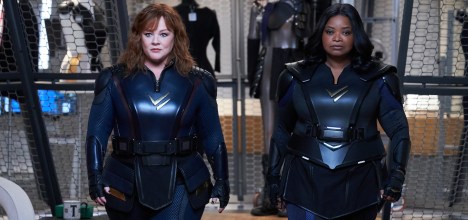
Non-Review Review: Thunder Force

There is a recurring joke in Thunder Force about how one character cannot tell a joke. It feels like a metaphor for the film itself.

To be fair, it’s more than just the premise of that joke itself, it is also the execution. The opening section of Thunder Force offers something of an origin story for its two lead characters, Lydia and Emily. The two meet at school. At school, their only other friend is a geeky kid named Clyde. In these flashbacks, Clyde is introduced with an obvious crush on Lydia, and an inability to tell a joke properly. When the film rejoins Lydia in adulthood, Clyde is quickly reintroduced and still unable to tell a joke properly.

A thundering disappointment.

The basic law of comedy – or storytelling – would suggest that this is a plot point being set up so that it might pay off. It is the standard “rule of three.” A concept is introduced to the audience. It is then repeated to establish it. Then, finally, it is subverted. It is that third iteration of the concept that serves as a punchline. It’s the heart of the joke. Instead, Clyde just disappears from the film. His inability to tell a joke is ultimately just an inability to tell a joke. It eats up screentime in building this world, and doesn’t go anywhere.

There’s something almost fourth-wall-breaking in this. It’s a joke about how a character in this movie cannot tell a joke, told in such a way that it isn’t really a joke either. It’s a moment that captures so much of Thunder Force, albeit in an unflattering light. It is also, much like the rest of Thunder Force, painfully unfunny.

The script could use a punch-up.

Continue reading