• Following Us

  • Categories

  • Check out the Archives


  • Awards & Nominations

15. Keloglan vs. The Black Prince (-#17)

Hosted by Andrew Quinn and Darren Mooney, The Bottom 100 is a subset of the fortnightly The 250 podcast, a trip through some of the worst movies ever made, as voted for by Internet Movie Database Users.

This time, Keloglan vs. The Black Prince.

At time of recording, it was ranked the 17th worst movie of all time on the Internet Movie Database.

Happy new year!

podcast-keloglanvstheblackprince

Continue reading

Star Trek: Voyager – Revulsion (Review)

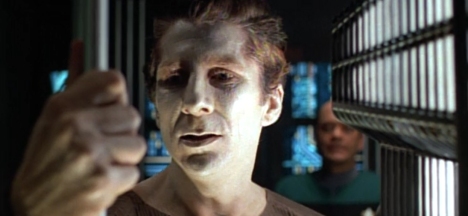
Revulsion is a solid episode elevated by a superb guest performance.

The most notable aspect of Revulsion is the guest appearance of veteran character actor Leland Orser. Orser’s screen presence is striking, making an impression with supporting role in high-profile films from The Bone Collector to se7en to Alien Resurrection to Daredevil. He has also worked reliably in television, holding down regular roles in shows like E.R. and Berlin Station, while recurring in series like 24 and Ray Donovan. To modern audiences, he is likely recognisable got his work as a fixture of the Taken franchise.

Not just holo praise.

Not just holo praise.

Even within the Star Trek franchise, Orser is very much a recurring fixture. While never a steady player like J.G. Hertzler or Jeffrey Combs, Orser made quite an impression. He played the changeling posing as Tal Shiar operative Colonel Lovok in The Die is Cast on Star Trek: Deep Space Nine, making the most of a rather minor role in one of the series’ most memorable two-part episodes. He would also do good work as the venal Loomis in the otherwise disappointing Carpenter Street during the third season of Star Trek: Enterprise.

However, his guest appearance in Revulsion on Star Trek: Voyager remains his most distinctive turn in the franchise. Playing Dejaren, a psychotic and fragmented hologram who murdered his crew, Orser singlehandedly elevates would could easily be a tired genre exercise. Revulsion is a solid episode, but one that sticks in the memory almost entirely due to the casting.

Kali Ma!

Kali Ma!

Continue reading

Non-Review Review: T2 Trainspotting

“Nostalgia,” Sick Boy scoffs. “You’re a tourist in your own childhood.”

It is no surprise that Trainspotting 2 is saturated with nostalgia. It is, after all, a long-delayed sequel to a beloved nineties classic, a prestige picture counterpart to Jurassic World or Independence Day: Resurgence. Despite its fine pedigree, Trainspotting 2 is subject to the same basic questions. Is this really necessary? Does the original require a sequel? Can this film be judged on its own terms? Why now? Is there anything more to the film than cynical nostalgia?

An impressive pool of talent.

An impressive pool of talent.

After all, one can never go home again. Any true sequel to Trainspotting would not be a film directed by Danny Boyle, featuring these characters or carrying this branding. Part of the appeal of Trainspotting was its gritty youthful aesthetic, the product of a young film-maker and a young cast with everything to prove against all odds. This is fundamentally at odds with approaching the original as a venerate relic and building a worshipful sequel around it. That is the central tension of Trainspotting 2.

This is also a key strength of Trainspotting 2. At its strongest, Trainspotting 2 is more a movie about the trap of nostalgia and the dangers of its sweet allure than a sequel to the adventures of four heroin addicts in nineties Edinburgh. Still, Trainspotting 2 is trapped in the gravity of its younger and angrier self. Trainspotting was a young man’s film, all manic energy and desperation and iconoclasm. Trainspotting 2 is a middle-aged man’s film, affectionate and soft in the middle. Its desperation is quieter and less endearing.

Projecting?

Projecting?

Continue reading

Non-Review Review: xXx iIi – The Return of Xander Cage

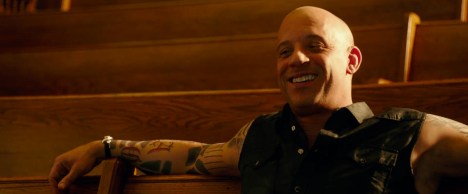
Perhaps the most endearing aspect of xXx iIi: The Return of Xander Cage is how absurd the movie feels, on just about every level.

xXx iIi is the third in a trilogy of films that launched in 2002. xXx is highly unlikely to rank as anybody’s favourite Vin Diesel film, sitting somewhere below The Fast and the Furious and Pitch Black on the “viable Vin Diesel movie franchises” scale. The movie was very much part of that turn-of-the-millennium attempt to craft an American answer to the highly successful James Bond franchise, and as such had arguably been rendered redundant by The Bourne Identity two months before it was released.

Quite Cagey on the matter.

Quite Cagey on the matter.

In fact, xXx was such an underwhelming Vin Diesel vehicle that the performer did not return for the sequel three years later. In xXx II: State of the Union, the extreme sports daredevil was replaced by a veteran marine played by Ice Cube. As such, it seems strange that the third film in the trilogy should be released fifteen years after the original and more than a decade following the only sequel starring a substitute lead. It is very hard to argue that the world was crying out for a xXx sequel promising the return of a low-tier Vin Diesel persona.

In its best moments, xXx iIi actively embraces that absurdity and swivels into the insanity. There are points at which xXx iIi ultimately collapses under its own ridiculousness, as it struggles to fill the gaps between admirably over the top set pieces with terrible dialogue delivered by a fairly weak cast. However, there are also moments when xXx iIi works much better than it should, if only because it recognises the absurdity of its own existence and just runs with it.

It's good to be back.

It’s good to be back.

Continue reading

Star Trek: Deep Space Nine – A Time to Stand (Review)

And so Star Trek: Deep Space Nine has changed once again.

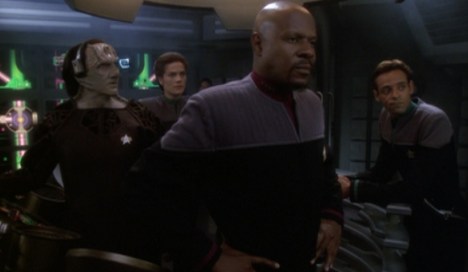
A Time to Stand represents a new beginning for Deep Space Nine, kicking off an ambitious six-episode arc that effectively sets up both the status quo and the tone for the final two years of the series. To be fair, this version of the show is very clearly the model to which the fourth and fifth seasons had been building. It is not quite a second (or third, or fourth) pilot in the style of The Search, Part I and The Search, Part II or The Way of the Warrior, but it is very clear that Deep Space Nine is entering a new stage of its evolution at the start of its penultimate sequence.

Touching reunion.

Touching reunion.

More than that, this opening six-episode arc very clearly serves to set up and establish themes and ideas that will play out across the series’ remaining episodes; Kira suggests she will support Odo’s decision to return home in Behind the Lines, Damar’s alcoholism and the shame it hides is introduced in Behind the Lines, Sisko talks about the house that he plans to build on Bajor in Favour the Bold, the Prophets promise that a price will be exacted from Sisko in Sacrifice of Angels.

Although the formal declaration of war came at the end of Call to Arms, the sixth season premiere truly ushers in the era of the Dominion War.

New frontier.

New frontier.

Continue reading

Star Trek: Voyager – Nemesis (Review)

Nemesis is a great example of Star Trek: Voyager pitching itself as generic Star Trek.

This is a story that is not unique or particular to this crew. In fact, the story could easily be adapted to service characters from Star Trek: The Next Generation or Star Trek: Deep Space Nine or even Star Trek: Enterprise. In some respects, Nemesis might even work better if Robert Beltran were swapped out for Jonathan Frakes or Colm Meaney or Connor Trinneer. There is very little in the script that relies on the particularities of this show or the nuances of its characters.

The Rifleman...

The Rifleman…

While this lack of a distinct identity is a problem for Voyager as a television series, it does lead to some great episodes. Many of the best episodes of Voyager could easily be ported to or from any of the other shows. It was an approach that really came to the fore during the third season, when Jeri Taylor and Brannon Braga made a conscious choice to steer the show away from its focus on a crew stranded far from home and towards a more generic Star Trek sensibility.

At its best, this leads to very strong allegorical storytelling. Episodes like Remember and Distant Origin are very much archetypal Star Trek episodes, extended science-fiction metaphors with a strong moral core that evoke the Star Trek beloved by so many of its fans. Nemesis is very much an episode constructed in that tradition, a metaphorical exploration of the dehumanisation of soldiers through combat training and conditioning. It is a powerful and thought-provoking piece of social commentary and a superb piece of Star Trek.

A hard shoot.

A hard shoot.

Continue reading

14. La La Land – This Just In (#23)

Hosted by Andrew Quinn and Darren Mooney, This Just In is a subset of the fortnightly The 250 podcast, looking at notable new arrivals on the list of the 250 best movies of all-time, as voted for by Internet Movie Database Users.

This time, Damien Chazelle’s La La Land.

podcast

Continue reading

La La Land and Nostalgia’s End

One of the enduring criticisms of La La Land is the extent to which it indulges in nostalgia.

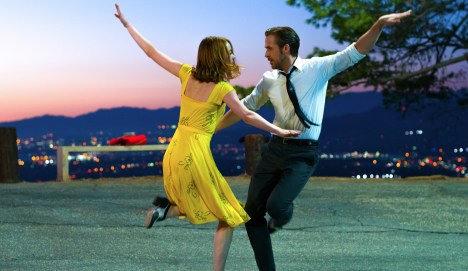
This is true of both the film and its characters. The opening scene proudly declares that the movie has been filmed in “Cinemascope”, with the landscape heavily saturated with bright colours that evoke classic Hollywood musicals even before a final showstopping number that evokes everything from An American in Paris to 7th Heaven. In this day and age, producing any big budget musical would feel like an act of nostalgia, but La La Land is a love letter to a genre that has fallen even further to the wayside than the western.

lalaland2

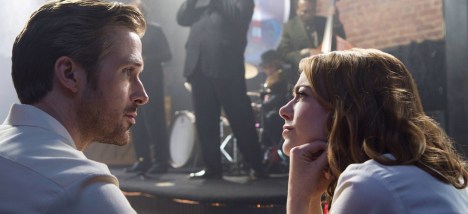
Even the characters inhabiting the film’s world are defined by nostalgia. This is most obvious with Sebastian, a jazz nerd who desperately wants to construct a loving shrine to the artform as he loves it. “It’s dying,” he urges Mia. “It’s withering on the vine.” Sebastian laments the conversion of a cultural landmark into a “samba and tapas” restaurant. However, Mia is implied to be just as nostalgic. Her room is decorated with classic Hollywood memorabilia. When she finishes a rendition of her one-woman show, she asks Sebastian, “Is it too nostalgic?”

This sense of nostalgia has become an obvious line of attack against La La Land, particularly once it emerged as a Best Picture frontrunner. This is the way that things work; the same accusations were leveled at films like The Artist and Argo, to pick two recent examples. However, these criticisms miss one of the more compelling and nuanced aspects of La La Land‘s nostalgia. The film clearly pines for a lost past, wistfully remembering a world that no longer exists. However, it also accepts that loss. Unlike most exercises in nostalgia, La La Land understands that things can have value because they end.

lalaland4

Note: This post contains spoilers for La La Land, including a discussion of the film’s ending. Go see it. Then come back.

Continue reading

Star Trek: Voyager – Day of Honour (Review)

Day of Honour is a reminder that, while Brannon Braga is clearly the heir apparent, Jeri Taylor is still the showrunner on Star Trek: Voyager.

Day of Honour is noticeably and recognisably a Jeri Taylor episode, particularly following so sharply from Scorpion, Part I, Scorpion, Part II, and The Gift. This is a script that plays very firmly to Jeri Taylor’s idea of Star Trek, including an emphasis on the development of interpersonal relationships and also a very traditional perspective on how the franchise is supposed work. Day of Honour is a very conservative episode following the bombast of the three very ambitious stories bridging the third and fourth seasons.

"Don't worry, Janeway will never miss it."

“Don’t worry, Janeway will never miss it.”

In some ways, this is undoubtedly a good thing. Jeri Taylor is clearly more interested in developing relationships between the characters than Brannon Braga. Taylor was a very old-school television writer and producer, but her best material on Voyager suggested a genuine interest in the cast and the characters. Resolutions is an episode consciously rooted in the romantic tension between Chakotay and Janeway. Coda is a very clear elaboration on Taylor’s interpretation of Janeway.

Taylor even drafted biographies for the crew in the form of Mosaic and Pathways, suggesting a deeper interest in the characters’ inner lives than any other writer on staff. In some ways, Day of Honour is an extension of this approach. It is the culmination of Taylor’s attempts to push Paris and Torres together in third season episodes like The Swarm, Blood Fever and Displaced. That relationship became one of the nicer dynamics on Voyager, and would never have happened under the oversight of either Michael Piller or Brannon Braga.

Adrift.

Adrift.

However, there are also very serious problems with Day of Honour. In keeping with the tone of Voyager during Taylor’s tenure, it is a very conservative piece of television both in terms of style and politics. After The Gift worked so hard to generate tension between Seven of Nine and the Voyager crew, Day of Honour casually brushes that aside. And it deals with an interesting story about the legacy of Seven’s relationship to the Borg in the most trite manner possible, the plot hinging on a techno-babble solution to ensure there is no actual conflict.

More than that, Day of Honour is incredibly reactionary in its portrayal of the Caatati, a refugee race who were rendered homeless by the Borg Collective. These dispossessed aliens are presented as greed and underhanded, ready to exploit the charity of our heroes and to betray them at the first opportunity. It is an extension of the xenophobic panic of Displaced, a tale about how our privileged heroes should react with paranoia and mistrust to those who arrive by accident or in distress. It is a rather uncomfortable Star Trek theme.

Means of transport.

Means of transport.

Continue reading

Non-Review Review: Live by Night

Live by Night is a film with big ideas. Writer, director, producer and star Ben Affleck is very clearly attempting to use the classic gangster film as a commentary upon the American Dream. This is hardly a novel idea, but it still resonates as powerfully as it did during the pulp era of the thirties and forties. Working from a novel by Dennis Lehane, Affleck crafts a story about violence and power that is clearly intended to resonate with modern audiences looking to understand fundamental aspects of the American identity.

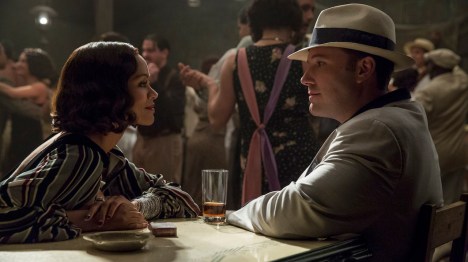
And there are moments when Live by Night really works. Affleck is a solid writer and a performer who can skilfully channel that old-school Hollywood charm, but he has proven himself a very impressive director. Live by Night is occasionally a beautiful film, as the camera pans across the wilderness of the Florida everglades or spins around a room during a tense dialogue scene or even just captures the lead character on the shore with the reflection of the sky framed so perfectly that it seems like he is standing upon the edge of heaven itself.

Speaking easy.

Speaking easy.

However, these moments are assembled in a haphazard fashion around a disjointed plot. Live by Night plays like a stream of consciousness attempting to delve into the symbolic heart of the United States, tossing out crazy ideas like a turf war between Prohibition gangsters and the Ku Klux Klan or arbitrarily drawing long-absent characters back into the narrative with little foreshadowing. Live by Night seems to navigate by night, prone to storytelling detours and narrative cul de sacs that undercut (rather than enrich) its thematic intent.

Live by Night is built like an epic, but its script lacks the discipline and structure to justify an impressive running time. Affleck is a strong enough director that the film never collapses, even as it stumbles. There is a sense that the writer and director is having a great deal of fun playing with a very archetypal set of iconography and themes, and that fun is occasionally contagious. However, Live by Night never truly comes alive in the way that it promises.

Sea changes.

Sea changes.

Continue reading