• Following Us

  • Categories

  • Check out the Archives


  • Awards & Nominations

Star Trek: Voyager – Latent Image (Review)

Latent Image is a powerful allegorical piece of Star Trek, a prime example of how Star Trek: Voyager could occasionally spin gold from its shift towards a more “archetypal Star Trek” template. It is a story that could easily have been told with Data on Star Trek: The Next Generation, for example.

At the same time, Latent Image is a story that touches on many of the core themes of Voyager, many of the show’s key recurring fixations and fascinations. It is an episode about the link between memory and identity, about the importance of preserving history rather than burying it; it touches upon both the metaphorical manipulation of history in stories like RememberDistant Origin and Living Witness and the literal manipulation of the past in stories like Future’s End, Part IFuture’s End, Part IIYear of Hell, Part I and Year of Hell, Part II.

Picture imperfect.

However, it filters that experience through Brannon Braga and Joe Menosky’s recurring fascination with themes of identity and self-definition. The writers have often used the artificial characters on Voyager to explore the malleability of self, how easily the sense of self might be eroded or decayed; the EMH grappled with this challenge in Projections and Darkling, while Seven wrestled with it in Infinite Regress. The artificial characters on Voyager frequently seemed on a verge of a nervous breakdown.

Latent Image is notable for wedding these two concepts together, for integrating these two concepts and exploring the manipulation of an individual’s history as the root of an identity crisis. What happens to the EMH in Latent Image is at once an extension of the dysfunction suggested in Projections and Darkling as well as a more intimate exploration of the cultural identity crises in episodes like RememberDistant Origin and Living Witness. Latent Image suggests that memory is the thread that ties identity together. Without that continuity of self, everything unravels.
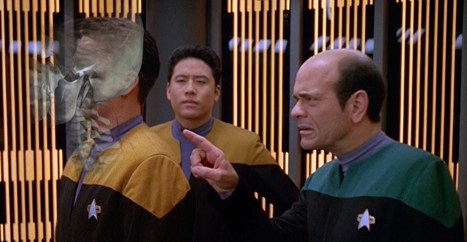
A bone to pick with him.

As such, Latent Image exists in an interesting space. It is a story that works very well as a high-concept character study, focusing on the nature of the EMH has a computer programme. Although episodes like Pen Pals suggest that Starfleet has the power to remove memories from biological life forms, the plot of Latent Image could not work as well with a character like Kim or Paris. At the same time, it is a broader allegory about how important memories and experiences are in terms of defining who a person is, and how dealing with these memories defines a cultural identity.

Latent Image is a powerful and clever piece of television.
The camera never lies.

Continue reading

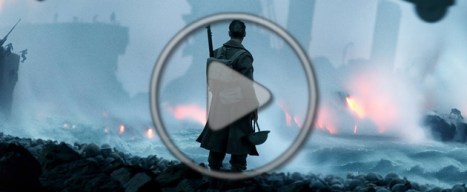
38. Dunkirk – This Just In (#37)

Hosted by Andrew Quinn and Darren Mooney, and this week with special guests Niall Murphy, Jay Coyle and Phil Bagnell, This Just In is a subset of the fortnightly The 250 podcast, looking at notable new arrivals on the list of the 250 best movies of all-time, as voted for by Internet Movie Database Users.

This time, Christopher Nolan’s Dunkirk.

Continue reading

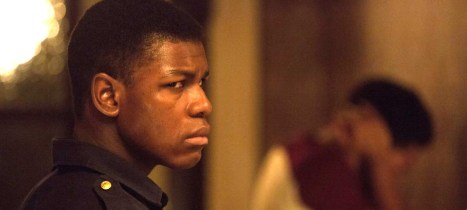
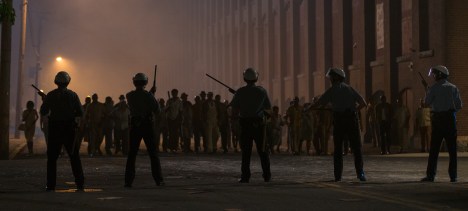
Non-Review Review: Detroit

Detroit is a powerful and visceral piece of cinema, one that loses its way in a muddled second act.

The Hurt Locker and Zero Dark Thirty cemented Kathryn Bigalow’s talent for conveying a sense of chaos and disorganisation on film. It can be very difficult to capture the messiness of real life in the movies, given how cluttered narratives can become distracting or disorienting. It takes a very real talent to guide the audience through this carnage in a way that captures the organic ambiguities of the story while ensuring that nobody is lost or distracted. Bigalow has a very rare talent for that.

Insecurity guard.

Unsurprisingly, Detroit works best in its opening and closing acts, when the narrative pulls back to the real-life story covering the Detroit Riots in late July 1967. The film’s opening and closing beats have the feel of a weird docudrama, with Bigalow using handheld cameras and tight focus in a way that allows her to blend footage of the cast with archive material. Characters are identified by legends down the bottom of the screen, while the audience is frequently put in the position of confused spectators in a way that captures the mere anarchy loosed upon the city.

However, Detroit fumbles a little bit in its second act. For the middle of the film, Detroit narrows its focus significantly. Instead of providing socio-economic and political context for the entire riots, or dealing with the aftermath of horrific events, Detroit transforms into a story about a bunch of characters locked in a confined space together. As the film’s closing text admits, these sequences are much less verifiable than the snapshots populating the opening and closing acts, much less a matter of public record.

Big Mackie.

The second act of Detroit is a more conventional fictional narrative. While the movie is never less than interesting and clever, that organic sensibility is lost. During the first and third acts, the focus is on the broader story of the larger community, so it does not matter that many of these characters feel like archetypes and ciphers. When Detroit zooms in on the characters, they seem drawn too crudely to support the scrutiny. Detroit works a lot better as an epic social study, and less well as a claustrophobic character study.

Bigalow struggles to get the balance right, resulting in a film that is certainly ambitious and worthy, but also more uneven than her recent output. Detroit is too confident and too professional to be deemed a failure, but its second act is too shallow to be a success either.

I predict a riot.

Continue reading

Star Trek: Deep Space Nine – Prodigal Daughter (Review)

Prodigal Daughter is an incredibly limp piece of television.

Prodigal Daughter plays more like a first season episode than a final season episode, the result of a creative process where the writing staff are still trying to figure out how best to approach major characters and even how best to structure individual episodes of the series. There is something distractingly amateurish about Prodigal Daughter, which seems to largely consist of one-shot guest characters standing around drab sets talking about things that happened off-screen. It is not so much bad as it is boring.

Painting a pretty picture.

To be fair, there are reasons for these problems. Ezri Dax was still a new character, and the production team were still getting to grips with her. Although Ezri had been integrated into the ensemble with relative ease, the writers had only given her a single character-focused episode in Afterimage. This was understandable, with everything else going on, but it meant that the character still had to find a unique voice. Beyond that, the structural problems with Prodigal Daughter were largely down to nightmarish disorganisation behind the scenes.

Of course, knowing this does not make it any easier to watch Prodigal Daughter.

Oh, brother!

Continue reading

Characters in Search of an Ending: Prestige Television and Literary Adaptation

The possibilities of prestige television seem limitless.

This is obvious just looking at the creative talent embracing the opportunities of the medium. Director Jane Campion observed, “The really clever people used to do film. Now, the really clever people do television.” It seems fair. Woody Allen has a television series at Amazon. Nicole Kidman and Reese Witherspoon headlined Big Little Lies. Cary Fukunaga directed all eight episodes of the first season of True Detective, starring Woody Harrelson and Matthew McConaughey. Quentin Tarantino reflected, “If ever there’s been a chance for somebody to truly do a filmed novel, it’s in this area.”

There is a sense that prestige television has come to occupy the space that used to be given to mid-tier mid-range movies, thrillers and character studies that were too small to compete with the blockbusters but also weren’t an easy fit for the traditional Oscar season. Television is arguably the place to go for smart character-driven narratives telling adult stories in a restrained and considered manner. It is an interesting shift that has in some ways redefined the relationship between film and television.

Part of this has seen an increased emphasis on book-to-television adaptations. In the past, the default path for audio-visual adaptations of successful novels has been from the page to the silver screen, cinematic takes on iconic and memorable pieces of fiction. After all, countless Best Picture winners have been adaptations of popular novels or short stories; No Country for Old Men, Million Dollar Baby, The Lord of the Rings: Return of the King, The English Patient, Forrest Gump, Silence of the Lambs. A lot of blockbusters are inspired by comic books or young adult novels.

However, as televisual storytelling has grown more complex and ambitious, producers and writers have increasingly looked to the storytelling opportunities afforded by the smaller screen. Television offers more space for writers and directors to tell their stories, to expand out novels with complex mythologies or epic scope. The gaps that had existed between film and television, in terms of budget and talent, are rapidly closing. It is entirely possible for a televisual adaptation of a beloved novel to have a list of credible writers and directors, and recognisable on-screen talent.

Still, as much as this shift might represent an important step forward in the development of television as an artform, it also illustrates some of the problems that still exist in how producers approach the medium. While television shows can do a lot of things that novels can do, they still struggle in one respect. Television shows have yet to truly embrace the power of brevity and the weight of a proper ending.

Continue reading

Star Trek: Deep Space Nine – It’s Only a Paper Moon (Review)

It’s Only a Paper Moon is a fantastic illustration of a lot of things that Star Trek: Deep Space Nine does consistently well.

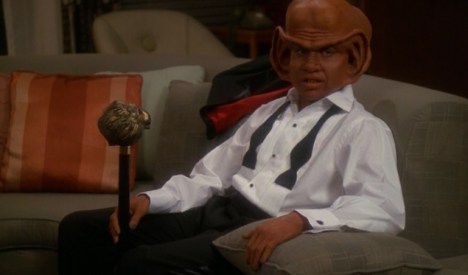
It is an episode that builds off events depicted in an earlier story, picking up with the character of Nog following the loss of his leg in The Siege of AR-558. In many ways, It’s Only a Paper Moon feels like a necessary part of that earlier adventure, dealing with the consequences of something truly horrific. It would have been cheap and crass to gloss over the enormity of what had happened to Nog. In The Siege of AR-558, the loss of Nog’s leg was a minor detail; one of many reminders of how war is hell. It’s Only a Paper Moon allows that story to play out in more depth.

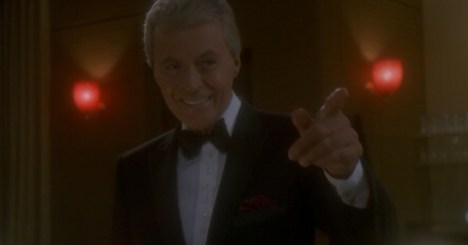
“I’ll be seeing you…”

It’s Only a Paper Moon is also an episode that feels quite removed from what audiences expect from a Star Trek episode. The central story focuses on two supporting characters who exist outside the regular cast, trusting Nog and Vic Fontaine to carry a story on their own terms. It is a testament to how well-developed the world of Deep Space Nine has become, recalling the focus on Martok in Soldiers of the Empire or Once More Unto the Breach, Dukat in Indiscretion or Return to Grace and Garak in The Wire or Improbable Cause and The Die is Cast.

Unfolding primarily in a holographic recreation of sixties Las Vegas, It’s Only a Paper Moon is a very surreal and unusual episode of Deep Space Nine. However, it works perfectly in the context of Deep Space Nine.

A hard day’s Nog.

Continue reading

Dunkirk and Issue of Genre Legitimacy

The release of Dunkirk has been interesting in many ways.

Most obviously, it seems to confirm Christopher Nolan as a brand name unto himself, managing to open a blockbuster war movie with no stars to speak of to impressive box office results in the middle of July. The film has been widely acclaimed, both by critics and by movie-goers; it scores well on Rotten Tomatoes, Metacritic, IMDb and CinemaScore. There is already talk of a massive Oscar push for the film, with reports of Academy screenings being so packed that additional screenings had to be scheduled.

However, beneath all of this success, there is an interesting narrative forming. There is a recurring suggestion that Dunkirk is not just a great piece of cinema from an incredibly talented director, but that it in some way represents a maturing of Nolan’s talent. Some of the critical narrative of Dunkirk has been framed almost as a cinematic “coming of age” story for Christopher Nolan, as if the veteran forty-six-year-old film maker is finally delivering on potential that has been teased over the past seventeen years.

In a not-untypical comment, David Fear at Rolling Stone reflected, “Everyone knew he had a mastery of the medium. Dunkirk proves he knows how to use it say something.” At The Guardian, Andrew Pulliver suggested that Nolan had finally earned one of the stock comparisons that had been (misguidedly) following him for most of his career, “With Dunkirk, Nolan may at last be able to walk the Kubrick walk.” The implication seems to be that Nolan’s previous nine films were all creative dry runs, cinematic confectionery suggesting (but never delivering on) true artistic talent.

This is, of course, complete nonsense. Nolan arguably established himself as a bona fides film maker with Memento, which was an impressive theatrical debut. Memento was structurally ambitious, thematically rich, and exceptionally clever. Nolan followed that up with Insomnia, a remake of a Scandinavian thriller. He then segued into a big-budget reimagining of the Batman mythos with Batman Begins, The Dark Knight and The Dark Knight Rises, interspacing them with his own projects of interest, The Prestige, Inception and Interstellar.

Whatever an audience member might make of individual films on that resume, and some are undoubtedly better than others, it seems quite clear that Nolan has been doing good work for a long time. Dunkirk is not a break in the pattern. It is in many ways a continuation and extrapolation of his earlier work. It is not so much a quantum leap forward in terms of technique, but simply a nudge in a different direction. So, why is Dunkirk being treated as a vital moment in Nolan’s career? It seems likely because Dunkirk belongs to a much more respectable genre than its Nolan stablemates.

Continue reading

Star Trek: Voyager – Counterpoint (Review)

Counterpoint is a spectacular episode of Star Trek: Voyager, a highlight of the fifth season and of the seven season run in general.

Counterpoint is meticulously constructed, put together with a great deal of care and consideration. This is most obvious in the plotting and characterisation in the episode, in the way that the focus of the story remains constant while peeling back the layers on the characters involved. Too many Voyager episodes indulge in a contrived sequence of “… and then…” plotting, while Counterpoint is an episode that understands what it is about and is content to explore its ideas and its characters to their logical conclusions.

Playing it pitch perfect.

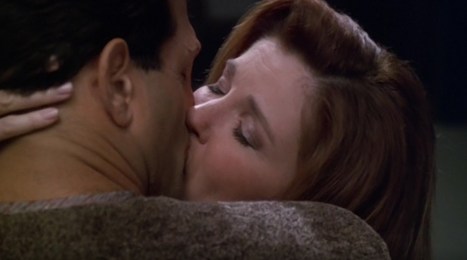
Counterpoint benefits from two superb central performances. Mark Harelik is one of the strongest one-shot guest stars to appear on Voyager, playing Kashyk as an endearingly ambiguous figure caught half way between a conventional romantic lead and a fascist thug. However, Counterpoint works best as a showcase for Kate Mulgrew as Kathryn Janeway. Mulgrew has always been one of the strongest members of Voyager‘s primary cast, but the production team always struggled to play to her strengths while building a consistent character.

Counterpoint is an episode that plays perfectly to the strengths of all involved, creating a symphony where all of the orchestra is playing both in key and in time with one another. At this point in the run, Voyager should be producing episodes like this with much greater consistency.

Near kiss.

Continue reading

37. No Country for Old Men (#171)

Hosted by Andrew Quinn and Darren Mooney, The 250 is a fortnightly trip through some of the best (and worst) movies ever made, as voted for by Internet Movie Database Users. New episodes are released every second Saturday at 6pm GMT, with the occasional bonus episode between them.

This time, Joel and Ethan Coen’s No Country for Old Men.

Lives are thrown into chaos when a drug deal in Texas goes horribly wrong. Llewelyn Moss stumbles across two million dollars in drug money, and finds himself drawn into a world of violence and chaos as cartel hitman Anton Chigurh is on his trail. If this is not the mess, it’ll do ’til the mess gets here.

At time of recording, it was ranked the 171st best movie of all time on the Internet Movie Database.

Continue reading

No, Christopher Nolan is not “the Next Stanley Kubrick”

Another Christopher Nolan film, another round of stock comparisons.

To his credit, Nolan sparks genuine critical debate and discussion online, even if there’s an uncomfortable whiff of sensationalism to the coverage. Is Christopher Nolan responsible for everything that is wrong with Hollywood right now? (Spoiler: No. Not at all. Not even slightly.) Is Christopher Nolan a pompous and privileged douchebag for wanting audiences to see his film in the format that he has intended? (Spoiler: While he could probably be a bit more mindful that one size doesn’t always fit all, dude has a right to have a preference about how his work is consumed.)

To be fair, these provocative and confrontational articles at least provide a nice reprieve from the listacles and fan service that define so much of the discourse about modern summer movies. How does [minor character] set up the future of [major franchise]? How many easter eggs did you identify from in [franchise blockbuster]? One of the advantages of Hollywood’s modern franchise-driven mindset is that it makes ranking [entire franchise] articles popular and recyclable. It is exhausting. At least a new Nolan film tends to mean new director-centric debates.

That said, there is one comparison that tends to get rehashed quite a bit. Almost every time that Christopher Nolan releases a feature film, film writers who really should know better stop to ask whether Christopher Nolan is the next Stanley Kubrick. Andrew Pulver addressed the comparison in The Guardian, providing a nice piece of symmetry to an article he wrote almost a decade ago. Christopher Priest, author of The Prestige, made the case only a few years ago.

It is a fairly obvious argument. Both Nolan and Kubrick are directors who worked at a remove from the press, tending to live and work outside the studio system while developing their ideas. They both seem to straddle the Atlantic, both having spent a lot of time living in England and working in America. Neither director ever seemed entirely comfortable talking to the press or doing the publicity circuit. Both produce films that are very stylishly produced, often tending to keep the audience at a slight remove from their characters that some may consider “cold.”

However obvious the comparison might be, it relies on a fundamental misunderstanding of both directors.

Continue reading