• Following Us

  • Categories

  • Check out the Archives


  • Awards & Nominations

Doctor Who: Flatline (Review)

Same time, same place… ish.

…ish? Don’t give me an ish.

These readings are very… ish-y.

In many respects, Flatline can be seen as the flipside of Turn Left.

Turn Left was twinned with Midnight towards the end of David Tennant’s final year in the lead role. If Midnight was a story about the Doctor trapped in an adventure without his faithful companion, Turn Left was very much the story of the companion trapped in an adventure without the Doctor. Both of those stories seem to stress the need for both a Doctor and a companion to form a functioning team, building very consciously towards the merging of the two in the season finalé, Journey’s End.
Eyebrows!

Eyebrows!

While Midnight suggests that the Doctor would have great difficulty without a companion to help ground him, Turn Left is even more pessimistic. It seems to set a ceiling for the role of the companion. Without the Doctor, the best that his companions can do is fight to a depressing stalemate and hope to rescue some alternate universe where the Doctor is still alive. As far as Turn Left is concerned, the companion fills a very important function – but that function is very clearly secondary to the Doctor.

In contrast, Flatline seems to suggest that the companion can step up to fill the vacancy left by the Doctor. Flatline builds off the climax of Kill the Moon in positioning Clara as a character who could step in to the role of the Doctor. It is an interesting idea, arguably one that the show has been teasing from as early as Ace’s character during the final season of the classic show. Here, Clara suggests that it might be possible for a companion to elevate themselves to such a position. However, it remains questionable if such a possibility would be desirable.
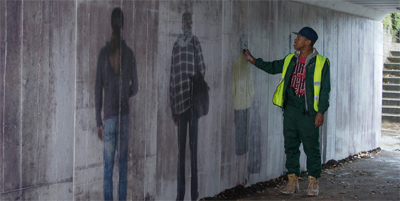
Drawn together...

Drawn together…

Continue reading

The Flash – Fastest Man Alive (Review)

So, I’m considering reviewing this season of The Flash, because the pilot looks interesting and I’ve always had a soft spot for the Scarlet Speedster. I’m also considering taking a storyline-by-storyline trek through the 1987-2009 Flash on-going series as a companion piece. If you are interested in reading either of these, please let me know in the comments.

In many ways, Fastest Man Alive plays like the second part of a pilot for The Flash. Like City of Heroes before it, Fastest Man Alive is written by Andrew Kreisberg and Geoff Johns, with Greg Berlanti credited on the story. It is also directed by David Nutter, one of television’s most respected pilot directors – even if his famous “hot streak” of pilots going straight to show was interrupted when CBS did not pick up The Doctor in 2011.

Fastest Man Alive is still about building the world around Barry Allen. City of Heroes established the basics, the ground rules of the world in which Barry operates. Fastest Man Alive exists to delineate them a bit further. It defines the ensemble better, clarifying the roles of Joe West and Iris West in the grand scheme of things; it gives Barry the confidence he needs to do what he does; it imposes limits on Barry’s ability; it clarifies that Harrison Wells is not entirely heroic.

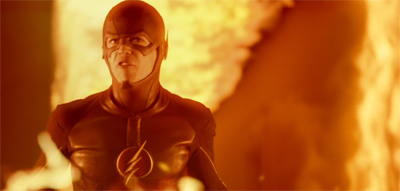
CGI flames! My fatal weakness!

CGI flames! My fatal weakness!

Given the amount of attention and effort that Fastest Man Alive devotes to cementing the foundations of The Flash, it’s understandable that there really isn’t too much room for anything else. Fastest Man Alive is about settling the cast and the writers into a sustainable status quo for the next stretch of episodes – maybe even the entire first season. It makes sure that everybody knows where everything lies and that there’s a solid base upon which to build.

So, while Fastest Man Alive might not be an especially brilliant episode of television, it does a very good job of setting up what it needs to set up.

Born to run...

Born to run…

Continue reading

The Flash (1987-2009) #3-4 – The Killg%re/Kill the Kilg%re! (Review)

So, I’m considering reviewing this season of The Flash, because the pilot looks interesting and I’ve always had a soft spot for the Scarlet Speedster. I’m also considering taking a storyline-by-storyline trek through the 1987-2009 Flash on-going series as a companion piece. If you are interested in reading either of these, please let me know in the comments.

In many respects, The Kilg%re and Kill the Kilg%re are indicative of Mike Baron’s approach to plotting The Flash. There’s never really a sense of an over-arching plot. It often feels like the comic is not being written with a structured story in mind. As the reader follows the story, it seems to develop and grow and move in odd directions. It’s hard to figure out exactly where any of these stories are going, because Baron himself never seems entirely certain from one moment to the next.

In a way, this style of storytelling suits The Flash as a character and as a comic. The Scarlet Speedster is all about forward momentum, a sense of urgency and dynamism. The sense that Baron is making all this up on the spot is energetic at points, because it feels like the comic is being written by the seat of his pants. However, it also means that the character and plot beats can feel arbitrary and illogical, as if to demonstrate that what works in a particular moment is not guaranteed to work in a larger context.

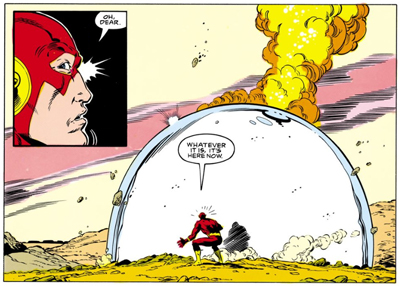
Hate to burst his bubble...

Hate to burst his bubble…

Continue reading

Star Trek: Deep Space Nine – Explorers (Review)

This September and October, we’re taking a look at the jam-packed 1994 to 1995 season of Star Trek, including Star Trek: Deep Space Nine and Star Trek: Voyager. Check back daily for the latest review.

Explorers is a wonderful piece of Star Trek: Deep Space Nine, an episode produced by a show entirely comfortable with itself. Indeed, the entire point of Explorers seems to be stressing just how comfortable Deep Space Nine has become in its own skin. It’s a leisurely and relaxed celebration of what makes the show unique in the Star Trek franchise, wallowing in the things that make Deep Space Nine the show that it is.

With a smart script by René Echevarria adapted from a solid premise by Hilary J. Bader, Explorers is an episode that never feels like it has anything to prove. And that’s the charm of it all.

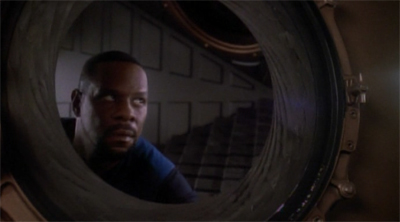
Open to new cultures...

Open to new cultures…

Continue reading

Star Trek: Voyager – Faces (Review)

This September and October, we’re taking a look at the jam-packed 1994 to 1995 season of Star Trek, including Star Trek: Deep Space Nine and Star Trek: Voyager. Check back daily for the latest review.

One of the more interesting aspects of the first season of Star Trek: Voyager is just how much of a throwback the show seems to be. In many ways, the show seems anchored in a very fifties mindset. While Star Trek: Deep Space Nine has embraced multiculturalism and the wake of the Cold War, the first season of Star Trek: Voyager seems to be dealing with anxieties carried over from the end of the Second World War.

Caretaker reconnected with the “Wild West in outer space” mentality of the classic Star Trek. Episodes like Time and Again and Jetrel are concerned with the splitting of the atom. Cathexis played out a decidedly Cold War paranoia thriller. Good old-fashioned technological espionage – like the leaking of nuclear secrets – was at the heart of State of Flux. There’s a sense that Voyager may have been a piece of fifties Americana that had the misfortune to arrive forty years too late.

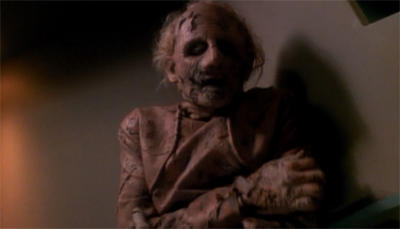
Faces is perhaps the most obvious example of this. Splitting a bi-racial character into two halves as part of a science experiment, evoking classic monster movies, and even the decision to define the Vidiians as stand-ins for the Nazis, all give the episode a delightfully pulpy feel. This is Voyager doing a cheesy fifties b-movie. And doing it quite well at that.

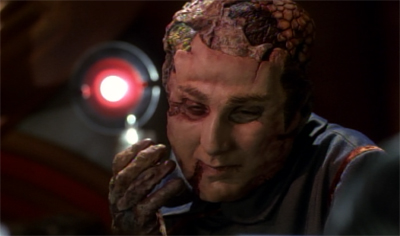
He has you now, his pretty!

He has you now, his pretty!

Continue reading

Non-Review Review: Nightcrawler

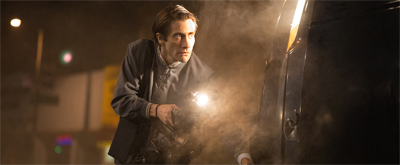
Nightcrawler features a tour de force performance from Jake Gyllenhaal.

Gyllenhaal plays Louie (“call me Lou”) Bloom, a wandering and lost soul who stalks late-night Los Angeles in search of a lucrative pay-day. He is just trying to get his foot on the ladder any way that an entrepreneurial young gentleman can – he’s introduced stealing construction supplies and scrap metal so he can sell them on, seguing effortlessly into a well-rehearsed job pitch applying for an unpaid internship.

nightcrawler

Bloom seems like a man who has watched people from a distance for years, almost through a filter. Gyllenhaal injects a haunting eccentricity into the character, his wide eyes and practised stillness almost edging Bloom into the uncanny valley. Though he seems to always know just what to say, there’s something distinctly inhuman about Lou Bloom. He watches people, but from the outside. He has got a pretty passable impersonation of a human being down, but there’s just something missing.

Nightcrawler is a fascinating, harrow and occasional wry look at desperation and ruthlessness – and the heady cocktail they make when blended together.

nightcrawler1

Continue reading

Star Trek: Deep Space Nine – The Die is Cast (Review)

This September and October, we’re taking a look at the jam-packed 1994 to 1995 season of Star Trek, including Star Trek: Deep Space Nine and Star Trek: Voyager. Check back daily for the latest review.

The Die is Cast is, like Improbable Cause before it, a wonderful piece of television.

As with most Star Trek: The Next Generation and Star Trek: Deep Space Nine two-parters, The Die is Cast maintains continuity and consistency with its predecessor, but it feels like a very different episode than Improbable Cause. After all, the curtain has been pulled back. The assassination attempt is no longer the driving force of the narrative (in fact, it’s barely referenced), with the plot focusing on Enabrain Tain’s pre-emptive strike against the Dominion.

A bruised ego...

A bruised ego…

It’s interesting that it falls to the Cardassians and the Romulans to drive the Dominion plot onwards. There’s been no real development of this long-form plot since Sisko and his crew escaped at the end of The Search, Part II. Episodes like The Abandoned and Heart of Stone have seen the crew encountering individual members of the Dominion, and shows like Visionary have had characters sitting around talking about them, but nothing has actually happened. It is mostly business as usual.

As such, the episode’s title feels beautifully appropriate – it’s the crossing of a threshold, a point from which there can be no return. Not just for Tain or the Cardassians, but the show itself.

Odo's sympathy for Garak runs dry...

Odo’s sympathy for Garak runs dry…

Continue reading

Win! Tickets to the Jameson Cult Film Club screening of Friday The 13th: Part II on Thursday October 23rd!

Camp Crystal Lake is looking for new unsuspecting victims… the Jameson Cult Film Club returns to Dublin for a double screening of the 1981 horror classic Friday The 13th: Part II on Wednesday 22nd and Thursday October 23rd. Thanks to the Jameson Cult Film Club, we have some tickets to give away. Keep reading to find out how to enter.

Jameson Cult Film Club screening of Friday The 13th Part II

Continue reading

Non-Review Review: The Best of Me

As with a lot of Nicholas Sparks adaptations, there’s something inherently reductive about The Best of Me. The film would suggest that characters are either inherently good or inherently bad, with several members of the cast existing as nothing more than roadblocks serving to keep the film’s central couple apart. The Best of Me is not set in the real world; it makes no allowance for the nuanced complexities of human emotions and relationships.

Instead, The Best of Me unfolds in a weird parallel world, a world where all human interactions and feelings are clear-cut and simple. It is easy to see the appeal of this world. It is a realm of romantic fantasy, where probability and chance are simply the tools of dramatic irony; where obvious twists are not only expected, they are obligatory. The Best of Me introduces its male lead, Dawson, reading Stephen Hawking as lazy shorthand for how smart he is. He can’t be that smart, or he’d understand this world doesn’t follow anything as bland as physics.

thebestofme5

Throughout The Best of Me, characters ruminate on the machinations of fate and destiny. We are told that mankind has always looked to the stars to guide them. However, this metaphysical musing is not so much a thematic statement as preemptive justification for a contrived (and entirely predictable) final act. The Best of Me is very much a twist in search of a movie. It is a tire-and-tested twist, at that.

However, the characters in The Best of Me don’t seem to realise that there is a difference between fate and hackneyed writing.

thebestofme4

Continue reading

Star Trek: Voyager – Cathexis (Review)

This September and October, we’re taking a look at the jam-packed 1994 to 1995 season of Star Trek, including Star Trek: Deep Space Nine and Star Trek: Voyager. Check back daily for the latest review.

Cathexis has a vaguely interesting premise, but it gets a little bit too caught up in science-fiction high concepts and New Age mysticism.

Once again, there’s a sense that the wrong writer has been assigned the wrong brief. The New Age spirituality elements of Chakotay’s character were largely championed by Michael Piller; the “romantic period mystery” story for Janeway clearly comes from Jeri Taylor. The only part of Cathexis that clearly comes from credited writer Brannon Braga is the somewhat generic Invasion of the Body Snatchers plot line – and, as such, it seems to be the only thread in which Braga is particularly interested.

So we get a bunch of half-hearted New Age stuff unfolding, with Chakotay’s wandering spirit represented by a camera with a blurry filter swooping through familiar sets. Once again, Chakotay’s Native American heritage becomes a launching pad for some ill-advised mysticism and exoticism, which Cathexis never even bothers trying to explain.

Frankly, I'm surprised Tuvok put up with this for so long...

Frankly, I’m surprised Tuvok put up with this for so long…

Continue reading