• Following Us

  • Categories

  • Check out the Archives


  • Awards & Nominations

Star Trek: Voyager – Heroes and Demons (Review)

This September and October, we’re taking a look at the jam-packed 1994 to 1995 season of Star Trek, including Star Trek: Deep Space Nine and Star Trek: Voyager. Check back daily for the latest review.

In many ways, Heroes and Demons is a watershed moment for Star Trek: Voyager. The two previous episodes, Prime Factors and State of Flux, may have been far from perfect, but they did at least hint at a direction for the show. They suggested that maybe Voyager might be interested in engaging in some of the big philosophical questions raised by the crew’s unique situation. Stranded seventy thousand light-years from home, the ship was cut off from the Federation. It was isolated and alone. That meant that tough choices at least had to be debated.

While neither Prime Factors nor State of Flux made for particularly exciting television, they were episodes that felt specific to Voyager in a way that a lot of the first season really doesn’t. Unfortunately, Heroes and Demons represents a step backwards. Far from telling a story specific to Star Trek: Voyager, this feels like a script that could easily have been recycled from Star Trek: The Next Generation or Star Trek: Deep Space Nine.

Can the Doctor hack it?

Can the Doctor hack it?

It’s written by veteran Next Generation writer Naren Shankar, who had also served on the staff of Deep Space Nine. He wrote Heroes and Demons as a freelancer, pitching the idea very early in the development cycle. Perhaps what is most remarkable is how little of Shankar’s script was adapted or edited from that first draft. In fact he described it to The Official Star Trek: Voyager Magazine as “the best experience I’ve ever had as a writer, in terms of writing something as a first draft and then seeing those exact words on screen.”

There’s a sense that Heroes and Demons is a fun story that could have really worked in any context, and doesn’t fit particularly well into the mould of Voyager‘s first season. This should be the year where Voyager is trying to find its own voice, rather than simply imitating that of its older siblings.

Only mostly armless...

Only mostly armless…

Continue reading

Doctor Who: Mummy on the Orient Express (Review)

“You know, Doctor, I can’t tell if you’re ingenious or just incredibly arrogant.”

“On a good day, I’m both.”

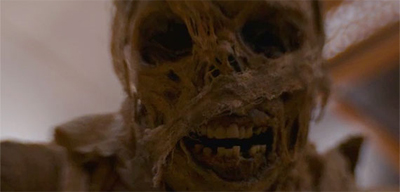
Mummy on the Orient Express is Doctor Who in a blender. It’s classic period piece, genre pastiche and science-fiction spectacle, mixed with a healthy dose of creature feature horror and a solid development of the themes running through the eighth season so far. It’s clever, witty and energetic. The episode is a delight from beginning to end, beating out Robot of Sherwood and Time Heist to claim the title of the year’s best “romp” – as you might expect from a story that is a Hammer Horror murder on the Orient Express in Space.

doctorwho-mummyontheorientexpress8

Continue reading

The Flash – City of Heroes (Review)

So, I’m considering reviewing this season of The Flash, because the pilot looks interesting and I’ve always had a soft spot for the Scarlet Speedster. I’m also considering taking a storyline-by-storyline trek through the 1987-2009 Flash on-going series as a companion piece. If you are interested in reading either of these, please let me know in the comments.

Appropriately enough for a television show based around the fastest man alive, City of Heroes moves pretty damn quickly. The forty-five minute episode tears through all the requisite superhero origin elements in forty-five minutes. It takes us two minutes to brush through the story of Barry Allen’s childhood trauma. By the ten-minute mark, Barry has already been hit by lightning. At the end of the forty-five minutes, his uniform is complete and his ensemble fully formed.

There are some minor problems with The Flash, but City of Heroes offers a pretty solid start for the series – hinting that perhaps the show has already found its legs.

Suit up...

Suit up…

Continue reading

The Flash (1987-2009) #1-2 – Happy Birthday, Wally!/Hearts… of Stone (Review)

So, I’m considering reviewing this season of The Flash, because the pilot looks interesting and I’ve always had a soft spot for the Scarlet Speedster. I’m also considering taking a storyline-by-storyline trek through the 1987-2009 Flash on-going series as a companion piece. If you are interested in reading either of these, please share the link love and let me know in the comments.

Like the rest of the comic book industry, DC comics went through some serious changes in the late eighties. Books like Watchmen and The Dark Knight Returns had re-shaped expectations of the comic book world. There was a sense that things had to change. DC was worried about its own expansive and increasingly convoluted continuity. In order to streamline that continuity, DC decided to stage a massive crossover event. Crisis on Infinite Earths was a truly epic comic that reshaped the shared universe.

It made quite the impression, providing the opportunity for a clean start for many of the characters. George Perez gave Wonder Woman a new origin and back story. John Byrne reinvented The Man of Steel, making several additions to the Superman mythos that have remained in place through to today. Frank Miller offered one of the defining Batman origin stories with Year One. There were obvious continuity issues around certain characters and franchises, but Crisis on Infinite Earths was a new beginning.

If the suit fits...

If the suit fits…

This was arguably most true for The Flash. Cary Bates had finished up a decade-long run on the title with the mammoth storyline The Trial of the Flash, where Barry Allen was accused of murdering his arch-nemesis in cold blood. Although the arc ended with Barry retiring to the distant future (comics!), the character went straight from that extended arc into Crisis on Infinite Earths, where he eventually gave his life to save the multiverse in what became an iconic death sequence.

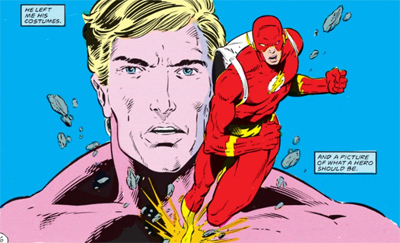
More than that, Barry Allen stayed dead for twenty years; a phenomenal amount of time for a comic book character. In the wake of Crisis on Infinite Earths, DC offered a fresh new beginning for the Flash. Wally West, the former “Kid Flash” and sidekick, stepped into the iconic role and headlined a monthly series for over two decades.

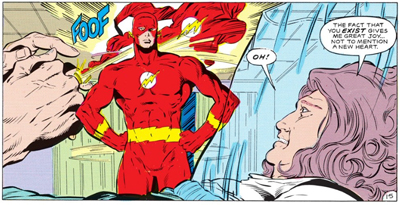
His heart might not be in it, yet...

His heart might not be in it, yet…

Continue reading

Jameson Cult Film Club Screening of Friday The 13th Part II in Dublin on October 22/23!

Happy Halloween!

The Jameson Cult Film Club are hosting a screening of Friday the 13th Part II in Dublin over the 22nd and 23rd of October. It’s a great early Halloween treat, with the group turning a Dublin location into a perfect duplicate of the Camp Crystal Lake Training Centre for the screening. And the tickets are free! If you haven’t already signed up, you can apply for free tickets to the event on the Jameson Cult Film Club website. If you’ve been before, you know how much fun it can be. If you haven’t, you’re in a for a treat.

Also worth pausing to note just what a great horror film connoisseur choice Friday the 13th Part II is. The default choice – and one supported by other horror film series like Nightmare on Elm Street or Halloween – would be to pick the first film in the series. However, this is the exception that proves the rule. Sure, you lose out on the Kevin Bacon factor of Friday the 13th Part I, but you get most of the wonderfully iconic aspects of the Friday the 13th film series. A very good choice, by all involved.

The full details are below, after the jump.

Jameson Cult Film Club screening of Friday The 13th Part II

Continue reading

Star Trek: Deep Space Nine – Improbable Cause (Review)

This September and October, we’re taking a look at the jam-packed 1994 to 1995 season of Star Trek, including Star Trek: Deep Space Nine and Star Trek: Voyager. Check back daily for the latest review.

Improbable Cause is an episode that should be a mess. It was originally conceived as a sort-of-sequel to Second Skin, building off Garak’s murder of Entek in that episode. The idea was that Garak would face the consequences of that action, with the Obsidian Order planning an assassination attempt. However, the script was incredibly difficult to break. The resolution felt contrived and forced, closing the story out with Garak blackmailing is adversaries into compliance using a never-before-referenced isolinear rod felt overly convenient.

With the script not working, desperate action was taken. It was decided to extend Improbable Cause into a two-parter at the last minute, tying it into the proposed sequel to Defiant. The decision was made so late in the production schedule that it was impossible to pull the script back out of production. Even though Improbable Cause aired after Through the Looking Glass, it was produced beforehand. Writer René Echevarria re-wrote the last two acts of Improbable Cause with The Die is Cast screenwriter Ronald D. Moore in a frenzy, to tie both parts together.

Everything burns...

Everything burns…

This is the very definition of “production nightmare.” It recalls one of those stories that you hear about blockbuster movies that start shooting without a finished script, or directors being locked out of the editing suite. By all accounts, Improbable Cause should have been a trainwreck held together by duct tape and good thoughts. Instead, there’s a credible argument that Improbable Cause is the strongest episode of the third season. It’s certainly the strongest episode broadcast since Star Trek: Voyager came on the air.

And that’s down to one simple fact: every single aspect of Improbable Cause works extraordinarily well.

Odo has the scent...

Odo has the scent…

Continue reading

Star Trek: Deep Space Nine – The Soul Key by Olivia Woods (Review)

This September and October, we’re taking a look at the jam-packed 1994 to 1995 season of Star Trek, including Star Trek: Deep Space Nine and Star Trek: Voyager. Check back daily for the latest review.

The Soul Key would wind up being the last novel published as part of the Deep Space Nine relaunch.

The Soul Key was published in July 2009. The next month, Una McCormack’s wonderful The Never-Ending Sacrifice would be published. However, McCormack’s novel was very written outside the relaunch, running as a companion to the series and unfolding in the immediate aftermath. After that, the Deep Space Nine book line found itself folded into various crossovers, like Typhon Pact and The Fall. There was a sense that the line was drifting away from Deep Space Nine and being recontextualised in Pocket Books’ larger Star Trek series.

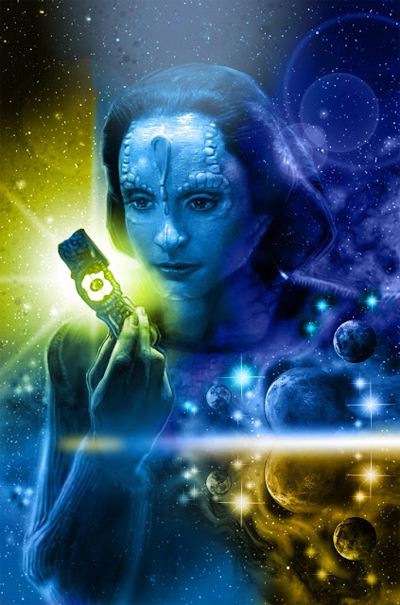
The Soul Key picks up where Fearful Symmetry left off, following Kira, mirror!Iliana and Vaughn as they venture into the mirror universe in pursuit of the crazed Iliana Ghemor.

ds9-soulkey

Continue reading

Non-Review Review: Annabelle

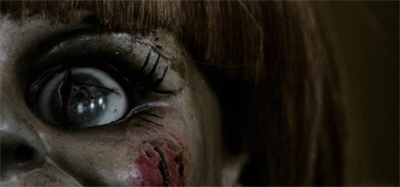
Annabelle certainly looks pretty. Not the doll, of course. The doll looks like the children’s toy version of Jack Nicholson. There is something immediately and effectively intense about the figure at the centre of this horror spin-off, to the point where it’s hard to imagine anybody wanting the toy in their home in the first place. To paraphrase Stephen King’s criticism of Jack Nicholson in The Shining, it is not a question of if this doll will start killing people, but when.

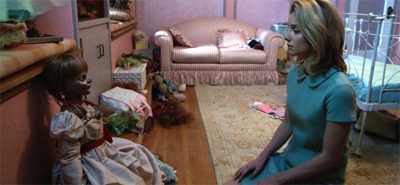
However, the production design on Annabelle is quite striking. It very much a period horror film in the way that The Conjuring was a period horror film. This time, we are visiting the sixties rather than the seventies. There are lots of bright colours and stylish clothes, and the film works hard to capture the mood and aesthetic of the era – or, at the very least, the era as we remember it. Annabelle feels like a horror film effectively riding the waves of sixties nostalgia that has rocked popular culture in recent years.

Well, it'll never be a collector's item now...

Well, it’ll never be a collector’s item now…

Sadly, Annabelle is not pretty enough to distract from its rather fundamental problems. Its script has some good ideas, but no real idea what to do with them. So, instead, it falls back on a kitchen sink approach to modern horror. The script for Annabelle is a collection of sequences and stock elements copied wholesale from recent films like Insideous or Sinister or The Conjuring. While those films did not necessarily have fresh scares, they were blowing the dust off some very classic horror movie tropes.

Here, it feels almost like reheated leftovers.

A doll's house...

A doll’s house…

Continue reading

Star Trek: Deep Space Nine – Through the Looking Glass (Review)

This September and October, we’re taking a look at the jam-packed 1994 to 1995 season of Star Trek, including Star Trek: Deep Space Nine and Star Trek: Voyager. Check back daily for the latest review.

It’s very tempting to write off the problems with the mirror universe episodes of Star Trek: Deep Space Nine as diminishing returns – the idea that repeated exposure to what was once novel robs that item of its novelty. It is possible to become immune to the charms of camp, dulled to absurd space opera, and just worn out by watching the cast play “space pirates meet Star Wars.”

However, this does a bit of a disservice to the mirror universe as a concept. As iconic as it has become, Mirror, Mirror worked very well as a piece of introspection for the original Star Trek. Crossover stands out as one of the strongest episodes in the first two years of Deep Space Nine, because it manages to capture the thoughtful-yet-campy self-criticism of Mirror, Mirror.

Let's face it, after what O'Brien's been through, nobody would be surprised if he snapped...

Let’s face it, after what O’Brien’s been through, nobody would be surprised if he snapped…

In contrast, Through the Looking Glass marks the point at which the mirror universe really ceases to be a clever concept, and becomes something that is simply kept around because it’s old and because the production team like the idea of playing “roguish rebels and evil empires” in a way that’s impossible in the mainstream Star Trek universe.

While the episode does have an interesting central premise and is nowhere near as weak as some of the mirror universe episodes ahead, Through the Looking Glass is the moment where the mirror universe seems to get away from Deep Space Nine.

They really nailed Rom to the wall...

They really nailed Rom to the wall…

Continue reading

Star Trek: Deep Space Nine (Malibu Comics) #29-30 – Enemies and Allies (Review/Retrospective)

This September and October, we’re taking a look at the jam-packed 1994 to 1995 season of Star Trek, including Star Trek: Deep Space Nine and Star Trek: Voyager. Check back daily for the latest review.

Enemies and Allies is a particular brand of oddity. It is the most throwaway story imaginable.

Continuing the trend of recruiting Star Trek actors to write for the comics, Malibu pursued Star Trek: Voyager regular Tim Russ to write for their monthly Star Trek: Deep Space Nine comic. Russ was ably assisted by Mark Paniccia. Paniccia was the editor for Malibu’s Star Trek comics. He co-wrote Rules of Diplomacy with Aron Eisenberg, and also wrote the script for the two-part Sole Asylum headlining the twenty-ninth and thirtieth issues of the Deep Space Nine monthly.

Star Trekkin' across the mirror universe!

Star Trekkin’ across the mirror universe!

As with the other actors to write for the line and the Star Trek actors-turned-writers in general, Russ concentrates on his own character. He crafts a story based around Tuvok. However, it is quite clear that Malibu has not reached the stage where it could launch a Voyager comic. It was in the process of planning such a comic when Marvel bought the rights to license all Star Trek comics in 1996. As such, Tim Russ is tasked with writing a comic centring around Tuvok without taking place in the same continuity of Voyager.

The solution to this problem was quite ingenious, even if the execution was less than satisfying. Tim Russ would write a two-part short story centring around mirror!Tuvok, the character who fleetingly cameo-ed in Through the Looking Glass.

Reflections on Tuvok...

Reflections on Tuvok…

Continue reading