• Following Us

  • Categories

  • Check out the Archives


  • Awards & Nominations

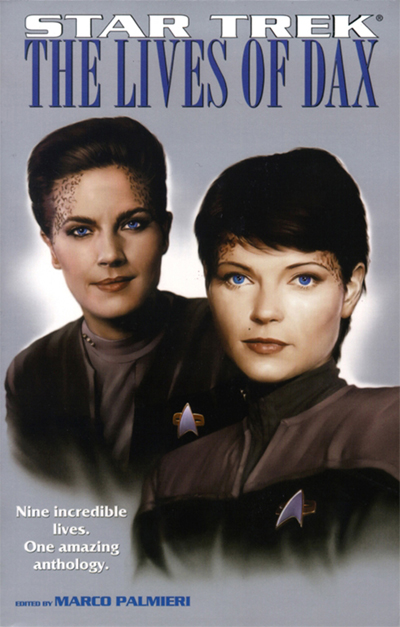
Star Trek: Deep Space Nine – The Lives of Dax: The Music Between the Notes (Curzon) by Steven Barnes

This September and October, we’re taking a look at the jam-packed 1994 to 1995 season of Star Trek, including Star Trek: Deep Space Nine and Star Trek: Voyager. Check back daily for the latest review.

Star Trek: Deep Space Nine struggled with the character of Dax on-and-off for the first three years. Terry Farrell found herself at the centre of interesting character-driven stories with Playing God and Facets, but the show tended to treat the Dax symbiont as a macguffin that just happened to be inside Jadzia. Episodes like Dax, Invasive Procedures and Equilibrium tended to marginalise Jadzia so that the symbiont itself could be pushed to the centre of a story driven by other members of the ensemble.

However, Dax is a character with absolutely phenomenal potential. There is something absolutely fascinating idea of a creature that has lived for centuries, and seen generations of history unfold within its lifetime.The symbiont has witnessed countless changes and pivotal moments. Dax has seen civilisations fall and alliances form; Dax has seen old enemies become true friends, and watched civilisations reach out into the cosmos.

The realities of a seven-season television show mean that Deep Space Nine never really got to explore the fact that Dax was living history. Perhaps Blood Oath and Trials and Tribble-ations come closest, using Dax as a rather logical bridge spanning almost a century of continuity. One of the joys of the Star Trek universe is how expansive and how limitless it is. Infinite diversity and all that. While even Dax cannot have seen everything, Deep Space Nine never felt like it captured the sense of Dax as living history.

At its best, Pocket Books’ The Lives of Dax anthology captures this sense of change and movement. The books spans the width and breadth of the Star Trek franchise, as lived through the life of one single organism. It is beautiful.
ds9-thelivesofdax1 Continue reading

Non-Review Review: The Babadook

Monsters are real.

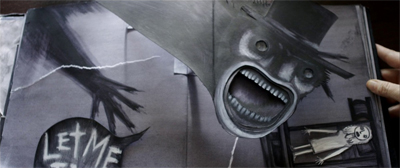
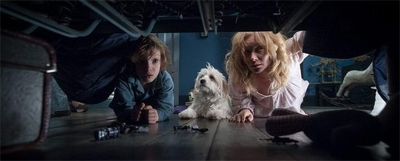
We all have our own monsters that we keep with us over our lives. “You can’t get rid of the Babadook,” a mysterious storybook threatens early in the runtime of The Babadook. Young Samuel tries to warn his mother Amelia about the monster lurking in the dark spaces – under the bed, in the closet, in the corner of his eye. He offers one rather sage bit of advice when it comes to such creatures. “You have to let it in.”

thebabadook1

Writer and director Jennifer Kent has crafted a superlative creature feature with The Babadook, acknowledging the metaphorical nature of monsters. These strange nightmares tend to stand in as expressions of guilt or anxiety. They give expression to thoughts and fear we could never properly articulate. The Babadook teases its audience with questions about the reality of the eponymous creature.

Is the strange “Mr. Babadook” something that truly exists, or is it something Samuel (and maybe Amelia) have created to cope with a horrific trauma?

thebabadook2 Continue reading

Star Trek: Deep Space Nine – Shakaar (Review)

This September and October, we’re taking a look at the jam-packed 1994 to 1995 season of Star Trek, including Star Trek: Deep Space Nine and Star Trek: Voyager. Check back daily for the latest review.

There are really two versions of Shakaar.

There is the episode that Shakaar very clearly wants to be. It’s intended to offer Kira a bit of closure, following on from the events of Life Support. It’s very clearly meant to explore Kira’s grieving process and to allow her to come to terms with the loss she suffered. After all, the episode opens establishing that Kira still mourns Bareil, while the episode closes with Kira extinguishing the memorial candle she lit for him. (Which does invite the audience to wonder if it was burning the whole time she was on Bajor.)

Carrying a torch...

Carrying a torch…

As such, it makes sense to offer Kira an opportunity to get back to her roots – to suggest that Kira might secretly want to return to the relative simplicity of a rebel fighter resisting an oppressive government; fighting a war is a lot less complex than navigating the peace. Kira’s reunion with the Shakaar Resistance Cell is meant to offer her a way to escape into something comfortable, to avoid moving forward; because moving forward is tough and painful. Shakaar should be about Kira learning that she has to push forward. It should be a companion piece to Progress.

The episode can’t quite manage this. Instead, we end up with an episode about how Kira gets swept off her feet by a dashing hunk of a man – an episode that leaves the viewer with the unfortunate implication that Kira only needed to find another weirdly paternal man to help her get past the death of the man she loved. Shakaar is an episode with a host of interesting ideas, but isn’t quite sure how to best bring those ideas to the screen.

You Winn some, you lose some...

You Winn some, you lose some…

Continue reading

Watch! Avengers: Age of Ultron Trailer!

The trailer for Joss Whedon’s Avengers: Age of Ultron has arrived. Check it out below!

Non-Review Review: Friday the 13th, Part II

There is something almost endearing about how direct the Friday the 13th film series is, how comfortable it is in its skin.

There are arguments to be made that the original Halloween and Nightmare on Elm Street are genuine cinematic classics, that are frequently underrated because they were followed by decades of sequels, knock-offs, reboots and remakes. Although they rapidly devolved into franchise zombies, Halloween really jump-started a cinematic genre, and Nightmare on Elm Street was slyly post-modern.

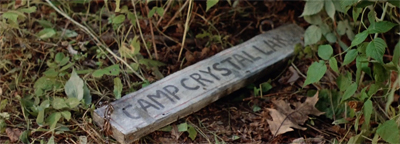
Somebody didn't read the signs...

Somebody didn’t read the signs…

In contrast, the Friday the 13th films have no such pretension. Instead, the Friday the 3th films exist as pure and uncompromising slasher schlock. Hack and slash and slice and dice. The Friday the 13th film series is powered not by central themes or ideas, but by a simply desire to churn out movies in which attractive and generic characters get brutally slaughtered. It is a ruthlessly efficient model; there were eight Friday the 13th films released between 1980 and 1989.

It’s hard not to admire the ingenuity at work here – the Friday the 13th films are relentless, refusing to let little things like logic or resolutions get in the way of the next sequel. Friday the 13th, Part II starts the franchise machine properly rolling, by rather efficiently getting around the fact that the first film’s serial killer had been fairly cleanly dispatched. It’s time to meet Jason Voorhees.

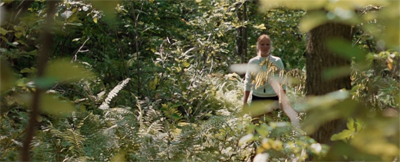
If you go down to the woods today...

If you go down to the woods today…

Continue reading

Star Trek: Voyager – Learning Curve (Review)

This September and October, we’re taking a look at the jam-packed 1994 to 1995 season of Star Trek, including Star Trek: Deep Space Nine and Star Trek: Voyager. Check back daily for the latest review.

So, Learning Curve is the last episode broadcast as part of Star Trek: Voyager‘s first season. It’s hard to get too excited about – or be too disappointed by – that.

Learning Curve is a bit of limp finalé to a mediocre season. Like a lot of the season before it, it’s a passable execution of what should have been a fantastic concept. (Boy, that really is Voyager in a nutshell, isn’t it?)

Is the show finally starting to gel?

Is the show finally starting to gel?

Learning Curve‘s position in the broadcast order was apparently a bit of blind luck. It was actually the fifth-last episode produced of the show’s first season. It just found itself broadcast in the “season finalé” slot when UPN decided to hold back the remaining four episodes of the season until the Fall, to broadcast leading into the second season.

However, despite this, Learning Curve seems as good a choice as any to close out the first season – and certainly a better choice than Brannon Braga and Jeri Taylor’s preferred candidate, The 37’s. It returns to the conflict between Starfleet and the Maquis promised in Caretaker, but only fleetingly acknowledged in episodes like Parallax or State of Flux. Although the execution leaves a lot to be desired, it does create a sense that the show has come something of a full circle.

It's Chakotay or the high way...

It’s Chakotay or the high way…

Continue reading

Star Trek: Deep Space Nine – Family Business (Review)

This September and October, we’re taking a look at the jam-packed 1994 to 1995 season of Star Trek, including Star Trek: Deep Space Nine and Star Trek: Voyager. Check back daily for the latest review.

Family Business is surprisingly good, standing as one of the strongest Ferengi-centric episodes produced during the run of Star Trek: Deep Space Nine. This is largely down to how Family Business treats its central characters. While still broadly played as a farce, Family Business is rooted in character. Like House of Quark (and unlike Prophet Motive), the episode takes care to treat its characters with a great deal of respect.

This isn’t an episode constructed around stock comedy tropes and trying to get the audience to laugh at one-note caricatures. Instead, it’s an episode firmly built around exploring Quark as a character in his own right. Family Business makes the decision to treat Quark (and its other Ferengi characters) with respect, and it’s a decision that ultimately pays dividends.

Naked ambition...

Naked ambition…

Continue reading

Star Trek: Voyager – Jetrel (Review)

This September and October, we’re taking a look at the jam-packed 1994 to 1995 season of Star Trek, including Star Trek: Deep Space Nine and Star Trek: Voyager. Check back daily for the latest review.

Jetrel is an interesting episode for a number of reasons. It’s another example of how the first season of Star Trek: Voyager seems anchored in the aftermath of the Second World War. The episode exists primarily as a meditation on guilt over the use of atomic weapon, with the Metreon Cascade attack on Rinax standing in for the dropping of the atomic bomb on Hiroshima and Negaska in 1945. Jetrel aired three months shy of the fiftieth anniversary of the bombing, and amid a national period of reflection about the morality of Harry S. Truman’s actions.

Whatever the context of Jetrel in 1995, it serves as another example of how Voyager seems like a relic from a bygone age, a snapshot of atomic age science-fiction. Cathexis was the show doing Invasion of the Body Snatchers. Faces was an old-fashioned monster movie. Jetrel wasn’t even the first time that the first season had traded in atomic imagery. The aftermath of the polaric detonation in Time and Again was very clearly designed to evoke the aftermath of an atomic blast.

The devil in the pale moonlight...

The devil in the pale moonlight…

Even without all this baggage, Jetrel still feels like a mess of an episode. The heart of the story finds a member of the ensemble confronting a former war criminal while dealing with issues of war guilt and responsibility – a structure that evokes Duet the penultimate episode of the first season of Star Trek: Deep Space Nine. While that episode worked brilliantly, there’s a sense that Jetrel is burdened a little bit trying to offer a two-hander about guilt while tackling the issue of the atomic bomb.

The problem is compounded by a somewhat messy final act that eschews all the episode’s heavy character-based drama in favour of a contrived techno-babble climax that involves a lot of characters spouting nonsense while playing with light-emitting diodes. Jetrel begins as the strongest and boldest episode of the show’s first season, but ends as one of the prime examples of Voyager‘s preference for techno-babble over character work.

Burn with me...

Burn with me…

Continue reading

Non-Review Review: Fury

Fury is an apocalyptic glimpse of warfare.

Unfolding in the last days of the Second World War, as Allied forces pour into Germany from all sides, there’s a sense that this is the end. This is the abyss. As the introductory text explained, Hitler had declared a doctrine of “total war” against these invading forces. Every man woman and child was to be mobilised against the advancing armies, in the hope that it might somehow slow down the Allied war machine. If you throw enough people at it, you might do some damage – even if it is just clogging the gears.

He will strike down with Fury-ous anger...

He will strike down with Fury-ous anger…

A movie about a tank crew enduring these last few days, Fury gets considerable mileage out of that image – of human flesh falling before the unstoppable and inevitable machine. At a couple of points in the movie, characters die with their faces quite literally down in the mud. At other points, bodies are crushed beneath the tracks of the eponymous vehicle. Towards the climax, we encounter a body so thoroughly squashed beneath the weight of the Allied advanced that it seems like an empty uniform.

Fury is at its best when it captures the sheer unrelenting terror and horror of the advancing war machine – the nihilism of fighting a war that has already been decided, and the bleak inevitability of large-scale slaughter.

Fog of war...

Fog of war…

Continue reading

Non-Review Review: Book of Life

Book of Life bristles with energy – almost too much energy at times.

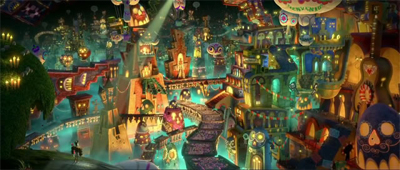
Book of Life is a sumptuous feast for the eyes, dynamic and beautiful, elegantly crafted and lovingly staged. It is packed with eye-popping visuals and an electric energy. In many ways, these help to compensate for a script that is simultaneously under-plotted and hyperactive. The basic plot arc of Book of Life – and the trajectory of all the featured characters – can be mapped from the opening scenes, while the movie is over-stuffed with pop culture references and snappy asides.

Book of Life is exhausting and exhilarating in equal measure, almost perfectly calibrated for its ninety-minute runtime. The result is a stylish and suave animated film that pops out of the screen, even if it doesn’t lodge in the memory. There’s little here that hasn’t been done before, but rarely has it been done so stylishly.

bookofthedead3 Continue reading