• Following Us

  • Categories

  • Check out the Archives


  • Awards & Nominations

Harsh Realm – Pilot (Review)

This November, we’re taking a trip back in time to review the seventh season of The X-Files and the first (and only) season of Harsh Realm.

Hereby it is manifest, that during the time men live without a common Power to keep them all in awe, they are in that conditions called Warre; and such a warre, as is of every man, against every man.

– Thomas Hobbes, Leviathan, The First Part, Chapter XIII

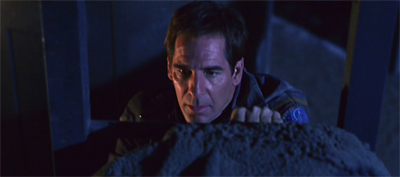
Harsh Realm is essentially a war story, or a collection of war stories.

To be fair, there are other themes that bleed through the show’s short nine-episode run; a critique of late-stage capitalism, a healthy dose of Chris Carter’s patented nineties existential spirituality, an exploration of American masculinity. The show plays on all sorts of genres across its short lifespan, from horror story to western to modern noir film. However, all of these unfold against the backdrop of a world locked in total warfare. The opening scenes of The Pilot unfold against the Siege of Sarajevo, setting the tone for the rest of the series.
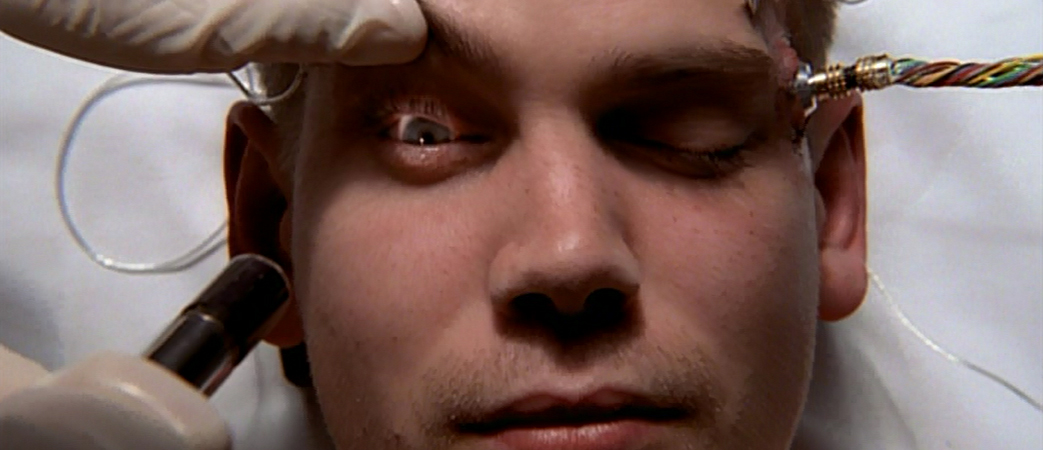
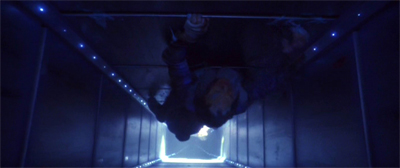
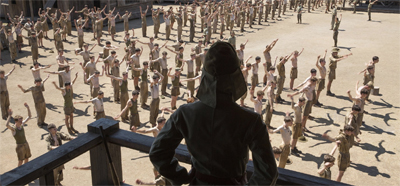
Tom's not here, man...

Tom’s not here, man…

Carter tends to wear his cinematic and televisual influences on his sleeves. The X-Files was a spiritual successor to Kolchak: The Night Stalker, with a little bit of The Parallax View and The Silence of the Lambs thrown in for good measure. Millennium launched in 1996 and owed a lot to the look and feel of David Fincher’s work on se7en. Harsh Realm owes a lot to the resurgence in war movies towards the end of the twentieth century, coming less than a year after Saving Private Ryan and The Thin Red Line both scored Best Picture nominations.

On the commentary for The Pilot, Chris Carter notes that the show’s protagonist was named for the philosopher Thomas Hobbes. Carter cites that Hobbes’ most famous observation is that life is “solitary, poor, nasty, brutish, and short.” The same might be said of the life of Harsh Realm.
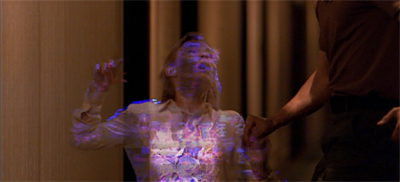
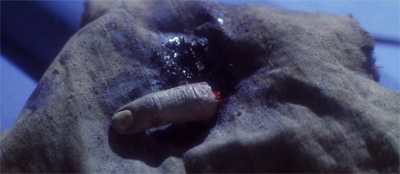
Fading out...

Fading out…

Continue reading

Star Trek: Enterprise – Hatchery (Review)

Next year, Star Trek is fifty years old. We have some special stuff planned for that, but – in the meantime – we’re reviewing all of Star Trek: Enterprise this year as something of a prequel to that anniversary. This August, we’re doing the third season. Check back daily for the latest review.

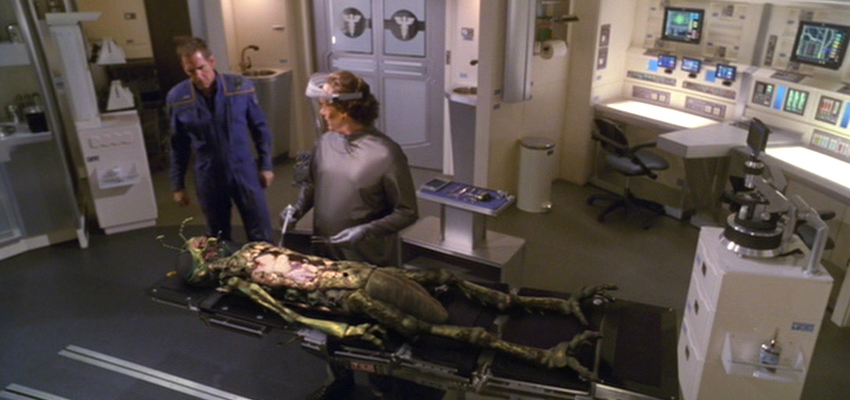
Hatchery is a very odd episode.

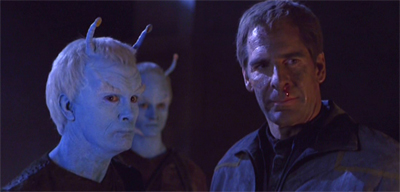
On the one hand, it feels like another irrelevant detour on the path to Azati Prime. It is a standalone episode about a wacky adventure that the crew have upon discovering a crashed ship on the surface of a dead world, playing with the standard Star Trek tropes about mind control and possession. This is not the first time that a Star Trek character has had their behaviour dramatically altered by an alien compound, and it does seem a bit distracting to tell this story at this point in this season, even in the aliens in this case are insect!Xindi.

Slice o' life...

Slice o’ life…

At the same time, it does feel like an important episode thematically. The third season of Star Trek: Enterprise is packed with all manner of existential explorations of what it means to be Star Trek. What are the essential ingredients of the franchise? How far can you wander off the template without breaking it? What does Star Trek even mean in a post-9/11 world? There are aspects of Hatchery that deal with these questions rather directly, as the episode explores the consequences of putting a bunch of marines on a Star Trek ship.

It just feels rather surreal that “Archer goes crazy from bug spray” should be the jumping-off point for that particular story.

"Hey there, little fella..."

“Hey there, little fella…”

Continue reading

Star Trek: Enterprise – Twilight (Review)

Next year, Star Trek is fifty years old. We have some special stuff planned for that, but – in the meantime – we’re reviewing all of Star Trek: Enterprise this year as something of a prequel to that anniversary. This August, we’re doing the third season. Check back daily for the latest review.

Twilight is a fascinating piece of Star Trek.

There are some significant flaws with the episode, particularly in how it treats T’Pol as a character and the eagerness with which it grabs at the famed “reset button.” However, despite these problems, Twilight is pretty much perfectly positioned. Eight episodes into the third season, the new status quo has been established. The ground rules have been laid down. Over the past seven episodes, fans have been given a sense of how the third season of Star Trek: Enterprise is supposed to work.

Keep your shirt on, Archer...

Keep your shirt on, Archer…

However, there is a palpable sense of unease about the larger arc – a question of how Star Trek can tell a story like the Xindi arc while remaining true to itself. The Shipment was an awkward attempt to impose a traditional Star Trek moral structure upon the season. North Star and Similitude are very much traditional Star Trek morality tales set against the backdrop of the larger arc. Like many of the stronger shows towards the tail end of the second season, these episodes seem to ask how you can apply old Star Trek standards to the twenty-first century.

Twilight is an episode about what happens if the Xindi arc goes wrong. Obviously, this is a story about what happens if Archer cannot save Earth from the Xindi, documenting the slow death of mankind as they are hunted through the cosmos. However, on an external level, Twilight is a story about what happens if Star Trek bungles this big grasp at relevance. It is no coincidence that the debilitating impairment that Archer develops involves his long-term memory. If the franchise forgets itself, all is lost.

Everything dies...

Everything dies…

Twilight is not just the story about the death of Earth or the death of humanity. It is a story about the death of Star Trek. Two years earlier, the franchise had seemed almost invincible; the idea of there not being any Star Trek on the air after the end of Star Trek: Voyager seemed almost absurd. However, by the time that the show had reached the third season, its existence was very much in peril. Twilight is a story about how horrible and apocalyptic the future might be; how Star Trek might find itself hobbled and then destroyed.

As its name implies, Twilight is a lament for the franchise; perhaps a tacit acknowledgement that the show was nothing more than a dead man walking at this point. The result is a surprisingly moving piece of television, a thoughtful and considerate examination of just how much is on the line for the franchise as well as the characters.

Waking dream...

Waking dream…

Continue reading

Star Trek: Enterprise – The Xindi (Review)

Next year, Star Trek is fifty years old. We have some special stuff planned for that, but – in the meantime – we’re reviewing all of Star Trek: Enterprise this year as something of a prequel to that anniversary. This August, we’re doing the third season. Check back daily for the latest review.

Delivering on change is always more difficult than promising change.

The first block of episodes in the third season of Star Trek: Enterprise struggle with the weight of expectation and the sense that the production team have no real idea of how to manage this sort of storytelling. Rick Berman and Brannon Braga had consulted with Ira Steven Behr towards the end of the second season, suggesting that they wanted to model the storytelling loosely on the blend of episodic and serialised scripting that Behr oversaw on Star Trek: Deep Space Nine. It makes sense, as Deep Space Nine was the only Star Trek series to really engage with that sort of storytelling.

A primate example of the Xindi...

A primate example of the Xindi…

In hindsight, it seems a shame that the writing room on Deep Space Nine was allowed to disintegrate so thoroughly. Ira Steven Behr, Hans Beimler and Rene Echevarria departed immediately following What You Leave Behind. Ronald D. Moore migrated briefly over to Star Trek: Voyager, but quit quite promptly following creative disagreements with former collaborator Brannon Braga. The veteran writers on Enterprise came from Voyager. Brannon Braga, Mike Sussman, Phyllis Strong and André Bormanis were all writers who had come into their own working on Voyager.

Star Trek: Voyager a show that was incredibly episodic and seemed to actively resist serialisation even more than Star Trek: The Next Generation. This is not a reflection on the production team. Braga had lobbied to expand Year of Hell into a year-long story arc during the fourth season, but his proposal had been rejected. Discussing the Xindi arc, Braga has talked about how he wanted to tell a year-long Star Trek story, and it is telling that one of his post-Star Trek writing assignments was on 24.

The ascent...

The ascent…

Nevertheless, it meant that the writers working on Enterprise faced a sharp learning curve when it came to structuring the third season. The experience accumulated during the arc-building on Deep Space Nine was largely lost to the franchise, and a lot of the early part of the third season sees Enterprise making a number of teething mistakes. The early stretch of the third season struggles to pace itself, and it struggles to integrate stand-alone stories with its larger serialised arc.

The Xindi is a prime example of this, an episode that has a wealth of interesting ideas and great concepts, but one that stumbles in the execution.

Pointing the finger...

Pointing the finger…

Continue reading

Star Trek: Enterprise – The Breach (Review)

Next year, Star Trek is fifty years old. We have some special stuff planned for that, but – in the meantime – we’re reviewing all of Star Trek: Enterprise this year as something of a prequel to that anniversary. This April, we’re doing the second season. Check back daily for the latest review.

One of the more interesting aspects of a heightened franchise like Star Trek is the way that invites particular members of staff to define their own voices. On most of the Star Trek shows, it is easy to distinguish the work of particular writers from one another. Ronald D. Moore likes militarism and world-building; Brannon Braga likes time travel and classic science-fiction. There are clear voices that can be distinguished from the choir on each of the shows, for better or for worse.

Although it enjoyed a considerably shorter run than the other Star Trek spin-offs, Star Trek: Enterprise is no exception.  The Breach is a script credited to writers Chris Black and John Shiban. The two had collaborated unofficially on Canamar, a script credited to Shiban alone. The two would work together again on First Flight towards the end of the season. It is certainly a partnership that had considerable potential, if not for Shiban’s departure at the end of the season.

What's up, Doc?

What’s up, Doc?

In many respects, The Breach feels like the product of those two voices. Xenophobia is a major theme of The Breach – as it was in Shiban’s other scripts for the season like Minefield, Dawn or Canamar. Like their last collaboration on Canamar and their future collaboration on First Flight, it seems The Breach presents a more balanced version of Archer than episodes like The Crossing or Horizon. This is a version of Archer who feels compelled to do the right thing, but without the same oppressive self-righteousness that drives his more awkward moments.

However, it seems like Chris Black provides The Breach with its very traditional and old-fashioned Star Trek aesthetic. A veteran of genre television with an understanding of the narrative conventions associated with the franchise, Black understands how Star Trek storytelling is supposed to work. The Breach is perhaps a little too formulaic and traditional in its storytelling, but it does demonstrate that – despite its best efforts – The Crossing had not completely buried a certain optimistic strain of Star Trek ethics.

Into darkness...

Into darkness…

Continue reading

Star Trek: Enterprise – Cease Fire (Review)

Next year, Star Trek is fifty years old. We have some special stuff planned for that, but – in the meantime – we’re reviewing all of Star Trek: Enterprise this year as something of a prequel to that anniversary. This April, we’re doing the second season. Check back daily for the latest review.

It is weird to think that Star Trek was dying in early years of the twenty-first century.

After all, the original series had greatly increased its cultural cachet at the height of the Cold War. The adventures of James Tiberius Kirk offered an optimistic alternative to total nuclear annihilation and a doomsday clock that was rapidly approaching midnight. Logic would suggest that utopian fantasy was all the more essential when contrasted against harsh reality. In fact, it seemed like cynicism and pessimism thrived in the (relatively) peaceful and prosperous decade following the collapse of the Cold War. The X-Files and Star Trek: Deep Space Nine were inescapably products of the nineties.

I'm blue dabba dee dabba dii...

I’m blue dabba dee dabba dii…

So one imagines that the dread and fear that took root in the wake of 9/11 might somehow make the optimism and hope of Star Trek all the more essential. After all, pundits and commentators wasted no time in suggesting that irony and cynicism were passé. Stephen Thompson, editor of The Onion, suggested that the age of irony had ended only a week after the attacks.  Graydon Carter, editor of Variety, observed, “I think it’s the end of the age of irony. Things that were considered fringe and frivolous are going to disappear.” In a highly publicised Time article, Roger Rosenblatt rejoiced.

Of course, irony was far from dead, as films like Team America: World Police demonstrated. The Colbert Report became a cultural phenomenon. The Onion is still in business. However, the speed with which these commentators latched on to the idea of the death of irony suggested that the mood had changed perceptibly. Maybe not definitively, maybe not completely, but there was a change in the air. If ever there was a time for the optimism and the utopianism of Star Trek, it would be this particular moment.

"This is the point where everything changed..."

“This is the point where everything changed…”

However, it seemed like 9/11 eroded the franchise’s faith in utopia. Understandably – and perhaps inevitably – Star Trek: Enterprise found itself warped by images and iconography associated with the attacks. The tradition idyllic alien worlds associated with the franchise – visible in early episodes like Strange New World and Civilisation were quickly replaced by landscapes evoking the popular mood – apocalyptic cityscapes of Shadows of P’Jem and Shockwave, Part II, the deserts of Desert Crossing, the militaristic settings of Detained and The Communicator, or even the darkness of Rogue Planet.

It was as if 9/11 had warped the psychological landscape of the Star Trek universe, throwing everything into doubt. Far from responding to that real-world tragedy with optimism and hope, it seemed that Enterprise only lost certainty in itself. Cease Fire is an episode that feels plagued by self-doubt and insecurity, even as it tries to find its way back to the franchise’s trademark idealism. It may not quite find its way back to the path, but it makes a reasonable effort.

It's all in ruins...

It’s all in ruins…

Continue reading

Non-Review Review: The Water Diviner

This film was seen as part of the Jameson Dublin International Film Festival 2015.

The Water Diviner is a solid directorial début for actor Russell Crowe, a well-intentioned and relatively under-explored story that occasionally wanders into clumsy melodrama.

Crowe works both in front and behind the camera, directing himself as a father who embarks on a journey across the world to bring his lost sons home. Set in the wake of the First World War, The Water Diviner charts Joshua Connor’s effort to recover the remains his three sons who perished in the battle for Gallipoli. Travelling from the Australia to Turkey, Connor finds himself fighting against bureaucracy and civil strife as he tries to keep the promise to bring his children back to home soil.

thewaterdiviner

It is a fascinating a compelling story. Crowe is a reliable leading man, imbuing Connor with a sense of humanity and relatability that helps to anchor a somewhat spotty screenplay. Crowe seems to trust his cast a great deal, affording them room to work and never rushing them along. However, he also seems somewhat sceptical of the audience. The Water Diviner is packed with repetitive flashbacks and awkward montages designed to impart information that the audience has already grasped.

The result is a rather uneven film. Much like its title character, it seems like The Water Diviner works best when it trusts its instincts; not when it tries to second-guess itself.

thewaterdiviner1

Continue reading

My 12 for ’14: Dawn of the Planet of the Apes and Talkin’ ‘Bout a Revolution…

With 2014 coming to a close, we’re counting down our top twelve films of the year. Check back daily for the latest featured film.

The world has always seemed like it was on the cusp of something – like there was a powder keg ready to errupt. The infamous “doomsday clock” has never been further than seventeen minutes from midnight, and – outside of that brief moment of post-Cold War euphoria – mankind has always been living within a quarter-of-an-hour from the end of existence as we know it. Nuclear weapons. Global warming. Biological warfare. Economic collapse. All possible world-enders.

The new millennium has been dominated by the threats of terrorism and of global warming, unconventional opponents that can difficult to engage. However, 2014 brought its own particular brand of uncertainties and discomforts. In February, a revolution in the Ukraine sparked a political crisis in Europe, pushing Russia to loggerheads with Europe and the United States. Since August, Ferguson has been simmering away, the imagery of the protests burnt into the collective unconscious. The Syrian Civil War has faded from the front pages.

dawnoftheplanetoftheapes11

The word “revolution” seemed to simmer away in the background, with certain young activists actively travelling to Ferguson in search of their own revolution. Writing in Time magazine, Darlena Cunha compared the trouble in Ferguson to the civil unrest which gave rise to the American Revolution. Demonstrating no shortage of self-importance, actor and comedian Russell Brand published his own manifesto – helpfully titled Revolution – in whish he pledged to lead a global revolution.

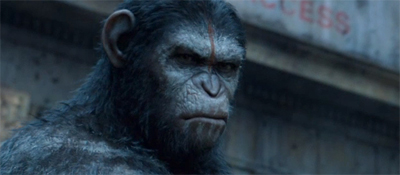
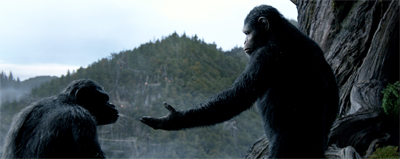
“The revolution can not be boring,” Brand advised readers. They seldom are. Revolutions are typically bloody, brutal, violent, horrific. There is a reason that wars of independence tend to be followed by civil wars and internal strife. Although the idea of revolution holds a romantic allure, history demonstrates that revolutions seldom help those most in need of assistance. “Meet the new boss,” the Who teased on Won’t Get Fooled Again, “same as the old boss.” Dawn of the Planet of the Apes is a harrowing and compelling exploration of revolutionary bloodshed.

dawnoftheplanetoftheapes3 Continue reading

Non-Review Review: Unbroken

The true story of Louis Zamperini is absolutely fascinating. It lends itself to this sort of big spectacle. It has everything you need for a movie that might clean up during awards season: a historical setting; a war; a sporting story about triumph of adversity; incredible physical transformations from the cast; a character enduring incredible hardship and coming out the other side. These are the sorts of ingredients that make a Best Picture contender. Unbroken just heaps more and more on top of these already alluring elements.

It isn’t the terrible and messy script that ultimately defeats Unbroken, with beloved filmmakers Joel and Ethan Cohen at the top of the bill. It isn’t the pedestrian unchallenging direction, either. It isn’t Alexandre Desplat’s condescending and patronising score, that doesn’t trust the audience to determine what they should be feeling from one moment to the next. It is not even the cynical Coldplay song playing over the closing credits, to put a pleasant life-affirming spin on events.

The Oscar race is on...

The Oscar race is on…

The detail that really shatter Unbroken is the fact that all of this has been very carefully and meticulously calibrated to check off the requisite items on the big Oscar check list. Unbroken is just as mechanical and lifeless a production as Transformers 4, but it happens to be built for a different purpose. There is no energy here, no enthusiasm, no emotion. It is just a bunch of things that have been successful in other stories heaped on top of one another, hoping to hit the high score on that fateful morning in January 2015.

Despite managing to eat up an incredible amount of attention and discussion in the larger Oscar race – taking attention off far more deserving contenders – Unbroken is a complete and utter misfire.

"This is what happens to anybody who suggests Merry Christmas Mister Lawrence is a better Japanese prisoner of war film."

“This is what happens to anybody who suggests Merry Christmas Mister Lawrence is a better Japanese prisoner of war film.”

Continue reading

Space: Above and Beyond – … Tell Our Moms We Done Our Best (Review)

This November (and a little of December), we’re taking a trip back in time to review the third season of The X-Files and the first (and only) season of Space: Above and Beyond.

Fox has a very weird (and perhaps even paradoxical) reputation when it comes to cancelling television shows. On the one hand, there is the tendency to run successful shows into the ground, missing the window of opportunity to transition them into big screen franchises. The X-Files and 24 are perhaps the most obvious example of this tendency. Of course, this isn’t unusual in American television. If a show is making money, it makes sense to keep on the air for as long as possible.

On the other hand, the network is notoriously ruthless when it comes to cancelling young shows. Although popularised by the cancellation (and subsequent revival) of shows like Firefly and Family Guy in the early years of the twenty-first century, the network had already demonstrated that it had little time for dead weight in the schedule. In hindsight, it seems like a wonder that The X-Files survived its first season, and was allowed to grow and develop into a massive cultural phenomenon.

We have met the enemy...

We have met the enemy…

Indeed, considering the abbreviated runs of shows like Profit or The Tick or The Ben Stiller Show or Harsh Realm or The Lone Gunmen, Space: Above and Beyond was lucky to get a full twenty-two-episodes-and-a-pilot run on Fox, even if it couldn’t count on the network to air the episodes at a consistent time on a consistent day. Space: Above and Beyond was undoubtedly treated shabbily by the network, but it could have been a lot worse.

That’s not the best eulogy you could write for a television show, but it is worth treasuring what we got.

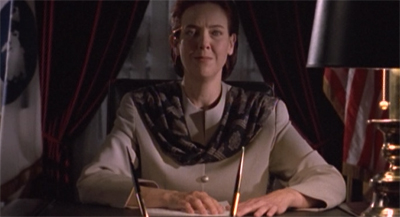
President of the World...

President of the World…

Continue reading