Human Error is a staggering act of creative cowardice.
Star Trek: Voyager is in the literal home stretch of its final season; only seven more episodes remain. By this point in its final season, Star Trek: Deep Space Nine was mapping out an impressive and ambitious epic tying together seven years of threads into something loosely resembling a single tapestry; the “final chapter” was kicking into high gear with Strange Bedfellows. While Star Trek: The Next Generation was less assuredly wrapping things up, as Star Trek: Generations loomed, there was an air of finality and closure to stories like Journey’s End or Firstborn.
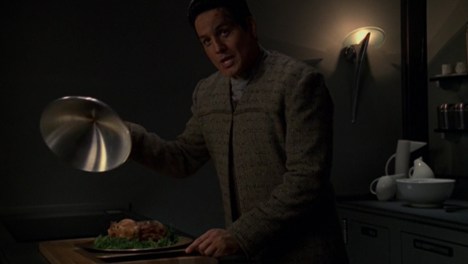
What a dish.
Voyager shows little real sign of progress in the final stretch. There is the occasional piece of housekeeping, such as the awkward decision to get Neelix off the ship in Homestead. There are occasional flashes of thematic reflection on the end of the journey, as in Workforce, Part I and Workforce, Part II. There are also episodes asserting the show’s place within the larger franchise, espousing hollow takes on familiar franchise storytelling in episodes like Critical Care or Repentance. Voyager even shows flashes of anxiety about the franchise iteration that will replace it, in episodes like Friendship One.
Watching the seventh season of Voyager, there is never any doubt that this will be the final season. There is a funereal atmosphere running through the season, that awkward sense of an exhausted athlete grasping desperately for the respite of the finish line. Watching the seventh season of Voyager, fatigue hangs in the air; it is abundantly clear that nobody involved expects an eighth season. However, it is equally obvious that nobody involved with the show has any idea what to do with the seventh season itself.
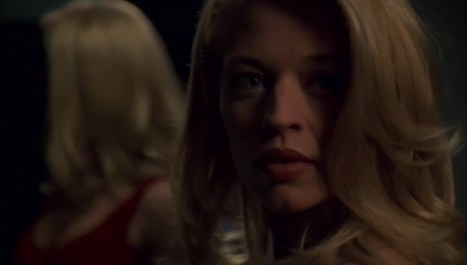
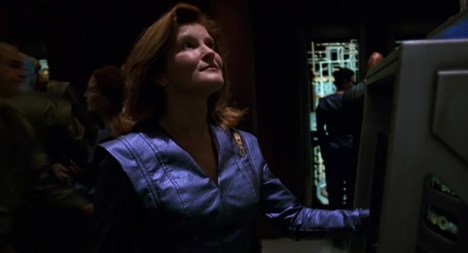
Not feeling herself.
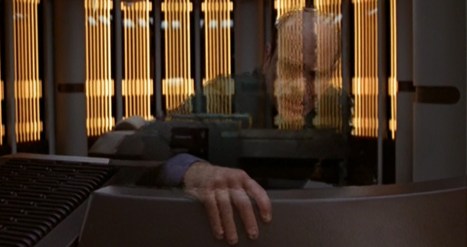
On its own terms, Human Error is a disappointment in a manner similar to a lot of late Voyager episodes. The premise is highly derivative of a number of relatively recent episodes. As with Imperfection, Seven of Nine experiences a technological malfunction that may kill her due to her Borg implants. As with Someone to Watch Over Me, Seven of Nine experiments with her humanity. As with Pathfinder (and much earlier Hollow Pursuits), a character finds themselves escaping from reality into holographic fantasy. As with Fair Haven, a lead character falls in love with a holographic partner.
Human Error is dull and drab in terms of plotting. Its structure is fairly conventional. It’s secondary plot is underdeveloped, unnecessary and distracting. Its resolution is trite, with Seven of Nine naturally redeeming her earlier failures by saving the crew at the last possible minute using techno-babble and hazily-defined stakes. All of this is pretty standard Voyager plotting. It is not an aberration. There is very little to be said about these elements of the episode. These have been problems with the show for years, and Human Error is not even the most egregious example of any of them.
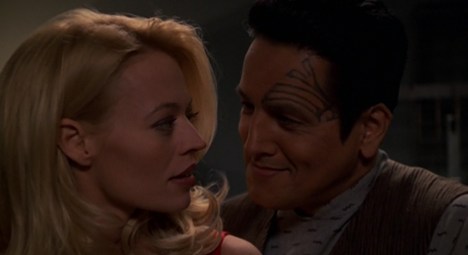
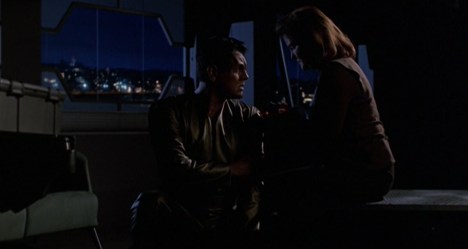
More like Chako-bae.
The big problem with Human Error is lack of conviction. Human Error is an episode with a premise that requires and demands proper development and exploration. It is an episode that lays down a marker, one that exists primarily so that it can be honoured over the final stretch of the season. Despite the problems within the episode itself, Human Error gambles in a big way on how the rest of the season builds off it. Naturally, Human Error loses this bet, its set-ups never honoured by the episodes that follow. This deals the episode a fatal blow, undercutting it brutally. Human Error is dull and drab, but also pointless.
To be clear, Human Error is not making an unreasonable request of the seven episodes that follow. The premise flowing from Human Error isn’t especially ambitious in the context of early twenty-first century television. Both The Next Generation and Deep Space Nine have built skilfully off individual episodes like Human Error, using these set-ups as stepping stones to build something more impressive. Even Voyager has employed that sort of storytelling before, albeit to mixed effect. There is no reason for Human Error to crash so spectacularly, beyond a complete disinterest from Voyager itself.
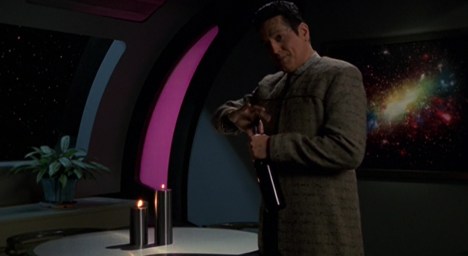
Don’t bottle it.
Continue reading →
Filed under: Voyager | Tagged: Brannon Braga, chakotay, continuity, romance, seven of nine, star trek, star trek: voyager, Television, voyager | 2 Comments »























 the m0vie blog
Star Trek: Voyager – Critical Care (Review)
Critical Care is the seventh season of Star Trek: Voyager attempting to be archetypal Star Trek.
To be fair, Voyager had done this before. When Jeri Taylor took over the show during its third season, she steered it away from the disaster of the Kazon arc and towards a more conventional style of Star Trek storytelling. Many of the episodes of the later seasons could easily have been repurposed for Star Trek: The Next Generation or Star Trek: Deep Space Nine or Star Trek: Enterprise without changing much beyond the characters’ names; think of Warlord, Scientific Method, Random Thoughts, Waking Moments.
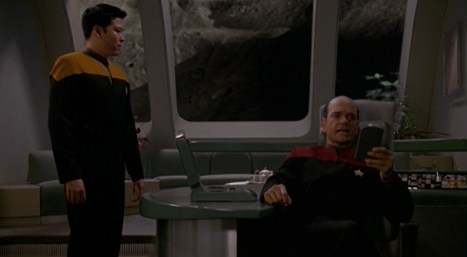
What’s up, Doc?
This isn’t inherently a bad thing. Indeed, many of the best episodes of Voyager had this broad and generic quality to them, offering something resembling an archetypal distillation of Star Trek for audiences. Remember and Memorial were both stunning explorations of cultural memory and Holocaust denial that could arguably have worked with any Star Trek cast. Blink of an Eye was a beautiful science-fiction parable that was more about Star Trek itself than Voyager. Even Nemesis could have easily worked with Riker or O’Brien or Tucker as easily as it did with Chakotay.
However, there are also points when these attempts to create “archetypal Star Trek” feels cynical and exploitative, the writing staff very cynically offering audiences something that is designed to meet as many of the vaguely defined aesthetic qualities of Star Trek, but without any substance underneath it. This happens repeatedly during the seventh season of Voyager, when it seems like the production team understand what Star Trek looks and feels like enough to offer a passable approximation, but don’t understand the underlying mechanics enough to replicate that ineffable feeling.
“Don’t worry, we’re almost home.”
Like a lot of seventh season episodes, Critical Care is couched in the trappings of Star Trek but without any substance to group it. On the surface, Critical Care is classic “social commentary” storytelling, the type of allegorical narrative exemplified by stories like Let That Be Your Last Battlefield or The High Ground. It is an episode about the horrors of contemporary healthcare, transposed to a distant alien world where Voyager can draw some very broad parallels for the audience watching at home. This is, on a very superficial level, what Star Trek is to a large number of fans.
Unfortunately, these touches do not add up to anything particularly insightful or compelling, Critical Care providing observations on contemporary American healthcare that amount to “this is pretty bad, isn’t it?” without anything resembling actual engagement. The result is a shell of an episode, a missed opportunity, and a pale imitation of the franchise’s best social commentary.
“What is up, Doc?”
Continue reading →
Filed under: Voyager | Tagged: capitalism, critical care, death panels, emh, healthcare, hmos, nostalgia, obama care, social commentary, socialism, star trek, star trek: voyager, Television, topical | 9 Comments »