• Following Us

  • Categories

  • Check out the Archives


  • Awards & Nominations

Millennium – 19:19 (Review)

This May and June, we’re taking a trip back in time to review the fifth season of The X-Files and the second season of Millennium.

One of the interesting aspects of the second season of Millennium is just how carefully structured all the chaos actually is.

There is an endearing and infectious randomness to the plotting of episodes like Sense and Antisense or A Single Blade of Grass, with individual episodes often struggling to fit together on an act-by-act basis. However, things become a lot clearer from a distance. Pulling back, it appears quite clear that there is a method to the madness. The episodes in the season – particularly those positioned towards the beginning and the end – each serve a clear purpose in the larger arc of the second season.
Will he die for our sins?

Will he die for our sins?

The first third of the season is very much about establishing concepts that will be of use later in the story. The Beginning and the End removes Frank from the yellow house and starts him on a new journey. Beware of the Dog introduces the Old Man and teases the mythology of the Millennium Group. Monster introduces Lara Means. The Curse of Frank Black gives Frank his long dark midnight of the soul. 19:19 and The Hand of St. Sebastian were the last two episodes in this opening act, and they exist to affirm the show’s cosmology.

Both 19:19 and The Hand of St. Sebastian firmly establish the show’s apocalyptic worldview in a Christian theological framework. 19:19 does this by exploring biblical prophecy and eschatology, while The Hand of St. Sebastian reveals the Millennium Group to be a secret Christian sect who have existed for over a thousand years. Although the show has always taken a lot of its imagery and iconography from Christianity, 19:19 engages explicitly with the idea of biblical prophecy and millennialism.
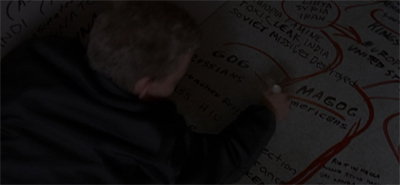
All part of the plan...

All part of the plan…

Continue reading

Millennium – The Curse of Frank Black (Review)

This May and June, we’re taking a trip back in time to review the fifth season of The X-Files and the second season of Millennium.

The Curse of Frank Black is a phenomenal piece of television, and an episode that demonstrates the raw potential of the approach that Glen Morgan and James Wong have adopted towards Millennium, making the show feel (simultaneously and paradoxically) more intimate and more epic. It is a show about the end of the world, but where the end of the world can be conveyed through the late night wandering of an old man on Halloween. It is a superb piece of work on just about every level.

The Curse of Frank Black is, in a many ways, the perfect encapsulation of many of the themes and ideas that Morgan and Wong have played with over the years. It is constructed in the style of a classic horror film, but is driven by character. As with Scully in Beyond the Sea, Mulder in One Breath, and McQueen in The Angriest Angel, Frank Black finds himself facing an existential crisis at the darkest moment of his life. What will Frank do when faced with the most horrific of possibilities?

millennium-thecurseoffrankblack22

What does anybody do when they are confronted with the end of their world? Morgan and Wong are fond of putting their characters through the metaphorical crucible, seeing what happens when the foundations are eroded and the support framework is taken away. The Curse of Frank Black suggests that there are only two possible options when the world falls to pieces: either you stand safely on your side of the line and watch it happen, or you pick up a bucket of water and start cleaning up.

It is a simple choice, an elegant metaphor, and it sits at the heart of The Curse of Frank Black.

millennium-thecurseoffrankblack15

Continue reading

Star Trek: Enterprise – Canamar (Review)

Next year, Star Trek is fifty years old. We have some special stuff planned for that, but – in the meantime – we’re reviewing all of Star Trek: Enterprise this year as something of a prequel to that anniversary. This April, we’re doing the second season. Check back daily for the latest review.

The story behind Canamar is much more interesting than the story told in Canamar.

On the surface, Canamar is quite simple – Star Trek does Con Air.” However, it had an interesting journey from original pitch to televised episode. Indeed, Canamar developed from David A. Goodman’s attempts to break out Judgment, trying to figure out what would happen to Archer after he had been found in Klingon court. Originally, the crew would have rescued Archer from a prison transport rather than Rura Penthe. However, producer Brannon Braga took such a liking to the “Archer on a prison transport” concept that he pulled it out of Judgment and assigned it to John Shiban to script.

"Have you seen Con Air?" "No." "Good. Then this'll all seem new to you."

“Have you seen Con Air?”
“No.”
“Good. Then this’ll all seem new to you.”

However, Braga also divorced Canamar completely from Judgment. Archer would no longer be a prisoner on a Klingon prison transport. Instead, he would find himself mistakenly arrested by an entirely new alien species a couple of episodes before he’d find himself arrested by a more recognised alien species. It feels somewhat redundant, with the first act of Canamar rushing through set-up of plot beats that would feel more organic and fluid if they came from an early episode explicitly designed to build to the idea of Archer on the prison transport.

Canamar is a prime example of just how out of touch Star Trek: Enterprise was with the television landscape, reinforcing the sense that the second season of the show was a holdover from some much earlier period of television production.

"It's the ship that made the Kessel Run in less than twelve parsecs. I've outrun Imperial starships."

“It’s the ship that made the Kessel Run in less than twelve parsecs. I’ve outrun Imperial starships.”

Continue reading

Daredevil – In the Blood (Review)

To celebrate the launch of Marvel’s Daredevil and the release of Avengers: Age of Ultron, we are reviewing all thirteen episodes of the first season of Marvel and Netflix’s Daredevil. Check back daily for the latest review.

There is something very functional and formulaic about stretch of the season running from Rabbit in a Snowstorm through to Condemned.

After a great opening set of episodes, it feels like the show stalls a little. It pulls back, taking the time run through some stock superhero origin plot elements before pressing ahead. This might just be a result of the thirteen-episodes-in-one-go format of the series, or it could be a result of the transition from original showrunner Drew Goddard to new showrunner Steven DeKnight. Whatever the reason, it feels like the first season slows down its plotting for Matt Murdock so that it can catch up on developing Wilson Fisk – a character who spent the first two episodes of the season as a phantom.

daredevil-intheblood18

As a result, it is rather unsurprising that Fisk’s plot should be the most interesting part of In the Blood. This is the audience’s first extended encounter with the new crime boss of Hell’s Kitchen, as we join him on an awkward first date right before we are reminded of just how violence he can be. As ever, Daredevil provides a nice sense of contrast with its characters, offering a striking juxtaposition between the well-meaning and innocent version of Wilson Fisk presented to Vanessa Marianna and the brutal and violent version of Wilson Fisk who decapitates Anatoly Ranskahov with a car door.

The problem, then, is the plotting as it relates to Matt Murdock. While the show is making up for lost time by developing Wilson Fisk, it seems like Matt is relegated to level-grinding against the Russian mob. These are villains so generic that it seems like everybody in Hell’s Kitchen just refers to them as “the Russians.” To be fair, the teaser to In the Blood does give us some sense of back story for Vladimir and Anatoly Ranskahov, but they feel rather transparently like a stalling tactic designed to eat up time before the show can get to the interesting stuff.

daredevil-intheblood6

The situation is not aided by the decision to play out the cliché “attack the hero by targeting a female acquaintance” plot as the centrepiece of Matt’s arc in the episode. In the Blood cleverly underscores the parallels between Wilson Fisk and Matt Murdock by juxtaposing their relationships with Vanessa and Claire respectively, but this structural cleverness is undercut by the decision to reduce Claire to emotional leverage. Victimising a female character to drive a male character to action is also a risky plotting decision, but particularly so when it feels like the show is just marking time.

In the Blood is a perfectly functional episode, albeit one that works much better when it focuses on its villain than when it focuses on its hero.

daredevil-intheblood1

Continue reading

Daredevil – Rabbit in a Snowstorm (Review)

To celebrate the launch of Marvel’s Daredevil and the release of Avengers: Age of Ultron, we are reviewing all thirteen episodes of the first season of Marvel and Netflix’s Daredevil. Check back daily for the latest review.

One of the more interesting aspects of Daredevil is the way that it wears its influences so confidently on its sleeve. As if aware that the stock comparison for the show will be Batman Begins, the series goes out of its way to hit a number of key points from that particular film – introducing its masked vigilante during an atmospheric attack at a dockland smuggling operation, stopping the import of superweapon into the city by a secret society of ninjas. The show returns to the work of Frank Miller time and time again, knowing that he is the defining Daredevil writer.

In terms of televisual influences, it feels like producer Steven DeKnight was heavily influenced by a lot of prestigious contemporary drama. In particular, Rabbit in a Snowstorm features sequences that feel like they might have been lifted from Breaking Bad and The Wire. This makes a certain amount of sense; those are two very well-respected shows that lend themselves to “binge” watching of (relatively) short seasons. Netflix has even found great success as a distributor of Breaking Bad in Europe. There are worse influences for Daredevil.

daredevil-rabbitinasnowstorm16

To be fair to Daredevil, the show never loses sight of itself. This is a superhero story about a masked vigilante who cleans up Hell’s Kitchen and comes face-to-face with honest-to-goodness ninjas and other possibly supernatural events. Nuance and subtlety have their place, but Daredevil arguably works best when it revels in its theatricality – grand sweeping statements, bold imagery, heightened drama. For all that Rabbit in a Snowstorm tries to expand and ground the world of Daredevil, it is marked by two acts of over-the-top violence at the open and close of the hour.

At the same time, this underscores the biggest problem with Rabbit in a Snowstorm. Daredevil is not a show that lends itself to the same sort of aesthetic as The Wire, and some of the attempts to ground the show feel clumsy and awkward; the show works best when it is big and bold and operatic, stumbling a bit when it tries to present a grounded real-world setting.

daredevil-rabbitinasnowstorm12

Continue reading

Daredevil – Cut Man (Review)

To celebrate the launch of Marvel’s Daredevil and the release of Avengers: Age of Ultron, we are reviewing all thirteen episodes of the first season of Marvel and Netflix’s Daredevil. Check back daily for the latest review.

If Into the Ring skilfully sets its tone in the opening teaser, telling the audience everything that they need to know about Daredevil before the first roll of the opening credits, then Cut Man saves its biggest and most defining moment for the closing seven minutes of the episode. It is almost impossible to talk about Cut Man without talking about the superb action sequence that closes out the episode – a single-take piece of stunt work that sees Matt Murdock tearing through an army of Russian mobsters in a way reminiscent of Oldboy.

That sequence is jaw-dropping, and possibly the visceral highlight of the thirteen-episode season. It is a very visceral demonstration of just what Daredevil can do. The technical skill on display in that seven-minute sequence rivals anything in the big-budget blockbuster Marvel movies. It eschews the clean-cut violence of something like the (also superb) elevator fight scene from Captain America: The Winter Soldier in favour of a more low-key and naturalistic vibe. Daredevil might not have the budget for monsters or armour suits, but it has a great stunt team.

daredevil-cutman11

In a way, the fact that Into the Ring is defined by its opening scene and Cut Man is defined by its closing scene feels appropriate. These are the only two episodes of the first season to be scripted by Drew Goddard, before he left the production and was replaced by Steven DeKnight. As such, these two episode have a tone that feels slightly distinct and removed from the episodes following on from this point. Although there is a very clear through line running from one end of the season to the other, Into the Ring and Cut Man feel like their own little part of the season.

These two episodes tidy away the broad strokes outline of Matt Murdock’s origin, to the point where the audience knows what they need to know before the actually story can kick in. The show will return to Matt’s early years in both Stick and Nelson v. Murdock, but Into the Ring and Cut Man represent the foundations of a superhero origin that will span the season.

daredevil-cutman13

Continue reading

Netflix and Marvel’s Daredevil – Season 1 (Review)

Marvel and Netflix’s Daredevil owes as much to the work of Christopher Nolan as it does to the larger Marvel Cinematic Universe. Taking advantage of the change in platform and format, the thirteen-episode season is a bit rougher and meaner than most of Marvel’s recent output. The show never reaches the excesses of The Punisher or Punisher: War Zone, but the show has a much rougher edge to it than many of its contemporaries. It is very much grounded in an urban noir storytelling style.

With thirteen episodes released to stream simultaneously, Daredevil is a unique venture for a studio that has been experiment in different media and different delivery methods. Daredevil is much more cohesive than either Agents of S.H.I.E.L.D. and Peggy Carter, feeling much more like its own thing. While each of the thirteen episodes is structured as an episode in its own right, the whole season amounts to a single long-form story. Distilled to its essence, Daredevil is the story of the conflict between an emergent vigilante and an ascendant crime lord.

daredevil-daredevil14

The series is not flawless; there are some pacing and structural issues that do haunt the series. However, it is a bold piece of work that stands unique among the prolific output from Marvel Studios. It is hard to imagine that either Avengers: Age of Ultron or Ant-Man will feel anything like this more grounded adventure, giving Daredevil a distinctive texture and demonstrating that Marvel is willing to experiment with the tone and style of some of its product. Given the volume of the studio’s output, this is inherently a good thing.

Daredevil is anchored in a set of terrific central performances and a clear sense of purpose. It might lose focus at points, or stumble into some plotting or pacing issues, but it marks a high point in Marvel’s television output.

daredevil-theonesweleavebehind8

Continue reading

Millennium – Season 1 (Review)

This February and March, we’re taking a trip back in time to review the fourth season of The X-Files and the first season of Millennium.

Millennium is a strange television show.

It is quite clear that Chris Carter and Fox both had a very different understanding about how best to follow on from the success of The X-Files. Fox clearly wanted another popular hit, a television show that it could plug comfortably into its 9pm Friday slot and grow into a multimedia franchise. The network spent a phenomenal amount of money promoting Millennium, with advertising and screenings and other publicity attempts. This approach paid off; The Pilot broke all sorts of records for Fox.

millennium-lamentation11

However, Millennium could not sustain those viewing figures. Over the first season, it haemorrhaged viewers. Chris Carter was not trying to present an accessible and popular pop hit; instead, Carter was taking advantage of the success of The X-Files to construct something decidedly more esoteric. Millennium is a tough show to watch. It is grim, unrelenting and oppressive. It is a show about darkness in the world that tends to roll up its sleeves and jump right in. Millennium has a clear idea of what it wants to be, but what it wants to be is alienating and uncomfortable.

On just about any level, the first season of Millennium is more accomplished than the first season of The X-Files. The production is more confident, the ideas are much bolder, the themes are much clearer. In fact, the first season of Millennium even holds up well when stacked against the fourth season of The X-Files on an episode-by-episode basis. But that’s not the problem. By definition, “Lance Henriksen fights serial killers and the concept of evil in America” will never be as popular as “David Duchovny and Gillian Anderson fight aliens and monsters and weird stuff!”

millennium-pilot11

The first season of Millennium is a show that offers a distinctive and uncompromising auteur vision which cares little for what the audience might want or expect. For better or worse, that approach would prevent Millennium from ever approaching the critical or popular support that The X-Files had already begun to accrue at the end of its own first season. The result is a television show that was never going to rival The X-Files as a pop culture phenomenon , but which serves as a bold philosophical statement from its creator.

“This is who we are,” the opening credits state, unapologetically. They seem to be speaking for the show as much for society.

millennium-bloodrelatives13 Continue reading

Star Trek: Enterprise – Dead Stop (Review)

Next year, Star Trek is fifty years old. We have some special stuff planned for that, but – in the meantime – we’re reviewing all of Star Trek: Enterprise this year as something of a prequel to that anniversary. This April, we’re doing the second season. Check back daily for the latest review.

Dead Stop is an interesting beast.

One of the stronger episodes from the second season of Star Trek: Enterprise, Dead Stop follows on directly from the events of the previous episode without serving as a direct continuation. It is very rare to see this approach taken on Star Trek, and it’s the perfect example of the sort of episode-to-episode connections that were lacking during the show’s first two seasons. Dead Stop is not a direct follow-on to Minefield, but it is fascinated with the fallout from that episode.

A model ship...

A model ship…

And yet, despite this, Dead Stop is also based around one of the most generic premises imaginable – a sentient space station with a sinister agenda. With a few choice edits, the premise could easily be adapted for Star Trek: The Next Generation or Star Trek: Voyager. Indeed, it’s not too difficult to imagine Kirk and Spock dealing with the rogue space station at some point during their five year mission. It is a story that could – in broad strokes – even work for a television anthology series.

The beauty of Dead Stop is the way that it blends these two conflicting elements together, to construct a show that feels like it showcases the best parts of Enterprise while working from a core story that could be told across the franchise.

Piecing it together...

Piecing it together…

Continue reading

Star Trek: Enterprise – Shockwave, Part II (Review)

Next year, Star Trek is fifty years old. We have some special stuff planned for that, but – in the meantime – we’re reviewing all of Star Trek: Enterprise this year as something of a prequel to that anniversary. This April, we’re doing the second season. Check back daily for the latest review.

Shockwave, Part I was one of the stronger episodes of the first season of Star Trek: Enterprise.

Shockwave, Part II is not one of the stronger episodes of the second season of Star Trek: Enterprise.

"Tell me how many seasons we get!"

“Tell me how many seasons we get!”

Continue reading