• Following Us

  • Categories

  • Check out the Archives


  • Awards & Nominations

Jessica Jones – AKA WWJD? (Review)

AKA WWJD?, AKA Sin Bin and AKA 1,000 Cuts represent the emotional climax of Jessica Jones.

The key is in handing the show over to its two strongest performers. Whether together or separately, Krysten Ritter and David Tennant are always engaging to watch. These three episodes push Jessica and Kilgrave into a sequence of tight interactions with one another. The dynamic between the two characters is constantly evolving and reversing, but the two actors are strong enough that every second is riveting television. While AKA Smile brings the season to an exciting close, there is nothing quite as powerful as watching Ritter and Tennant play off one another.

jessicajones-wwjd10a

Jessica Jones has a very good ensemble, with a lot of the roles cast very carefully and most the supporting players sketched out and developed. However, the core of the season is about Jessica Jones confronting and vanquishing Kilgrave, the man who abused her and countless others. It is highly debatable whether Kilgrave needed to be the focus of the season, particularly in the earlier episodes where he didn’t really have much to do, but Jessica Jones has reached the point where it can throw Jessica and Kilgrave into direct confrontation with one another.

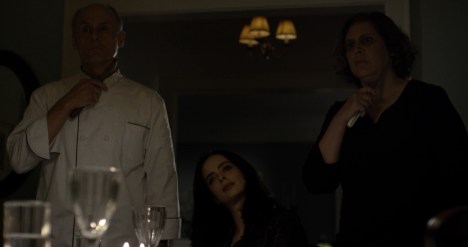
AKA WWJD? makes it clear that the confrontation between Jessica and Kilgrave will not be physical in nature. This is not a conventional super hero battle; Jessica will not be using her power to smash Kilgrave, and Kilgrave cannot use his mind control to manipulate Jessica. Instead, AKA WWJD? confirms that the confrontation between Jessica and Kilgrave will be emotional and psychological in nature; a victim confronting her accuser in pursuit of closure and satisfaction.
jessicajones-wwjd11a

Continue reading

Jessica Jones – AKA Ladies’ Night (Review)

“New York may be the city that never sleeps, but it sure does sleep around,” explains grizzled private detective Jessica Jones, the first line of Jessica Jones.

The line establishes two key themes going forward, running through the first season of the show. The more subtle theme is that of New York itself. Like Daredevil before it, Jessica Jones is rooted in a particular vision of New York; in its imagery and iconography. While Daredevil was arguably rooted in a version of Hell’s Kitchen that no longer existed, Jessica Jones seems at least a little more modern and more relevant. In AKA Ladies’ Night, and across the season, street names serve as an emotional anchor to the eponymous private eye. They are real and tangible places.

jessicajones-ladiesnight7

The second theme is more immediately pronounced. Jessica Jones might just be the most sex-positive aspect of the shared Marvel Universe. Although the usual limitations on nudity are in effect, Jessica Jones seems far more comfortable with human sexuality and sexual dynamics than any of the studio’s earlier output. AKA Ladies’ Night sets the tone for the season, opening with an awkward sequence of quick and grotty sex in (and around) a parked car. The show starts as it means to go on, embracing sex as a part of the human condition.

AKA Ladies’ Night does an effective job of setting the tone for what will follow. It is an effective introduction to the world of Jessica Jones.

jessicajones-ladiesnight12 Continue reading

Harsh Realm – Inga Fossa (Review)

This November, we’re taking a trip back in time to review the seventh season of The X-Files and the first (and only) season of Harsh Realm.

Inga Fossa is a noteworthy episode of Harsh Realm for a number of reasons.

In production terms, it closes out the loose three-episode introduction to the series. The Pilot, Leviathan and Inga Fossa were all written by Chris Carter and served as an introduction to the world and rules of Harsh Realm. Perhaps owing to the relative complexity of the show’s premise, Carter takes a bit of time to lay out and establish the core ideas of the show. It isn’t until the end of Inga Fossa that characters like Thomas Hobbes and Sophie have reached the status quo that will carry them through the rest of the first season.

Game on...

Game on…

However, all of this is ultimately irrelevant. Inga Fossa will always be notable for being the final episode of Harsh Realm to air on Fox. Chris Carter’s new show was infamously cancelled after only three episodes were broadcast. The six episodes that had been produced before cancellation were quietly shuffled off Fox’s 1999 schedule; they eventually aired on FX in mid-2000, to little fanfare. The cancellation was a shocking development. The ratings were spectacularly terrible, but Harsh Realm had been intended to establish Carter as the network’s idea-generating machine.

Something was very wrong.

"You can't $@!# in here, this is the war room!"

“You can’t $@!# in here, this is the war room!”

Continue reading

Star Trek: Enterprise – Harbinger (Review)

Next year, Star Trek is fifty years old. We have some special stuff planned for that, but – in the meantime – we’re reviewing all of Star Trek: Enterprise this year as something of a prequel to that anniversary. This August, we’re doing the third season. Check back daily for the latest review.

It goes almost without saying that the third season of Star Trek: Enterprise was an attempt to revitalise a franchise that had already been on television for a decade and half. It was an attempt to do something quite radical and dynamic with a television property that had become rather staid and conservative. Star Trek: The Next Generation had been perfectly calibrated for the late eighties and early nineties, but its approach towards storytelling was increasingly outdated after seven seasons of Star Trek: Voyager.

One of the recurring issues in the first season of Enterprise was the conflict between the established franchise structure and something more adventurous and exciting. So many of those first season episodes seemed laboriously paced and awkwardly arch; there was a sense of dull routine rather than exciting adventure. The show would occasionally try to deviated from the established template (to varying degrees of success) with stories like Dear Doctor, Shuttlepod One, and A Night in Sickbay, but narrative conservatism won out in the sophomore season.

"So... sweeps?"

“So… sweeps?”

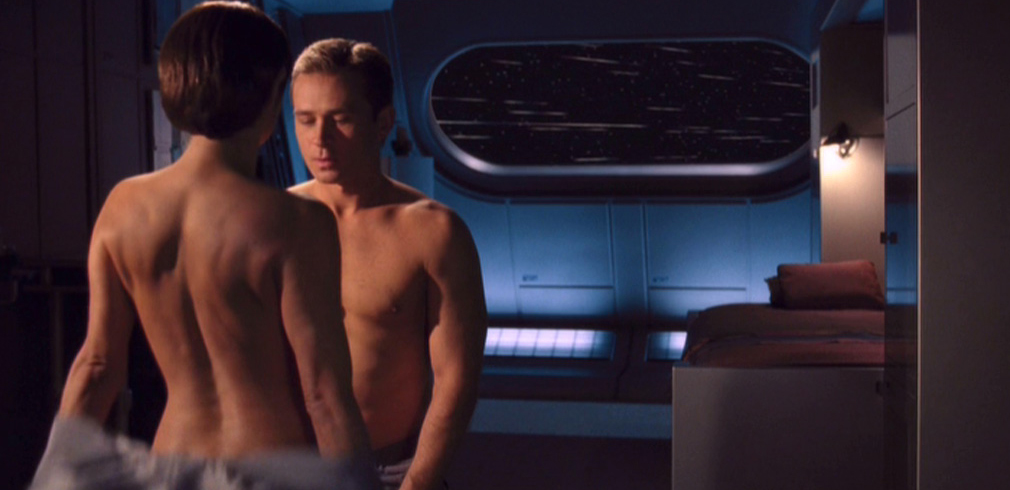
In many ways, Harbinger plays as a return to those earlier experiments in story structure. It is an episode that is not driven by story. Although the strange alien discovered by the crew provides a suitably dramatic climax, most of Harbinger is built around established character dynamics. Trip and T’Pol begin working through the sexual tension that has existed between them since the start of the third season; Reed and Hayes do something similar in a very different fashion. In the meantime, the ship just cruises along en route to the third season’s next big plot beat.

Harbinger is not entirely successful in this regard. There is a sense that the franchise is still figuring out how to construct episodes that don’t conform to a rigid story structure, with the mysterious alien visitor serving as an effective crutch to help get around these problems. Still, it is an interesting experiment and an example of how the show is consciously trying to reinvent itself in a manner that is more than simply cosmetic.

Expanding his Sphere of influence...

Expanding his Sphere of influence…

Continue reading

The X-Files – Milagro (Review)

This July, we’re taking a trip back in time to review the sixth season of The X-Files and the third (and final) season of Millennium.

The teaser establishes the mood quite quickly. It is a rather striking opening sequence for an episode of The X-Files, focusing on a writer staring at a blank page. The sequence cuts through time as the writer searches for inspiration, trying to take his cue from the index cards helpfully arranged on the wall. Eventually, the writer makes a grand gesture. He reaches into his chest, and pulls out his heart. It is a very effective opening sequence, one that makes it clear that Milagro will not be a normal episode of The X-Files.

The sequence also makes it clear that Milagro will not will it be a subtle piece of television. The teaser is not a particularly elegant metaphor, but it is an effective one. What is writing but tearing out a piece of yourself? Sometimes you have to wear your heart on your sleeve; sometimes you have to put it on the page. The teaser to Milagro is a very earnest piece of work from Chris Carter, a clear acknowledgement that what follows is a deeply personal piece of work.

Burning heart...

Burning heart…

Continue reading

Millennium – Darwin’s Eye (Review)

This July, we’re taking a trip back in time to review the sixth season of The X-Files and the third (and final) season of Millennium.

There is a reckless abandon to the the late third season of Millennium that is oddly endearing.

The first half of the year seemed almost cautious and conservative, as if trying to smooth the rough edges off the show in the hopes of turning it into a more generic piece of television. That approach failed spectacularly, and hobbled the rest of the season. Towards the end of the third season, Millennium allowed itself to become a bit bolder and more abstract, proudly flying its freak flag high. The show found an energy and verve, throwing crazy concepts into scripts with reckless abandon and little regard for how they fit together.

Shady theories...

Shady theories…

It doesn’t entirely work. If anything, it underscores just how skilfully the second season had integrated these crazy ideas with a clear creative direction and a solid thematic foundation. The second season know roughly where it wanted to go, and so embarked on an epic journey towards that point. While the third season has its own thematic underpinnings, these feel more like recurring visual motifs and ideas than a clear purpose. As a result, the weirdness can seem detached and purposeless, abstract and surreal.

However, even when the late third season episodes don’t quite work, they remain interesting. There is a breathless energy to these stories that was sadly missing in the first stretch of the year. Darwin’s Eye is a prime example. It is not an episode that could be described as a success by any measure, but it is still ambitious and dynamic in a way that mitigates its failings. Somewhat.

That's one way to get a head in love...

That’s one way to get a head in love…

Continue reading

Millennium – Loin Like a Hunting Flame (Review)

This February and March, we’re taking a trip back in time to review the fourth season of The X-Files and the first season of Millennium.

Loin Like a Hunting Flame represents the peak of a particular type of Millennium story.

It is an episode towards which the season seems to have been building. It is an episode that rather explicitly and candidly ties together two of the show’s favourite subjects: sex and violence, in harmony together. Loin Like a Hunting Flame is something of a stalking horse for the rest of the season; it is the first season episode that most obviously embodies the excesses of any show like Millennium. Fetishised violence has been baked into Millennium since The Pilot opened with a stripper dancing in her own blood; here, it reaches a logical end point.

Candid camera!

Candid camera!

Loin Like a Hunting Flame is an episode that is guilty of just about any criticism that might be thrown at it. It is gratuitous; it is sensationalist; it is excessive. It tries to have things both ways, titillating the viewer with glimpse of “exotic” sexual liberation while warning them that those sexually liberated individuals will be punished for their perceived transgressions. Yes, Loin Like a Hunting Flame tries to say something a bit more nuance, but it flails around for most of its forty-five minute runtime like a dying fish.

In many respects, this could be treated as a catharsis for the series. After this point, Millennium turns a corner. The rest of the first season is a lot more ambitious in tone and scope. As much as Loin Like a Hunting Flame closes off a particularly evolutionary line of Millennium, Force Majeure and The Thin White Line push forwards towards a more adventurous show. Loin Like a Hunting Flame just has to work these issues out, once and for all, to their logical (and unsatisfying) conclusion.

Wholesome family fun...

Wholesome family fun…

Continue reading

Star Trek: Voyager – Elogium (Review)

This September and October, we’re taking a look at the jam-packed 1994 to 1995 season of Star Trek, including Star Trek: Deep Space Nine and Star Trek: Voyager. Check back daily for the latest review.

Elogium is the first script from writer Kenneth Biller, even if it was his second script produced and his third script to air. Adapted from a script by Jeri Taylor from a freelance pitch from Jimmy Diggs, Elogium has gone through quite a few sets of hands before reaching the screen. In many respects, Biller’s script went through the opposite approach of many writers working on Star Trek for the first time.

Ronald D. Moore’s script for The Bonding and René Echevarria’s teleplay for The Offspring both went through story editor Melinda Snodgrass and executive producer Michael Piller for varying amounts of re-writes before their ideas reached the screen. In contrast, Biller’s début assignment is re-writing a script written by an executive producer from a freelance pitch. It’s no wonder that Elogium turned into such a mess.

Love in a turbolift...

Love in a turbolift…

The episode was produced towards the tail end of the first season of Star Trek: Voyager, and it’s almost a shame that it was held back into the second season. While hardly an episode deserving of repeat airing over the summer, it was also a pretty poor way of welcoming viewers into the show’s second season. It’s a problem with all of the hold-overs, except for Projections. The other three episodes carried over are among the weakest episodes of a troubled season. Elogium might not be quite as dull as Twisted or as unfocused as The 37’s, but it is a deeply creepy episode of television.

The two episodes produced during the second season to air in the first six weeks – Initiations and Non Sequitor – might not represent franchise high-points, but they are well-produced hours of television that suggest Voyager might be finding its feet. The hold-overs from the first season undermine that sense of progress.

Neelix was shocked to discover that Ocampan children were not found under cabbage patches...

Neelix was shocked to discover that Ocampan children were not found under cabbage patches…

Continue reading

The X-Files – 3 (Review)

This August (and a little of September), we’re taking a trip back in time to review the second season of The X-Files. In November, we’ll be looking at the third season. And maybe more.

3 is the first absolute misfire from the second season of The X-Files.

It’s easy enough to account for the problems with 3. The production on the episode was a mess. It was the first episode produced without one of the show’s two lead characters. It existed to plug a hole in the schedule caused by factors outside the control of the production staff. Writers Glen Morgan and James Wong were working on both this and One Breath simultaneously. And it’s also a traditional monster story, which is something that The X-Files had struggled with and would struggle with again.

Vamping it up...

Vamping it up…

To be fair, 3 does what it says on the tin. It is the episode between Ascension and One Breath, a forty-five minute breather that fills a broadcast slot and allows the show to continue on while Gillian Anderson takes maternity leave. The fact that there was only one slot to fill without Anderson is a testament to both the production team’s organisational skill and Anderson’s work ethic. Really, all that 3 needs to do is exist.

Even with that in mind, 3 still feels like a disappointment. Given how Anderson’s pregnancy managed to spur the production team to create a compelling long-form story for the show, culminating in stories like Duane Barry and One Breath, it’s disappointing that her absence doesn’t inspire the same creativity. Seeing The X-Files without Scully should be the opportunity for a fascinating adventure or insightful character study; it could play with audience expectations or the show’s rigid format. Instead, the result is just a mess.

"All by myself..."

“All by myself…”

Continue reading

Star Trek: The Next Generation – Ménage à Troi (Review)

This January and February, we’ll be finishing up our look at the second season of Star Trek: The Next Generation and moving on to the third year of the show, both recently and lovingly remastered for high definition. Check back daily for the latest review.

So, here we are again. We almost made it. Two episodes away from the series finalé and… boom! Lwaxana Troi episode. Sometimes you just can’t catch a break.

Still, this is the point where we reflect on how far the show has come in a season. Ménage à Troi is hardly the best episode of the season, but then Lwaxana episodes rarely are. We need to compare like with like, to get a sense of how far the show has come along. It’s not enough to say that Star Trek: The Next Generation is a better show when it made Ménage à Troi than it was when it made Manhunt or Haven, but it’s close.

Ménage à Troi is a problematic episode, much like Manhunt and Haven are both problematic episodes. There’s a weird awkward dated quality to the show’s attempts to do relationship humour – a vaguely unsettling sexist undertone about how confident older women are inherently hilarious and its great fun to see them involved in embarrassing relationships. Unfortunately, Ménage à Troi continues that trend.

Two Ferengi walk into a bar...

Two Ferengi walk into a bar…

Continue reading