• Following Us

  • Categories

  • Check out the Archives


  • Awards & Nominations

Millennium – Maranatha (Review)

This February and March, we’re taking a trip back in time to review the fourth season of The X-Files and the first season of Millennium.

Maranatha provides a nice close to Chip Johannessen’s four scripts for the first season of Millennium.

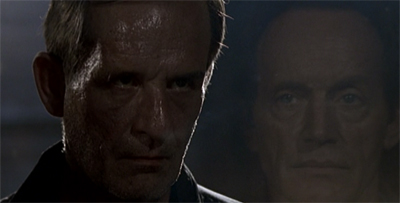
At its core, Maranatha is a story about stories. It is a tale about mythmaking and storytelling. It is about a monstrous man who seeks to transform himself into a creature of legend, brutally slaughtering innocent people in order to feed the idea that he is something much more than a corrupt political official. As such, the story sits quite comfortably alongside Johannessen’s other three scripts for the season, each of which is about storytelling or mythmaking in some form or another.
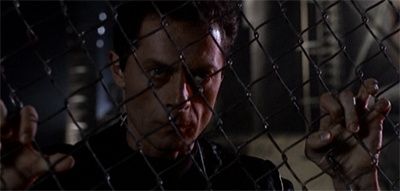
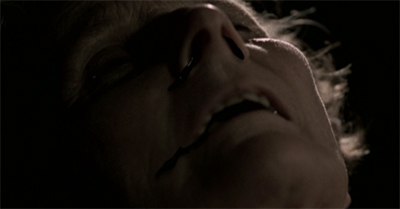
The power of Antichrist compels you...

The power of Antichrist compels you…

In Blood Relatives, James Dickerson attends the funerals of people he never knew, pretending to have been a part of the lives of the recently deceased; he tells stories and memories that never happened. In Force Majeure, Frank Black encounters a radical group of people who believe in the story of the end times; whether true or false, this story provides meaning to the life of the otherwise lost Dennis Hoffman. In Walkabout, Frank Black tries to piece together his recent history, constructing a narrative to account for out-of-character behaviour.

Maranatha serves as something of a culmination of this approach to Millennium. It the story of a sadist who seeks to elevate himself to the status of legend, dictating and shaping his own narrative through fear and manipulation.
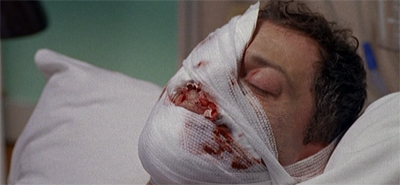
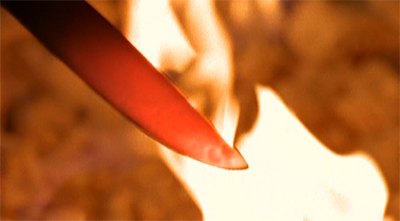
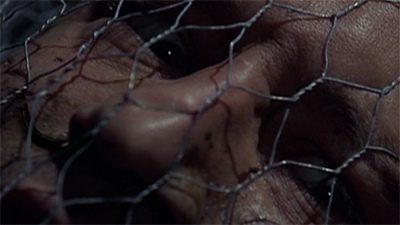
"I wanna take his face... off!"

“I wanna take his face… off!”

Continue reading

The X-Files – Terma (Review)

This February and March, we’re taking a trip back in time to review the fourth season of The X-Files and the first season of Millennium.

Tunguska and Terma borrows the structure that made the show’s early mythology episodes so effective. Tunguska is full of intriguing and compelling questions, implications that would seem to broaden or deepen the mythology. However, instead of resolving any of the major threads, Terma simply turns itself into a roller-coaster thrill ride. A cynical observer might compare the weaker mythology episodes to a shell-game: the potential of an interesting premise, lost in a shuffle designed to disorientate and catch the viewer off-guard.

It is an approach that has served the show well. Ascension avoided answering too many of the questions posed by Duane Barry, barrelling along with the momentum of a runaway freight train. Similarly, End Game did not dwell too heavily on the questions posed by Colony, instead serving as a series of high-momentum chase sequences with Mulder following the Alien Bounty Hunter to the ends of the Earth. Paper Clip moved so quickly that the viewers never wondered why the documents recovered in Anasazi were no longer earth-shattering, but merely macguffins.

Things are really heating up...

Things are really heating up…

The X-Files is very good at this sort of dynamic mile-a-minute plotting. The production team are very good at what they do. There is a sleek professionalism to these episodes that makes them easy to watch. Although filmed in Vancouver, there were few shows in the nineties ambitious enough to send their character to a Russian gulag for human experimentation. However, the cracks are starting to show. Herrenvolk demonstrated how frustrating a lack of answers could become. Terma struggles to balance a number of potentially interesting plot threads.

There are a lot of elements of Terma that might have worked well, if they had been given more room to breath. Sadly, the episode spends most of its run time trying to build up momentum towards the inevitable scene where proof narrow slips through Mulder’s fingers one more time.

Evil oil...

Evil oil…

Continue reading

The X-Files – Tunguska (Review)

This February and March, we’re taking a trip back in time to review the fourth season of The X-Files and the first season of Millennium.

The show’s conspiracy plot line is rapidly approaching critical mass.

It is quite clear at this point that while colonisation might have a schedule, Fox had just thrown Chris Carter’s out the window. The X-Files: Fight the Future looms large on the horizon. Indeed, Tunguska is credited to Chris Carter and Frank Spotnitz, who would end up writing the screenplay for the feature film over the Christmas break. However, while Carter had originally conceived the movie to put a cap on the television series, Fox wanted it to tie more aggressively into the series. It would not be the end of the journey, but a middle chapter.

Flagging the danger...

Flagging the danger…

As such, the larger conspiracy plotline that had been gathering momentum since the end of the second season spends two years largely spinning its wheels to keep the feature film relevant. The film was written midway through the fourth season and shot in the gap between the fourth and fifth seasons. So, there is a lot of stalling required. To use the “cancer” metaphor that is cleverly (and almost subconsciously) woven through the fourth season, the central conspiracy plotline seems to go into remission for a while.

This isn’t inherently a bad thing. Indeed, the stalling allows the show to take stock and to devote space in the mythology to more personal stories like Tempus Fugit and Max or Christmas Carol and Emily. However, it also means that episodes like Herrenvolk, Tunguska, Terma and The End felt like attempts to buy time – offering the illusion of dynamism and change while only inching the plot along.

Wired up...

Wired up…

Continue reading

Millennium – Gehenna (Review)

This February and March, we’re taking a trip back in time to review the fourth season of The X-Files and the first season of Millennium.

Written by Chris Carter and directed by David Nutter, Gehenna feels very much like a continuation of The Pilot.

More to the point, it feels like a restatement of many of the key themes of The Pilot, an attempt to reinforce many of the core ideas in that first episode, and hint at something larger. In many ways, it is about ensuring that Millennium retains its identity as it transitions from a pilot that had a relatively relaxed schedule and high budget into a weekly (well, eight-day) production schedule. Gehenna is about Carter and Nutter proving that Millennium can do what it wants and needs to do week-in and week-out, while also indicating towards larger threads.

Touching (or, at least, seeing) evil...

Touching (or, at least, seeing) evil…

This isn’t a bad way to approach the first regular episode of a television series. Indeed, Carter had done something similar with The Pilot and Deep Throat on The X-Files, structuring the episodes as a one-two punch of reinforced themes and world-building. Gehenna is very much about convincing the audience that The Pilot was not just a flash in the pan, and that the series has a long clear arc ahead of it. Much like Deep Throat really sketched the outline of the alien conspiracy only hinted at in The Pilot, Gehenna features more than a few nods towards a larger evil at work in Frank’s world.

There are points where Gehenna feels a little bit too forced, and a little bit too eager to restate and repeat the themes and ideas of The Pilot. However, it is an interesting episode that does hint towards the show’s future in a number of interesting ways.

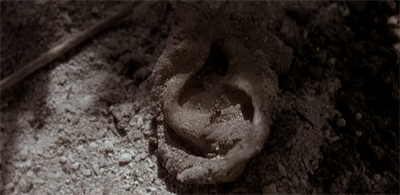
Ear today...

Ear today…

Continue reading

The X-Files (Topps) #4-6 – Firebird (Review)

This August (and a little of September), we’re taking a trip back in time to review the second season of The X-Files. In November, we’ll be looking at the third season. And maybe more.

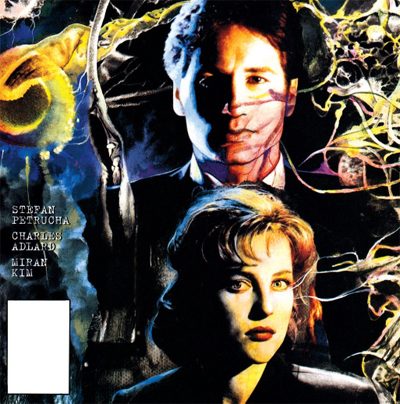
Firebird is the first multi-part story told in the pages of The X-Files. Writer Stefan Petrucha and artist Charles Adlard don’t transition from done-in-one stories to two-part adventures, instead skipping the middle step and producing a three-issue epic. While A Little Dream of Me exposed the limitations facing a creative team working on a tie-in, Firebird demonstrates the strengths of the format. Spanning from Siberia to New Mexico, Firebird has an epic scale that would not be possible on the second season of The X-Files.

(Rather interestingly – and perhaps tellingly – Petrucha takes the comics to places that the show wants to go. The American South-West would be very difficult to replicate in Vancouver, prompting the creative team to make an ambitious effort to bring Mulder and Scully to New Mexico in Anasazi, infamously painting a quarry red to achieve the desired result. The show would wait until the fourth season before it was confident enough to take Mulder to Siberia in Tunguska and Terma.)

Something out of this world?

Something out of this world?

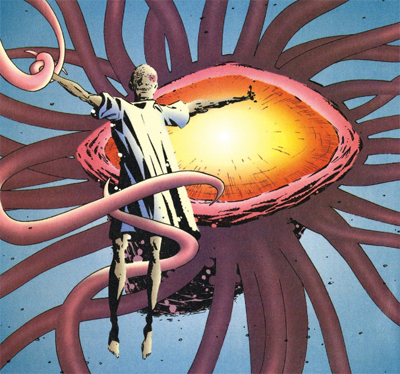
As with Not To Be Opened Until X-Mas, Firebird is very much a comic book story. While the show was reluctant have Mulder and Scully directly encounter aliens, the story features a monster that looks like something from the Lovecraft mythos. While the stakes on the show were generally rather personal to this point, Firebird puts the entire population of New Mexico (if not the world) at stake. While the series took its time revealing its evil conspiracy, Firebird gives us a cabal headed by a monologuing skull-holding would-be supervillain.

Perhaps surprisingly, this works. It’s clear that Petrucha and Adlard are aware that they are working in a different medium with different expectations and conventions. Firebird is very much an X-Files comic book epic, a story that couldn’t be realised on film. And there’s something very endearing about that.

Alien affairs...

Alien affairs…

Continue reading

My 12 for ’13: Gravity & Good Old-Fashioned Simplicity

This is my annual countdown of the 12 movies that really stuck with me this year. It only counts the movies released in Ireland in 2013, so quite a few of this year’s Oscar contenders aren’t eligible, though some of last year’s are.

This is number 4…

One of the more interesting aspects of blockbuster cinema over the past decade or so has been the way that bigger movies tend to have become more complicated and ambitious in their storytelling. This isn’t a bad thing, by any measure. The Dark Knight is a plot-driven blockbuster with no shortage of plot complications, reversals and reveals. However, not every blockbuster is as deftly constructed.

There’s been a surge in overly complicated and excessively convoluted blockbusters over the past few years. It’s not enough to have good guys and bad guys and spectacle. There’s a sense that there needs to be more crammed on in there. Double-crosses and triple-crosses, betrayal and redemption, shock reveals and game-changing twists. Bad guys no longer plan to simply destroy the world or kill the good guy, everybody has competing agendas, and big epic blockbusters often struggle to smooth those into a cohesive narrative.

gravity3

From this year, for example, Star Trek Into Darkness – while still an exceptionally enjoyable film – suffered from an over-complicated plot and a surplus of villainous motivation. The Wolverine featured a fiercely convoluted middle act where it seemed like half-a-dozen bad guys were all trying to kill our hero for different reasons. G.I. Joe: Retaliation featured an evil plot that was not only brilliantly stupid, it was also unnecessarily convoluted.

Gravity serves to buck the trend, offering something of a sharp contrast to this convoluted storytelling. Gravity is a celebration of old-school visual spectacle, guided through a decidedly old-fashioned plot.

gravity4

Continue reading

A View to a Bond Baddie: Ernst Stavro Blofeld

To celebrate James Bond’s 50th birthday on screen, we’re going to take a look at the character and his films. We’ve already reviewed all the classic movies, so we’ll be looking at his iconic baddies, and even at the character himself.

Blofeld is unique among the Bond villains for his capacity to keep turning up. He’s appeared in more on-screen adventures than any other Bond baddie, and he survives in the popular imagination, with a lot of gossip about the next Bond film likely to debate whether or not they’re bringing Blofeld back. The character has endured in the public imagination as the Bond baddie, and he’s perhaps best immortalised as Micheal Myers’ Doctor Evil from the Austin Powers movies. However, watching his appearances again, I’m actually struck by how little consistency there is in the portrayal of his character, and I can’t help but wonder if the reason he endures is because of his versatility as an adversary.

Bond movies have a remarkable adaptability. They can be serious, campy, ridiculous, sombre, mature and juvenile, often all at the same time. As far as Bond villains go, Blofeld’s really the only villain who can compete with that.

He looks like the cat who got the canary…

Continue reading

Non-Review Review: The Manchurian Candidate (1962)

The Manchurian Candidate is a rather wonderful piece of Cold War paranoia, with a handy bit of social commentary and a rather surrealist perspective thrown in on top. John Frankenheimer’s vision remains unnerving because of its occasionally absurd and strange imagery and subtext, much of which remains unsettling long after the end of the Cold War. While The Manchurian Candidate remains a fascinating story, and one which has seeped into pop cultural consciousness, It’s Frankenheimer’s direction that elevates the film, managing to convince the audience that there is some meaning and purpose to all the bizarre imagery and interactions.

Play your cards right…

Continue reading

Film Adaptation of the Play “Kursk” Streaming at the Space From Tomorrow…

Every once in a while, somebody passes on a bit of information to the site that I think is worth sharing, just because it’s kinda a little bit cool and a little bit fascinating. In May, the British Arts Council and the BBC launched The Space, an on-line hub for the arts – available to stream on-line for free. It’s an absolutely fantastic way of sharing the arts with people who honestly wouldn’t get a chance to see them otherwise. (Especially at the moment, when the economy is the way that it is.) Starting tomorrow, The Space will be streaming a film adaptation of a play Kursk, based around the infamous Russian submarine disaster.

Image: Kursk Photographer: Keither Pattison

Continue reading

Garth Ennis’ Run on Punisher MAX – Hardcover, Vol. IV (Review)

To celebrate St. Patrick’s Day, this month we’re going to take a look at Northern Irish writer Garth Ennis’ run on that iconic Marvel anti-hero, The Punisher. Check back every Friday and Wednesday for a review of a particular section.

I don’t know. It seems like, at times, I run hot and cold to Garth Ennis’ Punisher MAX run. It’s frequently cited as one of the great runs of modern comics, and there are moments when – if I squint – I can see hints of that masterpiece everybody is taking at. At other times, it seems I’m wandering in the desert, staring at a perfectly functional comic book, trying to figure out what everybody is making such a big fuss about. This penultimate collection of Ennis’ run contains two great examples of this. On one hand, the collection opens with the incredibly pedestrian Man of Stone, while it closes with the smarter-than-it-appears Widowmaker. Neither story is a masterpiece, but the latter has a lot more insight than I’ve come to expect from the series, while the former takes an interesting premise and does nothing with it.

The Punisherette?

Continue reading