• Following Us

  • Categories

  • Check out the Archives


  • Awards & Nominations

“The Things You Gotta Remember Are the Details”: Reservoir Dogs and the Fragility of Memory and Meaning in the Nineties…

It’s always interesting to understand how much of being one of the defining artists of a cultural moment is down to understanding the zeitgeist, and how much of it is down to simply being in the right place at the right time.

This is not to denigrate the incredible skill and talent required to be perfectly positioned “in the right place at the right time”, as any amount of sustained success requires both a great deal of determination and an incredible amount of talent. Quentin Tarantino is undeniably determined and impressively talented. Tarantino has a unique knack with dialogue, a keen understanding of genre, and a fine appreciation of the history the medium. It is hard to imagine a world in which Tarantino would ever have been unable to parlay those skills into some form of success in filmmaking.

Still, there are very few directors who were so perfectly in step with the nineties as Quentin Tarantino. Tarantino is a writer and director who emerged almost fully formed, to the point that many critics and pundits would argue that his first two films are the best films in his filmography; Reservoir Dogs and Pulp Fiction. (As an aside, there are a not-insignificant number of pundits who would argue that Tarantino’s best film was his third, the underrated Jackie Brown.) It seems fair to describe Tarantino, however controversial his legacy and however divisive his modern films might be, as a defining nineties filmmaker.

(As an aside, it should be acknowledged that Tarantino arguably had something of a similar moment towards the end of the first decade and into the second decade of the twenty-first century. Inglourious Basterds, Django Unchained and The Hateful Eight are films that have generated a lot of polarised debate, but they also seemed very much on-the-pulse in terms of the tensions and anxieties that bubbled to the surface of American popular consciousness at towards the end of the twenty-tens. However, that is perhaps a debate for another time.)
Reservoir Dogs and Pulp Fiction speaks specifically to a collection of nineties anxieties and uncertainties that seem only to have crystalised in retrospect, as if working through an existential crisis that the decade didn’t realise it was having in real time. Reservoir Dogs and Pulp Fictions are stories about memory and meaning, and how fleeting the human understanding of a chaotic world can be. They are stories about the breakdown of social order, and of trying to find some way to navigate increasingly turbulent and unstable times.

They are films that embody the tensions of nineties as effectively as Forrest Gump or the films of Oliver Stone or Chris Carter’s work on The X-Files and Millennium.

Continue reading

81. Django Unchained (#61)

Hosted by Andrew Quinn and Darren Mooney, The 250 is a (mostly) weekly trip through some of the best (and worst) movies ever made, as voted for by Internet Movie Database Users. New episodes are released every Saturday at 6pm GMT, with the occasional bonus episode thrown in.

This time, Quentin Tarantino’s Django Unchained.

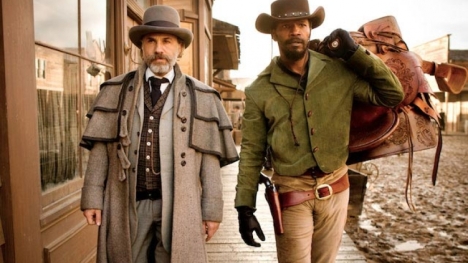
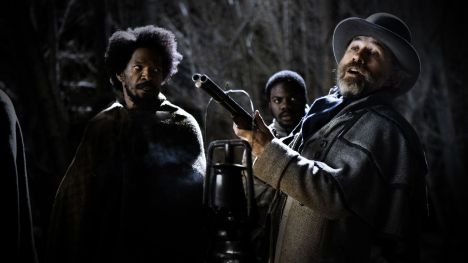
A “Southern” set against the backdrop of the southern states in the lead-up to the Civil War. Freed by the German bounty hunter King Schultz, Django embarks upon a mission to free his wife Broomhilda from the clutches of slave-owner Calvin Candie. Together, Schultz and Django find themselves entering the heart of darkness.

At time of recording, it was ranked the 61st best movie of all time on the Internet Movie Database.

Continue reading

Django Unchained and Tarantino Off the Chain….

Django Unchained is one of the most quietly influential movies of the twenty-first century.

It feels strange to acknowledge that fact, to say it out loud. On paper, it sounds absurd. Django Unchained is an R-rated western that deals with slavery in the manner of an exploitation film, released at Christmas. It is a movie that is downright abrasive, in terms of both tone and content. On the one hand, it is cheeky and provocative, playful and flippant; it is hyperstylised, from the Ennio Morricone score to the camera zooms to the bright flourishes of colour. It is also so violent and brutal that it is difficult to watch, even having seen the film before and knowing when the horrors are coming.

However, the film was a box office success. It earned over one hundred and sixty million dollars at the domestic box office, and more than two hundred and sixty million dollars at the foreign box office. More than that, it became a cultural touchstone. Jamie Foxx would reprise the role of Django in A Million Ways to Die in the West. The character would appear in a number of licensed comic book adaptations, including a crossover with Zorro published by Dynamite and Vertigo publishing.

The influence of Django Unchained is subtler than that. It is a film that shifted the conversation on the popular history of the United States. It did not do this alone, and it is hard to argue whether it was part of a broader cultural shift or simply a reaction to it. Nevertheless, Django Unchained coincided with a massive shift in how popular culture engaged with American history. Its impact is felt in the strangest of places, from the blending of horror movie conventions with a western aesthetic in films like The Revenant or Bone Tomahawk to the sounds of Kanye West playing over the opening scenes of Underground.

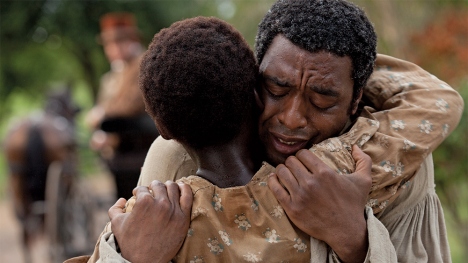
There had been movies about slavery before; indeed, Django Unchained was released roughly contemporaneously with both Lincoln and 12 Years a Slave. However, there had never been a movie about slavery like this. The western genre had been greatly diminished before Django Unchained was released, but it was profoundly changed in its wake. After Django Unchained, it seemed to become impossible to construct a western without reference to the atrocities upon which the west had been won.

Django Unchained argued that these horrors weren’t just one version of the story, but instead an essential part of the overall story of the frontier and the nation. Sofia Coppola’s refusal to confront slavery in The Beguiled became a minor controversy. Even Hostiles confronted the genocide of the Native Americans. There were westerns that avoided these controversies in the intervening years, but they became fewer and further between. Indeed, The Ballad of Lefty Brown is perhaps most notable for the ill-judged scene in which its only major African American character attempts to lynch the white lead.

Still, even approaching Django Unchained more than half a decade removed from its release, it remains a fascinating and compelling piece of cinema. It is a genuinely provocative piece of cinema, one designed to challenge and upset the audience. However, the true beauty of the film lies as much in its contours and finer details as it does in the broad strokes, in the little touches that enrich and enlighten the finished product. In particular, the sense that Tarantino understands the precarious nature of what he is attempting, despite the somewhat flippant attitude towards violence and bloodshed.

This sense of consideration and reflection is perhaps best explored in the character of King Schultz, who is positioned quite cannily as a deconstruction of the familiar white saviour trope.

Continue reading

13. Inglourious Basterds (#94)

This might just be our masterpiece.

Hosted by Andrew Quinn and Darren Mooney, The 250 is a fortnightly trip through some of the best (and worst) movies ever made, as voted for by Internet Movie Database Users. New episodes are released every second Saturday at 6pm GMT, with the occasional bonus episode between them.

This time, Quentin Tarantino’s Inglourious Basterds.

A genre-hopping Second World War revenge western, Quentin Tarantino’s ahistorical epic charts a number of parallel and overlapping plots to assassinate Adolf Hitler at the height of the World War II, drawing together a top British film critic, a German cinema star, a bunch of American Jewish commandos and the sole survivor of the massacre of a Jewish family.

At time of recording, it was ranked the 94th best movie of all time on the Internet Movie Database.

podcast-inglouriousbasterds

Continue reading

My 12 for ’13: Django Unchained & Suckerpunching Expectations

This is my annual countdown of the 12 movies that really stuck with me this year. It only counts the movies released in Ireland in 2013, so quite a few of this year’s Oscar contenders aren’t eligible, though some of last year’s are.

This is number 2…

Slavery seems to have been bubbling away at the back of the American pop cultural consciousness this year. Quentin Tarantino’s Django Unchained and Steven Spielberg’s Lincoln were both Best Picture nominees at this year’s awards ceremony. 12 Years a Slave is making pretty impressive head-way for next year’s Oscars, embarrassing moments like the film’s European marketing aside. They are all superb and moving films, but Tarantino’s Django Unchained is probably the strongest of them.

djangounchained8

Continue reading

Non-Review Review: interMission

interMission is a fantastic piece of Irish cinema, a broadly accessible exploration of intersecting and overlapping life in Dublin with a witty script lending the film some distinctly Irish flavour. The structure owes a little bit of a debt to Tarantino’s Pulp Fiction or even Altman’s Short Cuts, capturing a variety of perspectives on life from a reasonably-sized ensemble who only occasionally overlap with one another. It’s a funny, clever, well-acted and well-directed slice of life.

Drive of your life...

Drive of your life…

Continue reading

Look! Jack Kirby’s Designs for Argo!

I’m actually reasonably happy with Argo winning Best Picture. I’ve given up on the idea of the Academy Awards ever mirroring my own tastes, and Argo is a pretty great film from a director who is developing into a wonderful talent. And the awards last night spread the love around. It’s hard to hate a ceremony that can give Quentin Tarantino a Best Original Screenplay Oscar for Django Unchained.

Anyway, in celebrating the success of Argo, how about a look at Jack Kirby’s original designs for the fictitious movie Lord of Light (which became Argo)? Kirby was a comic book legend, who created The Fantastic Four, The X-Men, Captain America, Thor and countless other iconic comic characters. In the seventies, Kirby had an ever heavier science-fiction bint, creating his wonderful Fourth World and The Eternals and O.M.A.C. As part of the operation to rescue the escaped diplomats, Kirby designed these storyboards for the movie, which actually hit upon several of the author and artist’s favourite themes – including advanced god-like beings and the merging of the rational with the mystical.

Check out his sketches below. Click to enlarge.

Click to enlarge.

Click to enlarge.

Continue reading

Look! Quentin Tarantino Death Chart!

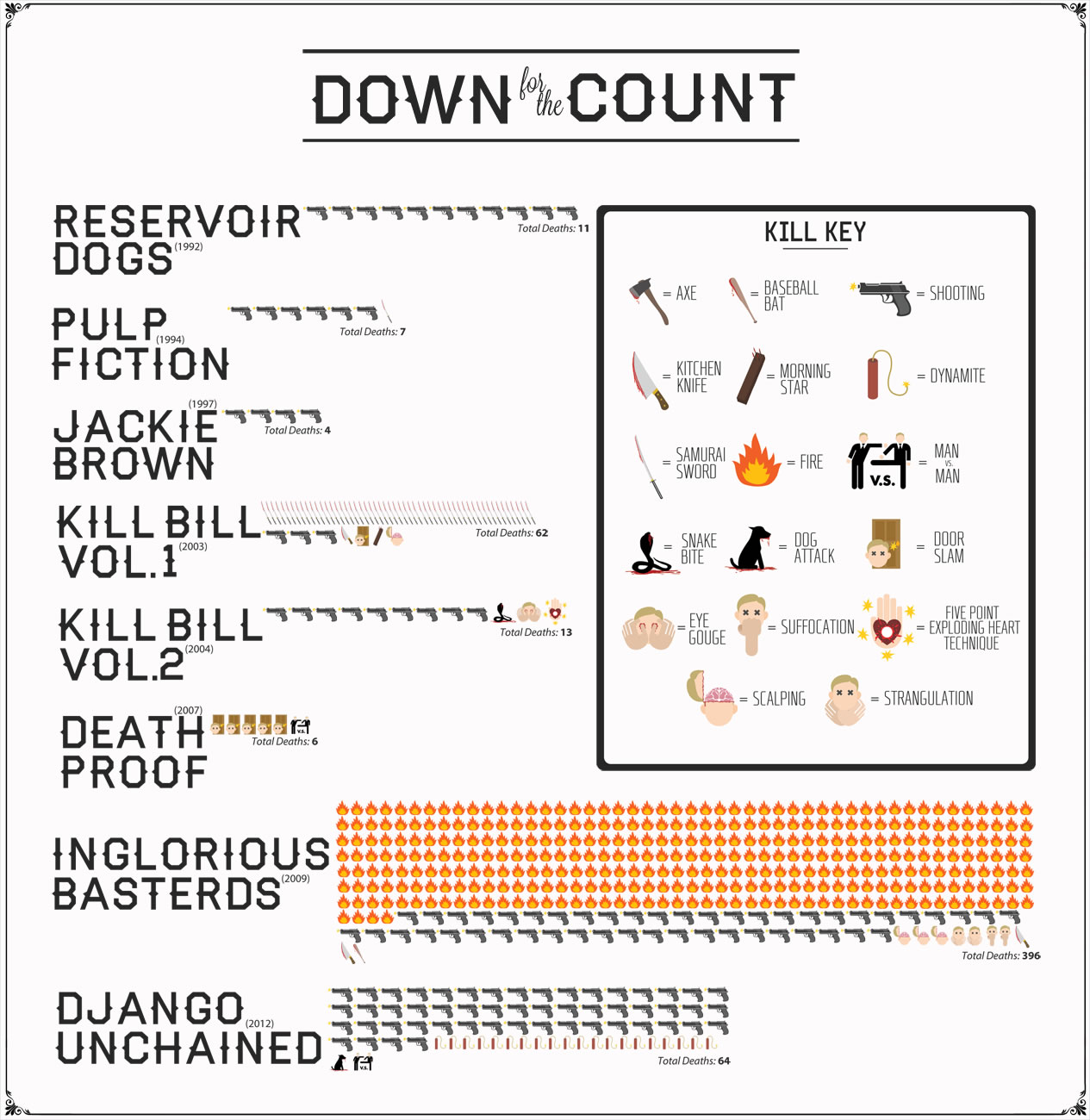
Vanity Fair have published this chart of the deaths in Quentin Tarantino’s film – breaking down each film in the director’s filmography by number and method of death. Yes, there is a lot of fire in Inglourious Basterds. It’s interesting to examine, if only because it is (generally speaking) a lot less bloody than I would have expected. I didn’t realise that Kill Bill, Vol. 1 only had 62 on-screen deaths. (That said, I did expect Kill Bill,Vol. 2 to have a much lower count – 13 sounds about right.) Anyway, check it out below.

tarantino-death-chart

“It’s None of Your Damn Business What I Think About That”: Tarantino and the Limits of Film Directors…

It’s a clip that’s gone viral. Tarantino lashing out at Channel 4 interviewer Krishnan Guru-Murthy has become something of in internet touchstone. “I’m shutting your butt down,” the director protests after getting another of those inevitable questions about the link between movie violence and real-life violence. It’s cringeworthy and awkward, and it plays into Guru-Murthy’s hands better than a straight answer would have, but I can’t help but empathise with Tarantino’s position.

Incidents like the shooting in Aurora or Connecticut shooting are truly horrifying and very hard for us to contextualise. I can understand Tarantino not wanting to get into that debate, because it’s really not the place of anybody involved in cinema to talk about it. It’s arrogant for anybody with any film background to try to relate their work to it, and it’s negligent of any journalist to try to sensationalise a link between film violence and real violence when the real questions are tougher, more uncompromising and more uncomfortable than a quick jab at Tarantino.

Continue reading

My 12 for ’12: The Muppets & Everything You Need, Right In Front Of You

I’m counting down my top twelve films of the year between now and January, starting at #12 and heading to #1. I expect the list to be a little bit predictable, a little bit surprising, a little bit of everything. All films released in the UK and Ireland in 2012 qualify. Sound off below, and let me know if I’m on the money, or if I’m completely off the radar. And let me know your own picks or recommendations.

This is #3

I can’t help but feel that The Muppets probably aren’t quite as popular over here as they really should be. After all, we had to wait about three months for the eventual release of the film in Irish cinemas. Even later this year, following all the publicity around the recent revival, I was only able to find one cinema in Dublin doing three screening of The Muppets’ Christmas Carol, despite the highly-publicised re-release. However, perhaps I shouldn’t take their international publicity for granted either. After all, Jason Segal spent six or seven years trying to guide everybody’s favourite felt performers to the big screen again.

Still, The Muppets demonstrated that the gang had lost absolutely nothing in transitioning out of retirement and back to the screen, demonstrating that all these sorts of characters need is a bit of sincere love and affection.

muppets6

Continue reading