• Following Us

  • Categories

  • Check out the Archives


  • Awards & Nominations

Non-Review Review: Star Wars – Episode VII: The Force Awakens

Star Wars: Episode VII – The Force Awakens is the Star Wars film you’re looking for. Mostly.

In many respects, Star Wars was the film the helped to launch the modern “blockbuster” model of cinema, and a large part of The Force Awakens is the reassurance that not too much has changed in the intervening years. Sure, there are a few script tweaks to reflect more modern tastes for the post-Dark Knight era, but the basic storytelling engine is still the same underneath. If The Force Awakens is a hybrid, it is a hybrid fashioned from the parts of the three original Star Wars films and just a dash of something more twenty-first century.

The Force is strong with this one...

The Force is strong with this one…

After the issues with the prequels, it is reassuring to know that the engine still runs. The franchise’s history as one of the forerunners of blockbuster cinema makes it perfectly suited to JJ Abrams’ nostalgic stylings. Abrams gets a lot of flack for his evocation of seventies and eighties blockbuster cinema, but he does have a fundamental understanding of how (and why) it works. Ever the keen student of Spielberg and vintage Hollywood blockbusters, director JJ Abrams is able to effortlessly blend that classic aesthetic with a contemporary sensibilities.

There are moments when The Force Awakens threatens to suffocate under the weight of what came before, but it largely succeeds on its own terms as a doorway to something new and exciting.

Handover from one generation to the next...

Handover from one generation to the next…

Continue reading

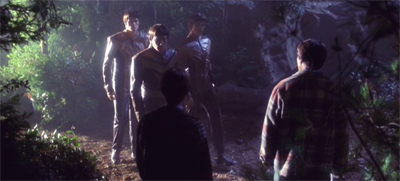
Harsh Realm – Kein Ausgang (Review)

This November, we’re taking a trip back in time to review the seventh season of The X-Files and the first (and only) season of Harsh Realm.

So, what does an average episode of Harsh Realm look like?

After all, the show was cancelled after only three episodes had been broadcast. Those three episodes were all written by the creator, and formed something of a loose introduction to the show. Inga Fossa ended with our protagonist finally accepting his place in the virtual world and his mission to defeat General Omar Santiago before the dictator can destroy the real world. There is a sense that the show had yet to even demonstrate what a regular episode of Harsh Realm might look like. It was over before it had even begun.

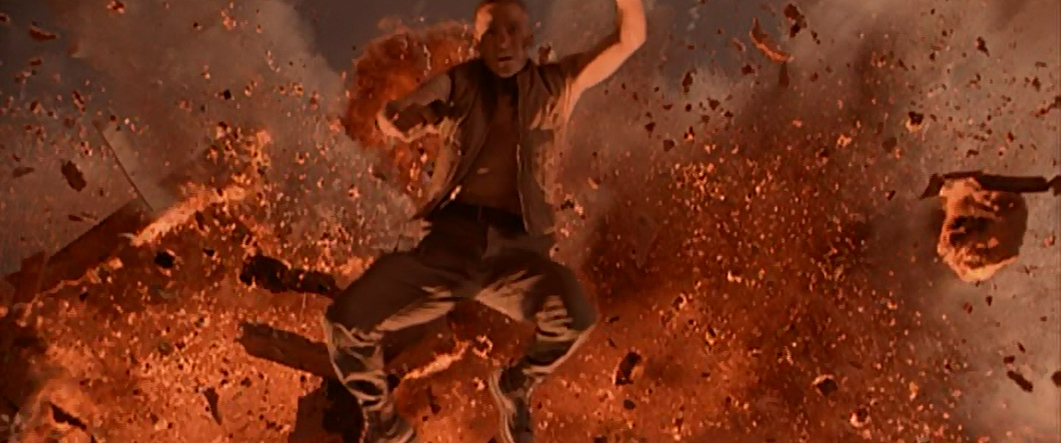
Jumping into action...

Jumping into action…

Kein Ausgang is the first episode of Harsh Realm to be written by somebody other than Chris Carter. As such, it is an important milestone in the development of the series. It is also the first of two episodes written by Steven Maeda, who would prove to be a pretty reliable set of hands in the life of the young show. Based on his contributions to Harsh Realm, it is easy to see why Carter drafted Maeda over to The X-Files in the wake of Harsh Realm‘s cancellation, even if his contributions to that show were a little more uneven.

Kein Ausgang offers an interesting glimpse of what Harsh Realm might have looked like going forward, if Fox had waited more than three episodes to cancel the show.

Shining a light on it...

Shining a light on it…

Continue reading

Star Trek: Enterprise – Chosen Realm (Review)

Next year, Star Trek is fifty years old. We have some special stuff planned for that, but – in the meantime – we’re reviewing all of Star Trek: Enterprise this year as something of a prequel to that anniversary. This August, we’re doing the third season. Check back daily for the latest review.

Chosen Realm is Manny Coto’s second script for Star Trek: Enterprise.

His script for Similitude marked Coto as something of an old-fashioned Star Trek writer. It was clear that Coto harboured a great deal of affection for the source material, and Similitude was structured in the style of a classic Star Trek morality play. It was a story about the circumstances in which “the needs of the many outweigh the needs of the few… or the one.” There is a reason that Star Trek fans are so very fond of Similitude, particularly given its position in the middle of a rather polarising and provocative season.
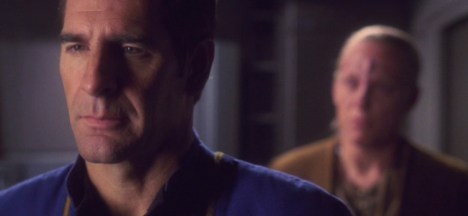
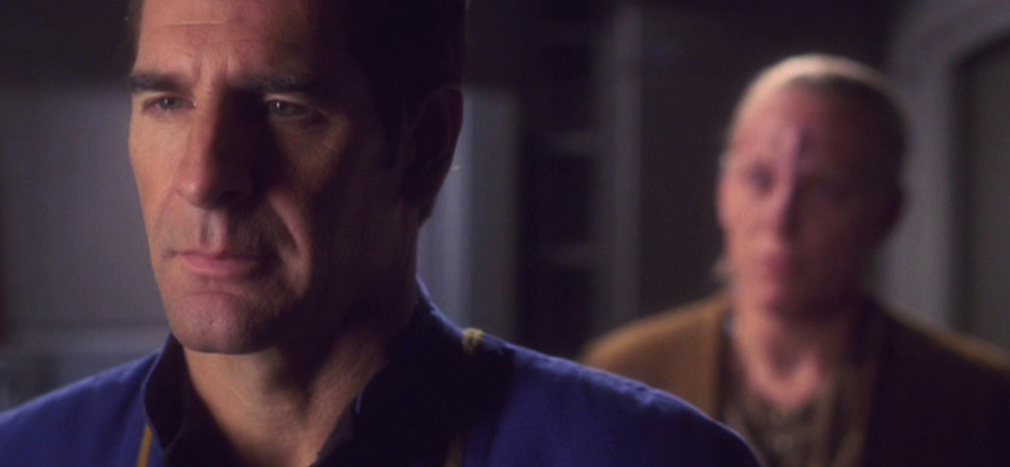
Archer encounter an enemy with faith of the heart...

Archer encounter an enemy with faith of the heart…

However, it was not entirely clear just how traditional Manny Coto was in his approach to Star Trek until the broadcast of Chosen Realm. If Similitude felt like a classic Star Trek morality play, then Chosen Realm literally was a classic Star Trek morality play. A commentary on religious fanaticism and zealotry, Chosen Realm was very much an update of the iconic Let That Be Your Last Battlefield. Coto is quite explicit about this, rather blatantly borrowing the emotive (and poignant) ending from that episode.

Although it aired in the much-maligned third season, and has no shortage of its own problems, Let That Be Your Last Battlefield is an instantly recognisable Star Trek allegory. Casual fans – and even those with a passing familiarity with the franchise – remember “the one with the aliens who are half-black and half-white who are racist against the aliens who are half-white and half-black.” It is not a subtle or nuanced allegory, but it doesn’t really need to be. It is not as if the sort of blatant racism against which the Civil Rights movement fought was a grey area.
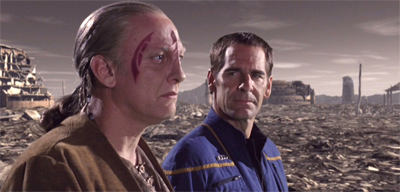
"I think I've seen this before..."

“I think I’ve seen this before…”

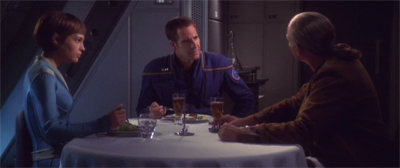
Unfortunately, Chosen Realm chooses to apply this simplistic metaphor to a complicated issue. In keeping with the War on Terror metaphor running through the third season, Chosen Realm explicitly ties religion into the larger arc. Archer finds his ship hijacked by a bunch of religious suicide bombers actively intent on turning Enterprise into a weapon that can be deployed against those who believe differently than they do. This is a very classic Star Trek morality tale – the “religion is bad” theme dating back to Who Mourns For Adonais? or The Apple.

Religion is undoubtedly an element of the War on Terror, but it is not the only issue or an issue that exists in isolation. Islamic extremism (as Chosen Realm never seems particularly interested in the trope of Christian extremism) is rooted in more than simply faith. There are political and economic factors at play that are just as vital to understanding why things happen in the way that they happen. Chosen Realm is uninterested in any of this, structuring itself as Richard Dawkins rant in science-fiction form.
What was that about politics or religion?

What was that about politics or religion?

Continue reading

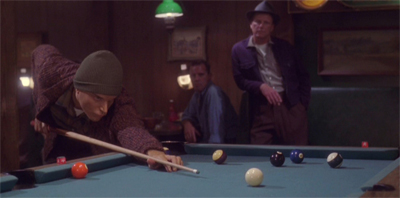
Millennium – Nostalgia (Review)

This July, we’re taking a trip back in time to review the sixth season of The X-Files and the third (and final) season of Millennium.

Nostalgia is the last “serial killer of the week” story produced by Millennium.

Sure, there is a serial killer in Via Dolorosa and Goodbye to All That, but the last two episodes of Millennium are much more interested in the show’s mythology than in a nuts-and-bolts “Frank catches a serial killer” story. Appropriately enough, given its title, Nostalgia feels like a throwback to a simpler version of Millennium. In a way, it does more to capture the mood and feel of the first season of the show than anything like Matryoshka or Seven and One. It helps that Nostalgia is a great episode, judged by it own merits.

Frank sees all. All.

Frank sees all. All.

It makes sense that Nostalgia should come from Michael R. Perry. With his debut script for The Mikado in the second season, Perry had demonstrated quite a knack for traditional Millennium storytelling. The Mikado was arguably something of a throwback itself, the most old-school “serial killer of the week” story in the show’s delightfully off-kilter second season. If the show wanted to do one last “serial killer of the week” story, there was no writer better suited to crafting it than Michael R. Perry.

In a way, Nostalgia feels like belated vindication for the “back to basics” aesthetic running through the third season – proof that perhaps it might be possible for the show to recapture some of the stronger aspects of the first season even this late in the game. Nostalgia is a much better version of the stories that Closure and Through a Glass Darkly had tried to resurrect earlier in the year. It might be enough to entirely redeem the season’s stubborn fixation on a past fading into history, but it does demonstrate that there were interesting stories to be told using that technique.

Parks and recreation...

Parks and recreation…

Continue reading

The X-Files – The Unnatural (Review)

This July, we’re taking a trip back in time to review the sixth season of The X-Files and the third (and final) season of Millennium.

Let me get this straight: a free-spirited alien fell in love with baseball and ran away from the other non-fun-having aliens and made himself black, because that would prevent him from getting to the majors where his unspeakable secret might be discovered by an intrusive press and public and you’re also implying that…

You certainly have a knack for turning chicken salad into chicken spit.

– Fox Mulder and Arthur Dales discuss the merits of The Unnatural

Swing and a hit...

Swing and a hit…

Continue reading

Non-Review Review: Mission: Impossible – Rogue Nation

Mission: Impossible: Rogue Nation moves like the clappers.

The movie speeds along through a selection of impressive stunt work and setpieces, constantly ramping up the tension and raising the stakes. The threat is constantly larger, the game ever more deadly. The film escalates and escalates, to the point where foreign heads of state are nothing more than pieces on a chessboard, fodder for impressive action sequences and swift double-crosses. In a way, this is the approach that made Mission: Impossible III and Mission: Impossible: Ghost Protocol taken to its logical conclusion. Momentum is key.

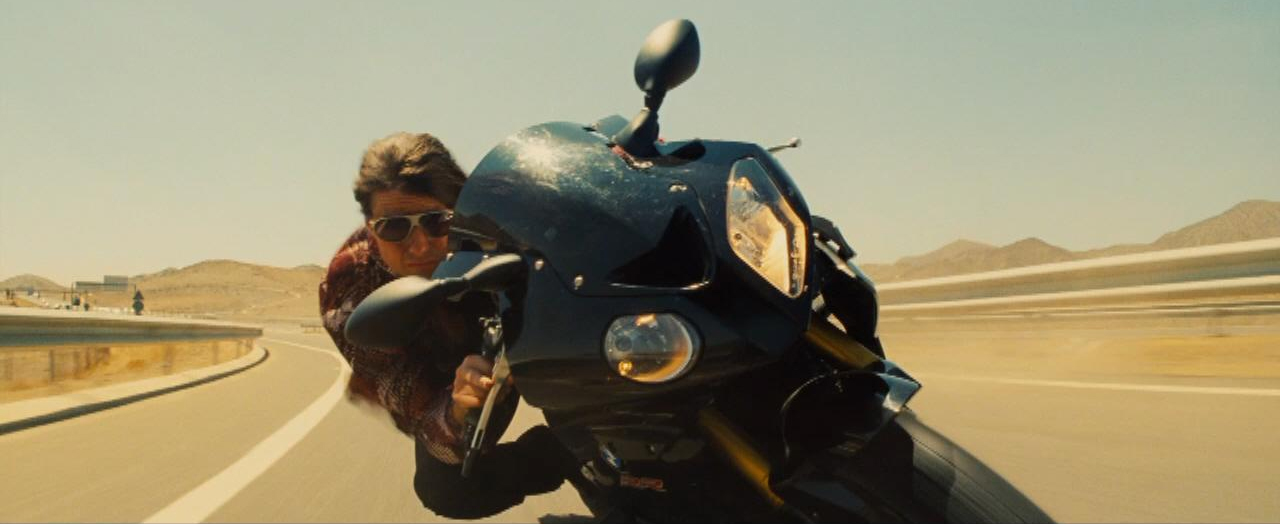
Cruising...

Cruising…

However, there are points where it feels like Mission: Impossible: Rogue Nation hits the limit of this approach – that it serves as a control case to demonstrate just how far you can push this sort of suped up storytelling without breaking the emotional tethers that hold all this together. There are several major emotional beats in Mission: Impossible: Rogue Nation that simply don’t land because the film has never eased its foot off the gas long enough to develop any of its characters beyond familiar archetypes.

This is perhaps the biggest problem with the film, but writer and director Christopher McQuarrie is shrewd enough that he never lets it get entirely out of hand. If the movie’s biggest emotional moments never have the necessary punch, that is not enough to sink the film; there is always another big action setpiece or another reversal or another tense thrill ride waiting after this underwhelming character beat. Mission: Impossible: Rogue Nation might move so fast that it seldom has room for its characters, but it also moves so fast that this is seldom a fatal flaw.

Winging it...

Winging it…

Continue reading

The X-Files – The Rain King (Review)

This July, we’re taking a trip back in time to review the sixth season of The X-Files and the third (and final) season of Millennium.

I do not “gaze” at Scully.

Somewhere over the rainbow...

Somewhere over the rainbow…

Continue reading

The X-Files – Travelers (Review)

This May and June, we’re taking a trip back in time to review the fifth season of The X-Files and the second season of Millennium.

For all that the fifth season of The X-Files is building towards a major summer movie release, the production team seem surprisingly relaxed about it.

The fifth season is as experimental and as loose as the show ever got. Patient X and The Red and the Black suggested that Chris Carter didn’t even feel beholden to the continuity of The X-Files: Fight the Future, introducing new characters and concepts to the mythology that could not possibly be inserted into the film at this late stage. Similarly, the show was willing to play around with special guest writers like Stephen King and William Gibson, film an entire episode in black and white, focus on relatively minor characters, and reveal two separate secret histories of the X-files.

What do you call a baby Fox?

What do you call a baby Fox?

Of course, some of these innovations were driven by necessity or large goals. Patient X and The Red and the Black represent the beginning of the end for this stage of the mythology. Stories like Unusual Suspects and Travelers focus on characters other than Mulder or Scully because David Duchovny and Gillian Anderson were otherwise engaged. Nevertheless, there is a very relaxed vibe to the fifth season, as if the show is taking an extended moment to enjoy the peak of its popularity. As well it should.

Travelers is an episode that is far from essential in many respects. It is clunky in places, indulgent in others. It feels like the production teams are just happy to root through the old costuming wardrobe and prop departments, delighted to compose over-written monologues and stock characters. Travelers is light and fun, with its indulgence and its relative lack of substance making it more enjoyable than it would otherwise be.

He'll (Garret Dilla)hunt you down...

He’ll (Garret Dilla)hunt you down…

Continue reading

The X-Files – Bad Blood (Review)

This May and June, we’re taking a trip back in time to review the fifth season of The X-Files and the second season of Millennium.

Despite a notable absence of Darin Morgan, Bad Blood makes a much more convincing case for Vince Gilligan as the heir apparent to Darin Morgan than Small Potatoes did at the end of the fourth season.

Bad Blood finds Gilligan touching on some of the same broad ideas as Small Potatoes – how Mulder is perceived and how he perceives himself, a sly awareness of the show’s tropes and conventions. However, Bad Blood feels a lot more honed and focused than Small Potatoes. It felt like Small Potatoes only got to the meat of the story it wanted to tell in its final third, while Bad Blood is shrewd enough to put its core concepts front-and-centre. While Bad Blood has the same broad humour of Small Potatoes, it feels a lot more convincing when it comes to characters.

The tooth is out there...

The tooth is out there…

It could be argued that Gilligan drew quite heavily on the work of Darin Morgan in some of his scripts. There is no shame in this. After all, Darin Morgan is perhaps the most widely-praised writer to work on The X-Files. In this context, Bad Blood is something of a spiritual successor to Jose Chung’s “From Outer Space.” Gilligan’s script is not quite as structurally or philosophically ambitious as Darin Morgan’s final credited script for the series, but it does hit on the same fundamental idea that truth is an inherently subjective construct.

Bad Blood is essentially an episode that is not only about how Mulder and Scully see each other, but how they see themselves.

Mulder knows what's at stake...

Mulder knows what’s at stake…

Continue reading

Star Trek: Enterprise – Carbon Creek (Review)

Next year, Star Trek is fifty years old. We have some special stuff planned for that, but – in the meantime – we’re reviewing all of Star Trek: Enterprise this year as something of a prequel to that anniversary. This April, we’re doing the second season. Check back daily for the latest review.

Although it was the second episode of the season broadcast, Carbon Creek was the first episode of the second season produced.

There are a variety of reasons for this. The fact that it only featured three primary cast members would have meant that everybody else got a little extra vacation time. With a lot of location shooting and a production design outside the Star Trek norm, it likely made sense to get it out of the way first. From a budgeting and production standpoint, the show likely benefited from a bit more time than episodes like Shockwave, Part II or Minefield.

"We come in peace...

“We come in peace…”

However, even outside of these pragmatic production concerns, Carbon Creek helps to set the tone for the second season of Star Trek: Enterprise. It is a largely nostalgic and romantic exercise, a rather light stand-alone episode that feels like it wallows in the iconography and conventions of Star Trek. Indeed, the teleplay is credited to Chris Black, the only new writer to survive the writing staff departures that Mike Sussman jokingly referred to as “purges.”

Black is in many respects the first “native” Enterprise writer – the first writer to last more than a season who had not worked on Star Trek: Voyager. As such, it seems only appropriate that he should set the tone for the season ahead.

Vulcan hustle...

Vulcan hustle…

Continue reading