• Following Us

  • Categories

  • Check out the Archives


  • Awards & Nominations

Star Trek: Voyager – The 37’s (Review)

This September and October, we’re taking a look at the jam-packed 1994 to 1995 season of Star Trek, including Star Trek: Deep Space Nine and Star Trek: Voyager. Check back daily for the latest review.

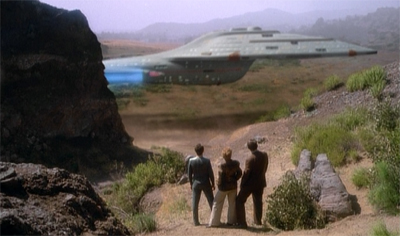
The 37’s did not close out the first broadcast season of Star Trek: Voyager, as the producers had intended. The last episode produced in the first season run, it was held back in the schedule into the second season – a decision made by UPN to allow Voyager to get an early start the following autumn. Still, the decision to reposition The 37‘s as the premiere of the broadcast season is quite telling.

Airing ahead of the three episodes produced before it, and ahead of any episodes produced specifically for the second season, there’s a sense that the production team intend The 37’s to be an important episode. After all, the season premiere is just as important as the season finalé in the basic structure of a broadcast season. The finalé serves as a capstone for what has come before, while (hopefully) indicating what might follow. The premiere is a way of setting up what is yet to come.
We have lift-off...

We have lift-off…

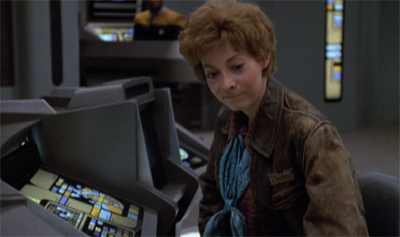
So the positioning on The 37’s is interesting, because it indicates just how much the production team had invested in the episode. This is a big episode of Voyager, this is an important episode of Star Trek. As such, it makes for a completely unsatisfying experience. The 37’s isn’t a bad episode by any measure – it has a few interesting ideas and a few memorable elements – but it’s not ambitious. It doesn’t radically change Voyager, but it also doesn’t distil it. It doesn’t offer the sense of purpose lacking for morst of the first season.

The 37’s just sort of is. It’s an episode that would be functional shuffled into the middle of a season – a few episodes earlier or later than broadcast. However, it simply doesn’t work when scheduled into a high-profile slot, particular when it has been moved so consciously and so purposefully.
A second pilot?

A second pilot?

Continue reading

Non-Review Review: A Walk Among the Tombstones

A Walk Among the Tombstones is an oddly nostalgic serial killer film.

The movie is an adaptation of Lawrence Block’s novel of the same name. Block originally published A Walk Among the Tombstones in 1992, around the time that pop culture’s fascination with serial killers was building to a crescendo. Thomas Harris had released Red Dragon and The Silence of the Lambs to universal acclaim. Jonathan Demme’s film adaptation of The Silence of the Lambs had managed to sweep the Oscars, despite the handicap of a February 1991 release.

Dead letters...

Dead letters…

Scott Frank’s feature film adaptation moves the action forward to 1999, towards the tail end of pop culture’s interest in serial killers. Morgan Freeman’s career in serial killer films offers perhaps the best illustration of the state of the genre. By this point, Freeman had already moved on from 1995’s stylish se7en towards 1997’s efficient Kiss the Girls and was on the cusp of 2001’s unnecessary Along Came a Spider. The serial killer’s stock was falling, and the serial killer would soon be replaced by another bogeyman.

This shift in the story’s setting makes it feel like A Walk Among the Tombstones is a funeral ode towards the serial killer.

Lives are on the line...

Lives are on the line…

Continue reading

Doctor Who: Robot of Sherwood (Review)

Shortly, I shall be the most powerful man in the realm. King in all but name, for Nottingham is not enough.

It isn’t?

After this, Derby.

Right.

Then Lincoln. And after Lincoln…

Worksop?

The world!

– the Sheriff outlines his plot to Clara

Robot of Sherwood is a functional piece of television, with a wonderful closing scene capping a very light forty-five minutes. Mark Gatiss is a writer who tends to trade on nostalgia, and who clearly holds a great deal of affection for the past. As such, Robot of Sherwood provides a fairly effective and straightforward counterpoint to the heavy moral questions of Deep Breath and Into the Dalek. Is the Doctor a hero? It doesn’t matter, because his story is that of a hero.

There is a sense that perhaps Gatiss is being a little bit too glib here, to the point where Robot of Sherwood almost plays defensively – a justification of the writer’s tendency to rose-tinted nostalgia and a rejection of critical approaches towards history or story. Nevertheless, Robot of Sherwood does pretty much what it sets out to do. It provides Peter Capaldi with a suitably light script and a chance to flex his comedic muscles, while providing a suitably fairy-tale-ish pseudo-historical.

Legendary outlaw...

Legendary outlaw…

This season is introducing a new lead actor, a risky proposition for any show. As a result, the first half of the season tends to play it rather safe. Robot of Sherwood is the only episode in the first half of the season not to credit Steven Moffat as writer or co-writer; however, it is still written by an established Doctor Who veteran. After all, Mark Gatiss wrote The Unquiet Dead, the first episode of the relaunched series not written by Russell T. Davies. He also wrote Victory of the Daleks, the first story of the Moffat era not written by Moffat himself.

Indeed, the season returns to the classic “home”/“future”/“historical” opening triptych structure that defined the Davies era; it is the first time that this structure has been seen since Matt Smith’s opening season. (For Davies, “home” was twenty-first century London; for Moffat, it is the Paternoster Gang.) Robot of Sherwood is the show’s first proper “celebrity historical” since Vincent and the Doctor in that same opening season. “Safe” is very much the name of the game for this stretch of the season. Robot of Sherwood is very safe.

"You'll ruin the paint work!"

“You’ll ruin the paint work!”

Continue reading

The X-Files – Our Town (Review)

This August (and a little of September), we’re taking a trip back in time to review the second season of The X-Files. In November, we’ll be looking at the third season. And maybe more.

A rare “monster of the week” script from Frank Spotnitz, Our Town could be seen as a mirror to Humbug. Humbug seemed to mourn the way that eccentric little communities seemed to be fading into history in the nineties – the loss of unique and distinct little hamlets. Our Town seems to offer a counterpoint, suggesting that perhaps the intrusion of the outside world into these tightly-knit communities is not a bad thing.

Inspired by the classic Spencer Tracy film Bad Day at Black Rock, Our Town sees Mulder and Scully investigating a small-town disappearance that eventually leads the duo to uncover a horrifying secret at the heart of the local community.

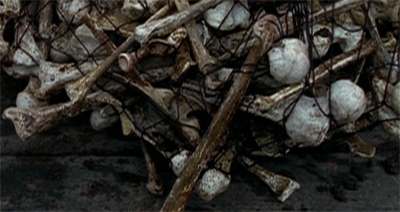
Fresh bones...

Fresh bones…

Continue reading

Star Trek – The Entropy Effect by Vonda N. McIntyre (Review)

This June, we’re taking a look at some classic Star Trek movie tie-ins and other interesting objects. Check back daily for the latest reviews and retrospectives.

The Pocket Books Star Trek line has to be one of the most stable and successful tie-in book ranges in the world. While the comic book license has bounced from publisher to publisher, Star Trek prose has remained firmly rooted at Pocket Books through the highs and the lows of the Star Trek franchise. This is undoubtedly because Pocket Books is a subsidiary of Simon and Schuster, which has been owned by the company that has owned Star Trek since 1975.

As such, from 1979 until the present day, Pocket Books has produced an incredible amount of tie-in material to support the Star Trek franchise. From reference material through to novels set within the fictional universe, the line has published a wealth of material across all the shows and all the time frames. Indeed, Pocket even launched their own separate spin-off brands run by authors like Peter David or Keith R.A. DeCandido.

While Gene Roddenberry’s novelisation of Star Trek: The Motion Picture was the first official Star Trek novel published by Pocket Books, and the line had published a number of reference books in the interim, Vonda N. McIntyre’s The Entropy Effect is the first original novel published by Pocket Books. In many ways, the influence of McIntyre’s work is still being felt, as she demonstrated how best to approach a Star Trek tie-in novel.

theentropyeffect

Continue reading

Ed Brubaker’s Run on Uncanny X-Men – Divided We Stand (Review/Retrospective)

This May, to celebrate the release of X-Men: Days of Future Past, we’re taking a look at some classic and modern X-Men (and X-Men-related) comics. Check back daily for the latest review.

Divided We Stand actually feels like the start of something interesting for Ed Brubaker’s run on Uncanny X-Men. It’s a story arc that heralds a bold new direction for Marvel’s merry mutants in the wake of Messiah Complex, taking the team out of their comfort zone and suggesting that Uncanny X-Men will be moving a little outside its comfort zone and trying something different. It’s a story arc that sees the team reflecting on the past and considering the future.

So, naturally, it is Ed Brubaker’s last solo arc on Uncanny X-Men.

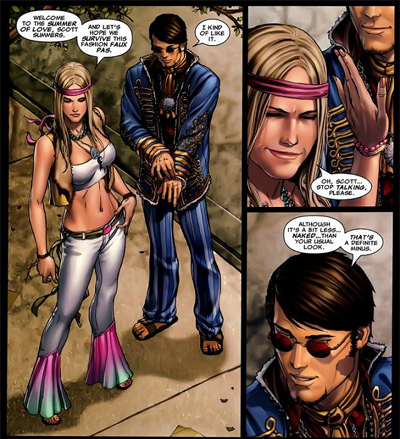
A bad trip?

A bad trip?

Continue reading

Mark Waid, Chris Samnee, Paolo Rivera et al’s Run on Daredevil (Vol. 3) (Review/Retrospective)

This April, to celebrate the release of The Amazing Spider-Man 2, we are taking a look at some classic and modern comics featuring Spider-Man (and friends). Check back daily for the latest review.

Daredevil had been one of the most consistently reliable books at a major comic book publisher over the last decade or so. Under creative teams from Kevin Smith to David Mack to Brian Michael Bendis to Ed Brubaker, the gritty street level superhero has enduring a whole host of twists and shifts that have made the book a compelling read. Indeed, the only real problem with the run was that Andy Diggle couldn’t quite stick the landing and so we ended up closing out that incredibly run with a bland and generic crossover like Shadowland.

Still, Daredevil remains an exciting book – a comic that affords the writers and artists a bit more freedom than they’d enjoy working on a more high-profile or major character. When Spider-Man’s identity was revealed by J. Michael Straczynski during Civil War, the publisher almost immediately hit a reset button in the form of One More Day to tidy up everything. When Brian Michael Bendis revealed Matthew Murdock’s secret identity to the world, there was no attempt to stuff the genie back in the bottle. That radical shift remained in play for the rest of Ed Brubaker and Andy Diggle’s run, casting a shadow over Mark Waid’s as well.

The big smoke...

The big smoke…

However, reading Andy Diggle’s Daredevil, it’s easy to get a sense that the character was suffocating under the influence of Frank Miller. Frank Miller and Klaus Jansen enjoyed a character-defining run in the mid-eighties. For Miller, it paved the way to The Dark Knight Returns, and it really shook the foundations of the superhero genre. Suddenly superheroes weren’t infallible; suddenly fights could get genuinely dirty; suddenly dressing up in a silly costume to fight crime was treated as something that might be deemed a little eccentric.

This had a dramatic impact across the superhero genre. At the same time, however, it really defined the character of Daredevil. In his year years, Daredevil often seemed like a cheap knock-off of Spider-Man; an imitation of a far more popular hero. With the work of Frank Miller, Matthew Murdock become more conflicted and more complex. He became a hero who could make mistakes, a hero who didn’t have the best judgement, a hero who could fail. This pushed the character of Daredevil more towards gritty urban crime and film noir conventions, and further away from superhero conventions.

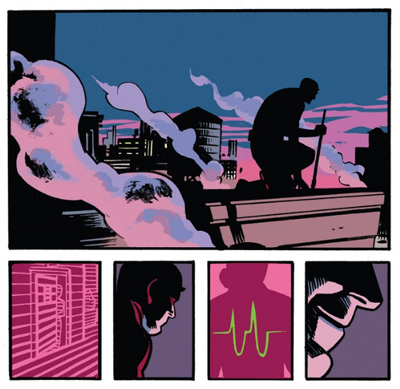
Radar love...

Radar love…

Decades after Born Again, writers are still drawing on that iconic take on Matthew Murdock. The Kingpin is still considered one of the – if not the – greatest foe of the Man Without Fear. Kevin Smith killed off Karen Page, the character who betrayed Matthew Murdock in Born Again. Brian Michael Bendis wrote a story featuring the character who planted the bomb in Born Again, two decades after that story was published. Miller cast a long shadow over the character. One of the (many) problems with Andy Diggle’s Daredevil was the way that it demonstrating that riffing on Frank Miller was getting old.

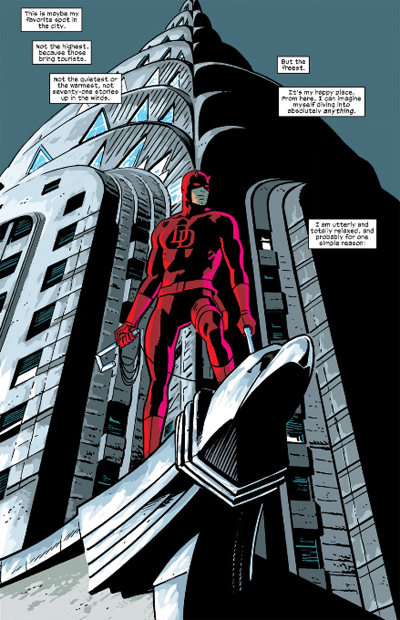
And so, Mark Waid’s run on Daredevil is absolutely fascinating. It’s a clear departure from the grounded urban realism that came to define the character, often feeling like an attempt to reconnect with the character’s Silver Age roots. Brought to life by some of the best artists in the business, the run just pops off the page. At the same time, Waid doesn’t ignore or avoid or overlook what has come before. He just seems to realise that there are other ways of approaching the character.

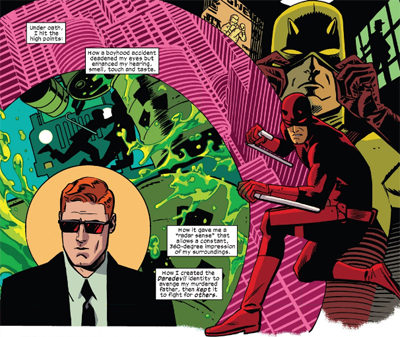
On top of the world...

On top of the world…

Continue reading

The Amazing Spider-Man – The Gauntlet: The Juggernaut – Something Can Stop the Juggernaut (Review/Retrospective)

This April, to celebrate the release of The Amazing Spider-Man 2, we are taking a look at some classic and modern comics featuring Spider-Man (and friends). Check back daily for the latest review.

Something Can Stop the Juggernaut is a bit of an oddity in the grand scheme of The Gauntlet, if not the larger scheme of Brand New Day. One of the stated goals of Brand New Day was to present readers with a thoroughly modernised version of Spider-Man, an iteration of the character who had been distilled to his purest essence, unburdened by the weight of decades of character development and continuity.

As the “new” in Brand New Day suggests, a large part of the editorial stance on Brand New Day was the opportunity to do something novel with The Amazing Spider-Man. It was a conscious break with the old, and an attempt to push the character in new directions. After all, the early issues made an effort to shuffle new characters into the established ensemble and to feature new villains and threats for our hero to face.

Leaping into action...

Leaping into action…

(To the point where the emphasis on classic foes was one of the selling points of The Gauntlet – a sense that the comics were finally trying to bring many of these iconic baddies into the twenty-first century alongside a reinvigorated and re-energised Spider-Man. Indeed, it’s interesting how much of The Gauntlet makes a point to reference or mirror Peter’s continuity reset into Brand New Day. Much like Peter in One More Day, many of his classic foes lose their new-found families to reset them to villainy, except without the benefit of a magical reset button at the end.)

So drawing back in celebrated creator Roger Stern to craft a sequel to a beloved eighties Amazing Spider-Man story feels rather surreal. The three-part Something Can Stop the Juggernaut exists as an explicit to Stern’s deservedly beloved classic Nothing Can Stop the Juggernaut, right down to classic flashbacks to the comic, follow-up references to various characters, and the fact that events spiral from that story.

Spidey is a little tied up...

Spidey is a little tied up…

Something Can Stop the Juggernaut is crafted as a celebration of vintage Spider-Man, which works very well in the context of The Gauntlet. As the on-going epic spirals towards its climax in Shed and Grim Hunt, it’s nice to hace a reminder of a classic Spider-Man story. After all, Grim Hunt makes a point to stress the perfection of another classic Spider-Man story, albeit in a very different way.

Something Can Stop the Juggernaut seems to exists to assure readers that the legacy and history of Spider-Man is still valid and meaningful, not rendered moot by the continuity-tinkering shennanigans of One More Day.

The Juggernaut who fell to Earth...

The Juggernaut who fell to Earth…

Continue reading

Non-Review Review: The Grand Budapest Hotel

This film was seen as part of the Jameson Dublin International Film Festival 2014.

“His world departed long before he entered it,” one of the narrators from The Grand Budapest Hotel notes of the film’s lead character. “But he maintained an elaborate illusion.” This description is applied to the suave sophisticated concierge Gustav H, played wonderfully by Ralph Fiennes, but it could also apply to director Wes Anderson – a director whose cinematic style is built upon nostalgic nods to a past that may never have actually existed.

Framed as a story within a story within a story, jumping back from the eighties to the sixties to the late thirties, Anderson draws even more attention to his artifice than usual. Wrapping a framing story around a framing story seems almost cheeky, as Anderson brings the audience incrementally into the past – suggesting that one needs to wade in rather than diving. The story of a romantic living in a cynical era, The Grand Budapest Hotel seems – despite its scale and scope – one of Anderson’s more intimate efforts.

It is also among his very best.

Vault out to see it...

Vault out to see it…

Continue reading

Avengers: Earth’s Mightiest Heroes, Volume 2 (Review)

April (and a little bit of May) are “Avengers month” at the m0vie blog. In anticipation of Joss Whedon’s superhero epic, we’ll have a variety of articles and reviews published looking at various aspects of “Earth’s Mightiest Heroes.”

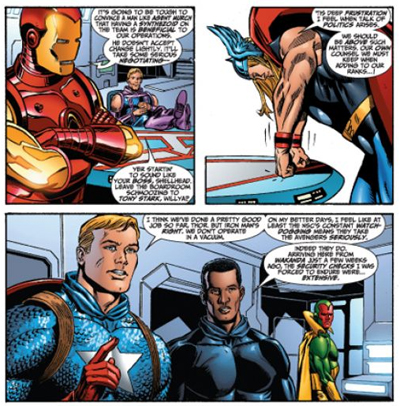
Written by Joe Casey, Avengers: Earth’s Mightiest Heroes, both volumes of it, can’t help but feel like an attempt to appease nostalgic fans, with a conscious throwback to simpler and more idealistic times, published while Mark Millar was deconstructing The Ultimates and Brian Michael Bendis was putting together the New Avengers. Both of those books represented something bold and new for a franchise that had been at the heart (but rarely the fore) of the Marvel Universe for decades, and both of which were undoubtedly controversial to older fans, offering a strange new direction for the series and its characters. Essentially an “untold” history of the team, drawing from classic published stories, Avengers: Earth’s Mightiest Heroes feels like a bone given to those fans uncomfortable at the very notion of change.

Looking for the blessing of the Trinity...

Continue reading