• Following Us

  • Categories

  • Check out the Archives


  • Awards & Nominations

Non-Review Review: Hustlers

Hustlers wears its influences on its sleeve, which no small accomplishment for a movie about a bunch of criminal strippers.

Hustlers is adapted from Jessica Pressler’s 2015 New York Magazine article, covering a post-recession swindle orchestrated by a group of enterprising strippers. The film is a tale of greed and commercialism, of opulence and corruption. The premise practically writes itself. Hustler is a story that is just lurid enough and just timely enough and just charged enough that it all comes together perfectly. The film’s narrative exists at an intersection of money and sex and drugs, but is anchored in a broader cultural and social context that uses this seemingly trashy set-up to say something seemingly profound about the American condition.

Given the premise and themes, it is no surprise that Hustlers should take so many of its cues from the films of Martin Scorsese. Joker has dominated a lot of the autumnal discussion about Scorsese’s influence on contemporary cinema with its obvious debts to films like Taxi Driver or King of Comedy, but Hustlers is just as transparent in the debts that it owes to Goodfellas, Casino and The Wolf of Wall Street. Scorsese’s influence is felt on every inch of the film, from the film-making to the narrative structure to the awkward articulation of the central theme in the closing scene. It is both a strength and a weakness for Hustlers.

While Hustlers occasionally feels a little too indebted to the work of Scorsese to stand on its own two feet, the film largely works. Part of this is down to the skill and playfulness with which director Lorene Scafaria acknowledges her influence. Part of this is down to the film’s engaging charm and sense of humour, belying a compelling moral sophistication befitting the films that it is so obviously evoking. A lot of it comes down to the strong casting, including a compelling central dynamic and a powerhouse performance from Jennifer Lopez.

Continue reading

Non-Review Review: IT – Chapter Two

IT: Chapter Two is muddled, messy and bloated, particularly in its middle stretch.

The horror sequel opens relatively strong and delivers a satisfying emotional pay-off. Unfortunately, the film’s structure means that it meanders wildly between those two fixed narrative points. Chapter Two runs a muscular two-hours-and-fifty-minutes, a full quarter-of-an-hour longer than the original film’s already impressive run time. In fact, taken together, the two films are more than one-and-a-half times the length of the early nineties miniseries adaptation of the novel. Chapter Two spends a lot of time on repetitive storytelling beats, splitting up the cast so each of the leads has their own identically-structured adventure.

Glowing, glowing… gone.

These structural flaws feel inevitable. Part of what worked so well with IT: Chapter One was the decision to largely eschew the complicated and convoluted mythology that King wove through his beloved doorstopper of a novel. The original film was not concerned with alien invaders or local legends beyond what was strictly necessary, allowing it to offer an extended horror movie riff on Stand by Me, a coming-of-age saga about young teens on the cusp of adulthood. In Chapter Two, that bill comes due. The sequel not only has to do its own heavy lifting, but take on a lot of the world-building the original film mostly ignored.

Indeed, there is a sense that Chapter Two works much better as a companion piece to the earlier film than as a narrative in its own right. Indeed, there is something interesting in the way that, taken as a whole, the two IT films represent the first real cinematic glimpse of Stephen King as an author of the American epic. IT is the story of a group of childhood friends facing a monstrous evil, but it feels much larger than that. Perhaps the most compelling thing about Chapter Two is the manner in which it creates a sense of scale and scope that has previous eluded adaptations of King’s work.

Pennywise, pound foolish.

Continue reading

Non-Review Review: The Informer

The Informer is essentially three films packaged in one.

While it’s hard to precisely outline these films without giving too much away, The Informer begins as a sleazy urban thriller about a police informer before morphing into a gritty prison drama before escalating into an elaborate hostage film. There’s nothing inherently wrong with any of these central premises. In fact, as fodder for film making goes, they are very reliable. Each of those three basic premises comes with stakes built in, and would be ubiquitous enough that the audience can follow along without the need for too much exposition or context.

🎵Oh Kinnaman, where’d you run to?
Oh Kinnaman, where’d you run to?
Kinnaman… where you gonna run to?🎶

Unfortunately, The Informer never quite settles on a particular tone or mood as it breezes through each of these three set-ups. The film runs just under two hours, which is a respectable run-time, but it does mean that each of those three genres ends up compressed. The film arguably spends more time on the transition between that initial urban thriller and subsequent prison drama than it does in either setting, creating the impression of a film more interested in visceral movement than a larger journey.

None of the three genres get enough screen-time or development to truly work, instead feeling like rough drafts rather than compelling set-ups. The characters and the storytelling are similarly rushed, often feeling flattened or sanded down in order to ease the movie’s transition from each type of story to the next. The result is a movie that only fleetingly engages, never holding its gaze long enough to deliver on any of its potential.

Poor (in)form.

Continue reading

Non-Review Review: Extra Ordinary

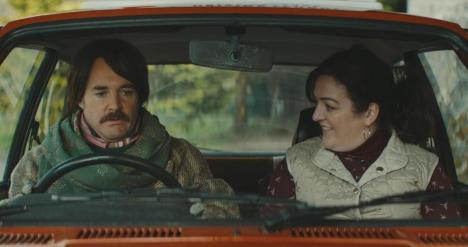
Extra Ordinary is very Irish ghost story.

“Irishness” is a very nebulous quantity. It can be very hard to precisely quantify. In humour, it tends towards a blend of irony and irreverence, often a surreal juxtaposition of the mundane with the surreal. As such, Extra Ordinary feels like a very Irish ghost story. It is a film anchored in the tropes and conventions of ghost stories – possessions, exorcisms, hauntings, satanic pacts – but which contextualises these things as just another minor frustration of country living. As the title implies, Extra Ordinary exists at the junction of the familiar and the uncanny. If the team produce a sequel, they should call it “Super Natural.”

Driving curiosity.

Extra Ordinary adopts a uniquely Irish approach to its premise, wondering what happens to those ghosts that are a bit less dramatic and lot more mundane than the usual spirits. There’s something engagingly quirky in Extra Ordinary’s depiction of the eccentricity of country living, and how so much of that eccentricity just goes on as a fact of life; the dancing lead attached to a discarded toaster, the tree branch that sways without even a breeze, the wheelie bin that just keeps flapping through the night. This is just the way that things are in this part of the world, and the locals have (mostly) made their peace with it.

Despite its supernatural premise, the most endearing aspect of Extra Ordinary is how perfectly it captures the smaller and more intimate eccentricities of the Irish countryside.

Now I seance you…

Continue reading

Non-Review Review: UglyDolls

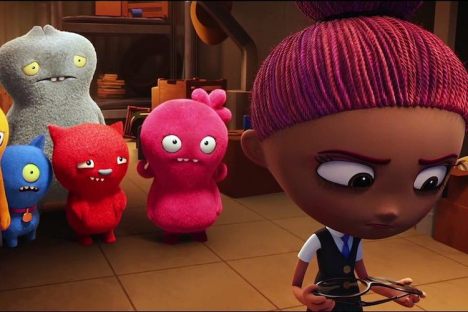
UglyDolls exists in the “uncanny valley” of modern children’s animated films.

Films like UglyDolls are a reminder of how profoundly Pixar has altered the cinematic landscape, and shifted expectations in terms of what audiences – young and old – expect from these sorts of films. Most obviously, the basic premise of UglyDolls echoes that of Toy Story; in much the same way that, say, The Emoji Movie mirrors Inside Out. This is a film about sentient toys trying to find an existential justification for their existence, often defined in terms of their relationship to a child. UglyDolls is a movie aout misfit toys cast out from the factory assembly line, wondering if they will ever be worth of love.

All dolled up with nowhere to go.

To be fair to UglyDolls, it is much better than The Emoji Movie. At the very least, UglyDolls understands that the film needs to be ordered around a strong central theme. UglyDolls has a solid conceptual basis, a familiar children’s movie allegory, and a very straightforward narrative structure. That said, although somewhat less crass in its materialist ambitions than The Emoji Movie, the film feels cynically calculated in other ways. The casting of performers like Kelly Clarkson, Nick Jonas, Janelle Monáe and Blake Sheldon seems designed to move the film’s soundtrack album. And the premise is obviously toyetic.

Still, UglyDolls comes closer than most of these sorts of films to working, largely failing because it ultimately underestimates the maturity and intelligence of its target audience.

A glass apart.

Continue reading

Non-Review Review: Animals

Animals lacks any real bite.

At its core, Animals is the story of the unhealthy relationship that exists between Laura and Tyler. Laura is a Dublin girl, with close ties to her extended family. Tyler is an American abroad, a young woman who seems to be running as far away from her family as possible. A chance encounter on a night out brought the two together in their twenties, and they have since become inseparable. Laura lives with Tyler in her lavish city centre apartment, while Tyler is a welcome guest at all of Laura’s family gatherings. The two seem to share a single life.

Putting the matter to bed.

Naturally, that relationship has begun to strain and fray as the women enter their thirties – Laura is about two years older than her best friend, while Tyler’s thirtieth birthday is a significant event in the context of the film. Laura seems to want to move on, to embrace adulthood and responsibility; she courts a young professional pianist named Jim and tries desperately to work on the novel she’s been picking over for the last decade. Tyler pushes back against this, terrified at the prospect that her best friend might leave her behind to wallow in her own hedonistic insecurities.

Animals is too generic to make a meaningful impression. Its major character and narrative beats are all helpfully signposted from the get-go, its destination obvious from the end of the first few scenes. However, there’s not enough substance present to justify that sense of inevitability, the leisurely-paced journey towards a foregone conclusion that hits every expected plot point and character moment along the way. Animals feels very much like every other “young person has a life crisis and has to find a way to be comfortable with themselves” narrative of the past decade, with little to distinguish it.

At home on the (G)rainger.

Continue reading

Non-Review Review: Luce

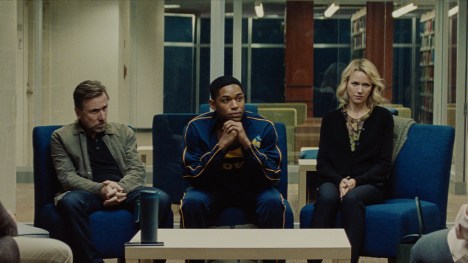
Luce is a compelling dialogue-driven thriller, anchored in a set of impressive performances and a meaty script.

At its core, Luce is a study of integration and idealism. It touches on the question of identity, that established by an individual and that imposed by the people around them. Luce derives its title and its tension from its lead character, a promising young African American student. Adopted by an upper-middle class white couple and rescued from his past as a child soldier, Luce has become an exemplar. He is an all-star debater, an impressive academic student, a successful athlete. He is loved by both the faculty and his fellow students. To hear the other characters talk about him, Luce is just about perfect.

Getting schooled.

Naturally, Luce challenges that idea. Luce invites the audience to wonder whether the title character really is everything that everybody else believes him to be. More than that, the film interrogates why so many people seem to need Luce to be an exemplar. The film is a fraught push-and-pull as questions are raised about Luce. When the honours student turns in an inflammatory essay and when fireworks with the explosive power of a shotgun are found in his locker, the characters around Luce find themselves asking if they understand the teenager, or if they ever could.

The result is a tense and claustrophobic drama, as the characters navigating these accusations and insinuations try to constantly reconfigure their understanding of the title character. It’s a remarkable push-and-pull, elevated by some very potent themes and a wealth of strong performances.

Keeping track.

Continue reading

Non-Review Review: The Art of Racing in the Rain

The Art of Racing in the Rain places a prestige veneer on the weirdness of the recent “man’s best friend” tear-jerker subgenre.

A Dog’s Journey and A Dog’s Purpose were a rough-and-ready example of the genre, films exploring the complicated world of human beings through the simple mind of a dog. There was an almost endearing clumsiness to how ruthlessly those films targeted the audience’s emotional vulnerability; A Dog’s Purpose used the gimmick of reincarnation as a narrative “get out of jail free” card, making a point to kill off its canine protagonist no fewer than three times, understanding this as a shortcut to the audience’s tear ducts.

“It’s about the good walk,
And the hard walk…
… It’s a beautiful ride.”

The Art of Racing in the Rain is a more prestigious product, executed with greater craft. That doesn’t mean that The Art of Racing in the Rain is any less surreal or eccentric than other entries in the subgenre, nor should it imply that The Art of Racing in the Rain has pushed that subgenre beyond the underlying assumptions that the bodily functions of a dog are hilarious. Instead, the polished exterior of The Art of Racing in the Rain is all about execution as opposed to content. The film makes the same points in the same ways, but shifts its tone to approximate sophistication.

The results are no less uncanny for that attempt at sophistication. If anything, The Art of Racing in the Rain feels all the weirder for how it juxtaposes the sillier and goofier “talking animal movie” tropes with the sensibilities of more earnest fare. The Art of Racing in the Rain is aggressive and merciless in its attempt to conjure up an emotional response to its over-extended central metaphor, but the film’s surreality lingers much longer.

Thinks are looking pup.

Continue reading

Non-Review Review: Fast and Furious Presents – Hobbs and Shaw

Fast and Furious Presents: Hobbs and Shaw works best when it delivers exactly what audiences expect from that title.

The breakout star of The Fate of the Furious was the chemistry between Jason Statham and Dwayne Johnson. Behind the scenes conflicts between Johnson and franchise headliner Vin Diesel had forced the production team to structure the eighth film in the franchise so Johnson and Diesel didn’t have to share the screen. This led to a number of endearingly absurd set pieces, such as a heart-to-heart appeal between the two men conducted across a street over the speaker systems of monster cars. It also meant that Johnson had to find a new screen partner, and Statham was the member of the ensemble who fit the bill.

I have to admit, there were many more explosions and fistfights than I expected for a historical biopic exploring the relationship between Thomas Hobbes and George Bernard Shaw.

It’s easy to over-intellectualise the chemistry between Johnson and Statham. There’s the obvious physical contrast; Johnson has the bulk of a former professional wrestler, while Statham has the lean physique of a diver. There’s Johnson’s wholesome all-American persona set against Statham’s slightly devilish charm. There’s Johnson’s deep authoritative voice playing off Statham’s distinctly hard-edged accent. The duo play very well as a study in contrasts, while both also being able to support otherwise forgettable action films in their own right. They are a perfect fit.

Hobbs and Shaw works best when it understands this. The film’s best scenes are not the ridiculously over-the-top action scenes, which often seem borrowed or lifted from much better movies and which only fleetingly manage to tip themselves over into the delightful surrealist absurdity that makes the modern (Johnson era) Fast and Furious movies such a delight. Instead, the movie comes to life when Johnson and Statham are trading schoolyard insults, posturing and snarking, indulging in the sort of old-fashioned buddy action movie banter that is so rare these days.

Suns out, guns out.

Continue reading

Non-Review Review: Once Upon a Time… In Hollywood

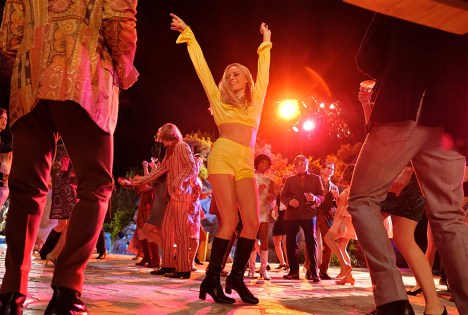
Once Upon a Time… in Hollywood is a fairy tale, for better and for ill.

Continue reading