• Following Us

  • Categories

  • Check out the Archives


  • Awards & Nominations

Star Trek: Enterprise – Zero Hour (Review)

Next year, Star Trek is fifty years old. We have some special stuff planned for that, but – in the meantime – we’re reviewing all of Star Trek: Enterprise this year as something of a prequel to that anniversary. This August, we’re doing the third season. Check back daily for the latest review.

There was a very real chance that Zero Hour might have been the last episode of Star Trek: Enterprise to air.

In fact, it was entirely possible that Zero Hour‘s distinctive (and downright provocative) closing shot of an evil!alien!space!Nazi might have been the last shot of Star Trek to air on television for quite some time.

Time is running out...

Time is running out…

Continue reading

The X-Files – Triangle (Review)

This July, we’re taking a trip back in time to review the sixth season of The X-Files and the third (and final) season of Millennium.

There are a lot of reasons to celebrate Triangle.

The episode gets a lot of attention for its wonderful use of long tracking shots. According to Chris Carter’s commentary, there are only twenty-four individual shots stitched together to produce the forty-five-minute episode. Considering the amount of split-screen action at the climax, that is not a lot. Triangle is an artistic tour de force for writer and director Chris Carter. The success that both Birdman and True Detective enjoyed in 2014 due to their extended takes suggests that Carter was significantly ahead of the curve.

Dragging up the past...

Dragging up the past…

There are other aspects to note. Triangle also ushers in a new mood and tone for the sixth season of The X-Files. The show had moved to Los Angeles, and would struggle with how to retain its identity in the new (and bright) surroundings of California. The Beginning and Drive had both answered the question in their own way, but Triangle ushers in a whole new approach to storytelling. Triangle is the first of a series of light and breezy episodes in the early stretch of the sixth season where The X-Files almost turns into a paranormal sitcom.

However, there is one other reason to celebrate Triangle. It is an extended forty-five minute pun on the word “ship.”

Cigarette-Smoking Nazi...

Cigarette-Smoking Nazi…

Continue reading

Millennium – Roosters (Review)

This May and June, we’re taking a trip back in time to review the fifth season of The X-Files and the second season of Millennium.

Then Peter remembered the word Jesus had spoken: “Before the rooster crows, you will disown me three times.” And he went outside and wept bitterly.

– Matthew 26:72

Everything is in runes...

Everything is in runes…

Continue reading

Non-Review Review: Suite Française

Suite Française is the name given to a planned series of five novels written by Irène Némirovsky during the Second World War. Living in France during the conflict, Némirovsky was Ukrainian and Jewish descent. She completed the first two novels in the series (Tempête en Juin and Dolce) and had outlined the third (Captivité) before she was arrested as a Jew in 1942. Némirovsky was detained at Pithiviers, before she was transferred to Auschwitz. She died in Auschwitz in August 1942.

The two novels were undiscovered for more than half a century; her daughter – Denise Epstein – only discovered the novels in the nineties. They were written microscopically inside journals. The 140 pages that Némirovsky had written expanded to more than 500 printed pages. There is some evidence that even the two “completed” manuscripts were not quite finished. Notes suggested that Némirovsky was considering revisions to Dolce so as to change the fate of a featured character. More than six decades after her death, Suite Française was eventually published in 2004.

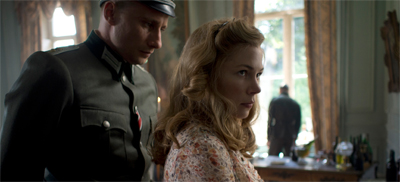
An officer and a gentleman...

An officer and a gentleman…

Adapting any novel for the screen is tough job, let alone a sequence of five novels – only two of which were ever finished, and published posthumously. Part of the intrigue of Suite Française was the fact that these were novels depicting incredible historical events as they actually occurred. It is impossible to quite convey that sense of urgency and vitality after decades of storytelling about the Second World War. Although it is an adaptation of a novel published only a decade earlier, Suite Française has the weight of considerable expectations baring down on it.

Even allowing for the difficulties with this particular adaptation, Saul Dibb and Matt Charman’s script still feels quite clumsy in execution; despite excising most of Tempête en Juin, the finished script feels curiously over-written. Monologues tend to meander and wander, as if the script doesn’t trust the cast to convey deep emotion through their performances, as if the writers are afraid the audience might miss the key philosophical or moral points of the script. This is a shame, as Suite Française is beautifully acted and looks quite wonderful.

The good German...

The good German…

Continue reading

Star Trek – Patterns of Force (Review)

The first Star Trek pilot, The Cage, was produced in 1964. To celebrate its fiftieth anniversary, this December we are reviewing the second season of the original Star Trek show. You can check out our first season reviews here. Check back daily for the latest review.

Patterns of Force is a rather strange little episode, the type of weird and iconic adventure that Star Trek tended to do quite well. It’s very much an off-the-wall adventure, of the kind that none of the spin-off shows would attempt. “Planet of the Nazis” is a concept that belongs alongside other second-season episodes like “Planet of the Romans” or “Planet of the Gangsters.” It’s a very goofy premise, one that requires considerable suspension of disbelief before the episode even starts.

And, yet, despite the many serious problems with Patterns of Force, this is an episode that very clearly and very forcefully has something to say. Reflecting the world in which it aired, Star Trek is a show that is largely defined by the Second World War. In The City on the Edge of Forever, it was revealed that the Second World War had to happen to beckon the bright and optimistic future of Star Trek. Almost forty years later, the final televised season of the franchise would return to that idea in its opening episode.

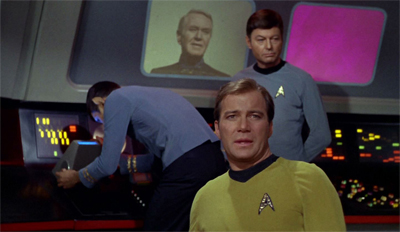
"Computer, query. What is Godwin's Law?"

“Computer, query. What is Godwin’s Law?”

Kirk’s “final frontier” was Kennedy’s “new frontier” extrapolated centuries into the future, an optimistic and very American vision of what the twenty-third century might hold. Given that the show aired two decades following the end of the Second World War, the conflict that made America the most powerful global superpower, it makes sense that the conflict should cast a shadow over Star Trek. Various members of the production had served in the conflict, and it remained part of the national consciousness.

So an episode pitting Kirk and Spock against honest-to-goodness space Nazis seemed inevitable.

"Well, there goes syndication in Germany..."

“Well, there goes syndication in Germany…”

Continue reading

The X-Files – Paper Clip (Review)

This November (and a little of December), we’re taking a trip back in time to review the third season of The X-Files and the first (and only) season of Space: Above and Beyond.

And now we return to your scheduled viewing.

In many respects, Paper Clip feels like the real third season premiere. It establishes a lot of the recurring themes and ideas for the mythology of the season, from Krycek-on-the-run through to collaboration in the wake of the Second World War. It builds on the successful multi-part formula established by episodes like Ascension or End Game during the show’s second season. It moves things along in a way that The Blessing Way simply refused to. (It even resolves the cliffhanger from the last episode on screen.)

The light at the end of the tunnel...

The light at the end of the tunnel…

Paper Clip demonstrates the strengths of the third season of The X-Files. The third season was the point at which the show really pushed the mythology out, building on earlier implications that there was form to be found in the shadows. The third season also looked to the second season to determine what had worked and what had not worked. Paper Clip is very clearly modelled on the successful aspects of second parts like Ascension or End Game.

It moves. The power of Paper Clip comes from an incredible forward momentum that allows the show to maintain tension and excitement while refusing to allow the audience to catch their breath. Instead of resolving the bigger plot threads from the first episode, questions and hints are thrown out with reckless abandon as the script just drives through set pieces and emotional beats and suspenseful sequences. It is a very meticulously, very cleverly constructed piece of television.

Watching the skies...

Watching the skies…

Continue reading

The X-Files – The Blessing Way (Review)

This November (and a little of December), we’re taking a trip back in time to review the third season of The X-Files and the first (and only) season of Space: Above and Beyond.

The Blessing Way is the first mythology episode of The X-Files that doesn’t really work.

And it doesn’t really work for a lot of the same reasons that some of the later mythology episodes don’t really work. Its pacing is terrible. It wallows in new age mysticism, allocating characters thoughtful monologues that awkwardly state themes and render subtext as supratext. It plays into the deification of Mulder, trying to bend Mulder’s story to fit into an archetypal “chosen one” narrative. More than that, it is very clearly a holding pattern, an effort to eat up time without moving forward.

Wiping it all out...

Wiping it all out…

However, despite the fact that The Blessing Way really doesn’t work, it is still a fascinating episode. It’s a wonderful demonstration of how The X-Files has developed a fleshed-out world inhabited by compelling characters. The best moments in The Blessing Way are character-focused, with Skinner caught between his duty to the government and his loyalty to his agents, the Cigarette-Smoking Man revealed to be middle-management at best, and the implication that even vast sinister government conspiracies are hostage to chaos.

The Blessing Way is an oddity, a rather strange piece of television that is almost endearing in its stubborn refusal to deliver what the audience wants and expects. That doesn’t make it good, but it does make it interesting.

The truth is up there...

The truth is up there…

Continue reading

The X-Files – Anasazi (Review)

This August (and a little of September), we’re taking a trip back in time to review the second season of The X-Files. In November, we’ll be looking at the third season. And maybe more.

Burn it.

– C.G.B. Spender, 16 April 1995

On alien soil...

On alien soil…

Continue reading

Red Skull: Incarnate (Review/Retrospective)

This March, to celebrate the release of Captain America: The Winter Soldier, we’ll be taking a look at some classic and not-so-classic Avengers comic books. Check back daily for the latest updates!

Incarnate is something of a companion piece to Greg Pak’s Testament. Testament was a miniseries following the life of a young boy named Erik during the Holocaust. Of course, Erik would grow up to become the supervillain known as Magneto, but Pak was more fascinated in the history surrounding the character – his origins as a Holocaust survivor. The series was beautifully written and well received, prompting Marvel to hire Pak to produce a companion piece.

Incarnate is effectively the origin story of the Red Skull, Captain America’s arch-enemy and a character Pak himself describes in the afterword as “the Marvel Universe’s most evil villain.” Setting the story in late twenties and thirties Germany, Pak sets the character’s origins against the rise of Nazism and the decline of the Weimer Republic.

A slice of life...

A slice of life…

Continue reading

Non-Review Review: Wakolda (aka The German Doctor)

This film was seen as part of the Jameson Dublin International Film Festival 2014.

Wakolda is a good old-fashioned pulpy pot boiler. The latest film from writer and director Lucia Puenzo, adapted from her own novel, is set in Argentina in 1960. Given the title, it’s easy enough to predict which direction Puenzo’s piece of historical fiction will be going. The history of the Nazis who sought refuge in South America following the Second World War is pretty compelling stuff, and Puenzo skilfully builds off this basic premise.

As much as popular history likes to paint the Second World War as an epic conflict of good against evil that neatly tidied itself up, there were lots of lingering threads – lots of loose ends dangling from the edge of this historical tapestry. The flight from justice, the protection that these people were afforded, and the desperate desire to bring these criminals to justice makes for a gripping pulpy narrative – but there’s also something more unsettling at work.

After all, acknowledging that the history of Nazi war criminals does not end after the signing of the German surrender means confronting the reality that such beliefs and philosophies cannot be vanquished with the stroke of a pen. Darkness still lurks in the wider world.

wakolda

Continue reading