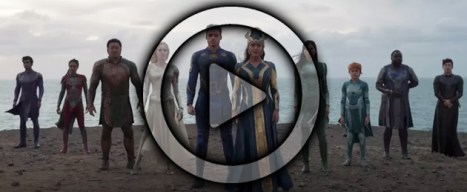
Podcast 616 is a podcast looking at the Marvel Cinematic Universe. I was thrilled to be invited to join Dan Owen for a discussion of Chloé Zhao’s Eternals, which is a movie I enjoyed considerably more than most.
It’s a fun and broad discussion, which delves into questions around auteurship within the Marvel Cinematic Universe, the paradox of superheroes, the question of power, and the challenges in adapting concepts like the Deviants for the big screen. It was really fun to roll up my sleeves and delve into this discussion with Dan, which allowed me to chat about everything from my blind spots with certain characters to the way in which the plot and themes of Eternals feels true to the spirit – if not necessarily the art – of Jack Kirby.
You can listen to the episode here, or click the link below.
It is easy to understand why this is. There have been Marvel Studios movies directed by Oscar-winners before; Joe Johnson won an Academy Award for visual effects on Raiders of the Lost Ark and Taika Waititi recently won a Best Adapted Screenplay award for JoJo Rabbit. However, there is something tangibly different about seeing a big budget blockbuster coming from an artist who won both Best Picture and Best Director at that year’s Academy Awards.
It also makes sense in the context of the Marvel Cinematic Universe. There have undoubtedly been Marvel Studios films with strong senses of authorship: Shane Black’s Iron Man 3, Taika Waititi’s Thor: Ragnarok, James Gunn’s Guardians of the Galaxy and Guardians of the Galaxy, Vol. 2, and Ryan Coogler’s Black Panther. However, those movies all feel quite a long time ago. Although one can perhaps pick up traces of Cate Shortland’s personality in Black Widow or Daniel Destin Cretton’s interests in Shang-Chi and the Legend of the Ten Rings, those films feel very familiar and very rote.
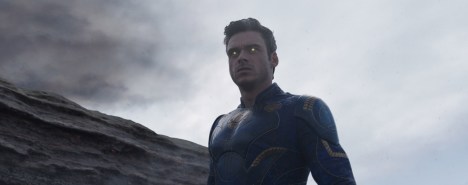
Red eyes in the morning…
There is tangible sense of opportunism at play in way that Marvel Studios has positioned Eternals as an auteur-driven project. After all, the studio has a long and complicated history with directors who have distinct visions; Patty Jenkins, Edgar Wright and Ava DuVernay have all suggested that the company’s culture is not particularly welcoming to creatives. In particular, Zhao’s assertion that she oversaw the movie’s action sequences exists in the context of Argentine director Lucrecia Martel, who recalls being told that if she chose to direct Black Widow, she would not be allowed to direct the action scenes.
Again, context is important here. Eternals is really the company’s first director-driven project since Black Panther, which is a big deal given the studio’s history of beginning pre-visualization of scenes and special effects “before the cinematographer or director has signed on to the project.” While movies like Avengers: Infinity War, Captain Marvel, Ant Man and the Wasp, Avengers: Endgame and Spider-Man: Far From Home are all varying degrees of entertaining, none of them feel like the work of a filmmaker who has something particularly pressing to say about the modern world.
Superfriends.
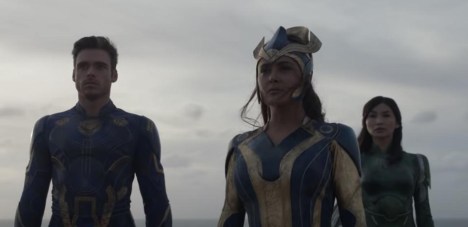
All this tension plays through Eternals, the fine balancing act between a director with a very distinctive artistic sensibility working with a studio that appears eager to launder its reputation by association, while also being anxious that this auteur doesn’t get to go too far. In some ways, Eternals feels like a limit case for the Marvel Cinematic Universe, an example of just how far the studio will allow a creative talent to stretch a rubber band before aggressively snapping it back into the default position.
This is the challenge facing Eternals. It goes further than any Marvel Studios film in recent memory, but that’s still not far enough.
I’m thrilled to be launching movie reviews on The Escapist. Over the coming weeks and months, I will be joining a set of contributors in adding these reviews to the channel. For the moment, I’m honoured to contribute a three-minute film review of Eternals, which will release in theatres next weekend.
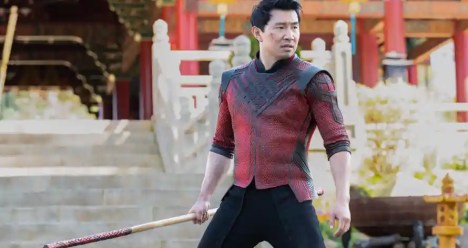
There’s something unsettling on how conservative Shang-Chi and the Legend of the Ten Rings is, even by the standards of the Marvel Cinematic Universe.
This is particularly frustrating when Shang-Chi and the Legend of the Ten Rings positions itself as a progressive piece of pop culture. There’s a lot to appreciate about the film, conceptually. It is the first film in the Marvel Cinematic Universe from an Asian American director. It is the first entry in the franchise with a predominantly (almost exclusively) Asian cast. It exists in conversation with the company’s long-standing history of clichés and stereotypes, exploring and reconstructing them. Even more than that, it has a fundamentally charismatic cast and a fairly solid emotional arc, both of which should sustain it.
Stick with it.
However, all of this ultimately feels like empty window dressing arranged around a weirdly traditionalist and pandering core. At its heart, Shang-Chi and the Legend of the Ten Rings is a story about how “kids these days” really don’t know what they’re doing or where they’re going, and really just need to get back in touch with their roots and learn from their elders. There are points when Shang-Chi and the Legend of the Ten Rings feels a little bit like a Jerry Seinfeld joke about stupid millennials with their gap years and their gig economy.
There’s something disheartening in all this, particularly with Shang-Chi and the Legend of the Ten Rings positioned as the first true origin story to follow Avengers: Endgame, the herald of a new era for perhaps the most ubiquitous pop culture franchise in the world. However, when Shang-Chi and the Legend of the Ten Rings should be looking forward into a bold new era, it casts its gaze backwards.
I published a new In the Frame piece at The Escapist this evening. With Loki wrapping up its first season this week, it seemed like a good opportunity to take a look back at the show. In particular, how the season finale betrayed the show’s core themes and characters.
Loki is a story about many things, but it is primarily about power. It is about whether individuals have the power to determine the paths of their own lives. It is about who has the power to determine what stories get told and what they do with that power. It is also about how power intrinsically acts in its own best interests. There’s a lot of really interesting and biting stuff in Loki, which makes it slightly frustrating when the final makes a conscious choice to rob its characters of their agency, to reveal that this story doesn’t belong to them, and to argue that power must be centralised. In the end, Loki betrayed itself.
You can read the piece here, or click the picture below.
The Escapist have launched a movie podcast, and I was thrilled to join Jack Packard and Richard Newby for the twenty-first episode of the year. With the release of Black Widow on streaming and in cinemas, there was only one movie to discuss. So we went for a deep dive into Marvel’s interquel, its character-centric movie for a dead Avenger.
Hosted by Andrew Quinn and Darren Mooney and with special guest Scott Mendelson, The Bottom 100 is a subset of The 250. It is a journey through the worst 100 movies of all-time, as voted for by Internet Movie Database Users.
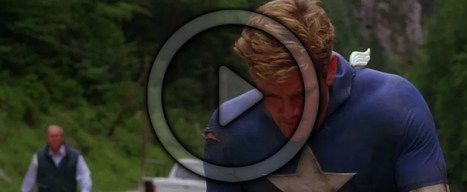
This time, Albert Pyun’s Captain America.
Polio sufferer Steve Rogers is selected for a dangerous experiment that could turn the tide of the Second World War, being reborn as Captain America. When a mission behind enemy lines throws him into conflict with the Italian supervillain the Red Skull, Steve Rogers ends up trapped in the ice. However, he awakens just as his country needs him most.
At time of recording, it was ranked the 65th worst movie of all time on the Internet Movie Database.

















 the m0vie blog