• Following Us

  • Categories

  • Check out the Archives


  • Awards & Nominations

Millennium – Via Dolorosa (Review)

This July, we’re taking a trip back in time to review the sixth season of The X-Files and the third (and final) season of Millennium.

And so, Millennium ends.

That is not entirely accurate. Via Dolorosa and Goodbye to All That are really the third ending to Millennium. Chris Carter’s oft-overlooked series famously reinvented itself in each of its three seasons. Every season finalé was a series finalé, bidding farewell to one version of the show before another arrives. In the first season, it was a serial killer procedural with ominous spiritual undertones. In its second season, it was the story of a family breakup that drew in all manner of religious conspiracy theories and eschatology. In its third season, it was…

"Did I tell you that I REALLY like The Silence of the Lambs?"

“Did I tell you that I REALLY like The Silence of the Lambs?”

Well, it is hard to tell what the third season was – or even what it wanted to be.

Nevertheless, Via Dolorosa and Goodbye to All That feel like an attempt to grant the series some sense of closure. In a way, these episodes typify the third season. They are messy and confused, awkwardly paced and drawn in broad strokes. At the same time, there are enough interesting ideas and clever concepts that one can see how they might have come together with a bit more craft. There is an outline of a great episode here, with Via Dolorosa and Goodbye to All That making a valiant effort to pull together messy strands of continuity from across the show’s run.

"Yep, it feels a little bit like that."

“Yep, it feels a little bit like that.”

The third season of Millennium was hampered by terrible decisions made out of the gate, but the final stretch of the season has no shortage of ambition and drive. It is no secret that the third season suffered from a number of serious problems at the start of the year. Maybe if those had been avoided, Via Dolorosa and Goodbye to All That would have an easier time drawing down the blinds. Still, it is impossible to know what might have been, and the truth is that Via Dolorosa and Goodbye to All That are a flawed conclusion to a flawed year.

Perhaps appropriately, Via Dolorosa and Goodbye to All That offer a rather disjointed conclusion to a rather disjointed year. Via Dolorosa and Goodbye to All That are written by two different teams of writers and directed by two different directors. Although the plot carries across both episodes, there are points where the transition seems rather inelegant or incongruous. Then again, this is about wrapping up the show’s troubled third season, so it is certainly representative.

"Take a picture. It'll last longer."

“Take a picture. It’ll last longer.”

Continue reading

Millennium – Nostalgia (Review)

This July, we’re taking a trip back in time to review the sixth season of The X-Files and the third (and final) season of Millennium.

Nostalgia is the last “serial killer of the week” story produced by Millennium.

Sure, there is a serial killer in Via Dolorosa and Goodbye to All That, but the last two episodes of Millennium are much more interested in the show’s mythology than in a nuts-and-bolts “Frank catches a serial killer” story. Appropriately enough, given its title, Nostalgia feels like a throwback to a simpler version of Millennium. In a way, it does more to capture the mood and feel of the first season of the show than anything like Matryoshka or Seven and One. It helps that Nostalgia is a great episode, judged by it own merits.

Frank sees all. All.

Frank sees all. All.

It makes sense that Nostalgia should come from Michael R. Perry. With his debut script for The Mikado in the second season, Perry had demonstrated quite a knack for traditional Millennium storytelling. The Mikado was arguably something of a throwback itself, the most old-school “serial killer of the week” story in the show’s delightfully off-kilter second season. If the show wanted to do one last “serial killer of the week” story, there was no writer better suited to crafting it than Michael R. Perry.

In a way, Nostalgia feels like belated vindication for the “back to basics” aesthetic running through the third season – proof that perhaps it might be possible for the show to recapture some of the stronger aspects of the first season even this late in the game. Nostalgia is a much better version of the stories that Closure and Through a Glass Darkly had tried to resurrect earlier in the year. It might be enough to entirely redeem the season’s stubborn fixation on a past fading into history, but it does demonstrate that there were interesting stories to be told using that technique.

Parks and recreation...

Parks and recreation…

Continue reading

Millennium – Seven and One (Review)

This July, we’re taking a trip back in time to review the sixth season of The X-Files and the third (and final) season of Millennium.

Seven and One is the last episode of Millennium to be written by Chris Carter and Frank Spotnitz.

That is a pretty big deal. Frank Spotnitz had been a vital part of Ten Thirteen since the second season of The X-Files. He had also been the only X-Files writer apart from Chris Carter, Glen Morgan and James Wong to cross over to work on Millennium. He would become one of Carter’s most trusted associates, also contributing scripts to Harsh Realm and The Lone Gunmen. When The X-Files: Fight the Future took Carter’s attention away from Millennium in its second season, he proposed Spotnitz to run the show in his stead.

Here's Frankie!

Here’s Frankie!

Chris Carter had created Millennium, and it was clearly a show that meant a lot to him. While The X-Files was populist and accessible, Millennium always felt like more of an auteur project. It was solemn, abstract, contemplative. There is a sense that he was quite disappointed when his attention was diverted away from the show in its second year. Carter has talked time and time again about how he created Millennium as an examination of evil in the world. Appropriately enough, Seven and One finds him circling back around to that idea right before the show concludes.

Seven and One might be the most overtly religious script that Carter and Spotnitz have ever written. It seems to foreshadow the closing themes of Carter’s script for The Truth, the final episode of The X-Files. It emphasises just how essential religious themes are to Carter’s work.

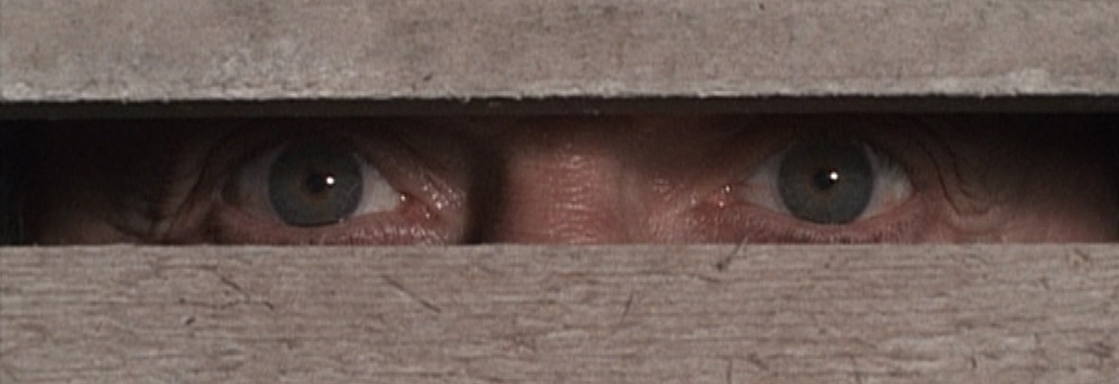
Eye spy...

Eye spy…

Continue reading

Millennium – Darwin’s Eye (Review)

This July, we’re taking a trip back in time to review the sixth season of The X-Files and the third (and final) season of Millennium.

There is a reckless abandon to the the late third season of Millennium that is oddly endearing.

The first half of the year seemed almost cautious and conservative, as if trying to smooth the rough edges off the show in the hopes of turning it into a more generic piece of television. That approach failed spectacularly, and hobbled the rest of the season. Towards the end of the third season, Millennium allowed itself to become a bit bolder and more abstract, proudly flying its freak flag high. The show found an energy and verve, throwing crazy concepts into scripts with reckless abandon and little regard for how they fit together.

Shady theories...

Shady theories…

It doesn’t entirely work. If anything, it underscores just how skilfully the second season had integrated these crazy ideas with a clear creative direction and a solid thematic foundation. The second season know roughly where it wanted to go, and so embarked on an epic journey towards that point. While the third season has its own thematic underpinnings, these feel more like recurring visual motifs and ideas than a clear purpose. As a result, the weirdness can seem detached and purposeless, abstract and surreal.

However, even when the late third season episodes don’t quite work, they remain interesting. There is a breathless energy to these stories that was sadly missing in the first stretch of the year. Darwin’s Eye is a prime example. It is not an episode that could be described as a success by any measure, but it is still ambitious and dynamic in a way that mitigates its failings. Somewhat.

That's one way to get a head in love...

That’s one way to get a head in love…

Continue reading

Millennium – Forcing the End (Review)

This July, we’re taking a trip back in time to review the sixth season of The X-Files and the third (and final) season of Millennium.

In its own odd way, Forcing the End is reassuring.

Not in any way that makes Forcing the End a good piece of television. In fact, Forcing the End is a terrible piece of television. It is poorly written, awkwardly staged, horribly muddled and needlessly convoluted. It wastes two potentially interesting guest stars in Julie Landau and Andreas Katsulas, and doesn’t give our characters anything interesting to do. The best that can be said bout Forcing the End is that it has some interesting ideas and striking imagery, but never seems to be able to fashion them into a functioning story.

"Wait. What."

“Wait. What.”

However, Forcing the End is reassuring because it stands as a monument to the second season of Millennium. The second season of Millennium was a gloriously odd and ambitious piece of television, one that floated ideas and concepts that often seemed insane or ridiculous. It was unlike anything else on television, and holds up rather well. However, the second season of Millennium is interesting because it invites the viewer to wonder whether to is fueled and sustained by its high concepts and big ideas, rather than its scripting and plotting.

Forcing the End answers that question rather clearly. It confirms that the second season works as well as it did because it was well written and beautifully constructed; carefully put together and meticulously crafted. It is not enough to just throw crazy apocalyptic concepts and imagery at the screen and see what sticks. The fact that Forcing the End is so packed with weird eschatological imagery and themes, and yet so stubbornly refuses to work, demonstrates that it is not enough for television to be odd. It has to be good.

Veiled threats...

Veiled threats…

Continue reading

Millennium – The Sound of Snow (Review)

This July, we’re taking a trip back in time to review the sixth season of The X-Files and the third (and final) season of Millennium.

“Our pasts are what we are,” Alice Severin explains to Emma Hollis and Bob Giebelhouse towards the climax of The Sound of Snow. It seems as if she might be talking for Millennium itself.

The Sound of Snow is a literal homecoming for Frank Black and Millennium as a television show. It is the last time that a number of crucial elements of Millennium appear in the show. It is the last appearance of Detective Bob Giebelhouse, the Seattle police officer who has been around since The Pilot. It is the last appearance of the yellow house, although it has since been painted a less striking white. It is also the last appearance of Catherine Black, who was a regular character for the show’s first two seasons.

...............

……………

The Sound of Snow features Frank Black returning to Seattle. This is not a big deal of itself. After all, Frank visited Seattle during TEOTWAWKI. However, The Sound of Snow sees Frank wading through memories. He flashes back to the events of The Fourth Horseman and The Time is Now, and visits the yellow house. He even takes a trip out to visit the cabin where he tried to wait out the end of the world with his wife and daughter. The Sound of Snow is about reconciliation, allowing Frank one last conversation with his beloved.

The Sound of Snow is also about reconciliation for the show itself. Since Omertà, the show has been trying to deal with the legacy of a second season that the first eight episodes of the year had tried minimise or ignore. The Sound of Snow is the culmination of that approach, with the third season finally picking up from where the second season let off.

...............

……………

Continue reading

Millennium – Collateral Damage (Review)

This July, we’re taking a trip back in time to review the sixth season of The X-Files and the third (and final) season of Millennium.

Collateral Damage continues the weird healing process at work in the third season.

After spending so much time pretending that the second season never actually happened, the third season has finally accepted that there were story developments flowing from that season that the show needs to deal with. In some respects, Collateral Damage can be seen as a process of healing and integration for the third season of Millennium, constructing a story that manages to tie together all three seasons of Millennium together into something resembling a cohesive whole.

"A bloody fine mess you've gotten me into!"

“A bloody fine mess you’ve gotten me into!”

From the first season, Collateral Damage takes its introduction and basic premise. Collateral Damage begins in a manner similar to many early Millennium episodes. A sinister attacker stalks their victim and brutally strikes. We are then treated to a few extended suspense-filled sequences as the attacker’s designs become increasingly uncomfortable and nefarious. It is not too hard to imagine Collateral Damage as the kind of “serial killer of the week” episode that populated the early first season.

For the second season, Collateral Damage inherits its fascination with the Millennium Group and its depiction of Peter Watts. Collateral Damage marks the first point in the third season where Peter Watts feels like the character that we watched grow and evolve over the second season. This is a version of Peter who has so repressed his doubts and uncertainties that they threaten to explode if they are even acknowledged. It is a much more compelling character than the knock-off conspirator featured in episodes like Exegesis and Skull and Bones.

"Don't be afraid."

“Don’t be afraid.”

From the third season, Collateral Damage takes its fixation on the link between the Millennium Group and conspiracies involving the American government. Collateral Damage suggests that the Millennium Group is responsible for Gulf War Syndrome. It feels like a plot point from an episode of The X-Files – and arguably makes it an ideal third season element. The result is perhaps the most all-encompassing episode of the show ever produced. Collateral Damage is not the best episode of Millennium ever produced, but it is perhaps the broadest representation of the show itself.

If you were to pull back and examine Millennium from a distance, it might look a lot like Collateral Damage.

"Surgical strike."

“Surgical strike.”

Continue reading

Millennium – Human Essence (Review)

This July, we’re taking a trip back in time to review the sixth season of The X-Files and the third (and final) season of Millennium.

Human Essence is the second (and final) script from Michael Duggan. It is also, notably, the first episode of the third season not to credit Duggan as an “executive producer” before the final credits.

Human Essence is a terrible episode of television. However, it is interesting to note that it is mostly terrible in ways that generic television can be terrible. The third season of Millennium is often terrible because of decisions or realities imposed by or resulting from creative decisions relating to the show itself. In the case of something like Through a Glass Darkly, the terribleness results from a perfect storm of vices associated with Millennium as a show. The Innocents and Exegesis are hobbled by choices made about the direction of the show.

Here there be monsters...

Here there be monsters…

Human Essence is terrible in a much more generic way. It would be a terrible episode of just about any television show. One of the problems with the episode is that it feels like it could easily be a terrible episode of just about any television show. With some light revisions, Human Essence could easily become a terrible episode of The X-Files or a terrible episode of Law & Order. Change the character names, tweak the dialogue a little. It wouldn’t take more than some light scrubbing to remove any hint of Millennium from the script.

However, it would take significantly more scrubbing to get the smell of crap off the script.

Yeah. We're hip.

Yeah. We’re hip.

Continue reading

Millennium – TEOTWAWKI (Review)

This July, we’re taking a trip back in time to review the sixth season of The X-Files and the third (and final) season of Millennium.

The best thing that can be said about TEOTWAWKI is that it knocks quite a few items off Chris Carter’s “millennial anxieties” checklist – touching on issues of school shootings, gun control, Y2K, anarchy, survivalism, and a few more.

There are some good and interesting ideas in TEOTWAWKI. It is written by Chris Carter and Frank Spotnitz, the first script credited to either writer since the first season of the show. It seems like both writers were clearly thinking about Millennium while working on the fifth season of The X-Files, storing up ideas for late use. TEOTWAWKI is not a script suffering from a lack of ideas. In fact, it has too many ideas packed too tightly. The script isn’t particular graceful; none of the threads dovetail as neatly into one another as they really need to.

Blood money...

Blood money…

This is a recurring theme across the third season of Millennium. There are shows with interesting and compelling ideas, but they are mixed together in a way that doesn’t work – often mingling with some of the more unfortunate creative decisions driving the show. Episodes in the third season frequently feel like curate’s eggs – scrambled messes with good bits and bad bits that are ultimately impossible to separate. TEOTWAWKI might be an interesting mess, but it is still a mess.

TEOTWAWKI makes it clear that The Innocents and Exegesis were not a rough spell as Millennium tried to find its sea legs. This is the way that things will be going forward, at least for a while.

"Doomsday Defense" was a better read...

“Doomsday Defense” was a better read…

Continue reading

Millennium – Season 2 (Review)

This May and June, we’re taking a trip back in time to review the fifth season of The X-Files and the second season of Millennium.

The second season of Millennium is understandably polarising.

It is returned from its summer hiatus as what was, on the surface, a radically different television show. The Millennium Group was no longer simply a forensic consultancy firm, but had transformed into a secret society dating back millennia; it had become, as Frank would concede in The Fourth Horseman, “a cult.” More than that, the show had changed around the Millennium Group. Serial killers had been the show’s bread and butter in its first season, prompting some critics to describe it as a “serial killer of the week” procedural; now they were a rare occurrence.

millennium-thebeginningandtheend2

More than that, Frank Black had also changed. In interviews around the first season, Lance Henriksen had been very proud to play a hero who solved problems with his mind rather than with a gun. In contrast, the second season opened with Frank Black brutally murdering the man who kidnapped his wife. The yellow house had been a symbol of everything pure and good in the world of Frank Black, of the family he worked hard to protect. The second season had exiled Frank Black from this family and had him move deeper and deeper into the Millennium Group itself.

However, there were other changes that were less profound, but just as striking. Frank Black was suddenly a fan of the music of Bobby Darin. He suddenly had a sense of humour that led him to crack more than two jokes in a season. at the same time, he was also more short-tempered and grouchy. The first season had presented Frank Black as a rock in the middle of otherwise chaotic seas; in the second season, it was clear that Frank himself was feeling the strain and the stress. In short, Frank Black felt a lot more human.

millennium-aroomwithnoview9

The entire mood of the show changed around Frank. Millennium was suddenly a lot weirder. Though the first season had largely moved away from the classic “Frank hunts a serial killer” formula by the end of the year, the second season abandoned any sense of formula altogether. Watching the second season of Millennium on a week-to-week basis, it was almost impossible to predict what the next show would be like. Although there was a very strong thematic continuity between episodes, there was less of a rigid structure to their construction.

The second season of Millennium was a radical departure from what had come before. It was also the best season of television ever produced by Ten Thirteen.

millennium-luminary28

Continue reading