• Following Us

  • Categories

  • Check out the Archives


  • Awards & Nominations

Non-Review Review: Avengers – Infinity War

There is a solid argument to be made for the Marvel Cinematic Universe as blockbuster television series that only releases three or four films in a given year.

There’s a lot of evidence to support this argument, perhaps most notably the directors chosen for “phase two” of the grand experiment. Joss Whedon might have directed Serenity and Much Ado About Nothing, but he remains known for his game-changing work on television series like Buffy: The Vampire Slayer, Angel, Firefly and Dollhouse. Removing Patty Jenkins from Thor: The Dark World and replacing her with Alan Taylor only reinforced this sense. Drafting in the Russo Brothers from Community to direct Captain America: The Winter Soldier cemented the notion.

Purple reign.

Indeed, the elevation of the Russo Brothers within the Marvel Studios hierarchy with Captain America: Civil War and with Avengers: Infinity War suggests the obvious similarities between managing the sprawling continuity of the shared cinematic universe and the day-to-day management of a television show, where individual instalments might be credited to individual authors, but it is also important to maintain consistency of tone and vision across the entire line. Infinity War suggests the sort of organisational ability associated with long-form television storytelling more than any single cinematic narrative.

There are moments in which this approach works. Infinity War is full of knowing winks and callbacks, allusions and references. There is a sense of set-up and pay-off to certain threads and arcs seeded across the eighteen previous films within the established brand. Characters get emotional scenes that play upon established relationships and dynamics, which are clearly articulated within the film itself, but building off years of watching (and rewatching) these actors play off one another in these roles. There is an undeniable weight to Infinity War that simply would not be possible without that television storytelling style.
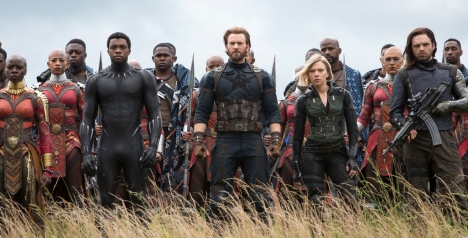
Avengers assembled.

At the same time, there are reminders of the limitations of this approach, of the challenges of balancing individual stories with a larger plan for the narrative universe in which they unfold. This is particularly notable because Marvel Studios recently shifted towards a more director-friendly approach in some of its standalone productions. Guardians of the Galaxy and Guardians of the Galaxy, Vol. 2 are both undeniably James Gunn productions. Black Panther could only have come from Ryan Coogler. Thor: Ragnarok worked as well as it did because of the unique directorial stylings of Taika Waititi.

Watching Infinity War, it becomes clear how far these directors deviated from the established style sheet, and the difference in approach between these directors and the Russo Brothers. It occasionally feels like Infinity War was constructed by people who watched those movies, without understanding why they worked as well. There is a tonal awkwardness when these characters are woven back into the fabric of the shared universe, in a manner that is occasionally unquantifiable but sometimes fundamental.
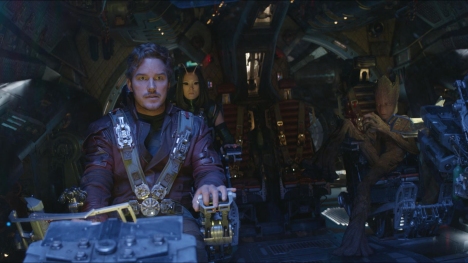
Guardians… Get In There?

Infinity War is good, clean fun. Perhaps too good and too clean. In order put the jigsaw pieces together, all of the rough edges have been sanded off. Anything that might generate friction has been stripped away, creating the impression of a very smooth and very functional storytelling engine. Midway through the film, Thor ruminates upon the existence of fate and how it has led him towards this particular moment and beyond to a greater purpose. Doctor Steven Strange perceives one single happy ending to this crisis.

There is a sense that Thor and Strange perceive the vast narrative machine of Infinity War working around them. It is an impressive machine, if a somewhat inhuman one.
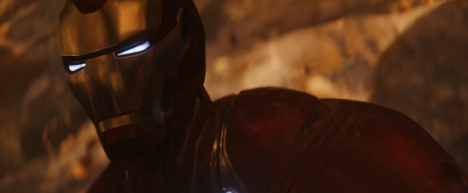
Things look pretty Stark.

Continue reading

Non-Review Review: Strangers – Prey at Night

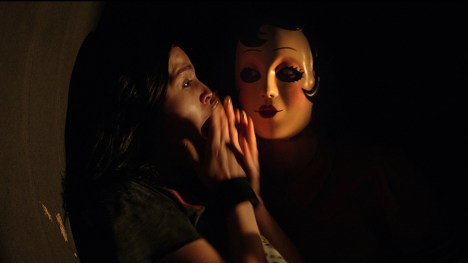
Strangers: Prey At Night is the story of a wholesome family that find themselves menaced by a group of Kim-Wilde-and-Bonnie-Tyler-loving, smiley-face-making, Nirvana-quoting nihilist hipster dirtbags. So, it’s a true horror story.

Strangers: Prey At Night is perhaps the flip side of the nostalgic-for-the-experience-of-horror-cinema movies like A Quiet Place or Lights Out, in that it’s just a straight-up nostalgic ode to all manner of forgettable eighties era slasher movies. It’s a canny example of the horror genre’s ability to cannibalise what works, a film very consciously built on the successful nostalgic retro horror vibe that made The Conjuring and The Conjuring II such massive hits, but applying it to the direct-to-video masked-and-axe-wielding-killer subgenre.

Let us prey.

Being honest, it is a surprise that it took so long to see that approach applied to the reliable low-budget slasher genre. After all, the twenty-first century has seen a host of remakes and reboots of classic hack-and-slash films like The Last House on the Left or The Hills Have Eyes, but those films consciously emphasised applying modern movie-making techniques to older material. Strangers: Prey at Night does the inverse, applying an older aesthetic to a sequel to a newer breed of horror film.

The approach is intriguing, even if the results are unsatisfying.

The horror franchise that burns twice as bright…

Continue reading

Non-Review Review: The Guernsey Literary and Potato Peel Pie Society

Early in the film, a supporting character reveals the ingredients of the eponymous culinary delight, the mysterious “potato peel pie.” Those ingredients are, somewhat predictably, potatoes and potato peels. With some small measure of pride, the character in question boasts that his potato pastry remains conceptually pure. There is no flour, no sugar, no flavouring. There is only potato. Watching The Guernsey Literary and Potato Peel Pie Society, this almost feels like a moment of self-awareness.

The Guernsey Literary and Potato Peel Pie Society could certainly use more flavouring.

Pie in the sky thinking.

Continue reading

Non-Review Review: Rampage

Rampage suffers from some pretty severe tonal issues. The video game adaptation starts and ends as a spiritual companion to Kong: Skull Island, but takes a detour into the last American Godzilla movie during its extended climax.

The results are jarring, creating a more dissonant movie than either of its obvious monster-movie forebearers. Rampage is goofy enough that its urban carnage feels out of place, and brutal enough that some of its cheekier decisions feel mean-spirited and vindictive. The result is very much a curate’s egg, to the point that it occasionally feels like Rampage escaped its creators in the edit room.

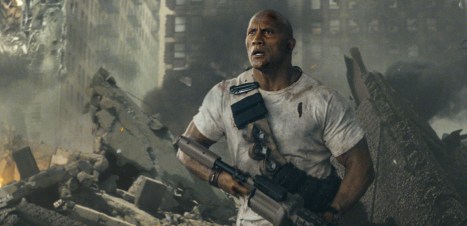
Going ape.

There is a lot to like in Rampage, particularly its weird committed earnestness when it comes to dealing with the friendship between a primatologist and his gigantic albino gorilla. Rampage skirts the line, occasionally embracing the camp absurdity of muscle-bound Dwayne Johnson’s deep-seated emotional attachment to a computer-generated rampaging “gene-edited” monster. Rampage understands the absurdity of the set-up, but makes a convincing sell of it nonetheless.

Unfortunately, Rampage‘s human characters are never as interesting, which creates a problem when the climax attempts to shift gears into a sprawling urban destruction epic. Rampage feels as much a product of careful and outrageous engineering as the creatures at its core. However, as with those creatures, it never feels quite like those doing the engineering had a clear design in mind.

“I sure picked a bad day to move George to the Metropolis Zoo.”

Continue reading

Non-Review Review: Blockers

Blockers is a lot funnier and a lot more endearing than its two-line synopsis might suggest.

The premise of Blockers is the stuff of stock teenage sex comedies, right down to the branding on the poster. As if worried that audiences might not get the substance of the comedy, advertising for Blockers prominently features the silhouette of a rooster above the title of the film, as if to assure potential viewers exactly what type of blocking is taking place. Blockers positions itself very candidly and very bluntly as a broad and old-fashioned story about teenagers having sex.

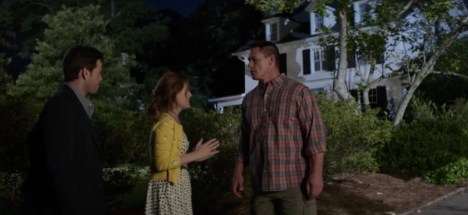
Prom here to eternity.

The basic plot of Blockers finds three parents discovering that their daughters have made a pact to lose their virginity on prom night. These three parents then embark upon an odyssey to prevent the planned sexual intercourse from occurring. As one might expect, all manner of complications and hijinks ensure, with the canny children struggling to stay one step ahead of their determined (and occasionally resourceful) pursuer. It is hardly the most innovative of concepts, even if it is a sturdy framework for comedic set pieces and humour concerning bodily functions.

However, what is most remarkable about Blockers is the way in which it uses this familiar framework to engage with its premise in a surprisingly nuanced and insightful way, avoiding (and even directly rebuffing) the reactionary attitudes baked into the core concept. The result is perhaps the most sincere and endearing film ever to include the phrase “butt-chugging.”

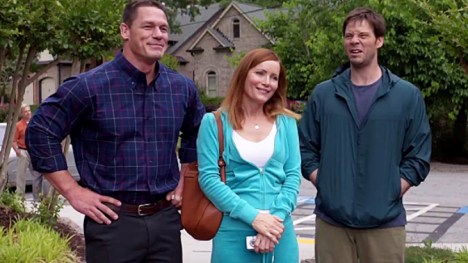
Taking the Cena-ic route.

Continue reading

Non-Review Review: Michael Inside

From writer and director Frank Berry, Michael Inside is harrowing, emotional and earnest look at cycles of incarceration affecting young Irish men from marginalised communities.

The plot of Michael Inside is fairly straightforward. As the title implies, the movie centres upon a young man named Michael who finds himself arrested in possession of drugs with a street value of two thousand euro. Receiving a custodial sentence, Michael finds himself incarcerated for three months. Michael must learn to navigate prison life, while his grandfather struggles to keep himself above ground on the outside. However, prison exerts a gravity, and escape is not as simple as release.

Inside, he’s dancing.

Michael Inside is an intense and claustrophobic experience. Asked early in the film if he suffers from any preexisting conditions, Michael responds, “Anxiety.” Shooting primarily in close-up with a hand-held camera, Michael Inside skillfully replicates that sensation. The characters constantly seem trapped and boxed in. Even before Michael is taken into custody, scenes are framed and blocked so as to suggest that he is trapped; the wire frame on crosswalks, the windows of the house, the bars of a fence. Michael Inside suggests that prison is more than just a physical construct.

Michael Inside is occasionally a little too earnest in its exploration of these vital and important themes, sometimes feeling more like an abstract civics lesson than an organic story. Still, there is no denying the raw emotional power of Michael Inside, particularly when director Frank Berry brings all the threads together at the climax of the story.

Everything, gone in a flash.

Continue reading

72. RoboCop – This Just In/Easter Sunday/April Fool’s Day 2018 (#∞)

Hosted by Andrew Quinn and Darren Mooney, The 250 is a (mostly) weekly trip through some of the best (and worst) movies ever made, as voted for by Internet Movie Database Users. New episodes are released every Saturday at 6pm GMT, with the occasional bonus episode thrown in.

This time, an Easter treat and a new entry: Paul Verhoeven’s RoboCop.

In an apocalyptic Detroit, a giant corporation announces its plans to privatise local law enforcement. In order to further this end, the company announces plans for a cybernetic law enforcement official. All that they need is a volunteer.

At time of recording, it was ranked the ∞th best movie of all time on the Internet Movie Database.

Continue reading

Non-Review Review: A Quiet Place

A Quiet Place is the latest entry in a string of contemporary high-concept postmodern horrors, very much of a piece with films like It Follows, Don’t Breathe or Lights Out.

These movies are largely predicated upon the internal logic of the horror movie, often incorporating and literalising fundamental parts of the horror movie experience into their conceptual frameworks. It Follows is obsessed with the rules that govern its unstoppable supernatural force, with the teen protagonists seeking to exploit and manipulate them. Lights Out focuses on a creature that can only really move when it is unseen, weaponising the audience’s impulse to look away or cover their eyes when presented with horrific images within the film.

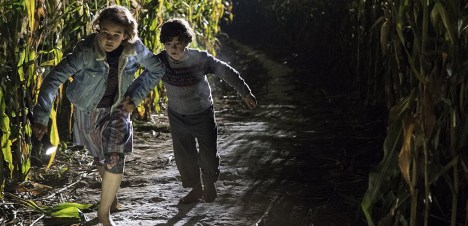
Maize runners.

A Quiet Place builds on the same horror movie anxiety as Don’t Breath – the audience’s urge to gasp or to scream in response to the events on the screen. A Quiet Place unfolds in a world dominated by monsters that hunt based on sound, creating an environment where the human cast members have to remain as quiet as possible in order to survive. No matter what happens, the characters cannot scream. Given that they are starring in a horror movie, that is quite the challenge.

A Quiet Place is a lean and effective piece of filmmaking from director John Krasinski, who also worked on the script written by Scott Beck and Bryan Woods. As one might expect given the premise, A Quiet Place is a horror movie that often feels quite minimalist; twenty minutes of set-up giving way to seventy minutes of sustained climax. The results are invigourating, a horror movie worth shouting about.

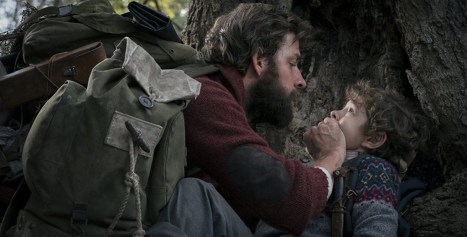
Children should be seen and not heard.

Continue reading

New Podcast! Scannain Podcast (2018) #10!

The tenth edition of the new and revived Scannain podcast discusses the week that has been in Irish film.

Joined by Grace Duffy and Graham Day, we take a look at the usual array of topics. We discuss what we’ve watched over the past week, the big news stories of the day and the top ten. We also take a look at the new releases hitting cinema this week. I also confuse Alia Shawkat with Ilana Glazer.

Check it out here, or give it a listen below.

Non-Review Review: Twin Peaks – The Missing Pieces

It says a lot about Twin Peaks: Fire Walk With Me that there were enough deleted scenes that they could be structured into a ninety-minute feature film. It says even more that the resulting feature film is almost coherent.

Twin Peaks: The Missing Pieces is a strange piece of work, essentially a narrative film stitched together from the cast-offs of a theatrical release two decades earlier. It is a collection of deleted scenes, but deleted scenes that have taken on an uncanny importance. These deleted scenes have been edited together into something approaching a linear narrative by David Lynch, the director who shot them in the first place. They even come packaged with an introduction and a set of closing credits. They are vitally important to the revived television series. They are, in other words, like a real movie.

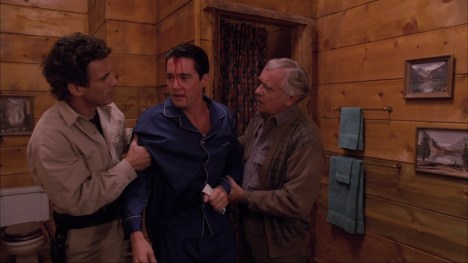
“Yeah, he’s going to need about twenty five years to recover.”

Some of this is because Fire Walk With Me is a notoriously inscrutable and abstract film, one defined by strange choices and bizarre imagery. David Lynch is a surrealist, and Fire Walk With Me reflects this; it is full of odd cul-de-sacs and strange segues. Fire Walk With Me was also a film heavily cut before its release, which accounts for why it feels like a film defined by what is absent so much as what is present. The incomplete nature of Fire Walk With Me makes the incomplete nature of The Missing Pieces more understandable. They fit together like the two pieces of Laura Palmer’s heart-shaped necklace.

However, The Missing Pieces is illuminating for more than just the little details of continuity and the appearances of familiar faces. It is a film that in some ways shades Fire Walk With Me, existing as a remainder of the absences carved from that earlier film. The Missing Pieces defines Fire Walk With Me through contrast, revealing the elements of Fire Walk With Me that were deemed inessential to the theatrical release. In keeping with Lynch’s recurring fascination with doppelgangers and doubles, The Missing Pieces illuminates Fire Walk With Me by presenting an alternative; it is what Fire Walk With Me chose not to be.

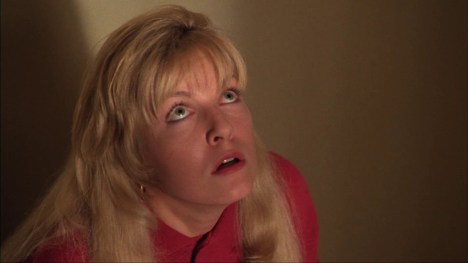
Past prologue.

Continue reading