• Following Us

  • Categories

  • Check out the Archives


  • Awards & Nominations

Non-Review Review: Kajillionaire

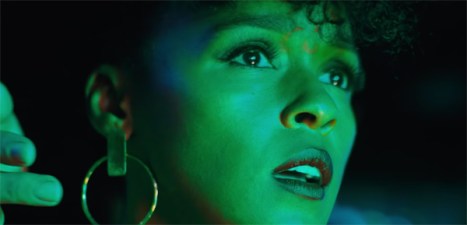
Kajillionaire is “quirky”, in a manner that is typical of the modern American independent film.

Miranda July’s third feature-length film operates on its own distinct wavelength, populated by eccentric and exaggerated characters who exist in a world caught in a twilight zone between the mundane and the surreal. Kajillionaire has a distinct sensibility, which it signals as early as a shot of its leading trio trying awkwardly to evade the landlord desperately seeking overdue rent. Kajillionaire operates at a level of heightened reality that immediately gives it a “marmite” flavour.

However, if the viewer can get past the abundance of quirk, there’s a lot to enjoy in Kajillionaire‘s study of emotional dysfunction. Kajillionaire is a con artist movie about a family living on the margins, but one that doesn’t seem particularly interested in the art of the con. Veteran hustlers Robert and Theresa are well removed from the smooth operators of films like Dirty Rotten Scoundrels, Matchstick Men or The Brothers Bloom. Instead, they are a mess of contradictions and maladaptations.

Kajillionaire works largely due to its wry sense of humour, which manages to offset a lot of what might otherwise be suffocating quirkiness. It also benefits greatly from a set of impressive performances. Debra Winger and Richard Jenkins do good work as Robert and Theresa, but the film belongs to Evan Rachel Wood as their daughter Old Dolio and Gina Rodriguez as Melanie, the character who quickly gets swept up in their hijinks.

Continue reading

Non-Review Review: The Boys in the Band

The Boys in the Band is not only a cinematic adaptation of a classic play, it is a cinematic adaptation of a particular staging of a classic play.

The Boys in the Band is a film designed to capture a snapshot of the 2018 Broadway run of Mart Crowley’s iconic 1968 off-Broadway play. It is directed by Joe Mantello, who is perhaps best know for his theatre work including Wicked and the fiftieth anniversary revival of The Boys in the Band that forms the basis of this filmed version. The film reunites the entire ensemble of that staging, including actors like Jim Parsons, Zachary Quinto and Matt Bomer.

Banding together.

In some ways, Hamilton feels like the obvious point of comparison here. The goal is not just to bring a beloved play to the screen, but to capture the particular energy of a particular staging of that beloved play. However, while Hamilton leaned into its attempts to recreate the Broadway experience for an audience watching at home, The Boys in the Band is a much more traditional cinematic adaptation of a theatrical staging. It is a film, but it is a film that feels particularly “stagey.” It recalls a particular brand of awards fare, like Doubt or Fences.

This is perhaps the biggest issue with this adaptation of The Boys in the Band. With the exception of a few framing scenes set outside the apartment at the beginning and the end of the story, The Boys in the Band doesn’t feel like a reimagining so much as a restaging. Then again, it’s debatable to what extent this is a problem. Mantello’s approach to the material is straightforward rather than showy, putting his faith in the script – which was reworked by Crowley shortly before his death with writer Ned Martel – and in the cast, trusting them to carry the film.

Not-so-midnight-cowboy.

This largely works. The Boys in the Band is a fascinating snapshot of a cultural moment. Crowley’s play was famously one of the first pieces of mainstream pop art to focus on a large a diverse cast of gay characters, arriving before the AIDS crisis and before Stonewall. While the play has remained constant in all of those years, the world around it has changed. Its fortunes have ebbed and flowed, while the text seems to remain vital and relevant – it always seemed to say something to the moment, even if that something made critics uneasy.

The Boys in the Band is a welcome reminder that there is nothing inherently wrong with a theatrical approach to cinematic stagings of beloved plays. The Boys in the Band may not pop off the screen in the way that Hamilton does, engaging as much with the audience’s experience of the show as with the content of the show itself. Instead, The Boys in the Band serves largely as a showcase for its actors and for its source material, proof that there is a lot to be said for locking a bunch of talented cast in a confined space with a good script.

Drinking it all in…

Continue reading

Non-Review Review: Antebellum

Antebellum never seems entirely sure whether it wants to be a biting social commentary or a pulpy genre exercise.

To be clear, this is a false dichotomy. One of the most interesting aspects of horror is how frequently it can satisfy both of those objectives. Get Out is perhaps the most obvious recent example of this, and it is telling that (like so many modern horrors) Antebellum markets itself as “from the producers of Get Out.” However, this has always been a feature of horror, as demonstrated by the films of directors like Wes Craven and John Carpenter. Antebellum shouldn’t have to choose between being socially relevant and being an effective horror, but it insists on doing so.

Shining some light on the matter.

There is a good movie buried somewhere in Antebellum. It is very clear that writers and directors Gerard Bush and Christopher Renz have a good idea that resonates in the current moment. Indeed, Antebellum hammers that point pretty heavily. It opens with a quote from William Faulkner, reminding audiences that “the past is never dead. It’s not even past.” In case the audience doesn’t get how that applies to the movie’s set-up, a character repeats it about forty minutes into the runtime. Antebellum has things to say, and is not shy about saying them.

However, what Antebellum is trying to say is muddled by a number of awkward structural choices. Antebellum is a film that is consciously built around a number of developments that are intended to wrong-foot the audience and catch them off-guard, to invite the viewer to ask questions about what is happening and why, and maybe even add some compelling gif-able content for the film’s marketing. This structuring of Antebellum is wrong-headed on a number of levels, but most profoundly in the way that it reduces the movie’s biting thesis to a cheap narrative hook.

Burning unease.

Continue reading

Non-Review Review: The Devil All the Time

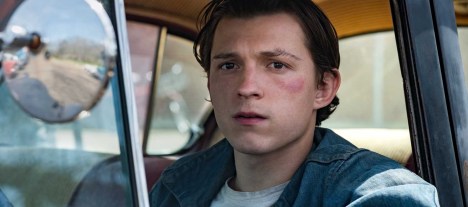
The Devil All the Time demonstrates that the adjective “novelistic” isn’t always a compliment.

Writer and director Antonio Campos is clearly aiming for an epic sweep to The Devil All the Time. The film unfolds over the course of several decades, following several intersecting lives in rural Ohio in the space between the end of the Second World War and the height of the Vietnam War. This is a tale that spans generations, with an impressive density. Small characters get huge arcs, dramatic twists hinge on chance encounters, and a large amount of the film’s plot is delivered by way of folksy omniscient narration.

Holland of the Free?

It is easier to admire The Devil All the Time than it is to appreciate it. Campos has drawn together a formidable cast to tell a story that explores a host of big ideas about small town life. The Devil All the Time clearly aspires to be a piercing study of religion, sex and violence in the American northeast. The film maintains an impressive atmosphere, in large part due to Campos’ moody direction and the work of Lol Crawley and the rumbling soundtrack from Danny Bensi and Saunder Jurriaans.

However, nothing in The Devil All the Time has room to breath. There are so many elements competing for narrative space that even films two-hours-and-twenty-minute runtime feels overstuffed. Characters are never allowed to stew or develop in a way that a story like this demands, instead reducing the movie to a series of plot points and thematic observations delivered in a rich and moody manner, but without any real substance to bind them all together.

Book ‘im.

Continue reading

Non-Review Review: Enola Holmes

Enola Holmes is a movie with a lot of charm, anchored in a sense of playful enthusiasm and a winning central performance.

Adapted from Nancy Springer’s The Enola Holmes Mysteries series of novels, the basic premise of Enola Holmes is straightforward enough. The classic Victorian detective Sherlock Holmes is given a younger sister, who inevitably finds herself forced to navigate the wider world while solving mysteries and avoiding the best efforts of her older brothers to ship her off to a suffocating and restrictive boarding school where she might be taught to be a lady.

Make yourself at Holmes…

Enola Holmes moves quickly and cheerfully through its starting premise and central mystery, bouncing from one sequence to another with considerable grace. However, it’s lead actor Millie Bobby Brown who carries the film. Brown is probably best known for her work on Stranger Things and a prominent role in Godzilla: King of the Monsters, but Enola Holmes suggests a long and promising career ahead of the young actor. It is impossible to imagine the movie seeming as effortless without her at its centre.

In fact, Enola Holmes suffers most when it moves away from its protagonist and makes room in her story for less compelling (but more nominally “important”) characters that wind up sapping the film’s energy. Enola Holmes has a surprisingly slow start for a film that breezes along once it finds its footing, and that is largely because it is initially reluctant to give its central character the breathing room that she needs. Still, once the film gets past that, it is a highly enjoyable adventure.

Enola that look…

Continue reading

Non-Review Review: The Roads Not Taken

There are two different, decent competing movies tucked away inside The Roads Not Taken. Sadly, the whole is much less than the sum of its two largest parts.

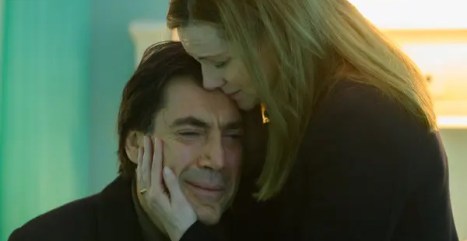
The first  of these movies is a fairly conventional study of a daughter coping with her father’s neurological degeneration. It is a fairly standard template, tapping into recognisable anxieties about growing old, and the realisation that many children will have to act as caregivers for their parents in old age. This is a solid basis for a movie on its own terms. Indeed, it seems like a film that could easily net an awards nominations for actors Javier Bardem and Elle Fanning.

Holding it together.

The second film is a more abstract and ambitious work, in which an older man reflects on the life that he has lived and – trapped inside his own head with a slipping sense of reality – allows himself to play out fantasies of how his life might have been different. This a more philosophical work, a more reflective and introspective film. It seems like something from a stranger and more unusual movie, something like The Fountain or even Cloud Atlas.

The problem is that these two angles on the story do not fit together. In cutting across them, director Sally Potter undercuts and undermines both narratives. Neither thread has enough room to breath and build momentum, and both are driven by fundamentally different stakes. One movie is about the experiences of an aging writer named Leo, while the other is about his daughter Molly, and shifting back and forth causes the movie to lose its emotional footing. The result is an interesting and well-intentioned curiosity, but an underwhelming film.

Baby, I’m a-maize-d by you.

Continue reading

New Podcast! The Escapist Movie Podcast – “Chadwick Boseman And Broken Time”

The Escapist have launched a movie podcast, and I was thrilled to join Jack Packard and Bob Chipman for the second episode, primarily discussing the passing of Chadwick Boseman and the summer of broken time typified by TENET, i’m thinking of ending things, Palm Springs and Bill & Ted Face the Music.

You can listen to the episode here, back episodes of the podcast here, click the link below or even listen directly.

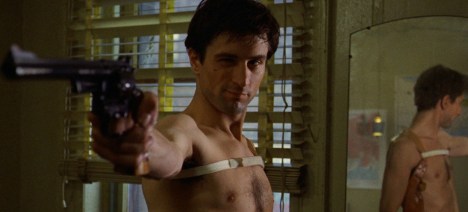
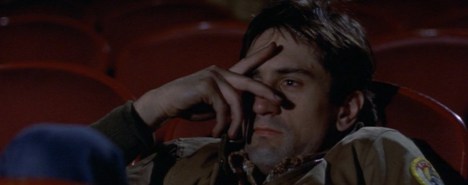
“You’re a Real Cowboy!” The Haunted Emptiness of Travis Bickle in “Taxi Driver”…

The podcast that I co-host, The 250, will be launching a belated Summer of Scorsese this week with a look at Taxi Driver. It is a fun and broad discussion that is well worth your time, but it spurred some of my own thoughts about Martin Scorsese and Paul Schrader’s 1976 classic.

Even watched today, there is something deeply unsettling about Martin Scorsese’s Taxi Driver.

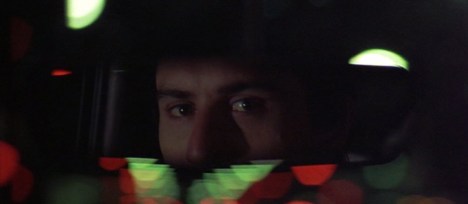
Travis Bickle is a haunting figure, drifting through the night in what writer Paul Schrader has repeatedly described as a “metal coffin.” Of course, Taxi Driver is a film of the seventies. The New York through which Bickle moves no longer exists – the one famously (but not actually) told to “drop dead” by Gerard Ford. Bickle is a Vietnam veteran, later sequences revealing scars on his body, and even his mohawk is drawn from experiences of soldiers who served in that war. Even beyond this, the vacuous-but-wholesome politics of Palantine evoke the disillusion of the post-Watergate era.

However, there is also a timelessness to Travis Bickle. His strange isolation in a city populated by millions of people is a manifestion of Emile Durkheim’s concept of “anomie”, the weird loneliness that human beings can feel when trapped in confined spaces with countless anonymous neighbours. More than that, as countless observers have explained in the nearly half-century since Taxi Driver‘s release, Bickle’s murderous possessiveness towards Betsy and Iris feels eerily prescient in an era of mass shootings and manifestos by entitled angry young men.

What is most striking about Taxi Driver is the emptiness of Travis Bickle. Bickle is a young man who seems to be completely lacking in any sense of identity or self, any strong sense of who he is or what he wants. As much as Taxi Driver presents Bickle as a nightmare of urban living, he is also a reflection. He is an empty vessel that seems to have been shaped by the world around him without any deeper understanding or comprehension of what that means. Bickle isn’t a person so much as a manifestation of a culture so far in decline that it has folded into itself.

Indeed, much of how Bickle sees the world is informed and shaped by the forces around him, perhaps even unconsciously and passively. Bickle offers a glimpse of American masculinity in crisis, of decades of westerns and pulp adventures that have been digested and processed and rehashed until there is no meaning underneath it all. It’s possible to read Taxi Driver as a reiteration of The Searchers, one of the greatest westerns ever made and one of Martin Scorsese’s famous films. However, it isn’t Taxi Driver recreating The Searchers so much as Bickle himself.

There’s an uncomfortably warped sensibility to all this, a bitter meaninglessness that serves as an indictment of the world around him. Travis Bickle is a monster, but he is a monster manifested from the collective unconscious of a city (and perhaps a world) trapped in decline and decay.

Continue reading

Non-Review Review: TENET

NOTE: I live in Ireland. Our cinemas are open. Evidence suggests that it is (relatively) safe for people to attend the cinema if they take the necessary precautions. However, I am aware that it is not safe in every country to do so, and I also understand that many readers may not feel safe attending their local cinema even in areas where the evidence suggests it is safe. As this seems to be a hot-button issue with all theatrical releases during the pandemic – but with TENET in particular – it feels important to stress this outside the body of the review itself.

This should go without saying, but given the nature of the current pandemic it is worth repeating: No movie is worth risking your life for. If you feel – or if information from sources you trust suggest – that it is unsafe to go to the cinema, then please do not go. I loved this film. I will see it in cinemas again at least twice within the next week, because it is safe for me to do so. This review should not be taken as an endorsement that the reader should feel they have to (or are expected to) risk their lives to see this film. With that in mind, here is the review.

“Time isn’t the problem,” insists Neil early in TENET. Like a lot of things that the shady operator says over the course of the film, this is not exactly true.

There is a lot riding on TENET. Almost none of this was intended when the film was conceived and produced. As the first major theatrical release since the coronavirus pandemic, TENET effectively shoulders the burden of saving cinema – particularly with a death of major releases between now and Wonder Woman 1984 and with the planned release of Mulan on Disney+. It’s a lot of weight for a film like TENET to carry. Time will tell whether it can succeed or not, but it makes a valiant effort.
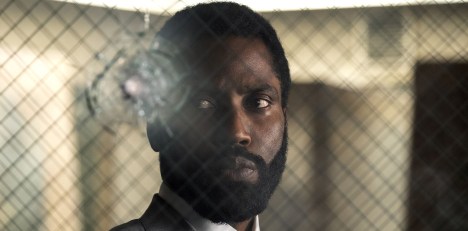
Shattering the release window.

TENET rises to this challenge in a couple of ways. Most obviously, TENET is quite simply a triumph of blockbuster filmmaking. Director Christopher Nolan has boasted about how much of the film was completed using in-camera effects and how carefully choreographed it all was. TENET is a movie that showcases the power of spectacle, whether in its delightfully complicated action sequences or even in Hoyte Van Hoytema’s breathtaking establishing shots. TENET is a movie that demands as big a screen as possible, reminding audiences of the scale of such filmmaking.

However, there’s more to it than that. TENET is a film that feels curiously attuned to this cultural moment. It is a film that deals with many of Nolan’s pet themes and obsessions, but in a way that feels very much in step with the modern moment. It’s hard to summarise TENET without spoiling the movie, without revealing too much in terms of plot mechanics or character motivations, but TENET is a film about the breakdown of time itself. It is a film about the collapse of chaos and effect, and a world in which the future and the past are a war over the present.

A career highlight?

It’s an ambitious film. Nolan’s movies are frequently driven by high-concepts and abstract ideas, and the director is remarkable in his ability to build crowd-pleasing blockbusters around concepts like time dilation in Inception and the theory of relativity in Interstellar. If anything, TENET seems to push that idea to breaking time. As Neil repeatedly points out over the course of the film, he has a degree in quantum physics and he struggles to make sense of the film’s internal logic. Perhaps the film’s protagonist (known simply as the Protagonist) sums it up best, “Woah.”

TENET is an interesting film from Nolan in a number of ways. The villainous Russian oligarch Andrei Sator is probably the director’s scuzziest character since Insomnia or Memento. The film itself is perhaps Nolan’s most emotionally repressed since The Prestige. These sensibilities are blended with his more modern high-concept blockbuster aesthetic, and flavoured with a surprising amount of self-awareness. The result is a heady cocktail that is occasionally overwhelming, but never unsatisfying.

Well, masks are recommended at cinema screenings.

Note: Warner Brothers have specifically requested that reviews avoid spoilers. As a result, this review will talk rather generally about TENET. However, if you want to see it completely unspoiled, it is perhaps best to just take our word for it: it is good. It is probably even the best film we’ve seen this year. That is a very short review.

Continue reading

Non-Review Review: Project Power

Project Power is an oddity, a strange clash of style and content that never quite aligns but results in some interesting chemistry.

The basic plot of Project Power is fairly straightforward. A mysterious designer drug known only as “power” has arrived on the streets of New Orleans. These pills cause the user to spontaneously manifest a random superpower for five minutes – that power can be awesome, mundane or fatal. It’s a basic set-up as these sorts of stories go, and its rooted in the tropes of the modern superhero genre: human experimentation, industrialised production. unchecked power fantasies.

The bitterest pill.

Project Power uses this central plot element to two competing ends. In terms of direction, the simple-yet-flexible set-up serves as a motivator for a variety of high-concept and high-energy action sequences as characters manifest strange abilities that inevitably alter the dynamics of one-on-one combat, allowing for impressive stunts and frantic violence. In terms of theme, Project Power uses this set-up as a metaphorical commentary on the War on Drugs and the historical exploitation of marginalised communities by those in… well, power.

These are two interesting angles, even if they are never explored as creatively as one might hope. Indeed, the two approaches make strange bedfollows, with Project Power feeling like a paranoid conspiracy thriller that movies with the hyper pacing of a modern direct-to-video action film. It doesn’t really work, but the cocktail is fascinating enough that it holds attention.

Power play.

Continue reading