• Following Us

  • Categories

  • Check out the Archives


  • Awards & Nominations

396. The Wild Robot (#154)

Hosted by Andrew Quinn, Darren Mooney, this week with special guest Deirdre Molumby, The 250 is a (mostly) weekly trip through some of the best (and worst) movies ever made, as voted for by Internet Movie Database Users. New episodes are released every second Saturday at 6pm GMT, with the occasional bonus episode between them.

This week, Chris Sanders’ The Wild Robot.

On a remote island, a freak storm brings a surprise visitor: a top of the line service robot. Without any humans around to give her a task, the robot searches for purpose among the island’s animal inhabitants. She stumbles across a young gosling, taking on the task of raising the small bird. Although parenting is not part of her programming, this wild robot discovers that love is a powerful force.

At time of recording, it was ranked 154th on the list of the best movies of all time on the Internet Movie Database.

Continue reading

376. Wall-E – Ani-May 2024 (#59)

Hosted by Andrew Quinn and Darren Mooney, and this week with special guests Graham Day and Deirdre Molumby, The 250 is a weekly trip through some of the best (and worst) movies ever made, as voted for by Internet Movie Database Users. New episodes are released Saturdays at 6pm GMT.

This week, Andrew Stanton’s Wall-E.

In the distant future, Earth has been abandoned. Towers of garbage loom over a toxic landscape consumed by dust storms. The planet is dead, except for Wall-E, a small service robot assigned the task of cleaning Earth in the hope that the planet might be ready to welcome a returning humanity. Alone and forgotten, Wall-E makes a life for itself among the ruins.

At time of recording, it was ranked 59th on the list of the best movies of all time on the Internet Movie Database.

Continue reading

317. The Lord of the Rings: The Two Towers (#13)

Hosted by Andrew Quinn and Darren Mooney, this week joined by special guests Grace Duffy and Charlene Lydon, The 250 is a (mostly) weekly trip through some of the best (and worst) movies ever made, as voted for by Internet Movie Database Users. New episodes are released every second Saturday at 6pm GMT, with the occasional bonus episode between them.

This time, to mark the 20th anniversary of its release, Peter Jackson’s The Lord of the Rings: The Two Towers.

The Fellowship of the Ring has been shattered. Its membership has fragmented into three smaller groups. Each of these parties – and many more beside – will find themselves playing a major role in the War of the Ring. The battle for Middle Earth has truly begun, and flames threaten to consume the continent, and any innocent caught in their path.

At time of recording, it was ranked 13th on the list of the best movies of all time on the Internet Movie Database.

Continue reading

242. Captain America (-#65)

Hosted by Andrew Quinn and Darren Mooney and with special guest Scott Mendelson, The Bottom 100 is a subset of The 250. It is a journey through the worst 100 movies of all-time, as voted for by Internet Movie Database Users.

This time, Albert Pyun’s Captain America.

Polio sufferer Steve Rogers is selected for a dangerous experiment that could turn the tide of the Second World War, being reborn as Captain America. When a mission behind enemy lines throws him into conflict with the Italian supervillain the Red Skull, Steve Rogers ends up trapped in the ice. However, he awakens just as his country needs him most.

At time of recording, it was ranked the 65th worst movie of all time on the Internet Movie Database.

Continue reading

234. Mononoke-hime (Princess Mononoke) – Ani-May 2021 (#69)

Hosted by Andrew Quinn and Darren Mooney and with special guests Deirdre Molumby, Graham Day and Bríd Martin, The 250 is a (mostly) weekly trip through some of the best (and worst) movies ever made, as voted for by Internet Movie Database Users. New episodes are released every Saturday at 6pm GMT.

This year, we are proud to continue the tradition of Anime May, a fortnight looking at two of the animated Japanese films on the list. This year, we watched a double feature of the last two anime movies on the list, Hayao Miyazaki’s Mononoke-hime and Sen to Chihiro no Kamikakushi.

This week, the first part of the double bill, Mononoke-hime, the last film before Miyazaki’s first announced retirement.

A freak demon attack disturbs the peace of a remote village, and places a curse on a young prince. The hero must venture into the larger world in search of a cure, and quickly finds himself embroiled in a struggle between industrialisation and nature, between city and forest, between man and god.

At time of recording, it was ranked 69th on the list of the best movies of all time on the Internet Movie Database.

Continue reading

181. Tenkû no shiro Rapyuta (Laputa: Castle in the Sky) – Ani-May 2020 (#—)

Hosted by Andrew Quinn and Darren Mooney and with special guests Graham Day and Bríd Martin, The 250 is a (mostly) weekly trip through some of the best (and worst) movies ever made, as voted for by Internet Movie Database Users. New episodes are released every Saturday at 6pm GMT.

This year, we are proud to continue the tradition of Anime May, a fortnight looking at two of the animated Japanese films on the list. This year, we watched a double feature of Hayao Miyazaki’s Tenkû no shiro Rapyuta and Hauru no ugoku shiro. We’ll also be covering a bonus on a recent entry on the list, Naoko Yamada’s Koe no katachi.

This week, the first part of the double bill, Tenkû no shiro Rapyuta, the first official Studio Ghibli film.

Perhaps overshadowed by the movies either side of it – Nausicaä of the Valley of the Wind preceding it and My Neighbour Totoro and Grave of the Fireflies following it – Castle in the Sky is in some ways an archetypal Hayao Miyazaki film. What begins as a chance encounter between a lonely boy and a girl who falls to Earth evolves into a fable about the perils of militarism and the importance of environmentalism.

At time of recording, it was not ranked on the list of the best movies of all time on the Internet Movie Database.

Continue reading

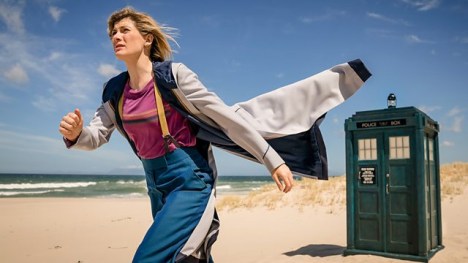
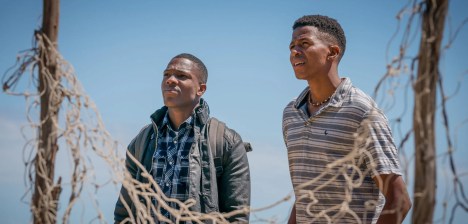
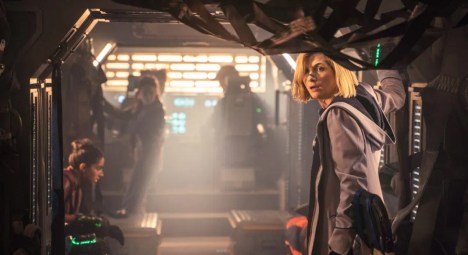
Doctor Who: Praxeus (Review)

Praxeus is business as usual for Chris Chibnall’s era of Doctor Who.

It’s always slightly fun when a showrunner takes a co-writing credit on an episode, because it implies heavy involvement in a particular aspect of the story. It’s always fun to speculate what that aspect might be. When Russell T. Davies took a rare co-writing credit on Waters of Mars, it seemed reasonable to suggest that he was (at least) heavily involved in the “Time Lord Victorious” stuff. When Steven Moffat took a co-writing credit on The Girl Who Died, it seemed likely that he worked on the Twelfth Doctor’s explanation of his choice of face.

Beach’s own.

Normally, it’s fairly easy to see what hand a showrunner took in a given script. Fugitive of the Judoon brought back Vinay Patel, who wrote one of the best-received episodes of the previous season in Demons of the Punjab, but paired him with Chris Chibnall. There were any number of elements in Fugitive of the Judoon that might have merited the heavy hand of the showrunner. The most obvious stuff is the subplot involving Jack Harkness, which is both isolated from the story and heavy on foreshadowing. That said, the Ruth!Doctor stuff was also a big deal.

This makes Chibnall’s credit on Praxeus seem very strange. On the surface, and even with the direct cliffhanger feeding in from Fugitive of the Judoon,there is nothing in the story that would seem to merit or necessitate the showrunner stepping in to work with writer Peter McTighe on the episode.

Net loss.

Continue reading

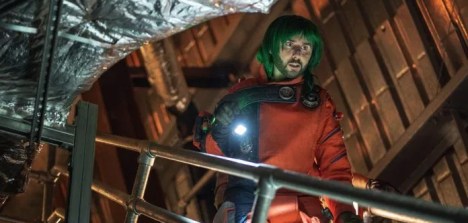
Doctor Who: Orphan 55 (Review)

“He’s moving at thirty-seven klicks an hour.”

“That doesn’t sound like my Benni.”

Like It Takes You Away in the previous season, Orphan 55 provides a something close to a workable model for the Chibnall era as a whole. Unfortunately, Orphan 55 doesn’t quite get there.

One of the strange paradoxes of the Chibnall era is that it often seems like the guest writers have a stronger grasp on its core themes than the showrunner. After all, Demons of the Punjab was perhaps the best single argument for Chibnall’s passive and observational characterisation of the Thirteenth Doctor, a far stronger argument than that articulated in Rosa or Arachnids in the U.K. or any of the episodes with Chibnall’s name on the credits.

“Game over, Doc.”

Orphan 55 draws from an impressive array of influences across the history of Doctor Who, providing a fascinating intersection between “holiday camp gone wrong” episodes like The Macra Terror and Delta and the Bannermen and “future of Earth” episodes like The Ark in Space or The End of the World. Indeed, the positioning of Orphan 55 as the first standalone episode after the premiere is quite canny; it fills what would be the “New Earth” slot on a Russell T. Davies season. However, it offers a much grimmer prognosis. This is appropriate for a much grimmer age.

Like so much of the Chibnall era, Orphan 55 is built around the general impotence of the Doctor. The Doctor is a fictional character, and so cannot save the world. The Moffat era dealt with this question in a more abstract and metaphorical sense in episodes like Extremis, demonstrating the importance of Doctor Who as a story and the Doctor as an idea. The Chibnall era tends to respond to this challenge with dull literalism. The Thirteenth Doctor spends an inordinate amount of her run confronting systemic or societal problems with which she refuses to engage.

A green message.

The Thirteenth Doctor’s passiveness when confronted with monstrosity is one of the more horrifying aspects of the Chibnall era as a whole. In The Ghost Monument, the Doctor refused to hold Ilan to account for the horrors he inflicted on the participants in his race. In Arachnids in the U.K., Jack Robertson just walked away from liability for mass murder in his hotel. In Rosa, the Doctor stage managed the oppression of Rosa Parks, even forcing her companion to be actively complicit in systemic racism.

While the Chibnall era is clearly trying to make a larger point about how the Doctor cannot save the world because she doesn’t exist, this often becomes a bleak and depressing study of how the public imagination can no longer conjure better worlds into being. Demons of the Punjab managed to make the best argument for this approach through careful construction, tying its historical injustices to Yaz’s personal history. Orphan 55 pulls off something similar, primarily by setting the action long after the world has failed to be saved.

Shattering expectations.

Continue reading

126. Kaze no tani no Naushika (Nausicaä of the Valley of the Wind) – Anime April 2019 (#216)

Hosted by Andrew Quinn and Darren Mooney and with special guests Graham Day and Marianne Cassidy, The 250 is a (mostly) weekly trip through some of the best (and worst) movies ever made, as voted for by Internet Movie Database Users. New episodes are released every second Saturday at 6pm GMT, with the occasional bonus episode between them.

This year, we are proud to continue the tradition of Anime April, a fortnight looking at two of the animated Japanese films on the list. This year, we watched a double feature of Hayao Miyazaki’s Kaze no tani no Naushika and Katsuhiro Ôtomo’s Akira.

This week, the first part of the double bill, Kaze no tani no Naushika, celebrating its thirty-fifth anniversary.

Unofficially and retroactively folded into the Studio Ghibli canon, Nausicaä of the Valley of the Wind was only Hayao Miyazaki’s second film. Nevertheless, it demonstrated remarkable confidence. It also signalled a lot of the director’s interests, with its tale of a strong young woman navigating the aftermath of a horrific environmental disaster and trying to prevent a new war from breaking out.

At time of recording, it was ranked the 216th best movie of all time on the Internet Movie Database.

Continue reading

Star Trek: Voyager – Night (Review)

Star Trek: Voyager typically bridged its seasons with epic two-parters, a sprawling single narrative told over two forty-five minute episodes separated by the three-month summer hiatus. In fact, it was somewhat striking when the production team chose to end the fourth season with Hope and Fear, a standalone episode with a very definite conclusion. However, it becomes even more ironic once the fifth season opens with Night. Rather than one story split over two episodes, Night feels like two narratives compressed into a single chunk of television.

Of these two narratives, one is definitely more interesting than the other. The first half of Night essentially focuses on the ship and crew as they venture through an empty (and starless) section of space known as “the Void.” No light can get in. Nothing seems to live in there. There are no anomalies to investigate. “Anything to report?” Tuvok asks Kim. Kim responds, “Not even a stray electron.” It is so dull that even Tom classifies the detection of “a sudden increase in theta radiation” as “excitement.”
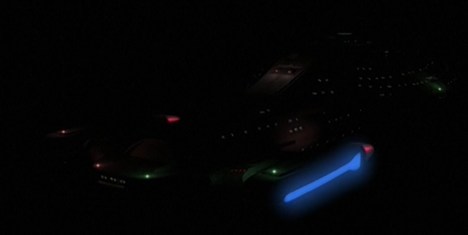
Starless, starless night.

This is an interesting approach to storytelling, particularly for a show so focused on plot. More than any other series in the franchise, Voyager runs on plot beats. Stories tend to progress from one revelation and escalation to the next, affording little room for character development or exploration. As such, the first half of Night seems like a very ambitious piece of work, an introspective character-driven drama where there are no plot beats to distract from character. It is a very brave and compelling set-up.

Of course, Night somewhat fumbles the ball in this first half. The thread is never explored as thoroughly as it might be, the character never allowed to properly express themselves. There is far too much emphasis on the holodeck, and the ship’s ability to simulate comforts and illusions even in this most depressing of surroundings. However, compared to the way that Voyager usually tells stories, the first half of Night is refreshing. Ironically, it is genuinely exciting, because it feels like the writers are pushing outside their comfort zone.
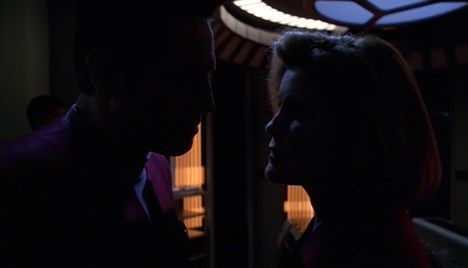
A darker side of Janeway.

Unfortunately, it cannot last. Night can only resist the comfort of plot for so long. Eighteen minutes into the hour, the second plot kicks into gear. It is a much more conventional Voyager episode, particularly for these later seasons. There is a broadly drawn piece of social commentary that ties into the both Voyager‘s New Age sensibilities and its attitude towards the Delta Quadrant as a whole. There are new aliens introduced, that will become recurring foils. It is all very standard, and all very rushed. The second half of Night makes up for those missed plot beats.

The result is an episode that is deeply frustrating, a game of two halves were each horribly undercuts the other.
A black-and-white issue.

Continue reading