• Following Us

  • Categories

  • Check out the Archives


  • Awards & Nominations

Doctor Who: Four to Doomsday (Review)

To celebrate the fiftieth anniversary of the longest-running science-fiction show in the world, I’ll be taking weekly looks at some of my own personal favourite stories and arcs, from the old and new series, with a view to encapsulating the sublime, the clever and the fiendishly odd of the BBC’s Doctor Who.

Four to Doomsday originally aired in 1982.

Come along, children. Not in front of our hosts.

– the Doctor finally manages to strike the right tone with his companions

Four to Doomsday is an interesting story, if only because it’s so rarely discussed. The second story of a particular Doctor seems to set the tone for their era. William Hartnell’s second story, The Daleks, introduced the iconic pepperpots. Patrick Troughton’s second serial, The Highlanders, introduced the companion Jamie, who would remain with him for the rest of his tenure. Jon Pertwee’s second story, The Silurians, saw Barry Letts taking over the role of producer. Tom Baker’s second story, The Ark in Space, is one of the most memorable and definitive instances of horror in the history of the show. Colin Baker had the misfortune to have Attack of the Cybermen as his second story, an adventure that set the tone for his time in the TARDIS. Sylvester McCoy didn’t really develop until his second season, but he’s probably the exception that proves the rule.

Peter Davison’s Four to Doomsday, on the other hand, just sort of… is.

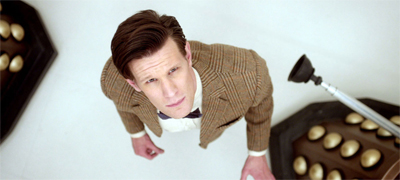
Ground control to Major... dammit, why couldn't I get this image a year earlier in the show's run?

Ground control to Major… dammit, why couldn’t I get this image a year earlier in the show’s run?

Continue reading

Doctor Who: Asylum of the Daleks (Review)

You’re going to fire me at a planet? That’s your plan? I get fired at a planet and expected to fix it?

In fairness, that is slightly your M.O.

Don’t be fair to the Daleks when they’re firing me at a planet.

And more wacky structural hijinks ensue.

The sixth and seventh seasons of the revived Doctor Who are strange beasts, for a number of reasons. The decision to split the seasons stands out, but there is also a sense that they are structured in a counter-intuitive manner. The Impossible Astronaut and Day of the Moon served as a two-part season finalé, despite opening the sixth season. In contrast, Let’s Kill Hitler played like a frothy season premiere. (The Wedding of River Song is perhaps the most difficult to place; while certainly not a light run-around season opener, it was nevertheless a bit light for a finalé.)

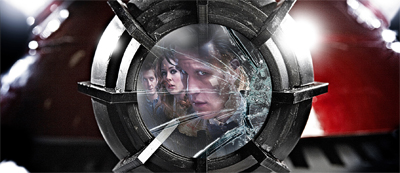
Things are looking up...

Things are looking up…

The seventh season arguably streamlines the structure a bit. The Name of the Doctor plays almost like a season premiere, revealing the origin story for “the Impossible Girl” and teasing ideas like the War Doctor and Trenzalore relentlessly. In contrast, Asylum of the Daleks feels like a season finalé, teasing a new companion as the existing companions struggle to get on with their real lives, featuring fleets of Dalek ships destroying planets and massive amounts of continuity.

Indeed, the biggest problem with Asylum of the Daleks is that it has not enough time to establish all its core elements. Plot points come out of nowhere. Character beats are established in the same scenes that resolve them. Asylum of the Daleks is a big episode in keeping with the “blockbuster” aesthetic of the anniversary season, but it also establishes the limitations of that approach.

Moffat’s crack at writing a Dalek episode…

Continue reading

Possible Villains for the Zack Snyder Superman Reboot…

March is Superman month here at the m0vie blog, what with the release of the animated adaptation of Grant Morrison’s superb All-Star Superman. We’ll be reviewing a Superman-related book/story arc every Wednesday this month, so check on back – and we might have a surprise or two along the way.

This being a month dedicated to Superman and all, I thought I’d put together a “rogues gallery” of Superman foes that Snyder might possibly consider using for the upcoming Superman reboot. After all, Luthor and Zod are the only Superman foes to really get a shot at a big-screen adaptation so far, so there’s a whole range of choices out there. Superman might not have as deep a selection of foes as Batman or Spider-Man, but he’s not exactly short on major threats, either.

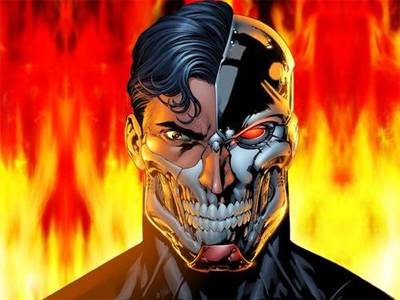
A viable threat to the Man of Steel?

Continue reading

Justice League – Hereafter (Parts I & II)

This post is part of the DCAU fortnight, a series of articles looking at the Warner Brothers animations featuring DC’s iconic selection of characters. With the review of Superman: Doomsday earlier, I thought it might be worth taking a look at some of the other times Superman has “died” in these animated stories.

Despite the rather large cast that the writers and producers used in producing Justice League and Justice League Unlimited, I always felt that the show was better with a more narrow focus. Of course, new characters like Green Lantern and Wonder Woman got their own episodes, but Batman and Superman were rarely the focus of attention – perhaps because they had each had their own television show beforehand, and ample time for exposure. Hereafter is a two-part episode which really feels like two separate stories, both of which are fundamentally about Superman. The first is an exploration of who the hero is, based around removing him from the fictional universe and examining the holes left in his absence. The second half explores what makes Superman a hero, if it isn’t his collection of superpowers.

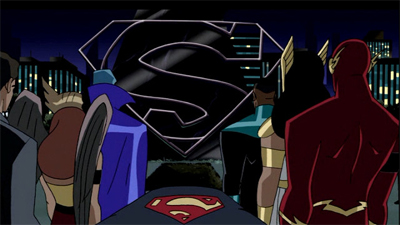
Part of me wonders where Clark Kent is buried...

Continue reading

Non-Review Review: Superman – Doomsday

This post is part of the DCAU fortnight, a series of articles looking at the Warner Brothers animations featuring DC’s iconic selection of characters. This is the very first of the “stand-alone” animated movies produced by the creative team that gave us the television shows. 

Superman: Doomsday is the first entry in the range of animated DC films featuring their iconic superheroes. The line has since ballooned to feature a wide range of other heroes, with movies focusing on Batman, Wonder Woman, Green Lantern and even the Justice League itself, but Superman seemed a logical place to start. Of course, the fact that the movie came from the minds that brought us Batman: The Animated Series and the rest of the animated universe (even if it didn’t share continuity) was also a solid indication. However, there’s very much a sense of a production team attempting to find their footing. Although it’s solidly entertaining on its own terms, the film feels like perhaps the weakest entry in the selection of films. 

Well, at least he can wipe it on his cape and no one will notice...

Continue reading

It’s The End of The World As We Know It – And I Feel Fine

So last week we had the box office dominance of Zombieland, a post-apocalyptic comedy. Over the weekend we had the simultaneous broadcast across US network television of five minutes of Emmerich’s newest disaster flick 2012. We also may have the first post-apocalyptic Oscar-nominee in The Road this year. And that’s just in the last three months of the year. Looking back over the last decade alone there have been a million-and-one end-of-the-world thrillers, chillers, comedies and dramas. That’s a lot of apocalypse for a relatively small planet. So, what gives? is there a greater reason for the zeitgeist’s fascination with the end of the world?

Darth Vader offers an example of what the end of the world might just look like...

Darth Vader offers an example of what the end of the world might just look like...

Continue reading