• Following Us

  • Categories

  • Check out the Archives


  • Awards & Nominations

X-Men: Messiah Complex (Review/Retrospective)

This is the seventh in a series of comic book reviews that will look at the direction of Marvel’s core continuity (and in particular their “Avengers” franchise) over the past five or so years, as they’ve been attempting to position the property at the heart of their fictional universe. With The Avengers planned for a cinematic release in 2012, I thought I’d bring myself up to speed by taking a look at Marvel’s tangled web of continuity.

It has been commonly accepted that the “golden days” of X-Men crossovers are behind us. Of course, “golden days” is a subjective term – for every Age of Apocalypse, there was an Onslaught Saga – but there’s no way to argue that the mutants didn’t dominate Marvel’s output in the nineties. One would have thought that with Bryan Singer’s X-Men helping give birth to the superhero genre, this past decade might have been an even better one for the franchise, but it was not to be. In fact, The Avengers seem to have replaced the X-Men as the engine driving Marvel’s storytelling universe. Some might suggest that it is so blatant that it looks intentional (prompting a movie-related “conspiracy theory”), although Marvel have casually denied it – with vice president Tom Brevoort stating “these things tend to go in waves”. However, Messiah Complex is the first of a series of crossovers with the X-Men titles following House of Mwhich would chart the franchise’s gradual return to the status quo.
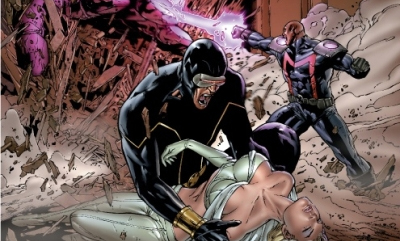
Cyclops has warmed to Ms. Frost…

Continue reading

World War Hulk (Review/Retrospective)

This is the sixth in a series of comic book reviews that will look at the direction of Marvel’s continuity (and particularly their “Avengers” franchise) over the past five or so years, as they’ve been attempting to position the property at the heart of their fictional universe. With The Avengers planned for a cinematic release in 2012, I thought I’d bring myself up to speed by taking a look at Marvel’s tangled web of continuity. Get an overview of what I’m trying to take a look at here.

Forget sides. They’re all screwed when the Hulk gets back.

– a popular internet meme which puts Civil War in perspective

I have to admit, World War Hulk reads like something of a guilty pleasure. The fantastic artwork from John Romita Jr. (whose fantastical character designs work much better here than in Kick-Ass or even Enemy of the State) certainly helps, as does the relative brevity of the miniseries. It’s a relatively self-contained five-issue storyline, as opposed to the large House of M or Civil War which directly preceded it and Secret Invasion which would follow – it also helps that the tie-in issues seem a lot less essential (and certainly less omni-present) than they did for any of those series. World War Hulk is pretty far from perfect, but it’s an enjoyable little arc from a writer who is clearly familiar with the Incredible Hulk.

Hulk makes quite an impact...

Continue reading

Civil War (Review/Retrospective)

This is the fourth in a series of comic book reviews that will look at the direction of Marvel’s “Avengers” franchise over the past five or so years, as they’ve been attempting to position the property at the heart of their fictional universe. With The Avengers planned for a cinematic release in 2012, I thought I’d bring myself up to speed by taking a look at Marvel’s tangled web of modern continuity. Get an overview of what I’m trying to take a look at here.

Civil War was Marvel’s big event of 2006-7, and – as this lovely deluxe edition loves to remind you – it was “the industry’s best selling series in over a the decade”. The premise of the series is straight-forward enough – it’s a conflict between the heroes of the Marvel Universe (it’s all there in the title) – and perhaps that is the reason that the series has arguably had more crossover mainstream appeal than the vast majority of comic book crossovers. Marvel have produced a lovely deluxe hardcover which contains just about everything you could possibly want from the event, it’s just a shame I’m not overly impressed by the event itself.

I'm sure we can iron this out...

Continue reading

House of M (Review/Retrospective)

This is the third in a series of comic book reviews that will look at the direction of Marvel’s “Avengers” franchise over the past five or so years, as they’ve been attempting to position the property at the heart of their fictional universe. With The Avengers planned for a cinematic release in 2012, I thought I’d bring myself up to speed by taking a look at Marvel’s tangled web of continuity. Get an overview of what I’m trying to take a look at here.

The X-Men represent the oddball of mainstream superhero comic books. In a genre and medium dedicated offering a static setup – things never really change or resolve – the X-Men are built upon the very idea of evolution. The whole basis of the franchise is the pursuit of equality by the genetically distinct mutant population, the idea that they and mankind can grow together. It has even been frequently suggested that these super-powered individuals represent out future or our replacements. However, the only way to actually tell a story like that is to follow it through to its logical conclusion – to let the ball roll and to let the world change. It feels a little counterproductive for Charles Xavier and his students to still be fighting for the same rights as everyone else nearly fifty years on – it might even seem a little stale. Grant Morrison’s superb New X-Men run offered a solution of sorts – it gave us a world where humanity would be extinct in a couple of generations and showed the growth and relationship between human and mutant subculture. Gone was the minority struggling against an oppressive majority – a more complex example of race relations had come into play with “mutant music” and “mutant slang” making their impression on the youth, amid a silent and almost invisible middle-class backlash. This was an ingenious approach which demonstrated the relevance of the franchise. Unfortunately, Marvel were not quite pleased with this – some people even, ridiculously, accused Morrison of telling all the remaining X-Men stories – and decided to set things right. They did that through House of M.

Dive in...

Continue reading

Blueprint for Success: Is The Dark Tower The Future of Multi-Media Experience?

Perhaps it’s down to the fact that movies have always been inherently distrustful of other forms of media (particularly newer modes like television or the internet), as reflected in the constant battle with them (with movies seeking an edge – like 3D – that other media can’t quickly ape) – but I’m surprised that an idea like this hasn’t been tried before. After quite a long period of speculation, it has been confirmed that Stephen King’s The Dark Tower is coming to the big screen. But it’s also coming to the little screen, at the same time. In fact, the not-at-all unambitious plan for the franchise can be laid out as follows:  

Step 1: They’ll kick it off with a movie, presumably the movie will tell the story of the first book, The Gunslinger which is a shorter book and extremely cinematic. They could also maybe fit in The Drawing of the Three in which the Gunslinger Roland meets his companions.  

Step 2: That movie will be immediately followed by a TV series which will pick up where the movie leaves off. A TV series is the ideal format to tackle some of the longer, more episodic stories.  

Step 3: The TV series will then lead into a second feature film.  

Step 4: After that second feature film, a TV series will then cover the events of the book Wizard and Glass in which the story of Roland’s youth is retold.  

Step 5: That will then launch into a third feature film… perhaps to wrap the story up or maybe simply to take the next step. Whether they end it there or plan more movies and more television presumably depends on audience response.  

That’s certainly one heck of a roadmap for a franchise, right there.  

Towering ambition...

Continue reading

Brian Michael Bendis’ Avengers – New Avengers Vol. 1-2 (Hardcover) (Review/Retrospective)

This is the first in a series of comic book reviews that will look at the direction of Marvel’s “Avengers” franchise over the past five or so years, as they’ve been attempting to position the property at the heart of their fictional universe. With The Avengers planned for a cinematic release in 2012, I thought I’d bring myself up to speed by taking a look at Marvel’s tangled web of continuity. Get an overview of what I’m trying to take a look at here.

Alright. I figure I sound a bit hypocritical complaining about the impact of big events on Marvel’s storytelling continuity without reading said big events. Well, actually, I don’t think I’m a hypocrite – I think it’s perfectly reasonably that a reader should be able to pick up Ed Brubaker’s Captain America without having to worry about Mark Millar’s massive Civil War crossover which they either don’t know enough to care about or know enough not to care about. However, I feel like maybe – just maybe – I should try to ride this “cross-continuity” thing out just once and see if the story somehow justifies the damage it causes to the cohesion of individual runs.  Yes, I’m going to jump head-first into the event-populated minefield of continuity which is recent Marvel history, and I will be using New Avengers as a checklist to that. I’m going down the rabbit hole, following the arc from Civil War through to Siege.

Sentry is responsible for the Carnage in this run...

Continue reading

Geoff Johns’ Run on Green Lantern – Blackest Night: Black Lantern Corps (Vol. I & II) & Rise of the Black Lanterns

All right, gang. Let’s go shoot some zombies.

– Captain Cold, Blackest Night: Flash

It wouldn’t be a massive world-ending crisis of a DC Universe cross-over if there weren’t tie-in issues by the bucketful. Sinestro Corps War, Geoff Johns’ earlier Green Lantern mega-event, was relatively low-key in its ambitions, only really spilling across into four specials that dealt with the wider DC Universe. This time there’s close to thirty, which is, as you’d imagine, quite a lot. Given the relatively simplistic nature of the event (it’s basically “superhero zombies”), you’d be forgiven for expecting that the crossovers and tie-ins would become dull or monotonous, but they mostly avoid that. It’s partially due to the variety of perspectives offered, but also due to the extremely talented pool of writers and artists on hand.

As cold... as ice...

Continue reading

Geoff Johns’ Run on Green Lantern – Blackest Night, Blackest Night: Green Lantern, Blackest Night: Green Lantern Corps & Blackest Night: Tales of the Corps (Review/Retrospective)

Wow. This is pretty much the climax of Geoff Johns’ five year run on Green Lantern, dating all the way back to Rebirth – where he reintroduced Hal Jordan, the original Silver Age version of the character. Since the very start of his run, he’s been dropping hints about the upcoming “war of light” and the prophecy first articulated in an Alan Moore short story decades ago – the prophecy of “blackest night”. Throughout his tenure on the title (and indeed his role shaping the DC Universe as a whole, as one of its guiding writers in the last decade), he has hinted again and again about big events looming on the horizon. Blackest Night is that event. And, in a way, it’s just as wild and crazy and huge as it should be.

Green Lantern reaches new heights...

Note: I am aware that the excellent Peter J. Tomasi wrote the Green Lantern Corps tie-in, but I thought it best to include it in the write-up here. I’ll actually be including my review of the tie-ins under the “Geoff Johns’ Run on Green Lantern” banner, even though he didn’t write all of them. If you’re looking for an opinion on Tomasi’s writing, it’s excellent and it’s highly recommended. Indeed, all four of these wonderful hardcovers are. Oops, did I just spoil my review?

Continue reading

The Tommy Westphall Hypothesis

I’m a sucker for meta-fiction – the idea of storytelling outside the story. One of the more fascinating notions suggested by Marvel’s recent spate of movies is the notion that all the individual stories in Iron Man, Thor and Captain America will be tied together to be revealed to be part of a larger canvas (in this case, The Avengers in 2012). I love it when television and films are shown to occupy the same fictional reality (for example, the Star Trek franchise, spread across five television shows (possibly six) and eleven feature films). So it goes without saying that I adore The Tommy Westphall Hypothesis.

And I thought I had an active imagination! (Click to enlarge)

For those unfamiliar with the hypothesis, it basically states that most television takes place within the head of an eleven-year-old autistic boy.

Continue reading

Should Marvel Look at Merging Some of Its Smaller Projects?

There’s been a lot of buzz generated about the new “shared universe” that Marvel is generating on-screen in the run up to The Avengers, being released in 2012. It has generated fantastic buzz and discussion given there are only really two scenes that have been screened suggesting how the the format might work: the presence of Samuel L. Jackson at the end of Iron Man, welcoming Tony Stark into a wider “universe” and the one-scene appearance of Robert Downey Jnr. at the end of The Incredible Hulk. Undoubtedly next year’s Iron Man 2 will feature even more treats (as will Thor and Captain America: The First Avenger), but it’s interesting to see the fuss that two tiny scenes have generated. I really do think that Marvel are on to box office gold here, and I also think it’s an interesting (and honest) attempt to transfer the medium of comics to film. However, these are all playing into one giant box office buster. Might it be worth taking the same concept and applying it to some of Marvel’s smaller screen franchises?

dp

Fighting over top billing...

Continue reading