• Following Us

  • Categories

  • Check out the Archives


  • Awards & Nominations

Mark Millar’s Run on Ultimate Fantastic Four – Vol. 3 (Hardcover) (Review/Retrospective)

Celebrating the 50th anniversary of the Fantastic Four, I’m taking a look at some of the stories featuring the characters over the past half-century.

Mark Millar isn’t quite the tough guy he makes himself out to be. Asked a few years ago about whether the birth of his child might tame some of his more sensationalist tendencies, Millar replied that – if anything – he would be even more motivated to push the envelope in order to demonstrate he hadn’t mellowed. And, in fairness, the years since have seen ideas like Kick-Ass or Wanted or Nemesis, all excessively and ridiculously cynical, graphic and violent. However, I maintain that Millar is a stronger writer when he channels his inner softer romantic – for example, demonstrating the respect he showed Superman in Red Son. Taking over Ultimate Fantastic Four for a year (perhaps on a trial run before writing for regular Fantastic Four), you get a sense that Millar has a genuine affection for these characters and their world – too much to try to make them “darker and edgier”, for example. While his run on Ultimate Fantastic Four isn’t the best thing he’s written, it is sharp and entertaining – and delivered with enough energy that it can’t help but warm the reader’s heart.

Never a drag...

Continue reading

Warren Ellis’ Run on Ultimate Fantastic Four – Vol. 1-2 (Hardcover) (Review/Retrospective)

Celebrating the 50th anniversary of the Fantastic Four, I’m taking a look at some of the stories featuring the characters over the past half-century.

I have to admit that I’m quite surprised to see Warren Ellis writing for a year on Ultimate Fantastic Four. You could make the case for Ellis – an avowed technophile – as perhaps the perfect author for a high-concept series like the Fantastic Four. It was Mark Waid who dubbed the family “Imaginauts” – explorers of the imagination, rather than superheroes or guys in costumes. In a way, given how skilfully Ellis handled Tony Stark’s technological transformation in Extremis, you might not have been unreasonable in expecting he’d prove a deft hand with Marvel’s first family. However, reading the twelve issues he wrote for the title, it’s hard to get a sense that Ellis was ever really giving it his all – although he does play around a bit, it never feels like he’s genuinely pushing things to the limit and playing with all the associated toys. In fact, quite a lot of his run feels like it’s playing it safe.

See, the Thing is...

Note: Ellis’ run on the title picks up after the initial six issues written by Brian Michael Bendis and Mark Millar, and so is split over the second half of the first hardcover and the first half of the second. The second hardcover is rounded off by a two-part Think Tank story from Mike Carey (who would take over as regular writer after Mark Millar) and an annual written by Millar. So this review/retrospective just covers the issues written by Ellis.

Continue reading

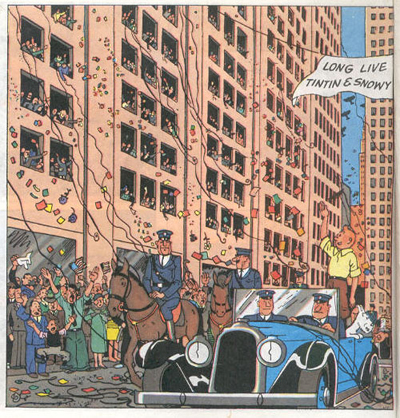
Tintin: Tintin in America (Review)

In the lead-up to the release of The Adventures of Tintin: The Secret of the Unicorn, I’m going to be taking a look at Hergé’s celebrated comic book character, from his humble beginnings through to the incomplete post-modern finale. I hope you enjoy the ride.

Tintin in America was the earliest Adventures of Tintin book I read as a child, and I owned the entire collection from this point on (for obvious reasons, Tintin in the Land of the Soviets and Tintin in the Congo were not recommended childhood reading). That said, I’ve always regarded Tintin in America as one of the weaker entries in the series, perhaps because my childhood imagination yearned for something relatively more exotic than a trip to North America, or perhaps because the saturation of American pop culture made all the elements Hergé was spoofing seem like old hat. I’m not entirely sure, but I have to admit that the story hasn’t improved too much on re-reading.

America, %&#! Yeah!

Continue reading

Tintin: Tintin in the Land of the Soviets (Review)

In the lead-up to the release of The Adventures of Tintin: The Secret of the Unicorn, I’m going to be taking a look at Hergé’s celebrated comic book character, from his humble beginnings through to the incomplete post-modern finale. I hope you enjoy the ride.

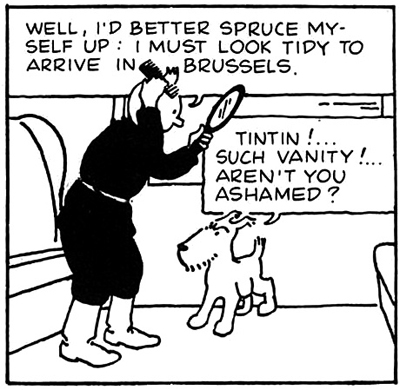
The two earliest Tintin adventures, Tintin in the Land of the Soviets and Tintin in the Congo, are looked back upon as the black sheep of the Tintin novels produced by Hergé. While Tintin in the Land of the Soviets is shameless anti-Communist propaganda (and does contain a hint of the foul racism we’d see a lot more of in Tintin in the Congo), one can detect a lot of the charm that Hergé brought to his iconic creations, scattered throughout the work, from the surreal sense of humour to the writing style to the love of ridiculous suspense, seemingly for the sake of suspense. The best was definitely yet to come, but it all started here.

The collection isn't Tintin at his finest...

Continue reading

Absolute Planetary, Vol. 2 (Review)

With Wildstorm being officially folded into the relaunched DCU (the “DCnU”), I thought I might take a look at some of the more successful and popular Wildstorm titles that the company produced. In particular, Planetary, the which will apparently inspire Paul Cornell’s Stormwatch – easily one of my more anticipated titles of the relaunch.

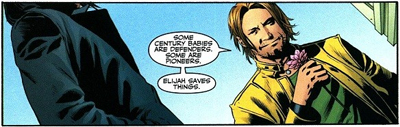
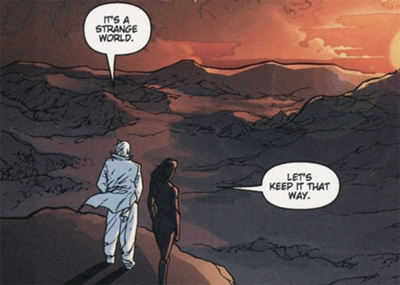
“We keep the world strange because that’s the way it’s suppose to be.”

– Elijah Snow outlines Planetary‘s mission

I really do love Warren Ellis’ Planetary, a love letter to pulp fiction in all its forms, about a team of crack pop culture archeologists, tracking down and preserving many of the weird and wonderful fictional specimens that we see all too rarely these days, from cowboy vigilantes to kung-fu epics. There’s a genuine love poured into the series by Ellis and his artistic collaborator, John Cassaday, as the pair celebrate some of the truly wonderful fiction of the twentieth century, as we brace ourselves for the twenty-first.

Little drummer boy...

Continue reading

The Absolute Authority, Vol. 2 (Review)

With Wildstorm being officially folded into the relaunched DCU (the “DCnU”), I thought I might take a look at some of the more successful and popular Wildstorm titles that the company produced. In particular, The Authority, the superhero saga that spun out of Stormwatch – a series that is getting its own post-relaunch book written by Paul Cornell, easily one of my more anticipated titles.

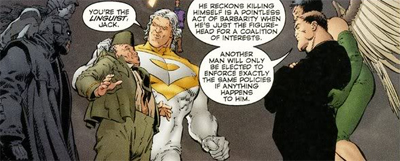
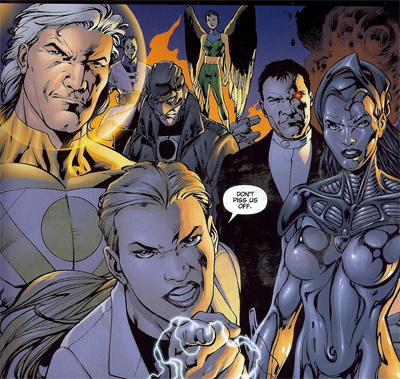
In many ways, it was The Authority that established Mark Millar and Frank Quitely as talents to watch in their own rights, rather than through their associations with Grant Morrison. As a concept, the series was launched by Warren Ellis and Bryan Hitch, but the duo picked their own replacements. I have to say, I think they chose rather wisely, even if the series has lost a rather considerable amount of its bite nearly a decade after its initial publication. That said, it’s still a highly entertaining superhero book, and one which had more than its fair share of influence on the mainstream titles over the last ten or so years.

There's a new Authority in town...

Continue reading

Absolute Planetary, Vol. 1 (Review)

With Wildstorm being officially folded into the relaunched DCU (the “DCnU”), I thought I might take a look at some of the more successful and popular Wildstorm titles that the company produced. In particular, Planetary, the which will apparently inspire Paul Cornell’s Stormwatch – easily one of my more anticipated titles of the relaunch.

Planetary, as imagined by Warren Ellis and John Cassidy charts “the secret history” of the fictional Wildstorm Universe, as we follow a team of pulp archeologists attempting to uncover “what’s really been going on this century.”As such, it provides Ellis and Cassidy a chance to dig around and play in the pop culture of the twentieth century, celebrating concepts and ideas as diverse as Japanese monster movies, Hong Kong revenge actioners and American pulp heroes, all with more than a hint of nostalgia and affection.

Strange ways...

Continue reading

The Absolute Authority, Vol. 1 (Review)

With Wildstorm being officially folded into the relaunched DCU (the “DCnU”), I thought I might take a look at some of the more successful and popular Wildstorm titles that the company produced. In particular, The Authority, the superhero saga that spun out of Stormwatch – a series that is getting its own post-relaunch book written by Paul Cornell, easily one of my more anticipated titles.

It’s really hard to grasp how much of a revolution Warren Ellis’ run on The Authority was, in hindsight. Sure, the writer had been playing with the idea of a more “real world” superhero team (at least in political and philosophical terms) since his original run on Stormwatch, but it was with The Authority that Ellis and Hitch managed to effectively lay out the design of superhero comics in the twenty-first century. It’s no coincidence that both halves of the creative team behind The Ultimates cut their teeth on the title (albeit at different times).

Was I the only one thinking of Gene Hunt everytime I read the word "superbastards"? "You are surrounded by armed superbastards!"

Continue reading

Justice League International: Volume 4 (Hardcover) (Review/Retrospective)

In light of the massive DC reboot taking place next month, launching with a Geoff Johns and Jim Lee run on a new Justice League title, I thought I’d take a look back at another attempt to relaunch the Justice League, emerging from the then-recent Crisis on Infinite Earths.

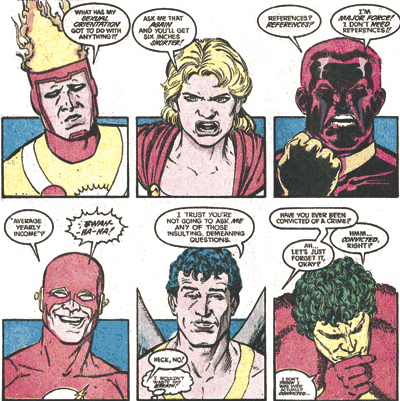
Hm. Typical. Just as DC stops collecting Justice League International in these nice little hardcovers, I find that the series is getting back into the sort of swing and rhythm that I really loved about the superb first volume, but which became hard to maintain in equilibrium through the second and third collections. The last two books have veered just a little bit too much into sit-com territory for me. Don’t get me wrong, I like the humour that Giffen and deMatteis bring to the book, but I think it works better as a counterbalance to some nice superhero spectacle or drama, rather than being allowed to run free. The wonderfully wicked, occasionally subversive and often amusing sense of humour is in full effect in this collection, but it also features some nice character-centred storytelling, the type of refreshingly not-too-serious, but never completely out of control, approach that made the first few issues so damn appealing.

The new line-up...?

Continue reading

Justice League International: Volume 3 (Hardcover) (Review/Retrospective)

In light of the massive DC reboot taking place next month, launching with a Geoff Johns and Jim Lee run on a new Justice League title, I thought I’d take a look back at another attempt to relaunch the Justice League, emerging from the then-recent Crisis on Infinite Earths.

Instructions, m’lord?

Keep him sedated and set course for —

For where, m’lord?

Quiet L-Ron… Don’t you know a dramatic pause when you hear one?

Set course for — Apokolips!

L-Ron and Lord Manga

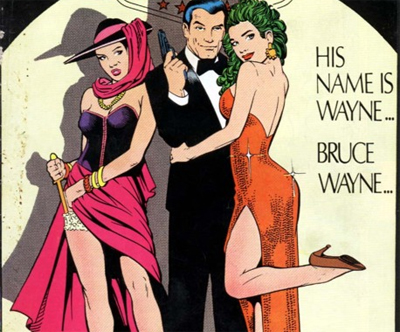
The third volume of Justice League International is certainly more consistant than the one directly previous. Giffen and deMatteis are – with the exception of a final-issue tie-in to Invasion – free to tell their own story featuring their somewhat eclectic cast. The series has swung heavily in the direction of humour, with the issues increasingly becoming a collection of gags with the occasional nice set-piece rather than conventional super-hero stories with a greater-than-usual dosage of humour. Admittedly, some of the humour (and set-ups) feel a little tired and dated, but it’s still not a bad little series.

Licence to Thrill...

Continue reading