• Following Us

  • Categories

  • Check out the Archives


  • Awards & Nominations

Doctor Who: The Armageddon Factor (Review)

To celebrate the fiftieth anniversary of the longest-running science-fiction show in the world, I’ll be taking weekly looks at some of my own personal favourite stories and arcs, from the old and new series, with a view to encapsulating the sublime, the clever and the fiendishly odd of the BBC’s Doctor Who.

The Armageddon Factor originally aired in 1979. It was the sixth and final part of The Key to Time saga.

The Key to Time was perhaps the first conscious attempt to tell a season-long story in Doctor Who. Sure, we’ve had elements of an arc before. The first season, for example, gave the Doctor himself a character arc where he evolved from cowardly curmudgeon into an unlikely heroic figure. Jon Pertwee’s second season was given the Master as a linking element. Tom Baker’s Doctor embarked in a pretty much unbroken series of adventures from Robot through to Terror of the Zygons, with the ending of one serial seemingly leading directly into the next. None of these were necessarily that ambitious and you could argue they evolved more by chance than by design.

So, The Key to Time represented a bit of a learning curve, an attempt to tie a season’s stories together using an over-arching concept. As I’ve discussed quite a bit in my reviews of the season, the result was a little clunky, with those concepts seemingly clumsily shoe-horned into a separate bunch of adventures. That leaves the finalé, The Armageddon Factor to do the heavy-lifting with regards to The Key to Time saga. Unfortunately, the pay-off feels a bit jumbled, over-wrought, disorganised and non-sensical, as it juggles a wealth of elements that never add up to more than the sum of their parts.

While a great many Doctor Who six-parters suffer from being too long, too padded, too stretched for their story and concepts, The Armageddon Game feels curiously over-stuffed, lacking a tight focus on the interesting elements and too many distractions clogging up the story.
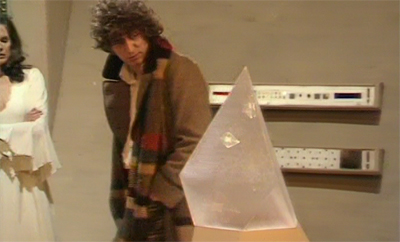
The problems are crystal clear...

The problems are crystal clear…

Continue reading

Doctor Who: Cold War (Review)

Hair. Shoulderpads. Nukes. It’s the eighties. Everything’s bigger!

– the Doctor

The theory that this fiftieth anniversary half-season is intended as an homage to Doctor Who‘s rich and varied past holds up with Cold War. If The Bells of St. John was a Pertwee-era invasion tale, and The Rings of Akhaten was a shout-out to classic Hartnell world-building, then Cold War wears its influences even more brazenly. It’s the archetypal “base under siege” story popularised in the Troughton era, to the point where it even brings back one of the era’s most iconic monsters.

Indeed, the “Troughton base under siege by classic monsters” story is the only classic Doctor Who formulation that this half-season visits twice. While Cold War is easily weaker (and less ambitious) than Nightmare in Silver, it still fills that niche remarkably well. After all, if any Doctor Who writer can channel nostalgia, it’s Mark Gatiss.

Going green...

Going green…

Continue reading

The Spirit Archives, Vol. 20 (Review/Retrospective)

By 1950, it seemed like time was almost up for The Spirit. Indeed, the run of stories collected here represents perhaps the last six months of the truly superb hot streak the strip had been on since Eisner returned home from the Second World War. There’ll be time, discussing the next few volumes, to explore and to contemplate the decay and decline of The Spirit as a Sunday newspaper strip, but The Spirit Archives, Vol. 20 contains a pretty solid run of weekend adventures for the masked crimefighter. There’s still a lot of the fun and energy and verve that defined Eisner’s best work on the character, even if you can almost sense the ennui creeping in at the very edge of the page.

The man behind the mask...

The man behind the mask…

Continue reading

The Spirit Archives, Vol. 13 (Review/Retrospective)

With Eisner now back on the strip for over half-a-year, The Spirit is forging ahead into the middle part of its run. Many commentators and pundits would argue that the few years following Eisner’s return from military service were among the best in the strip’s history, and it’s hard to disagree. While Eisner took the time in his first six months to tidy up loose ends – killing the Squid, sending Satin home with a daughter – here we see the creator building up the world he has created. This collection includes the strips introducing (and a number of subsequent appearances from) both P’Gell and the Octopus, arguably two of the most important characters introduced into the strip following the Second World War. There’s also a sign that Eisner is branching out a bit, and pushing the strip out from the shadow of the Second World War. After all, a new era of prosperity and a Cold War were both just around the corner, very fertile ground for the creator to explore.

A banner year?

Continue reading

Star Trek: The Next Generation – Lonely Among Us (Review)

To celebrate the twenty-fifth anniversary of Star Trek: The Next Generation, and also next year’s release of Star Trek: Into Darkness, I’m taking a look at the recent blu ray release of the first season, episode-by-episode. Check back daily for the latest review.

Lonely Among Us actually embodies quite a few of the problems with these early episodes of Star Trek: The Next Generation. While it’s hardly the worst episode of a season, it is certainly not among the stronger episodes. It’s a story that doesn’t really have a centrally defined conflict, and plays into the worst of the smug “humans are special” subtext that pervades episodes like The Last Outpost. At one point, possessed!Picard observes, “The search for knowledge is always our primary mission.” Based on episodes like this and The Last Outpost, it seems more likely the ship’s primary mission is lording it over alien cultures they deem inferior.

However, more than that, Lonely Among Us simply lacks a compelling narrative drive to make it entirely worthwhile. The ideas here aren’t half-bad, but the execution is downright dull.

Has Picard’s judgement been clouded?

Continue reading

The Six Faces of 007: Pierce Brosnan

To celebrate James Bond’s 50th birthday on screen (and the release of Skyfall), we’re going to take a look at the character and his films. We’ve already reviewed all the classic movies, so we’ll be looking at his iconic baddies, and even at the character himself.

I have a great deal of affection for Pierce Brosnan’s term as James Bond. I think the actor easily portrayed the most rounded James Bond since Connery, capable of being an angel or a killer as the script demanded it. His run got off to a solid start with (for my money) the most consistent two-fer in the franchise’s history. (Taken together, I’d argue that GoldenEye and Tomorrow Never Dies are the perfect revision and update of the Bond mythos.) While the last two films of his tenure were awkward and uneven efforts, Brosnan never gave the role less than his all. He has gone on record as being disappointed that his term as James Bond didn’t last longer than four films and, despite the mess of Die Another Day, I can’t help but agree with him.

I was quite shaken by his departure…

Continue reading

A View to a Bond Baddie: Max Zorin

To celebrate James Bond’s 50th birthday on screen, we’re going to take a look at the character and his films. We’ve already reviewed all the classic movies, so we’ll be looking at his iconic baddies, and even at the character himself.

An interesting thing about Roger Moore’s Bond films is the fact that the best baddies tended to pop up in the worst films. Okay, I have a soft spot for Julian Glover in For Your Eyes Only, arguably the best of Moore’s outings as James Bond, but I’m thinking of Christopher Lee in The Man With the Golden Gun and Christopher Walken in A View to a Kill. In particular, Walken’s Max Zorin stands out – in my opinion – as one of the best villains of the entire franchise. He’s a character who really stands at the half-way point between the classical Bond villains and the characters we’ve seen since, positioned half-way between Auric Goldfinger and Franz Sanchez. It also helps that Walken is having a whale of a time, and that fun is contagious.

Hang on in there…

Continue reading

Non-Review Review: The Manchurian Candidate (1962)

The Manchurian Candidate is a rather wonderful piece of Cold War paranoia, with a handy bit of social commentary and a rather surrealist perspective thrown in on top. John Frankenheimer’s vision remains unnerving because of its occasionally absurd and strange imagery and subtext, much of which remains unsettling long after the end of the Cold War. While The Manchurian Candidate remains a fascinating story, and one which has seeped into pop cultural consciousness, It’s Frankenheimer’s direction that elevates the film, managing to convince the audience that there is some meaning and purpose to all the bizarre imagery and interactions.

Play your cards right…

Continue reading

Non-Review Review: The Peacemaker

It’s interesting to look back at George Clooney’s early road to movie stardom. Indeed, the actor’s first leading roles seem like movies that really should have been star-making turns, but just weren’t. There’s obviously his portrayal of Bruce Wayne in Batman & Robin, a performance not quite as bad as the film around it, but there’s also his roles in films like The Peacemaker. The Peacemaker also was the first film released under Spielberg’s Dreamworks company, and it’s hardly an auspicious début. It’s not that The Peacemaker is a bad film. It’s a very well made, and the production values are excellent.

However, the problem is the premise itself, the plotting, the pacing and the script. The Peacemaker feels like it really wants to be a Tom Clancy thriller, and it really wants us to accept George Clooney as a more dynamic Harrison Ford. Unfortunately, it feels like all the plot points, characters and motivations all came second-hand. There isn’t one thing here that hasn’t been done before, and done better, and those parts aren’t even assembled in an especially original way.

The name’s Clooney. George Clooney.

Continue reading

The Adventures of Tintin: The Calculus Affair (Review)

To celebrate the release of The Adventures of Tintin: The Secret of the Unicorn in the United States later this month, I’ll be taking a look at some of nineties animated television show. Check back daily!

Note: This is our review of the animated episode, check out our review of the book here.

We’re just finished the more fantastical series of Hergé’s adventures, where he took his lead (and supporting cast) to the bottom of the ocean, to the heart of a lost Inca society and even to the moon itself. The animated series proved quite adept at handling these stories. The fact that Hergé’s two-part adventures translated to four-part feature-length episodes was just icing on the cake. However, I find myself wondering how the team will handle The Calculus Affair. It’s a relatively mature adventure, and it represents a point where the series became considerably more self-aware and reflexive. Given some of the changes made to earlier stories, I can’t help but wonder how the series will deal with these very different themes and ideas.

Tintin must have ticked off some important people in his time...

Continue reading