• Following Us

  • Categories

  • Check out the Archives


  • Awards & Nominations

Star Trek: Deep Space Nine – In the Cards (Review)

In the Cards is the perfect penultimate episode to a sensational season of television.

One of the more common observations about Star Trek: Deep Space Nine is that it is the most dour and serious of the Star Trek series. It is the grim and cynical series of the bunch, with many commentators insisting that the series rejects the franchise’s humanist utopia in favour of brutality and nihilism. This criticism is entirely understandable. The series is literally and thematically darker than Star Trek: The Next Generation or Star Trek: Voyager. Even at this point, it is about to embark upon a two-year-long war arc, the longest in the franchise.
Jake and the Ferengi Man.

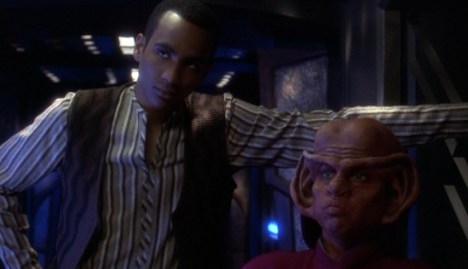
Jake and the Ferengi Man.

However, this is also a very reductive reading of Deep Space Nine. The series is more willing to criticise and interrogate the foundations of the Star Trek universe than any of its siblings, but it remains generally positive about the human condition. Governments and power structures should be treated with suspicion, but individuals are generally decent. Positioned right before the beginning of an epic franchise-shattering war, In the Cards is the perfect example of this philosophy. In the Cards elegantly captures the warmth and optimism of Deep Space Nine.

Deep Space Nine is fundamentally the story of a diverse and multicultural community formed of countless disparate people drawn together by fate or chance. In the Cards is a story about how happiness functions in that community, how the bonds between people can make all the difference even as the universe falls into chaos around them. It is also very funny.

Pod person.

Pod person.

Continue reading

Harsh Realm – Reunion (Review)

This November, we’re taking a trip back in time to review the seventh season of The X-Files and the first (and only) season of Harsh Realm.

So that in the first place, I put for a general inclination of all mankind a perpetual and restless desire of Power after power, that ceaseth only in Death. And the cause of this is not always that a man hopes for a more intensive delight than he has already attained to, or that he cannot be content with a moderate power: but because he cannot assure the power and means to live well, which he hath present, without the acquisition of more.

– Thomas Hobbes, Leviathan, The First Part, Chapter XI

Reunion continues the sense that Chris Carter envisioned Harsh Realm as something of an allegorical episodic adventure series through a post-apocalyptic reflection of contemporary America.

Carter quite clearly wanted to use Harsh Realm as a vehicle to explore and comment upon certain aspects of the American experience. Inga Fossa touched on the links between projected masculinity and violence; Cincinnati will find Santiago’s “manifest destiny” brushing up against the country’s Native American population. Even scripts like Three Percenters and Manus Domini feel tied into Carter’s large oeuvre, touching on the writer’s recurring fascination with homogeneity and spirituality in the modern world.

Things come to a head...

Things come to a head…

Reunion is very consciously a critique of excessive and abusive capitalism, presenting a vision of America built upon the economics of slave labour reinforced by the rhetoric of freedom and competition. In some respects, Reunion feels like Harsh Realm is channelling the spirit of classic science-fiction television like Star Trek or The Twilight Zone. Its central allegory is hardly subtle, but there is a goofy charm in carrying these ideas well past their logical extremes. The vision of labour presented in Reunion is grotesque and exaggerated, but it is not completely fantastical.

Reunion also reaffirms the link that exists between the digital world and the real world, suggesting that perhaps the world that we inhabit is not as far removed from the horrors of the virtual reality as might hope.

Family matters...

Family matters…

Continue reading

The X-Files – Monday (Review)

This July, we’re taking a trip back in time to review the sixth season of The X-Files and the third (and final) season of Millennium.

It always ends the same way. As is appropriate for a story about a time loop, Monday begins with an ending. The teaser catches the last few minutes of one of the episode’s repeating time loops. It is a striking image. Everybody dies – including Mulder and Scully. How could the episode possibly continue past that point? It is simple. Time resets. The universe snaps back into shape around Mulder and Scully, much like it did at the climax of Dreamland II. Everybody gets another chance to set things right. The show bounces back to its status quo, as it did with One Son.

Time for a do-over. Revise it until it’s right.

A ticking clock...

A ticking clock…

Continue reading

The X-Files – Drive (Review)

This July, we’re taking a trip back in time to review the sixth season of The X-Files and the third (and final) season of Millennium.

In many ways, Drive feels like an episode that tackles the move to California head-on.

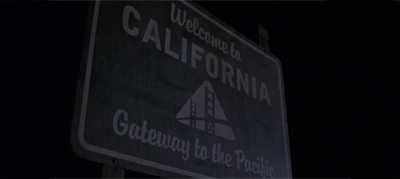
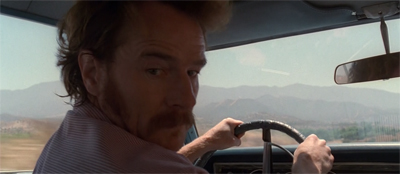
After all, the plot of Drive essentially finds Mulder trapped in a car heading westwards through Nevada and into California. The episode even lingers on a “welcome to California” sign, tacitly acknowledging the massive change that had taken place behind the scenes between the fifth and sixth seasons of The X-Files. It is a very clever way of addressing a major change to the production of the show, one that is candid and open about the fact that things are inherently different now.

"Running out of west..."

“Running out of west…”

More than that, Drive figures out how to build an episode of The X-Files around the change in production location. The sixth season often finds the production team struggling to find the right tone and mood to match the new location; after all, the show cannot simply pretend that it is still filming in Vancouver. California is sunnier, hotter and drier than Vancouver ever was – the sixth season of The X-Files spends a little time trying to adapt to those new filming conditions.

This challenge is arguably most obvious in the string of (literally and metaphorically) lighter episodes in the first stretch of the season. The sixth season is quite controversial among fans of the show because there is a period of time where it seems like The X-Files might transform itself into a quirky romantic sit-com. Episodes like Triangle, Dreamland I, Dreamland II, How the Ghosts Stole Christmas and The Rain King would be the lighter episodes of any previous season; they seem to pile in on top of one another at the start of the sixth season.

Feels like going home...

Feels like going home…

In contrast, Drive is very much a quintessential episode of The X-Files. It is a classic episode of the show. It is scary, it is tense, it is meticulously constructed. There is humour to be found, but the stakes feel real and personal. Writer Vince Gilligan very shrewdly plays into the constraints of the new Los Angeles production realities. A lot of Drive takes place during the day on long desert roads. It takes advantage of California’s impressive interstate system, with twenty-five highways covering almost two-and-half thousand miles.

However, Drive is more than simply a demonstration that The X-Files can still work in its new home. Drive is a superb piece of television in its own right. It is highly regarded as one of the finest episodes of The X-Files from the second half of the run. It is notable for a wonderful premise, a great script, and a mesmerising guest performance from Bryan Cranston. Drive would be the first collaboration between writer Vince Gilligan and actor Bryan Cranston, but not the last.

Drive of your life...

Drive of your life…

Continue reading

The X-Files – Terma (Review)

This February and March, we’re taking a trip back in time to review the fourth season of The X-Files and the first season of Millennium.

Tunguska and Terma borrows the structure that made the show’s early mythology episodes so effective. Tunguska is full of intriguing and compelling questions, implications that would seem to broaden or deepen the mythology. However, instead of resolving any of the major threads, Terma simply turns itself into a roller-coaster thrill ride. A cynical observer might compare the weaker mythology episodes to a shell-game: the potential of an interesting premise, lost in a shuffle designed to disorientate and catch the viewer off-guard.

It is an approach that has served the show well. Ascension avoided answering too many of the questions posed by Duane Barry, barrelling along with the momentum of a runaway freight train. Similarly, End Game did not dwell too heavily on the questions posed by Colony, instead serving as a series of high-momentum chase sequences with Mulder following the Alien Bounty Hunter to the ends of the Earth. Paper Clip moved so quickly that the viewers never wondered why the documents recovered in Anasazi were no longer earth-shattering, but merely macguffins.

Things are really heating up...

Things are really heating up…

The X-Files is very good at this sort of dynamic mile-a-minute plotting. The production team are very good at what they do. There is a sleek professionalism to these episodes that makes them easy to watch. Although filmed in Vancouver, there were few shows in the nineties ambitious enough to send their character to a Russian gulag for human experimentation. However, the cracks are starting to show. Herrenvolk demonstrated how frustrating a lack of answers could become. Terma struggles to balance a number of potentially interesting plot threads.

There are a lot of elements of Terma that might have worked well, if they had been given more room to breath. Sadly, the episode spends most of its run time trying to build up momentum towards the inevitable scene where proof narrow slips through Mulder’s fingers one more time.

Evil oil...

Evil oil…

Continue reading

Millennium – Gehenna (Review)

This February and March, we’re taking a trip back in time to review the fourth season of The X-Files and the first season of Millennium.

Written by Chris Carter and directed by David Nutter, Gehenna feels very much like a continuation of The Pilot.

More to the point, it feels like a restatement of many of the key themes of The Pilot, an attempt to reinforce many of the core ideas in that first episode, and hint at something larger. In many ways, it is about ensuring that Millennium retains its identity as it transitions from a pilot that had a relatively relaxed schedule and high budget into a weekly (well, eight-day) production schedule. Gehenna is about Carter and Nutter proving that Millennium can do what it wants and needs to do week-in and week-out, while also indicating towards larger threads.

Touching (or, at least, seeing) evil...

Touching (or, at least, seeing) evil…

This isn’t a bad way to approach the first regular episode of a television series. Indeed, Carter had done something similar with The Pilot and Deep Throat on The X-Files, structuring the episodes as a one-two punch of reinforced themes and world-building. Gehenna is very much about convincing the audience that The Pilot was not just a flash in the pan, and that the series has a long clear arc ahead of it. Much like Deep Throat really sketched the outline of the alien conspiracy only hinted at in The Pilot, Gehenna features more than a few nods towards a larger evil at work in Frank’s world.

There are points where Gehenna feels a little bit too forced, and a little bit too eager to restate and repeat the themes and ideas of The Pilot. However, it is an interesting episode that does hint towards the show’s future in a number of interesting ways.

Ear today...

Ear today…

Continue reading

Star Trek – A Piece of the Action (Review)

The first Star Trek pilot, The Cage, was produced in 1964. To celebrate its fiftieth anniversary, this December we are reviewing the second season of the original Star Trek show. You can check out our first season reviews here. Check back daily for the latest review.

A Piece of the Action is the last script credited to Gene L. Coon.

Of course, Coon would write two episodes for (and contributed two more stories to) the show’s troubled final season under the alias Lee Cronin. However, A Piece of the Action could be seen as the last hurrah for Gene L. Coon’s vision of Star Trek. The writer and producer had helped to shape and define many of the ideas that Star Trek fans take for granted. A lot of the core Star Trek ideas that have permeated into popular culture – the Federation, the Klingons – originated with Coon.

Dey call his Boss Koik...

Dey call him Boss Koik…

While Coon is often overlooked when it comes to crediting those responsible for creating Star Trek as fans have come to know it, history has tended to gloss over his wry subversive streak. In many ways, Coon could be said to be the godfather of Star Trek: Deep Space Nine. Had he not passed away at the tragically young age of forty-nine, Coon might have been coaxed back to write a first season episode of Deep Space Nine alongside Dorothy Fontana. Coon was, after all, the first Star Trek writer to shrewdly and knowingly problematicise the Federation.

So it feels appropriate that the last Star Trek script credited to Coon should have Kirk proposes the Federation as an intergalactic racket.

Top gun...

Top gun…

Continue reading

My 12 for ’14: Nightcrawler and Bleeding Leads…

With 2014 coming to a close, we’re counting down our top twelve films of the year. Check back daily for the latest featured film.

One of the most compelling criticisms of Nightcrawler is that the almost obligatory comparisons to Network are all too apt; that the film has not really bothered to update its social and political commentary for the twenty-first century. In many ways, this is true. The social satire at the heart of Nightcrawler is pretty familiar at this point. Lou Bloom is a young man who talks like a living and breathing self-help book, willing to do whatever is necessary to get ahead in life. It is just the latest in a long line of searing criticism of American capitalism.

After all, Nightcrawler would make a suitable companion piece to The Drop or Snowpiercer from this year; perhaps it make an interesting double-feature with Killing Them Softly from last year. The decision to focus this tale of exploitational capitalism on the media industry means that Network becomes the obvious point of comparison for Nightcrawler – just as 2001: A Space Odyssey inevitably comes up in discussions of Interstellar. If it feels like the satire has not really been updated, that is because that satire is still largely relevant.

nightcrawler6

That said, Nightcrawler is just a stunningly well-produced film. Writer and director Dan Gilroy brings a delightfully kenetic energy to the movie. Cinematographer Robert Elswit helps to give the film a unique style by adopting a hybrid approach to filming the movie – the daylight scenes are shot on film, while the late-night sequences are shot on digital. This helps to create a clear sense of different between the Los Angeles seen during the day and nightmarish version present by Nightcrawler after dark.

However, Nightcrawler largely belongs to Jake Gyllenhaal, who provides one of the year’s most mesmorising lead performances as a young man willing to do whatever it takes to get ahead. Whatever it takes.

nightcrawler1 Continue reading

Star Trek – Bread and Circuses (Review)

The first Star Trek pilot, The Cage, was produced in 1964. To celebrate its fiftieth anniversary, this December we are reviewing the second season of the original Star Trek show. You can check out our first season reviews here. Check back daily for the latest review.

Bread and Circuses is not subtle. Then again, that is the point.

There’s a lot of interesting stuff happening in Bread and Circuses, the fourteenth episode produced for the second season, but the last to air. There’s the idea of a world dominated by “a twentieth century Rome”, a rogue captain, a Prime Directive dilemma and a scathing indictment of modern television. Not only is it one of the last episodes with a “produced by Gene L. Coon” credit, it is also an episode co-written by Roddenberry and Coon. It is also the episode of Star Trek that endorses Christianity most explicitly and heavily.

"Wait, we're only getting it in black and white?"

“Wait, we’re only getting it in black and white?”

Bread and Circuses is a bold and audacious piece of television, full of venom and righteous anger, rich in satire and cynicism. It’s a plot so ridiculously over-stuffed with good ideas that viewers are liable to forgive the show’s somewhat cop-out ending where Kirk and his away team beam back to the Enterprise and continue on their merry way as though little has actually happened. Bread and Circuses feels like it uses every minute of its fifty-minute runtime wisely, balancing character with world-building.

It is probably a little bit too messy and disjointed to be labelled a dyed-in-the-wool classic, particularly when compared to the shows produced around it. Nevertheless, it is a decidedly ambitious piece of work, and one that demonstrates what Star Trek could do when it sets its mind to something.

When in Rome...

When in Rome…

Continue reading

The X-Files (Topps) – The Pit (Review)

This November (and a little of December), we’re taking a trip back in time to review the third season of The X-Files and the first (and only) season of Space: Above and Beyond.

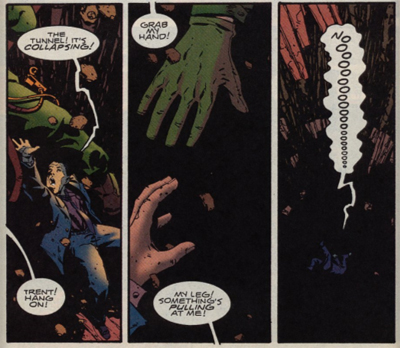
Tucked away in the Winter 1996 issue of The X-Files Magazine and republished with The Silent Sword in September 1996, The Pit is an atmospheric short story from Petrucha and Adlard, demonstrating the two work quite well together across a variety of formats. The Pit is only nine pages long, including two splash pages – and another half-page splash. There isn’t a lot of room for plot or detail. Instead, Petrucha and Adlard opt for mood and atmosphere, crafting a weird and spooky little diversion.

All fall down...

All fall down…

Continue reading